
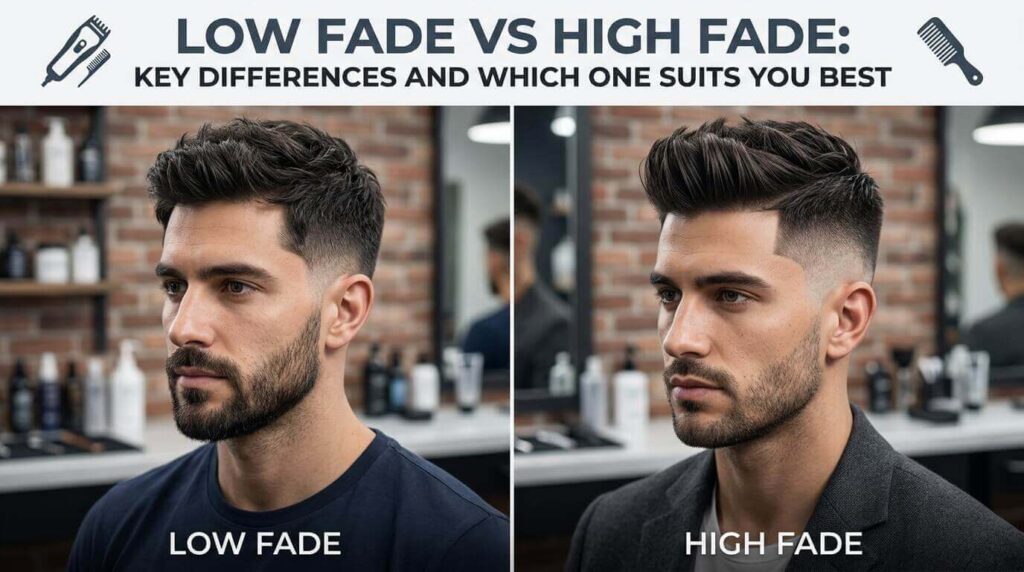
When it comes to low fade vs high fade, the real difference comes down to where the blend starts. A low fade starts just above the ear, giving a subtle, gradual blend on the sides. A high fade begins at or above the temples, giving bold, high-contrast sides with a sharp transition. The starting point of the blend is the single defining difference, and that one factor changes the look, maintenance cost, face-shape suitability, and styling potential entirely.
Reviewed for accuracy by the Men’s Hairstyle Empire editorial team, specialists in men’s precision haircuts and fade techniques
What Is a Fade Haircut?
A fade is a barbering technique that gradually shortens the hair on the sides and back, blending from longer on top down to shorter, or bare skin, at the bottom. The height at which the shortest blending point begins decides whether the fade reads as low, mid, or high. Every fade relies on clippers fitted with progressively shorter guard sizes to create a seamless gradient from longer to shorter hair.
A fade works as a technique, not a standalone hairstyle. Combine a fade with a crew cut, pompadour, buzz cut, textured crop, textured quiff, slick back, comb over, faux hawk, or side part; the fade only controls what happens on the sides and back.
The name “fade” describes the visual effect exactly: the hair appears to fade away as it gets shorter toward the skin. That gradient can sit anywhere from soft and subtle to sharp and dramatic, depending entirely on where the blend starts.
Fade haircuts, including low fades, mid fades, high fades, skin fades, burst fades, drop fades, and temp fades, carry deep cultural roots in the United States. The fade gained fresh prominence when Black barbers in the 1980s reworked it into an edgier version that became a defining element of hip-hop culture during its golden era. Artists including Big Daddy Kane, Will Smith on The Fresh Prince of Bel-Air, and Kid ‘n Play turned the hi-top fade into a cultural icon that pushed the style into mainstream fashion.
According to the American Academy of Dermatology, scalp hair grows at an average rate of about half an inch per month, or roughly six inches per year. This growth rate matters directly for fade maintenance: the shorter the sides, the faster visible regrowth shows up.
Key Point: A fade is a technique, not a haircut. Pair any fade level with virtually any top hairstyle, including the crew cut, pompadour, buzz cut, textured crop, quiff, slick back, comb over, faux hawk, or side part. The fade defines the sides; the top style defines the personality.
Barber Tip: Walk into any barbershop in the USA and say “fade,” and your barber will immediately ask: low, mid, or high? Know the answer before you sit down. That single decision shapes the entire haircut.
See our complete men’s haircuts guide for the full range of popular styles.
What Is a Low Fade Haircut?
A low fade begins roughly half an inch to one inch above the ear and gradually gets shorter toward the neckline. The sides stay fuller higher up, and the move from the longer top to the shorter sides is slow, smooth, and natural-looking. The low fade is the most subtle of the three fade levels and the most fitting choice for professional, conservative, and formal settings.
The occipital bone, the bony ridge just above the neckline, gives barbers a fixed anatomical reference point for consistent low fade placement. On every visit, a skilled barber returns the blend to that same position for a reliable, repeatable result.
Key characteristics of a low fade:
- Starting point: Just above the ear, roughly 0.5 to 1 inch above
- Transition style: Gradual, smooth, natural
- Visual impact: Subtle, refined, conservative, polished
- Best suited for: Professional environments, first-time fade wearers, square faces, long faces, men with fine or straight hair
- Maintenance schedule: Every 3 to 4 weeks
Pick a low fade as your starting point if this is your first fade. The gradual blend grows out gracefully, the gap between visits is forgiving, and switching back to a regular haircut is painless if the style does not end up suiting you.
Barber Tip: The low fade’s starting point lines up with the occipital bone, the natural ridge above the neckline. Mention this reference point to your barber for precise, consistent placement at every appointment.
Explore our complete low taper fade guide for a deep dive into this specific style.
What Is a High Fade Haircut?
A high fade begins at or above the temples, typically two to three inches above the ear, and moves sharply down to very short or bare skin on the sides. The contrast between the longer top hair and the closely cropped sides is strong, immediate, and visually commanding. The high fade is the boldest of the three fade levels and suits men who want their haircut to make an immediate statement.
The parietal area, the upper side region of the head between the temples and the crown, is often fully exposed in a high fade. This produces the maximum visual contrast available in men’s grooming. A high fade that reaches bare skin at its shortest point becomes a high skin fade or high bald fade, the most dramatic version of any fade haircut.
Key characteristics of a high fade:
- Starting point: At or above the temples, 2 to 3 inches above the ear
- Transition style: Sharp, high-contrast, dramatic
- Visual impact: Bold, modern, statement-making, eye-catching
- Best suited for: Creative professionals, round faces, thick or curly hair, men who style the top aggressively
- Maintenance schedule: Every 1 to 2 weeks
The closely cropped sides of a high fade make sure that whatever hairstyle sits on top becomes the undisputed focal point. Pompadours, textured quiffs, faux hawks, and mohawks all reach their fullest visual potential above a high fade.
Barber Tip: A properly executed high skin fade takes a barber through 4 to 6 different clipper guard sizes, from a #3 or #2 guard down to a zero guard at bare skin, for a seamless, streak-free gradient. The number of blending steps is what separates a skilled skin fade from an amateur one.
See our complete high taper fade guide for style options and comparisons.
What Are the Key Differences Between a Low Fade and a High Fade?
A low fade and a high fade differ across six key dimensions: starting point, visual contrast, maintenance frequency, daily styling effort, grow-out behaviour, and lifestyle fit. The starting point drives everything else: a low fade blends from just above the ear while a high fade blends from at or above the temples, and every other difference follows from that single factor.
Starting Point
The starting point is the foundational difference between the two styles.
A low fade begins its blend just above the ear, so the sides stay fuller toward the top of the head. A high fade begins at or above the temples, so the sides sit closely cropped at a much higher point, exposing significantly more skin or very short hair.
Visual Impact and Contrast
A low fade creates a soft, seamless move between the top and sides. The contrast is present but stays conservative, clean, and understated. A high fade creates a strong, deliberately dramatic boundary between the longer top and the closely cropped sides: bold, high-contrast, and immediately noticeable.
Maintenance Frequency
The maintenance commitment is the most significant practical difference between the two styles.
A low fade stays sharp for 3 to 4 weeks between visits. A high fade needs a fresh cut every 1 to 2 weeks. The American Academy of Dermatology confirms that scalp hair grows at roughly half an inch per month, about 2 to 3 millimetres per week. On a high fade where the sides are shaved to near-bare skin, 2 millimetres of new growth becomes visually noticeable within days.
Daily Styling Effort
A high fade actually simplifies the morning routine. The sides need no styling since they sit bare or near-bare, so all product application and attention goes to the top, and clean sides make even a simple top style look sharp.
A low fade needs slightly more daily attention on the sides. Pomade, clay, or wax application keeps the blend defined and the overall shape clean between barbershop visits.
Grow-Out Behaviour
A low fade grows out gracefully. The gradual blend shifts naturally into a soft taper over time, so the result looks intentional rather than unkempt.
A high fade grows out far less gracefully. The bold contrast between the shaved sides and the longer top wears off within days. A sharp high fade turns into a visibly overgrown look faster than any other fade level.
Low Fade vs High Fade: Full Comparison Table
| Factor | Low Fade | High Fade |
|---|---|---|
| Starting Point | Just above the ear | At or above the temples |
| Visual Style | Subtle, conservative, refined | Bold, dramatic, high-contrast |
| Barber Visits | Every 3 to 4 weeks | Every 1 to 2 weeks |
| Best Face Shapes | Square, long, heart-shaped, oval | Round, oval |
| Best Hair Types | Fine, straight, thinning | Thick, curly, coily |
| Lifestyle Fit | Corporate, professional, formal | Creative, casual, expressive |
| Daily Styling | Moderate, sides need pomade, clay, or wax | Easier, sides need nothing |
| First Fade? | Ideal starting point | Requires maintenance commitment |
| Grow-Out | Graceful, shifts into a taper naturally | Noticeable within days |
| Annual Cost (est.) | $390 to $800/year | $780 to $1,300/year |
Key Point: The practical difference between a high fade and a low fade extends far beyond looks. The national average price for a standard barbershop haircut runs from $30 to $50, with major-city prices reaching $50 to $100. At those rates, keeping up a high fade every 1 to 2 weeks costs an estimated $390 to $650 more per year than a low fade on a 3 to 4 week schedule.
Where Does the Mid Fade Fit Between a Low Fade and a High Fade?
The mid fade starts at the temple area, roughly 1.5 to 2 inches above the ear, and sits right between the subtlety of a low fade and the boldness of a high fade. It delivers balanced contrast with manageable upkeep and works as the most versatile fade level for men who need a style that holds up in corporate offices, casual outings, and social events alike.
According to professional barbers surveyed by grooming publications, including Best Fort Worth Barber and The Milan Institute, the mid fade is consistently among the most-requested fade variations in US barbershops. The reason: balanced contrast without weekly upkeep.
What Makes the Mid Fade the Balanced Choice?
The three fade levels sit on a clear spectrum:
Subtle (Low) to Balanced (Mid) to Bold (High)
The mid fade occupies the centre. The contrast is noticeable, sides look clean and modern, but the blend never turns aggressive. The maintenance schedule lands at every 2 to 3 weeks, splitting the gap between the low fade’s monthly rhythm and the high fade’s weekly demands.
Key characteristics of a mid fade:
- Starting point: Temple level, roughly 1.5 to 2 inches above the ear
- Visual impact: Balanced, modern, noticeable but not aggressive
- Maintenance schedule: Every 2 to 3 weeks
- Best suited for: Men who want a contemporary look that works equally well in professional, casual, and social settings
The mid fade pairs naturally with textured crops, quiffs, side parts, textured fringes, and pompadours. The contrast supports the top style rather than overpowering it.
See our complete mid fade guide for photos and style inspiration.
Low vs Mid vs High Fade: Three-Way Comparison
| Low Fade | Mid Fade | High Fade | |
|---|---|---|---|
| Starts At | Above the ear | Temple level | Above the temples |
| Contrast Level | Low | Medium | High |
| Barber Visits | Every 3 to 4 weeks | Every 2 to 3 weeks | Every 1 to 2 weeks |
| Style Personality | Classic, conservative, refined | Versatile, modern, balanced | Bold, expressive, dramatic |
| Office Appropriate | Always | Yes | Depends on industry |
| Best for New Fades | Yes | Yes | Requires commitment |
Key Point: Choose the mid fade when torn between a low fade and a high fade. It delivers modern contrast without the demanding upkeep of a high fade or the restraint of a low fade, and it works as the safest starting point for first-time fade wearers and professionals alike.
Which Fade Suits Your Face Shape?
Face shape decides which fade level creates the most flattering visual proportions. A high fade adds vertical height and slims the sides, while a low fade preserves width and softens angular features. Choosing the right fade for your face shape creates the illusion of more balanced, proportional features; choosing the wrong one amplifies existing imbalances.
The core principle is simple: fades control visual height and width. High fades elongate. Low fades soften. Mid fades balance.
Round Face: Best Fade, High Fade
A round face is wider than it is long, with soft curved features and no strong angular definition.
A high fade adds visual height by cropping the sides closely and pulling the eye upward toward the top of the head. This elongates the face and creates the impression of stronger, more angular features. Pair the high fade with a textured quiff, pompadour, or faux hawk for maximum elongation.
Avoid low fades on a round face since they preserve side fullness and emphasize horizontal width.
Square Face: Best Fade, Low Fade
A square face features a wide, strong jawline and sharp angular features.
A low fade keeps more hair on the lower sides, framing the jawline gently and softening its sharp edges. The gradual blend fits naturally with the angular geometry of a square face.
Avoid high skin fades on a square face since they strip away all side hair near the jaw and sharpen the angular jawline further.
Oval Face: Best Fade, Any Level
An oval face has balanced proportions, longer than wide, with a gently rounded jawline and forehead.
All fade levels suit an oval face. Choose based on lifestyle, hair type, and maintenance preference rather than face shape. The mid fade is the safest universal default for oval faces.
Long or Rectangular Face: Best Fade, Low Fade
A long face already carries plenty of vertical height. A high fade pushes even more visual height upward, making the face appear longer and narrower.
A low fade preserves side width, creating horizontal visual balance that makes the face appear more proportional. Avoid high fades entirely on long or rectangular faces.
Heart-Shaped Face: Best Fade, Low Fade
A heart-shaped face is wider at the forehead and narrower at the chin.
A low fade keeps fullness on the lower sides, adding visual weight near the jawline and chin. This creates proportional balance between the wider upper face and the narrower lower face.
Diamond Face: Best Fade, Mid Fade
A diamond face is narrow at both the forehead and chin, with wide cheekbones marking the widest point.
A mid fade creates balanced contrast without extremes; it adds neither excessive height nor excessive side fullness. The balanced blend fits the diamond shape’s natural proportions.
Face Shape to Fade Recommendation Table
| Face Shape | Best Fade | Why It Works |
|---|---|---|
| Round | High fade | Creates vertical elongation, slims the face |
| Square | Low fade | Softens the sharp, angular jawline |
| Oval | Any fade | Balanced proportions suit all three levels |
| Long / Rectangular | Low fade | Prevents added unwanted visual height |
| Heart-shaped | Low fade | Balances the narrower chin with side fullness |
| Diamond | Mid fade | Creates harmony across the wide cheekbones |
Barber Tip: Pull all your hair back tightly, stand in front of a mirror, and trace your facial outline with your finger. Identify the widest point, forehead, cheekbones, or jawline, and compare it to the shapes above. This 30-second test pinpoints the best fade level for your anatomy right away.
Which Fade Is Best for Your Hair Type and Texture?
Hair texture and density guide fade height selection just as much as face shape does. A fade blends differently across straight, wavy, curly, coily, fine, and thick hair, so the wrong combination highlights weaknesses instead of strengths. Choose the fade level that works with your natural texture rather than fighting it.
Curly and Coily Hair: Best Fade, High or Mid Fade
A high fade works exceptionally well with curly and coily hair. The closely cropped sides create strong contrast that puts the natural curl or coil pattern on top centre stage. A high skin fade paired with a curl sponge top, twist-out, natural Afro, or loc styles on top is one of the most visually celebrated combinations in men’s grooming.
A low fade also works with curly hair, keeping more textured volume on the sides for a fuller, more natural profile.
See our complete high fade for curly hair guide for specific styling options.
Straight and Fine Hair: Best Fade, Low or Mid Fade
Straight hair lies flat by nature. A low fade or mid fade fits more naturally with the smooth, flat texture of straight strands. A high fade with fine, straight hair can leave the sides looking sparse and draw unwanted attention to the scalp.
Thick and Coarse Hair: Best Fade, High Fade
Thick, coarse hair benefits most from a high fade. The closely cropped sides manage the natural bulk effectively and create intentional, clean contrast with the fuller hair on top. A low fade on very thick hair can look heavy, dense, and undefined on the sides.
Wavy Hair: Best Fade, Mid Fade
Wavy hair fits most naturally with a mid fade. The balance between wave texture on top and clean sides is achieved at mid level without going to extremes. A high fade with wavy hair creates a dramatic look. A low fade with wavy hair pairs best with slick-back styles, side parts, and pompadours.
Thinning or Sparse Hair: Best Fade, Low Fade
Always choose a low fade for thinning or sparse hair. A high fade draws the eye to the sides, where the scalp shows most through thin strands. A low fade keeps more coverage and creates a fuller-looking appearance overall.
Hair Type to Fade Recommendation Table
| Hair Type | Best Fade | Why |
|---|---|---|
| Curly / Coily | High or Mid fade | Highlights the natural curl or coil pattern |
| Straight / Fine | Low or Mid fade | Gradual blend suits the smooth, flat texture |
| Thick / Coarse | High fade | Manages bulk, creates intentional contrast |
| Wavy | Mid fade | Balances wave texture with clean sides |
| Thinning / Sparse | Low fade | Preserves coverage, avoids scalp exposure |
Key Point: Hair density matters as much as texture. Two men with curly hair, one with high density and one with low density, need noticeably different fade heights for the best result. Always talk through both texture and density with your barber before settling on a level.
Which Fade Requires More Maintenance, Low or High?
A high fade needs significantly more upkeep than a low fade, roughly double the barbershop visits and nearly double the annual cost. This maintenance gap is the most underestimated factor in the low-vs-high decision, and the one that matters most in daily life once the initial novelty wears off.
Low Fade: Touch-Up Every 3 to 4 Weeks
A low fade holds its shape for 3 to 4 weeks before the blend starts to look noticeably grown-out. The gradual nature of the blend means the grow-out happens slowly and naturally. The sides shift into a soft taper as hair length increases, a process that looks intentional rather than unkempt.
High Fade: Touch-Up Every 1 to 2 Weeks
A high fade needs fresh attention every 1 to 2 weeks. The American Academy of Dermatology confirms that scalp hair grows roughly half an inch per month, about 2 to 3 millimetres per week. On a high skin fade, where the sides sit at bare-skin level, 2 millimetres of new growth becomes visually obvious within days. The crisp, dramatic look fades fast without regular upkeep.
Grow-Out: Which Fade Ages Better?
The low fade wins the grow-out comparison decisively. A low fade shifts naturally into a soft, clean-looking taper as the weeks pass, and the overall shape stays presentable for an extended period.
A high fade grows out far less gracefully. The bold contrast between the shaved sides and the longer top disappears within days. A fresh, sharp high fade turns into a visibly overgrown look faster than any other fade level.
Grow-Out Timeline: Low Fade vs High Fade Week by Week
| Timeline | Low Fade Appearance | High Fade Appearance |
|---|---|---|
| Day 1 | Sharp and precise | Sharp and precise |
| Week 1 | Still clean | Slight regrowth visible on sides |
| Week 2 | Looks good, blend intact | Noticeably grown-out |
| Week 3 | Blend softening | Needs a fresh cut |
| Week 4 | Due for a touch-up | Overdue by 1 to 2 weeks |
The Annual Cost Difference
The average barbershop haircut in the United States costs $30 to $50, with prices in major cities like New York, Los Angeles, and Chicago reaching $50 to $100 per visit.
Using the national average of $30 to $50 per visit:
- High fade at biweekly visits: 26 visits per year, $780 to $1,300 annually
- Low fade at monthly visits: 13 visits per year, $390 to $650 annually
The annual difference runs from $390 to $650 in favour of the low fade. Over five years, that gap exceeds $2,000 at average pricing.
Key Point: Work out the annual cost honestly before committing to a high fade. The maintenance difference is not just a scheduling inconvenience; it is a meaningful financial commitment that most men do not think through before sitting in the barber’s chair.
What Hairstyles Pair Best with a Low Fade or High Fade?
The best pairings for a low fade include the comb over, crew cut, side part, Ivy League, Caesar cut, and textured crop, all conservative, polished styles that match the low fade’s refined character. The best pairings for a high fade include the pompadour, faux hawk, textured quiff, slick back, buzz cut, and modern mullet, bold, dramatic styles that lean into the high fade’s powerful contrast.
The fade is the foundation. The hairstyle on top completes the structure.
Best Hairstyles to Pair with a Low Fade
Comb Over The comb over fade and low fade is the most popular professional combination in men’s grooming. The low fade keeps the sides conservative while the structured comb over adds polished definition on top.
Crew Cut The crew cut and low fade is a timeless pairing. The low fade adds a modern edge to the traditional crew cut without making it aggressive or trend-dependent.
Side Part The side part and low fade combination is clean, refined, and professional. The low fade sharpens the clean separation on the sides without adding bold contrast.
Ivy League The Ivy League is the most formal haircut in men’s grooming. The low fade is the only fade level that suits its intention; a mid or high fade undermines the formal, classic character of this style.
Caesar Cut The horizontal fringe of the Caesar cut paired with a low fade creates a sharp, clean combination that needs minimal daily styling effort with pomade, clay, or wax.
Textured Crop The textured crop and low fade adds subtle contrast below the textured top, keeping the overall look relaxed, modern, and office-appropriate.
Best Hairstyles to Pair with a High Fade
Pompadour The pompadour and high fade is the premier power combination in men’s hairstyling. The bare or near-bare sides make the voluminous pompadour the undisputed visual centrepiece.
Faux Hawk The faux hawk and high fade amplifies the mohawk-inspired shape dramatically. Together, they produce one of the boldest looks in modern men’s grooming.
Textured Quiff The textured quiff and high fade is one of the most-requested combinations in 2026 barbershops. Modern, youthful, and structurally impressive.
Slick Back The slick back above a high fade defines sharp, contemporary style. The clean sides frame the slicked-back top with precision.
Buzz Cut The buzz cut and high fade turns a simple, uniform cut into a precision-focused style with real contrast and structure.
Modern Mullet The modern mullet paired with a burst fade or high fade is among the top trending combinations in 2026, particularly on TikTok. Bold, expressive, and deliberately statement-making.
Barber Tip: The bolder the top hairstyle, the higher the fade needs to sit underneath. Dramatic styles, pompadours, mohawks, faux hawks, reach their full visual potential only above a high fade. Conservative styles, crew cuts, comb overs, Ivy Leagues, pair best with a low fade that matches their measured, refined character.
Which Fade Works Best with a Beard?
A low fade pairs most naturally with full beards and medium-length stubble, while a high fade pairs best with short, shaped beards or clean-shaven faces. The interaction between fade height and beard style changes the entire lower third of the face; a fade that works well without a beard may produce a completely different effect once beard growth enters the picture.
Low Fade with a Beard
A low fade starts above the ear and blends toward the neckline, the same area where beard growth begins. This creates a seamless, natural continuation from the faded sides directly into the beard without a harsh boundary.
The low fade fits naturally with:
- Full beards: the gradual low blend flows into the beard without disruption or harsh lines
- Medium stubble: the subtle contrast of a low fade complements the soft, even texture of stubble
- Corporate beard styles: a trimmed, shaped beard with a low fade is the most professional beard-and-fade combination available
High Fade with a Beard
A high fade with a beard creates a deliberately contrasting effect. The shaved sides sit cleanly above, while the full textured beard occupies the lower face. This is a bold, intentional aesthetic.
The high fade fits best with:
- Short, shaped beards: the contrast between high-faded sides and a defined, trimmed beard creates a striking, deliberate look
- Disconnected beard fades: a visible gap between the high-faded sideburns and the beard line creates a “disconnected” effect that is a popular barbershop specialty
How Sideburns Connect the Fade and Beard
Sideburns act as the bridge between the fade and the beard. Their length and shape signal where the fade ends and the beard begins.
On a low fade, sideburns stay at a moderate length, creating a gradual, connected transition from the fade into the beard. On a high fade, sideburns are often removed entirely or kept very short, creating a sharp boundary between the bare sides and the beard line below.
Barber Tip: Communicate both your fade preference and your beard preference at the start of every appointment. The fade line needs to integrate with your beard’s neckline and cheek line; these are connected decisions your barber needs to plan together, not separately.
See our buzz cut with beard guide for more fade-and-beard combinations.
What Is the Difference Between a Low Taper Fade and a High Taper Fade?
A low taper fade begins just above the ear and gets shorter gradually while keeping visible hair at every point; it never reaches bare skin. A high taper fade begins near the crown and creates pronounced contrast with a slightly softer edge than a true high fade. The key distinction between taper fades and regular fades is that taper fades always keep visible hair at the shortest point, while regular fades can reach skin level.
What Is a Low Taper Fade?
A low taper fade begins just above the ear and gradually blends the hair shorter toward the neckline. The hair is noticeably shorter on the sides but never approaches bare skin; visible hair remains at the shortest point throughout.
The result reads as natural, conservative, and highly professional. The sides look clean and structured without the dramatic contrast of a full skin fade.
Best suited for: professional environments including corporate offices, legal firms, and medical settings, men with fine or straight hair, and men who prefer a conservative style with modern structure.
What Is a High Taper Fade?
A high taper fade begins higher on the head, near the crown in some versions, and creates pronounced contrast between the closely cropped sides and the longer top. The blend is sharper and more structured than a low taper, but softer than a full high skin fade.
The high taper fade sits in the middle ground between bold visual impact and conservative appropriateness. Choose a high taper fade when a full high skin fade feels too aggressive for your workplace or personal preference.
Best suited for: men who want a modern, structured look without the demanding upkeep of a full high skin fade, and men in semi-formal professional environments.
Key Point: The US Army’s appearance standards specify that men’s haircuts should be “neatly tapered” and “evenly blended” on the sides and back, a specification that describes a low taper fade in civilian barbershop terminology. The low taper fade is the only fade level consistently approved across all branches of the US military.
Low Taper Fade vs High Taper Fade
| Factor | Low Taper Fade | High Taper Fade |
|---|---|---|
| Starting Point | Just above the ear | Near the crown |
| Blend Style | Gradual, natural, conservative | Sharper, higher contrast |
| Shortest Point | Visible short hair | Very short, visible hair |
| Maintenance | Every 4 weeks | Every 2 to 3 weeks |
| Office-Appropriate | Always | Generally yes |
| Best For | Conservative, classic looks | Modern, structured styles |
What Is the Difference Between a Taper and a Fade?
A taper gradually shortens the hair toward the ears and neckline while keeping visible hair at every point. A fade pushes that blending further, reducing the hair all the way down to near-skin or bare-skin level at the shortest point. Every fade uses a taper technique, but not every taper produces a fade. The shortest point marks the defining difference: a taper always shows hair, while a fade approaches or removes it entirely.
Think of the two as different points on the same scale:
- Taper: Longer to shorter. Hair remains visible throughout. Natural, classic finish.
- Fade: Longer to shorter to near-skin or bare skin. Precise, dramatic finish. Stronger visual contrast.
A taper produces a classic, traditional result. A fade produces a modern, contemporary result. Both read as clean and professional; the difference lies in intensity and contrast.
See our complete taper vs fade guide for the full side-by-side breakdown.
Taper vs Fade: Quick Reference Table
| Taper | Fade | |
|---|---|---|
| Shortest Point | Visible short hair | Near-skin or bare skin |
| Visual Feel | Classic, traditional, natural | Modern, precise, contemporary |
| Barber Visit Frequency | Less frequent | More frequent |
| Visual Contrast | Subtle | Dramatic |
| Office Use | Always appropriate | Usually appropriate |
Barber Tip: Ask for a “taper fade” when unsure about terminology. This phrase communicates a blend that reads more refined than a plain taper but more natural-looking than a full skin fade, and every experienced barber across the USA knows exactly what it means.
What Is the Difference Between a Low Skin Fade and a High Skin Fade?
A skin fade, also called a bald fade or zero fade, blends all the way down to bare skin at its shortest point using a zero guard or razor. A low skin fade starts that bare-skin blend near the ear. A high skin fade starts it at or above the temples. The “skin” descriptor defines how short the fade goes, while “low” or “high” defines where it starts. These are independent variables that combine to produce different results.
Low Skin Fade
A low skin fade starts near the ear and reaches bare skin within the lower one inch of the sides. Subtle from a distance, precise and impressive up close. The skin line shows only at close range, which makes this option appropriate for most professional environments while still delivering the crisp definition of a true skin fade.
High Skin Fade
A high skin fade starts at or above the temples and shaves entirely down to bare skin. The parietal area is fully exposed, and the contrast between the skin-shaved sides and the longer top is as bold and dramatic as men’s grooming allows.
This version needs the most upkeep of any fade; weekly barbershop visits are often necessary. Choose a high skin fade only when maximum contrast is the specific aesthetic goal.
Key Point: A seamless skin fade takes a barber through 4 to 6 different clipper guard sizes, from a #3 or #2 guard progressively down to a zero guard at bare skin. Guard sizes can vary slightly by clipper brand, including Wahl, Andis, and Oster; confirm numbering with your barber before specifying a guard.
See our complete skin fade guide for photos and style breakdowns.
What Are Burst Fades, Drop Fades, and Temp Fades?
Burst fades radiate in a semicircular arc around the ear, drop fades curve downward behind the ear, and temp fades concentrate only at the temples and neckline. These three specialty shapes describe the pattern of the fade rather than its height; each one exists across low, mid, and high levels. The name defines the shape; the height defines the level.
Burst Fade
A burst fade radiates outward in a semicircular arc around and behind the ear. Instead of running straight across the sides, the fade curves outward in a “burst” or “halo” pattern. The burst fade does not extend all the way around the head.
Best paired with: faux hawks, mohawks, and modern mullets. The semicircular arc frames the ear uniquely and creates a rounded profile that complements styles with a narrow, defined top.
Drop Fade
A drop fade follows a curved line that drops downward behind the ear rather than running straight across the sides. This creates a more natural, rounded profile that follows the head’s natural contour. Drop fades come in low, mid, and high levels; “drop” describes the shape, not the height.
Temp Fade (Temple Fade)
A temp fade, short for temple fade, concentrates the fade only at the temples and neckline. The sides remain mostly untouched. Also called a Brooklyn fade or blowout fade, the temp fade delivers the clean-line effect of a fade at the temples without committing to a full side fade.
See our blowout taper guide for more on temple-area styling.
Shadow Fade and Scissor Fade
Two additional fade techniques worth knowing:
A shadow fade creates a very soft, blurry blend that produces a shadow-like gradient rather than a sharp contrast. A scissor fade uses scissors instead of clippers for the blend, producing a more textured, natural transition that suits longer hairstyles on top.
Specialty Fade Shapes at a Glance
| Fade Shape | Pattern | Best Paired With | Maintenance |
|---|---|---|---|
| Burst Fade | Semicircular arc around ear | Mohawk, faux hawk, modern mullet | High |
| Drop Fade | Curved, drops behind ear | All styles | Medium |
| Temp / Temple Fade | Temples and neckline only | Natural, low-profile styles | Low |
| Shadow Fade | Soft, blurry gradient | Longer styles, textured tops | Low-Medium |
| Scissor Fade | Scissors, not clippers | Long tops, natural texture | Medium |
Which Fade Works Best for Black Men and Curly Hair?
A high fade, particularly a high skin fade or bald fade, is the most iconic and celebrated fade choice for Black men with coily and Type 4 hair. The closely cropped or bare-skin sides create extraordinary contrast with the natural texture on top, producing a powerful visual focal point. A low fade serves as the more conservative, professional alternative for Black men who want the clean-line benefit of a fade without the demanding upkeep of a high skin fade.
Fade haircuts carry deep cultural significance in Black barbershop culture. The Black barbershop functioned as more than a grooming destination; it served as a cultural hub where new fade techniques, temple designs, and personalized variations based on individual hair texture were developed and refined. The revival of the fade in mainstream fashion during the late 1980s and early 1990s was fuelled by African American and hip-hop culture, with artists like Big Daddy Kane, Will Smith, and Kid ‘n Play turning the hi-top fade into a cultural icon.
High Fade for Black Men and Coily Hair
The high fade, especially the high skin fade or bald fade, ranks among the most celebrated styles in Black men’s grooming. Coily hair provides strong natural texture, volume, and pattern on top. That texture, set against closely cropped or skin-faded sides, creates an extraordinary visual statement.
High fades pair powerfully with: natural Afros, box tops, hi-top fades, twist-outs, loc styles, and curl sponge tops. The bare sides ensure the texture and shape of the natural hair becomes the undisputed focal point.
Artists including ASAP Rocky, Odell Beckham Jr., and Jaden Smith have popularized high skin fades with natural textured tops, bringing the combination into mainstream cultural visibility.
Low Fade for Black Men and Coily Hair
A low fade delivers a more conservative, versatile option for Black men with coily hair. The low fade fits naturally with: 360 waves, short twist-outs, edge-ups with a crisp line-up at the temples and sideburns, and low-cut natural styles. The reduced maintenance schedule, every 3 to 4 weeks rather than weekly, makes the low fade the preferred choice for professional environments, corporate settings, and busy schedules.
Key Point: The modern fade was developed and refined by Black barbers in the United States. Black barbers in the 1950s through 1970s transformed the military taper into an art form, introducing dramatic contrast, creative temple designs, and personalized variations based on individual hair texture. Acknowledging this history is a fundamental mark of genuine barbering knowledge.
When Should You Choose a Low Fade Over a High Fade?
Choose a low fade for professional environments, first-time fades, formal events, and conservative personal style. Choose a high fade for creative workplaces, active lifestyles, hot weather, bold self-expression, and maximum visual impact. The situation shapes the fade choice just as much as personal aesthetic preference does.
Situational Fade Selector
| Situation | Best Fade Choice | Reasoning |
|---|---|---|
| Job interview | Low fade | Professional, conservative, trustworthy |
| Corporate office daily | Low fade | Clean, polished, always appropriate |
| First date or night out | Mid or High fade | Sharp, bold, makes a strong impression |
| Wedding (as groom) | Low fade | Timeless, formal, photographs well |
| Creative workplace | High or Mid fade | Expressive, modern, trend-forward |
| Sports or active lifestyle | High fade | Minimal side hair, easy to manage during activity |
| Hot weather or summer | High fade | Cooler with less hair on the sides |
| Men 40 and older | Low or Mid fade | Refined, age-appropriate, understated |
| Teens and young adults | High fade is trending | Trend-aligned, bold, socially expressive |
| First-time fade | Low or Mid fade | Forgiving grow-out, easy to adjust, lower commitment |
Celebrity Low Fade Examples: David Beckham’s 2018 World Cup ambassador appearance featured a clean low fade paired with a swept-back top. Cristiano Ronaldo frequently wears a low fade with a structured side part for formal occasions; both embody the style’s timeless, polished character.
Celebrity High Fade Examples: ASAP Rocky, Odell Beckham Jr., Chris Brown, and Jaden Smith wear bold, high-contrast high fades that reflect their creative identities.
Celebrity Mid Fade Examples: Drake, Idris Elba, and Zayn Malik wear modern, versatile mid fades that function across professional and casual contexts without extremes.
How Do You Ask Your Barber for the Right Fade?
Use the exact phrases below to communicate your fade preference clearly. Show your barber a reference photo from your phone before any clipper is switched on; even the most experienced barbers prefer a photo over a verbal description. A reference image closes every gap between what you envision and what they deliver.
Exact Scripts for Each Fade Level
For a low fade:
“I want a low fade, start the blend just above my ear and keep the transition gradual. Leave the top [your preferred length] and style it as a [crew cut / comb over / textured crop / side part].”
For a high fade:
“I want a high fade starting at the temple, faded down to a [#1 guard / skin] on the sides. Leave the top [length] and style it as a [quiff / pompadour / textured top / slick back].”
For a mid fade:
“Give me a mid fade starting at the temple, medium contrast on the sides, and style the top as a [textured crop / side part / quiff].”
Key Barber Vocabulary
Knowing these terms ensures your barber delivers exactly what you envision:
- Guard numbers: #1 = very short (1/8 inch), #2 = short (1/4 inch), #3 = slightly longer (3/8 inch)
- Skin / Bald / Zero: Hair faded all the way to bare skin, no visible hair at the shortest point
- Blended / Tapered: A gradual, natural-looking transition between lengths
- Disconnected: A sharp, unblended boundary between the top and sides, no gradual blend
- Edge-up / Line-up: A sharp, straight line cut along the hairline, sideburns, and neckline for clean definition
- Shadow fade: A very soft, blurry gradient that produces a shadow effect rather than a sharp contrast
Barber Tip: Always show your barber a reference photo from your phone before any clipper is switched on. Even the most experienced barbers across the United States prefer a photo over a verbal description. A photo closes every possible gap between your mental picture and their execution.
Low Fade or High Fade, Which Should You Choose?
Choose a LOW FADE if:
- Your work environment is professional, corporate, legal, medical, or formal
- Your face shape is square, long, heart-shaped, or rectangular
- Your hair is fine, straight, wavy, or thinning
- Visiting the barber every 3 to 4 weeks suits your schedule and budget
- This is your first fade haircut
- A graceful grow-out between visits matters to you
- Your beard style is full, medium, or stubble; the low fade fits naturally
Choose a HIGH FADE if:
- Your face shape is round or oval
- Your hair is thick, curly, coily, or heavily textured
- A bold, high-contrast, statement-making look is the goal
- Visiting the barber every 1 to 2 weeks fits your schedule and budget
- Your top hairstyle is dramatic, pompadour, faux hawk, quiff, mohawk, or Afro
- You are active, live in warm climates, or prefer minimal side-hair management
- Your beard style is short, shaped, or disconnected, or you are clean-shaven
Still Unsure? Choose the Mid Fade.
The mid fade is the most universally flattering option in men’s grooming. Balanced contrast, manageable maintenance, and modern style, without the extremes of either end. Most experienced barbers across the United States recommend the mid fade as the default starting point for men choosing their first fade.
The right fade matches your face shape, complements your hair type, fits your maintenance budget, and aligns with the impression you want to make. Face shape, hair type, budget, and lifestyle: that is the formula for choosing a fade you will be genuinely satisfied with long after you leave the barber’s chair.
Frequently Asked Questions
Which Fade Is Better?
Neither is universally better. It depends on your face shape, hair type, and lifestyle. A low fade suits professional settings and softer, angular features; a high fade suits bold styling and round or oval faces. The mid fade works as the safest all-round choice when you are unsure.
What Looks Better, a High Fade or a Low Fade?
Neither is objectively better. High fades look better on round faces that need vertical elongation. Low fades look better on square, long, and heart-shaped faces that need softening and width balance. The mid fade is the most universally flattering starting point for men who are unsure.
Which Fade Is Most Attractive?
Any clean, well-maintained fade at any level reads as more attractive and polished than ungroomed hair. The most attractive fade is the one that correctly matches your face shape, hair type, and lifestyle. Mid and low fades score highest in professional settings. High fades come across as bolder and more fashion-forward.
Is a Low Fade or High Fade Better for a Round Face?
A high fade works significantly better for a round face. The closely cropped sides draw the eye upward, creating the illusion of a more elongated, angular face. A low fade on a round face preserves side fullness that emphasizes horizontal width.
Are Low Fades Professional?
Yes, the low fade is widely considered the most professional fade option available. Its gradual, conservative blend suits corporate offices, legal environments, medical professions, and all client-facing roles.
Is a High Fade Hard to Maintain?
Yes, relative to a low fade. Scalp hair grows roughly half an inch per month according to the American Academy of Dermatology (aad.org), meaning even one week of growth makes a high fade look visibly overgrown. Barbershop visits every 1 to 2 weeks are required.
What Is the Difference Between a Low Fade and a Low Taper?
A low fade starts just above the ear and blends toward or down to skin level. A low taper starts in the same area but keeps visible hair throughout; it never reaches skin level. Tapers produce a more natural, traditional finish. Fades produce a more precise, dramatic finish. Our complete low taper fade guide covers this distinction in full detail.
Which Fade Is Best for Curly Hair?
A high fade or mid fade complements curly hair best. The closely cropped sides create strong contrast that makes the natural curl pattern on top the visual centrepiece. A high skin fade with a curl sponge, twist-out, or natural Afro on top is one of the most celebrated combinations in Black barbershop culture.
Can Women Get a Low or High Fade?
Absolutely. Fade haircuts are not gender-exclusive. Women increasingly choose low fades for a clean, defined neckline or high fades for bold undercut styles. All face-shape matching principles, round, square, oval, heart-shaped, long, and diamond, apply regardless of gender.
Conclusion
The low fade and the high fade both deliver a clean, modern result, but they serve very different goals. A low fade rewards patience and restraint: it grows out gracefully, costs less to maintain, and reads as polished in almost any professional or formal setting. A high fade rewards boldness: it demands more barbershop visits and a tighter grooming routine, but it delivers the sharpest possible contrast and turns any top style into a genuine statement.
There is no single correct answer, only the answer that fits your face shape, hair type, schedule, and the impression you want to make. Bring a reference photo, use the exact scripts above, and talk through both your fade and beard preferences before the clippers start. Get that conversation right, and either fade, low, mid, or high, will leave you with a haircut worth showing off.