


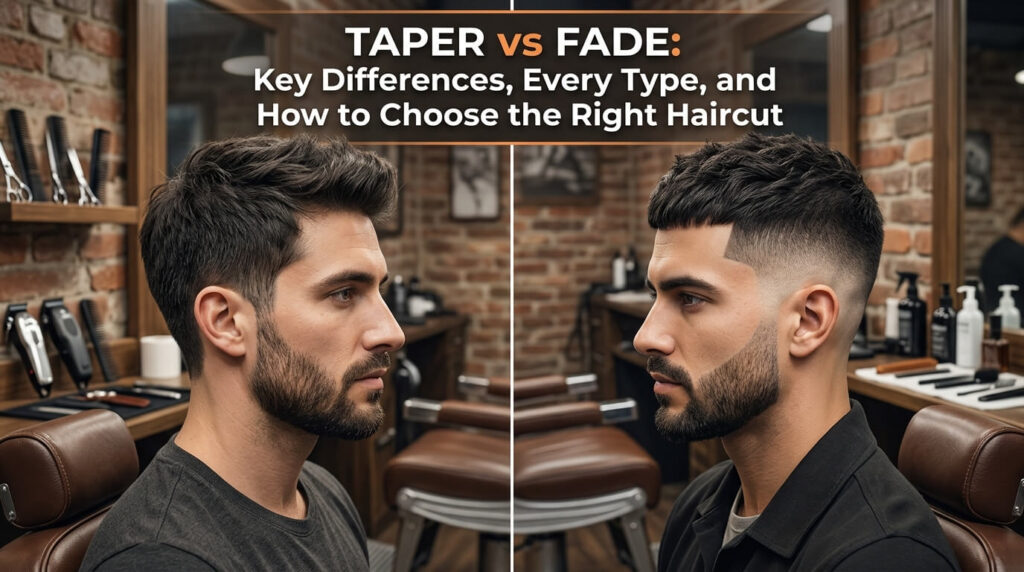
The main difference between a taper and a fade is how dramatically the hair changes length on the sides and back. A taper gradually shortens hair while keeping some length visible at the edges. A fade blends hair down much shorter, often to bare skin, creating a sharp, high-contrast look.
If you’ve ever sat in the barber’s chair and frozen when they asked “taper or fade?” you’re not alone. These two terms get confused constantly. Picking the wrong one can leave you walking out with a completely different haircut than what you pictured in your head.
I’ve spent years studying men’s grooming techniques, consulting with professional barbers, and analyzing what makes these two cuts truly different. This guide breaks down everything, every variation, which suits your face shape and hair type, exact maintenance costs, and word-for-word scripts to use with your barber.
When comparing taper vs fade, the best choice ultimately depends on how much contrast you want in your haircut and how much maintenance you’re willing to commit to between barber visits.
By the time you finish reading, you’ll never have a miscommunication in the barbershop again.
What Is the Difference Between a Taper and a Fade?
The core difference comes down to intensity and endpoint.
A taper creates a gradual, natural reduction in length. Think of it like a dimmer switch, it slowly turns the light down. The hair gets progressively shorter as it moves toward the neckline and sideburns, but it never fully disappears. You always see some hair at the very bottom.
A fade creates a much sharper, more dramatic change. Think of it like a light switch, the difference is immediate and obvious. The hair blends down aggressively, often reaching bare skin, and the transition wraps all around the sides and back of the head.
Here’s the technical reason behind this visual difference: it comes down to clipper guard numbers. A taper typically keeps hair at a #2 or #3 guard at the shortest point (roughly 6-10mm). A fade uses progressively smaller guards, #1, #0.5, or no guard at all, reaching 0-3mm or completely bare skin.
Key Point: Every fade technically contains a taper (a gradual reduction). But not every taper is a fade. The distinction lies in how short the hair gets at the lowest point and how much skin shows through.
Quick Comparison Table
| Feature | Taper | Fade |
|---|---|---|
| Transition style | Gradual, smooth, natural | Sharp, defined, dramatic |
| Shortest length | #2-#3 guard (6-10mm), hair always visible | #0-#1 guard (0-3mm) or bare skin |
| Placement | Neckline and sideburns primarily | All around sides and back |
| Contrast level | Low, subtle and understated | High, bold and striking |
| Maintenance | Every 3-5 weeks | Every 1-3 weeks |
| Primary tools | Scissors + clippers | Clippers with multiple guard sizes + lever technique |
| Grow-out | Stays tidy longer, forgives missed appointments | Shows regrowth within days, loses crispness fast |
| Formality | Universally professional | Varies by type, skin fades lean casual, low fades work in offices |
| Average cost | $20-$35 per visit | $25-$45 per visit |
| Barber skill needed | Standard | Higher precision required |
What Is a Taper Haircut?
A taper haircut gradually reduces hair length as it moves down the sides and back of the head, but the hair never fully disappears. The blend is smooth, subtle, and refined. Your natural hairline at the neckline and around the sideburns stays visible and intact.
Barbers create tapers using a combination of scissors-over-comb and clippers. They work downward from the longer hair on top, gradually reducing length without ever exposing the scalp. The result is a polished, clean outline that looks intentional but never dramatic.
Key characteristics of a taper:
- Hair shortens gradually, visible length remains at every point
- Natural hairline stays intact at the neckline and sideburns
- Smooth, refined transition with no harsh lines
- Works in every setting, office, wedding, weekend brunch
- Grows out gracefully without looking unkempt between cuts
- Compatible with all hair types (straight, wavy, curly, coily)
- Often called the “gentleman’s cut” for its understated finish
Barber Tip: If you’re visiting a barber for the first time and genuinely don’t know what to ask for, say “low taper.” It works on every face shape, every hair type, and it grows out beautifully. You can always go shorter or bolder next time.
Types of Taper Haircuts
Tapers come in several variations based on where the gradual shortening begins and how short it goes.
Low Taper
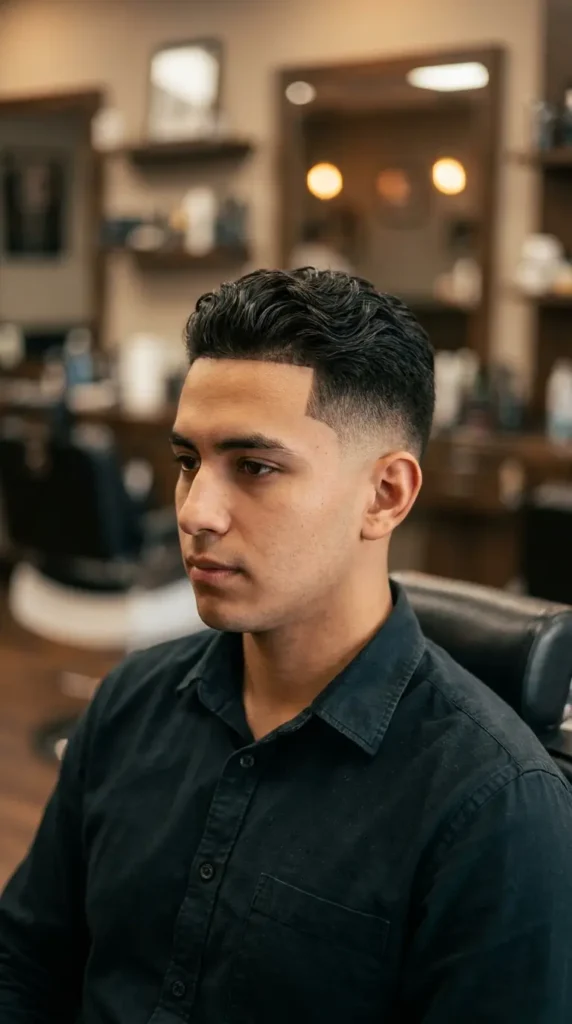
A low taper starts just above the ears, roughly 1 inch up from the ear, and around the neckline. It’s the most subtle, most conservative taper available.
The blend is barely noticeable from a distance. That’s exactly the point. It creates a clean, polished finish at the edges without drawing attention to itself. The grow-out is the most natural and graceful of any taper or fade variation. For a full breakdown of how the low taper fade works, including styling options and photos, check out our dedicated guide.
Best for: First-timers. Men in corporate or professional environments. Older men who prefer a classic appearance. Anyone wanting a clean look without a dramatic change.
Mid Taper
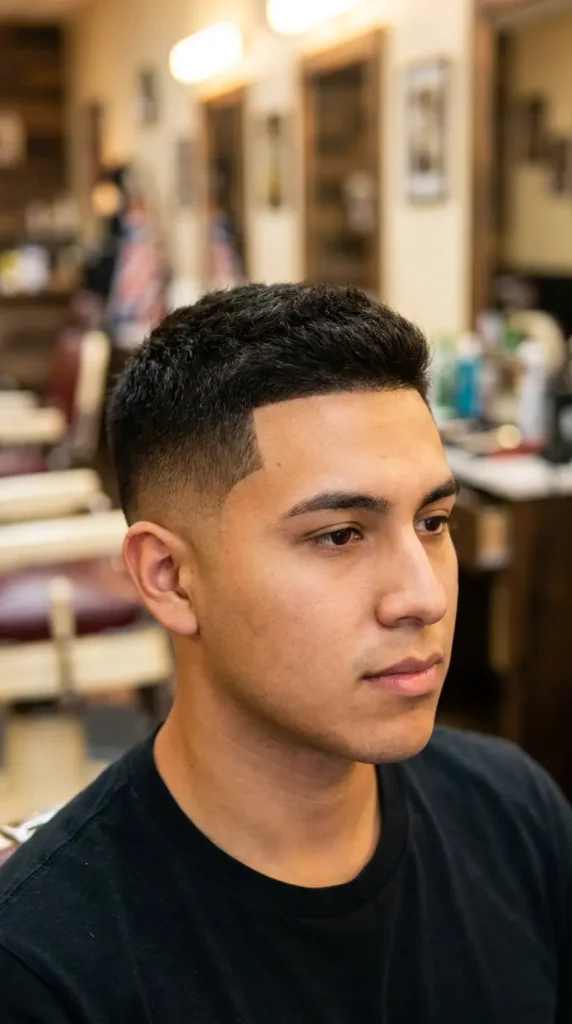
A mid taper starts around the temple area, roughly 1.5 to 2 inches above the ear. It sits perfectly in the middle ground, more defined and modern than a low taper, less dramatic than a high taper.
This is the most versatile taper variation. It creates real contrast without being extreme. It pairs naturally with comb overs, side parts, and textured crops. And it grows out more forgivingly than higher variations. Our complete mid taper fade guide covers every styling option in detail.
Best for: Men who want a modern, balanced look. Those who split time between professional and social settings. Anyone who values versatility above everything else.
High Taper
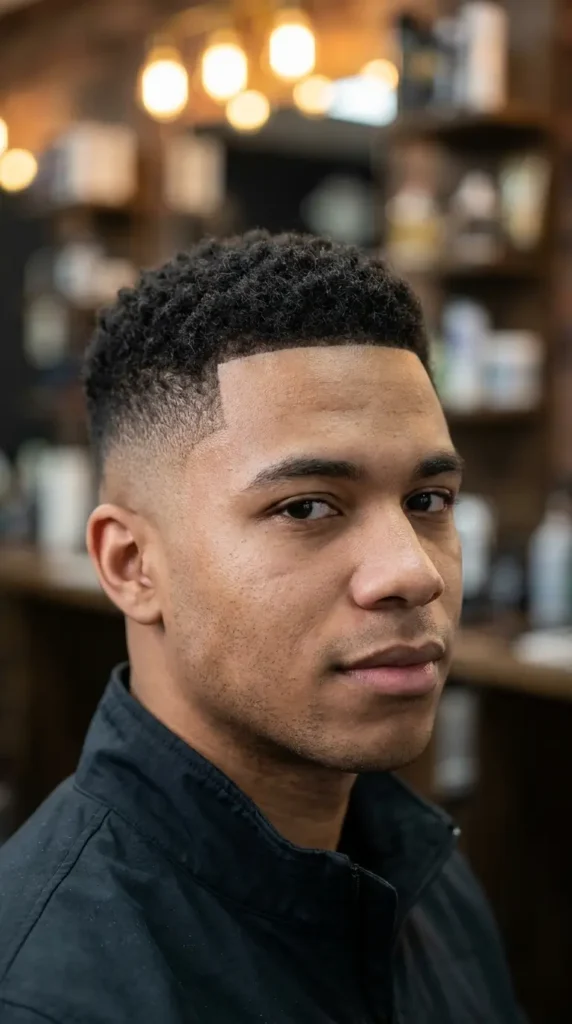
A high taper starts near the crown, approximately 2 or more inches above the ear. The contrast between the full length on top and the shorter sides is the most pronounced of all taper variations.
It’s bold and fashion-forward. It naturally pairs with pompadours, textured quiffs, and modern high-tops.
Best for: Men wanting dramatic style. Creative professionals. Those with oblong or rectangular face shapes who want to add visual width at the sides.
Tapered Neckline
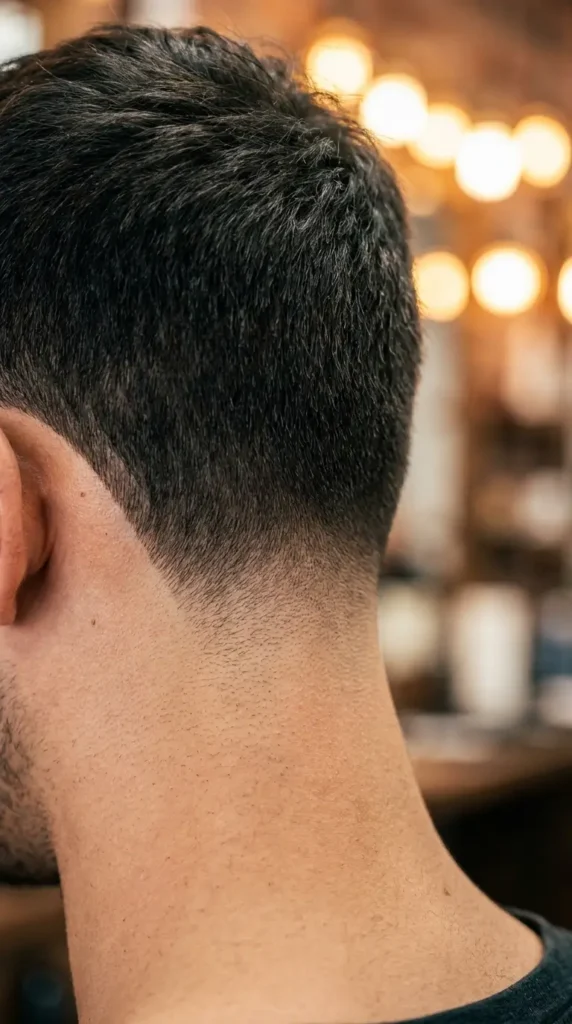
A tapered neckline refers specifically to how the back of the haircut is finished at the nape of the neck. Rather than cutting straight across (blocked neckline) or in a rounded shape, a tapered neckline gradually feathers the hair to follow your natural growth pattern.
It can be combined with any taper or fade level. It grows out the most naturally of all neckline finishes, no harsh line appears as hair grows back.
Skin Taper
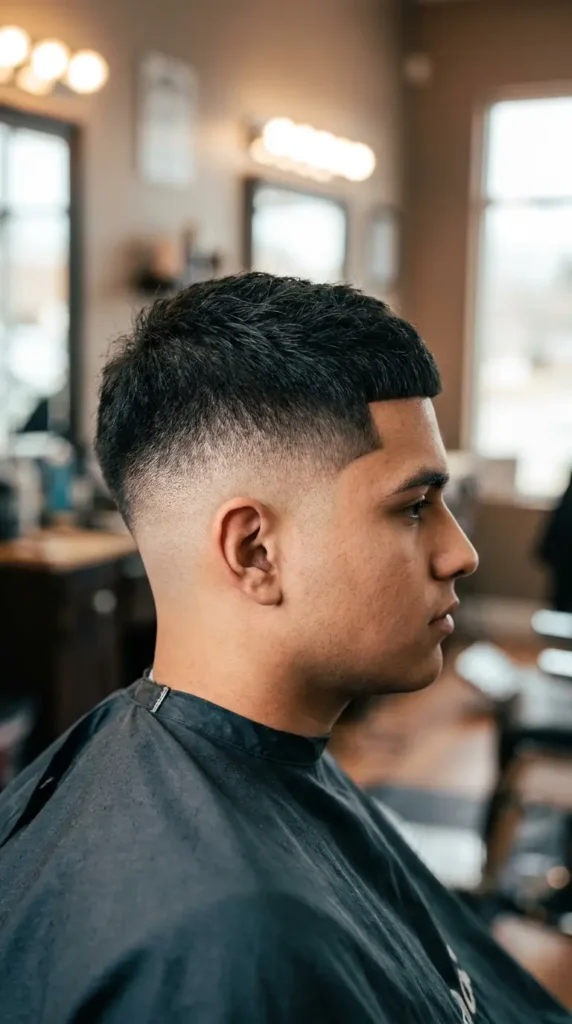
A skin taper blends hair down to bare skin at the very edges, the neckline and sideburns, while maintaining the gradual transition style of a traditional taper everywhere else.
Unlike a full skin fade, it doesn’t wrap all the way around the head. It bridges the gap between a classic taper and a skin fade, giving you sharper jawline and neckline definition without the full fade commitment.
Best for: Warmer climates. Men wanting cleaner edges without going all-in on a fade. Those who like the idea of a fade but want something more conservative.
What Is a Fade Haircut?
A fade haircut blends hair from longer on top to very short, or completely bare, on the sides and back. The transition is sharp and defined, creating a high-contrast look where the hair appears to literally dissolve into the skin.
Unlike a taper, a fade typically extends all around the sides and back of the head, not just at the neckline.
Barbers create fades using clippers with progressively smaller guard sizes, or no guard at all. The process involves building a seamless gradient through multiple passes with different guards. The lever technique, opening and closing the clipper’s adjustable lever to create micro-gradients between guard sizes, is what separates a quality fade from a mediocre one.
Key Point: A professional fade typically requires between 3 and 5 different clipper guard sizes, along with lever adjustments between each, to create a truly seamless transition. The entire process takes anywhere from 15 to 45 minutes depending on the barber’s skill level and your hair density.
Types of Fade Haircuts
Fades come in more variations than tapers. The primary differences are height (where the fade starts) and endpoint (how short it goes).
Low Fade
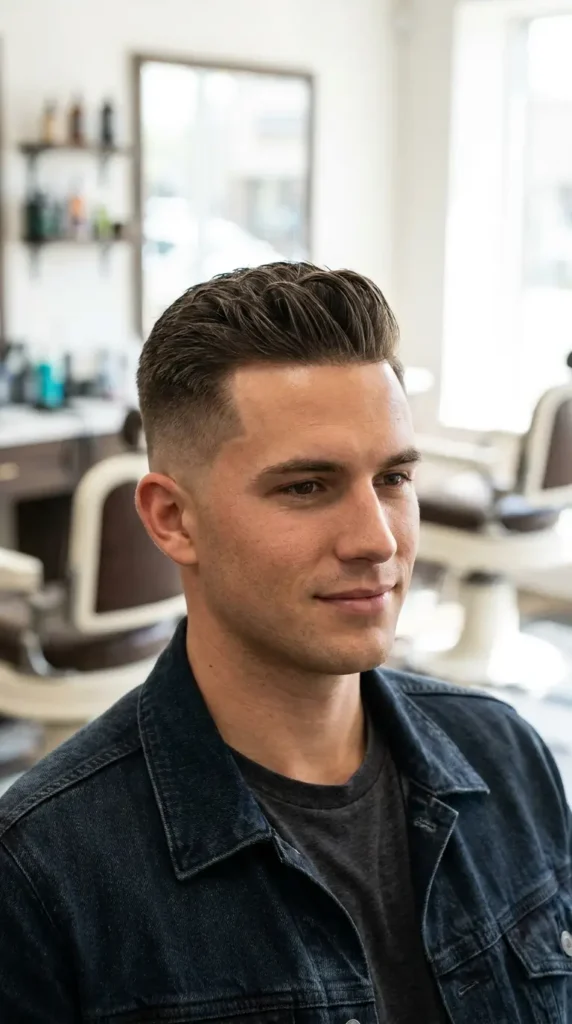
A low fade starts about 1 inch above the ear, just above the natural hairline. The shortest hair (or skin) sits right at the bottom edge near the ears and neckline.
It’s the most conservative fade option. Cleaner and sharper than a taper, but less dramatic than a mid or high fade.
Best for: Professional settings where a taper feels too subtle but a high fade is too bold. A great middle ground for first-time fade requests.
Mid Fade
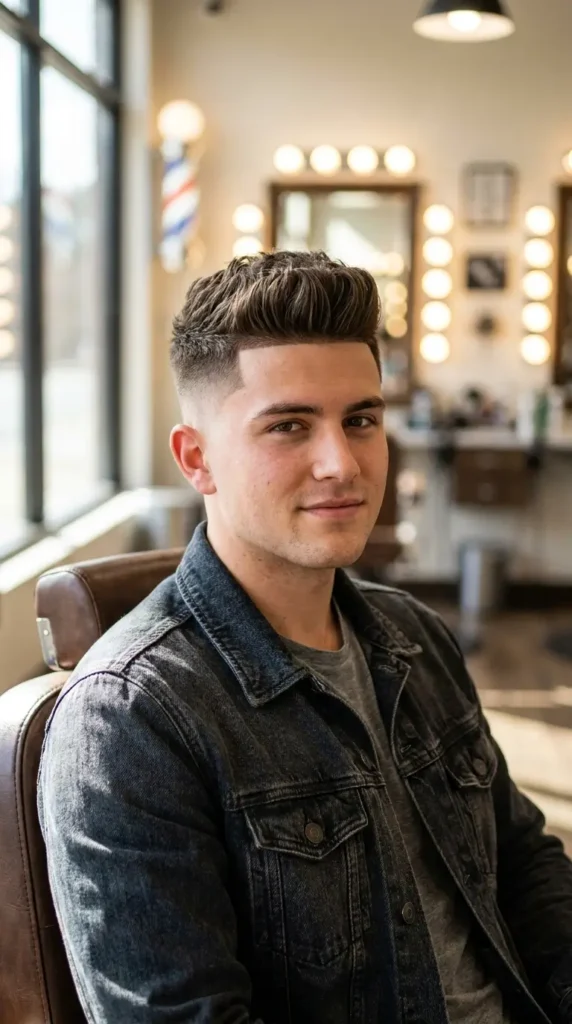
A mid fade starts at the temple area, roughly the midpoint between the ear and the crown. This is the most popular and versatile fade variation globally.
It creates a balanced, clean look that works in nearly any context. When someone says “give me a fade” without specifying height, many barbers default to a mid fade.
Best for: Most men. Works across face shapes, hair types, and settings. The safest “standard” fade choice.
High Fade
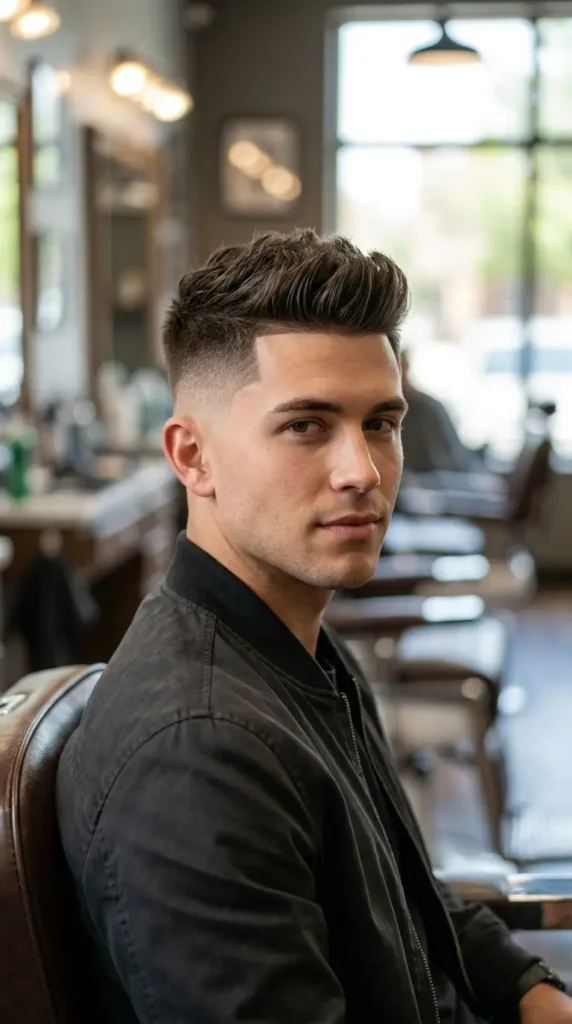
A high fade starts near or above the temple line, leaving very little hair on the sides. It creates maximum contrast between the length on top and the sides. For visual inspiration, browse our gallery of 50 high fade haircuts for men.
Bold, attention-grabbing, and fashion-forward. Requires the most frequent maintenance of all fades, every 1-2 weeks for a crisp appearance.
Best for: Men wanting maximum visual impact. Athletic and active lifestyles. Round face shapes where you want to create vertical elongation.
Skin Fade (Bald Fade)
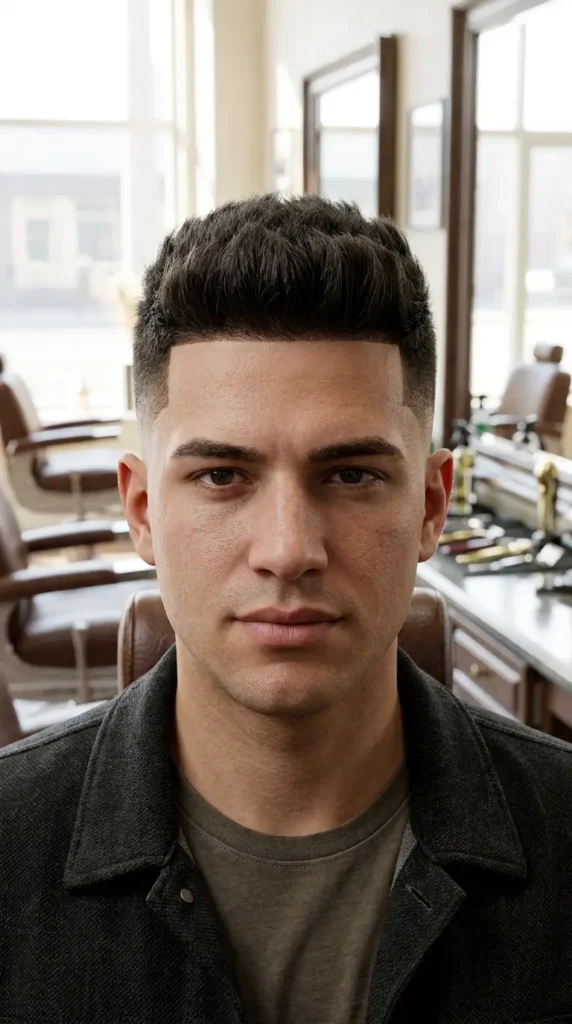
A skin fade blends all the way down to bare skin, no visible hair at the shortest point. Barbers achieve this using a guardless clipper (zero-gapped) or a foil shaver for a completely smooth finish.
The terms “skin fade” and “bald fade” are interchangeable. This creates the most dramatic contrast of all fade types.
Best for: Men wanting the sharpest possible look. Those comfortable with weekly or bi-weekly barber visits. Works exceptionally well with textured styles on top like pompadours or curly tops.
Drop Fade
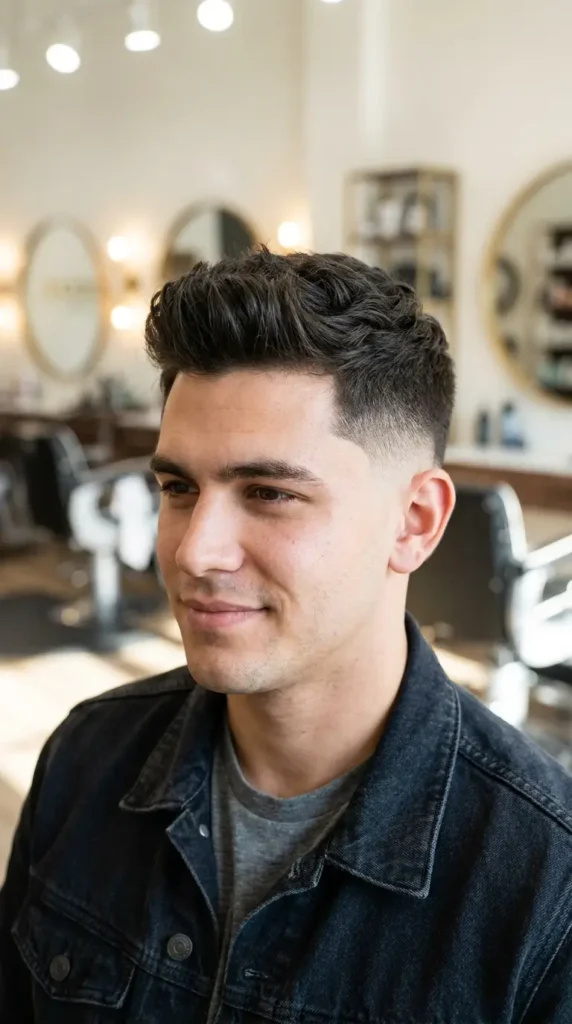
A drop fade has a fade line that curves downward behind the ear rather than going straight across. It follows the natural curve of the head more organically, creating a rounded appearance when viewed from the back.
Best for: Men with curly or coily hair (the curve complements natural texture). Those wanting a less geometric, more organic silhouette.
Shadow Fade
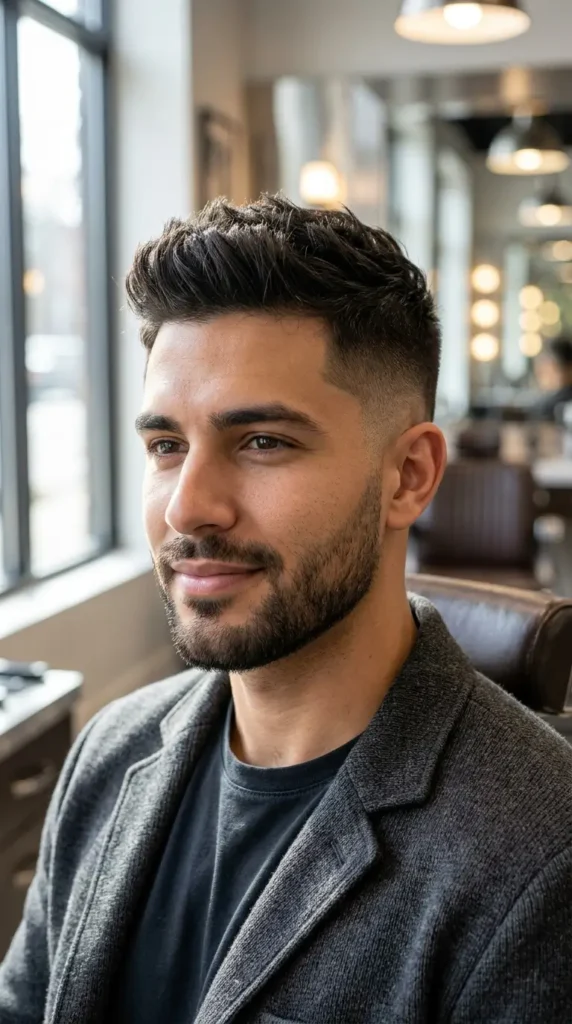
A shadow fade stops just before reaching bare skin. It maintains a “shadow” of very short hair (roughly 0.5-1mm) at the shortest point. Less harsh than a skin fade, but more defined than a standard low fade.
The regrowth pattern is more forgiving, you won’t notice growth as quickly as with a skin fade.
Best for: Men who want fade crispness without full skin exposure. Darker skin tones where the shadow creates beautiful natural definition without harsh contrast.
Burst Fade
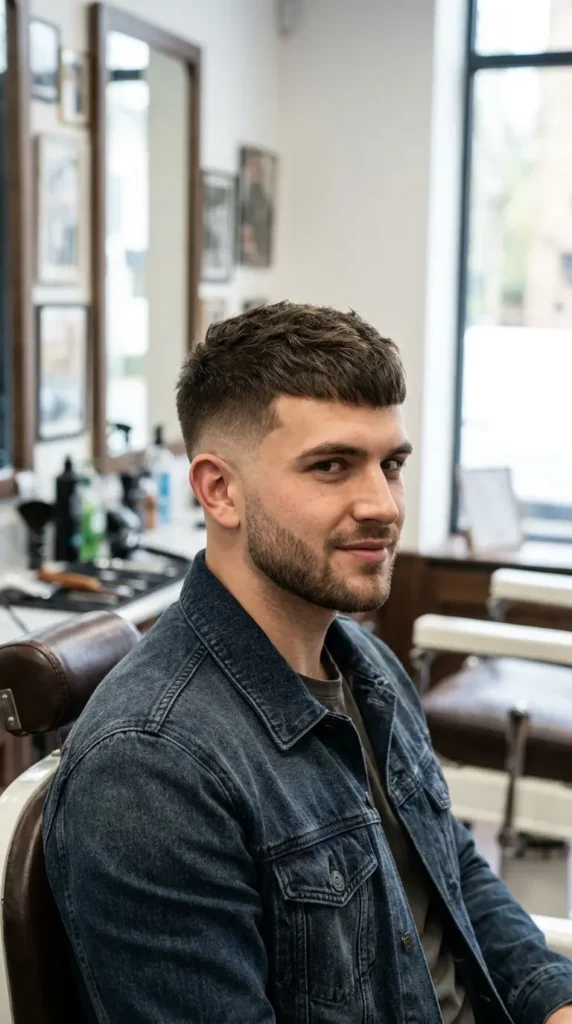
A burst fade radiates outward around the ear in a semicircle pattern, unlike traditional fades that follow straight horizontal lines. It creates a sunburst or halo effect behind and around the ear.
Best for: Creative, unconventional styles. Frequently paired with mohawks, mullets, and longer textured styles. Men wanting a fade with personality and movement.
Temple Fade (Temp Fade)
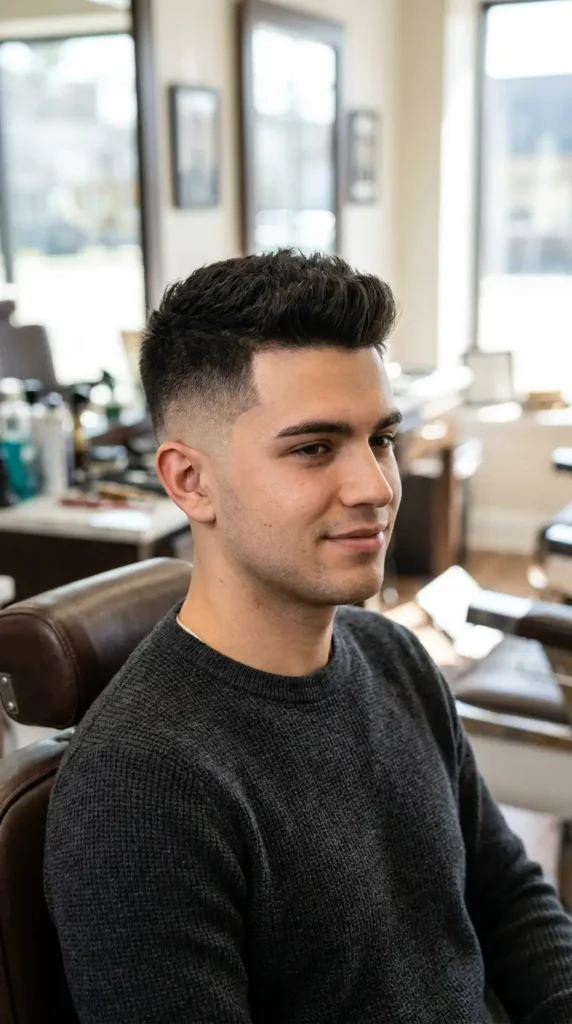
A temple fade fades only the temple and sideburn area, it’s the most minimal, localized fade available. It affects the smallest area of any fade type.
Best for: Men wanting clean edges without changing the overall silhouette. Popular with afros, natural hairstyles, and longer top styles where you want tidiness at the edges only.
What Is a Taper Fade? (Clearing Up the Confusion)
This is the term that confuses people most. And honestly, it confuses some barbers too.
A taper fade combines both techniques. It uses the gradual philosophy of a taper with the skin-blending finish of a fade, but the fade is confined to the lower edges (neckline, behind ears) rather than extending high up the head.
Here’s why the term sounds confusing: technically, all fades include tapering (a gradual reduction). So “taper fade” sounds redundant. But in barbershop culture, the phrase has evolved to mean a specific thing, a conservative, gradual fade with a gentle transition rather than a sharp, aggressive one.
Simple way to understand it:
- Taper means gradual reduction, never reaches skin
- Fade means dramatic reduction, often reaches skin
- Taper fade means gradual reduction that does reach skin, but gently and only at the very bottom
Taper fades come in low, mid, and high variations, just like both parent techniques. Pairing a taper fade with volume on top, like a blowout taper fade, is one of the most popular modern combinations.
Key Point: When you tell your barber “taper fade,” you’re requesting a fade that’s conservative in placement (usually low) and gradual in transition (not aggressive). Always specify the height (low, mid, or high) to avoid miscommunication.
Taper vs Fade: How to Choose the Right One for You
Now that you understand what each cut is and how they differ, let’s figure out which one actually suits you. The right choice depends on four things: your face shape, your hair type, your lifestyle, and how often you want to visit the barber.
Choosing by Face Shape
Your face shape determines which cut creates the most flattering proportions.
| Face Shape | Best Choice | Why It Works |
|---|---|---|
| Oval | Either, both work beautifully | Balanced proportions suit any style |
| Round | High fade or high taper | Creates vertical elongation, visually slims the face |
| Square | Low-mid taper or low fade | Softens strong angular jawline without adding sharpness |
| Oblong / Rectangle | Low fade or mid taper | Avoids adding more vertical height, keeps proportions balanced |
| Heart | Mid taper | Balances wider forehead with narrower chin |
| Diamond | Mid fade or taper fade | Adds visual width at the temple to balance prominent cheekbones |
Choosing by Hair Type and Texture
Your hair type affects how each cut looks and how easy it is to maintain.
| Hair Type | Best Options | Why |
|---|---|---|
| Straight, fine | Low-mid taper | Fades can expose scalp too visibly when hair is fine |
| Straight, thick | Any fade or taper | Density makes all transitions look clean and seamless |
| Wavy | Mid fade or mid taper | Natural wave adds movement to the transition zone |
| Curly (Type 3) | Drop fade or mid fade | Curls create natural contrast with faded sides |
| Coily (Type 4) | Temple fade, high fade, skin fade | Texture holds shape well, fades look exceptionally crisp |
| Thin / thinning | Taper (any level) | Avoids exposing scalp, creates the illusion of more density |
If you’re dealing with thinning hair specifically, our guide on haircuts for men with thin hair covers the best options in depth.
Choosing by Lifestyle and Setting
| Your Situation | Best Choice | Why |
|---|---|---|
| Corporate / law / banking | Low taper or classic taper | Universally conservative, zero risk |
| Business casual office | Mid taper or taper fade | Modern but professional |
| Creative industry | Any fade or high taper | Personal expression is expected and welcomed |
| Athletic / active lifestyle | Mid-high fade | Stays clean with sweat, looks sharp without product |
| Low-maintenance priority | Low-mid taper | Longest time between required barber visits |
| Style-conscious / trendy | Skin fade or drop fade | Maximum impact, always current |
Choosing by Maintenance Budget
This is where many guys make mistakes. They choose a cut they love the look of but can’t keep up with.
| Cut Type | Visit Frequency | Average Cost per Visit | Monthly Cost |
|---|---|---|---|
| Low taper | Every 4-5 weeks | $20-$30 | $20-$30/month |
| Mid taper | Every 3-4 weeks | $20-$35 | $25-$45/month |
| Low fade | Every 2-3 weeks | $25-$40 | $35-$70/month |
| Mid-high fade | Every 1.5-2.5 weeks | $30-$45 | $50-$120/month |
| Skin fade | Every 1-2 weeks | $30-$45 | $60-$180/month |
Barber Tip: Be honest with yourself about how often you’ll actually go back to the barber. A skin fade that’s 3 weeks grown out looks worse than a taper that’s 5 weeks grown out. Choose a cut that matches your schedule, not just your ideal look on Day 1.
Taper vs Fade: Grow-Out Timeline Compared
This is something most guides never show you, but it’s critical for making a realistic choice. Here’s what each cut actually looks like as it grows between appointments:
| Timeframe | Taper Appearance | Fade Appearance |
|---|---|---|
| Day 1-7 | Fresh, clean, barely changes | Fresh and crisp, but stubble begins appearing at skin level |
| Week 2 | Still looks intentional and tidy | Losing sharpness, blend lines starting to blur unevenly |
| Week 3 | Slightly grown-out but still acceptable | Clearly needs a cut, visible uneven regrowth |
| Week 4-5 | Time for a touch-up, but you won’t look unkempt | Overdue, obvious that maintenance was missed |
This is why barbers often say that a taper is more forgiving while a fade demands commitment. If your lifestyle doesn’t allow regular barbershop visits, a taper will always serve you better long-term.
How to Ask Your Barber for a Taper or Fade
The right words prevent the wrong haircut. Most miscommunication happens because clients use vague terms and barbers interpret them differently. A clear, specific request, combined with reference photos, guarantees you walk out with exactly what you pictured.
Professional barbers recommend a three-step communication process when requesting any haircut: describe what you want verbally, physically point to the area on your head where you want the cut to start, and then show a reference photo to confirm you’re both on the same page.
For a Classic Taper:
“I want a taper on the sides and back. Keep some length visible at the bottom, don’t take it shorter than a #3 guard at the edges. Blend it smooth into the length on top. I want the neckline to follow my natural hairline, no hard lines.”
Why this works: You’ve specified the technique (taper), the minimum length (#3 guard), the placement (sides and back), and the neckline finish (natural). A classic taper uses scissors-over-comb and clippers with attachment combs, your barber will typically start with a #4 attachment at the top of the sides and work down to your specified #3 at the edges. This leaves visible hair everywhere and creates that refined, gradual graduation without any skin showing through.
Additional detail to mention: If you want a specific neckline shape, say “rounded,” “squared,” or “tapered” at the nape. If you don’t specify, most barbers default to a natural tapered neckline that follows your growth pattern.
For a Low Fade:
“Low fade starting just above my ear. Blend it down to skin at the very bottom, but keep it low, I don’t want the fade going past my temple. Take it to a zero at the very bottom edge.”
Why this works: You’ve defined the height (low, just above the ear), the endpoint (skin/zero), and the boundary (not past the temple). The barber knows exactly where to place that first guideline. In a low fade, the initial guideline typically sits at the top of the ear, with the back guideline at the bottom of the ear, creating a contained fade zone that stays conservative.
Additional detail to mention: Specify whether you want the fade to be a “skin fade at the bottom” (completely bald at the edges using a foil shaver) or just “close to skin” (trimmer-short but not fully bald). This distinction matters, some barbers will automatically reach for the electric shaver unless you tell them otherwise.
For a Mid Fade:
“Mid fade starting at the temples. Take it down to a #1 at the bottom, blending seamless. I want the transition smooth, no visible lines between the guards.”
Why this works: You’ve identified the starting height (temples, the midpoint of your head), the shortest length (#1 guard at the bottom), and the quality standard (seamless, no lines). A mid fade is the most requested fade height because it creates balanced contrast without being extreme.
Additional detail to mention: Tell your barber how you want the top to connect to the fade. Say “connected” if you want smooth blending from the longer top into the faded sides, or “disconnected” if you want a visible contrast between the top length and where the fade begins. This changes the entire personality of the cut.
For a Skin Fade:
“Skin fade, all the way down to zero at the bottom. I want a seamless blend with no visible lines. Use the foil shaver at the very bottom to get it completely smooth. Take the fade up to about mid-height on the sides.”
Why this works: You’ve specified the technique (skin fade), the endpoint (zero/bare skin), the tool expectation (foil shaver), the quality standard (seamless), and the height (mid). A professional skin fade involves the barber setting their first guideline with the lever closed and clippers zero-gapped, then building progressive guidelines using lever adjustments and multiple guard sizes before finishing with a trimmer in forward position and an electric shaver against the grain.
Additional detail to mention: If you have sensitive skin or are prone to ingrown hairs, tell your barber before they start. Some clients specifically request no razor or foil shaver at the hairline because of irritation, and a skilled barber can still create a very close skin fade using just a zero-gapped trimmer without going fully bald.
For a Taper Fade:
“Taper fade, a gradual fade that’s not too aggressive. I want it to reach skin only at the very bottom edge, and I want the transition to be soft, not sharp. Keep it low, don’t bring the fade up past my ear. The blend should look natural, not dramatic.”
Why this works: You’ve communicated the hybrid nature of the cut (gradual like a taper, but reaching skin like a fade), the placement (low, below the ear), and the aesthetic goal (soft, natural, not dramatic). The term “taper fade” signals to your barber that you want a conservative fade, one where the transition zone is wider and more gradual than a standard fade.
Additional detail to mention: Since “taper fade” means different things to different barbers, this is the variation where a reference photo matters most. Some barbers hear “taper fade” and think low skin fade. Others think classic taper with slightly shorter edges. Pointing to the exact spot on your head where you want skin to start showing eliminates all ambiguity.
General Tips for Communicating with Your Barber:
- Always bring 2-3 reference photos from multiple angles, front, side, and back. A picture eliminates 90% of miscommunication.
- Specify three things: height (low, mid, high), endpoint (skin or short hair), and how much length stays on top.
- Ask to see the guideline first, a good barber will show you the initial line before continuing.
- When in doubt, start conservative. You can always go shorter next visit. You can’t glue hair back on.
Key Point: The single most effective thing you can do is show your barber a reference photo. Words mean different things to different barbers, especially across regions. A photo gives you both a shared visual target.
Common Mistakes to Avoid
These are the errors that lead to “I told my barber X and got Y” situations:
1. Saying “taper fade” without specifying height or endpoint. This means different things to different barbers. Always say low, mid, or high, and whether you want it reaching skin.
2. Asking for a “fade” when you actually want a taper. If you want visible hair at the bottom, you want a taper. The word “fade” signals your barber to go much shorter.
3. Skipping the reference photo. Verbal descriptions are interpreted differently by every barber. A photo creates a shared visual target that eliminates guesswork.
4. Requesting a skin fade with fine or thinning hair. Skin fades can emphasize sparse areas and make thinning more obvious. A taper creates the illusion of more density.
5. Going too high on your first fade. Start conservative. You can always go shorter or higher on your next visit. Starting aggressive leaves no room for adjustment.
6. Waiting too long between fade appointments. A fade that’s 4+ weeks grown out often requires starting from scratch, costing more time and more money than regular maintenance would.
7. Assuming all barbers use the same terminology. Regional differences exist. “Skin fade” in New York, Los Angeles, and London can mean slightly different things. Always verify with your specific barber using photos and guard numbers.
History of the Taper and Fade
Understanding where these styles came from helps you appreciate why they carry the associations they do today.
The Taper: A Century of Tradition
The taper is one of the oldest men’s haircut techniques in the Western world. It gained widespread popularity during the early-to-mid 20th century as the standard look for businessmen, military personnel, and professionals across America.
Hollywood’s Golden Age made it iconic. Actors like Cary Grant, Gregory Peck, and James Dean wore classic tapers that communicated discipline, professionalism, and taste. The style became so standard that many men’s haircuts still default to a tapered neckline without anyone requesting it by name.
The Fade: From Barbershop Culture to Global Phenomenon
The fade has a different origin story. It emerged from African American barbershop culture and was influenced by military grooming standards in the mid-20th century. The short-back-and-sides military crop evolved into more stylized, high-contrast fades as urban barbershop culture grew through the 1970s and 1980s.
By the late 1980s and 1990s, hip-hop artists, basketball players, and entertainers brought the fade into the mainstream. Kid ‘n Play, Michael Jordan, and Will Smith made high-top fades and skin fades part of global popular culture.
Today, the fade is consistently one of the most requested haircuts in barbershops worldwide, crossing every cultural, age, and professional boundary.
Styling Products: Taper vs Fade
The right product makes your cut look better and last longer between visits.
| Product | Best With | What It Does |
|---|---|---|
| Matte clay | Tapers, natural, textured finish | Adds texture and hold without shine, suits the understated taper aesthetic |
| Water-based pomade | Classic tapers, slicked, polished looks | Provides shine and hold for comb overs and side parts, washes out easily |
| Matte pomade | Fades, clean, natural hold | Holds style without visible product, lets the fade be the focal point |
| Styling powder | Fades, volume on top | Adds grip and lift to longer top sections, invisible finish |
| Sea salt spray | Both, pre-styling prep | Creates natural texture and wave, works as a foundation before other products |
| Edge control gel | Skin fades, baby hair and hairline management | Keeps edges crisp between barber visits |
Barber Tip: Match your product’s finish to your cut’s formality. A skin fade with matte clay creates a modern casual look. A classic taper with water-based pomade creates a boardroom-ready finish. The product should complement your cut’s personality, not fight against it.
Frequently Asked Questions
Is a taper or fade better for a professional workplace?
A taper is universally safe for conservative professional environments like banking, law, and corporate offices. Low and mid fades also work in most modern offices. Skin fades and high fades may be perceived as too casual in traditional corporate settings, though this varies by company culture.
How often do I need to get a fade touched up?
Most fades need a touch-up every 1-3 weeks to maintain their sharpness. Skin fades show visible regrowth within 5-7 days. Tapers remain presentable for 3-5 weeks, making them far more forgiving.
Can I get a taper and a fade at the same time?
Yes, this is what a “taper fade” is. It combines the gradual philosophy of a taper with a fade’s skin-level finish, typically confined to the lower edges rather than extending high up the head.
What clipper guard numbers are used for a taper vs. a fade?
A taper typically stays at #2-#3 guard minimum (6-10mm). A fade progressively uses #1, #0.5, and guardless settings (0-3mm or bare skin). The lever technique creates micro-adjustments between each guard for seamless transitions.
Does a fade work on curly hair?
Fades look excellent on curly and coily hair. The natural texture creates defined contrast against the faded sides. Drop fades and skin fades are especially popular with Type 3 and Type 4 curl patterns because the texture holds shape beautifully.
Which lasts longer between cuts, a taper or a fade?
A taper lasts significantly longer. Because the shortest point still has visible hair, regrowth is less noticeable. A fade’s crisp skin-to-hair transition deteriorates visibly within 1-2 weeks.
Is a taper fade the same as a regular fade?
Not exactly. A taper fade is a more conservative, gradual version of a fade. A regular fade (especially mid or high) is more dramatic and covers a larger area. Taper fades stay low and blend more gently toward the skin.
What should I show my barber if I can’t explain what I want?
A reference photo is the most effective communication tool available. Save 2-3 images showing the length, fade height, and finish you want, from front, side, and back angles. Show these before your barber picks up clippers.
Is a taper cheaper than a fade?
Generally, yes. Tapers are less technically demanding and require less frequent visits. A taper costs $20-$35 per visit every 3-5 weeks. A fade costs $25-$45 per visit every 1-3 weeks. Over a year, that difference adds up significantly.
Which is better for thin hair, a taper or a fade?
A taper is almost always better for thin or thinning hair. It maintains visible hair at all points, creating the illusion of density. A fade, especially a skin fade, can emphasize sparse areas by creating harsh contrast between hair and exposed scalp.
What looks better, taper or fade?
Neither is objectively better, it depends on the statement you want to make. A fade looks sharper and more striking because of its high contrast, it’s the look most people notice first. A taper looks more refined and understated, the kind of haircut that reads as put-together without drawing attention to itself. If you want people to notice your haircut, a fade wins. If you want your haircut to simply look clean without being the focal point, a taper wins.
What is the Gen Z male haircut called?
There isn’t one single official name, but the mid fade paired with a textured, disconnected top is the combination most associated with current Gen Z style, along with the curtain haircut and modern mullet. When it comes to fades specifically, Gen Z overwhelmingly favors mid and low fades with textured tops over the ultra-high skin fades that were more popular a decade ago.
Conclusion
A taper is gradual, subtle, and forgiving. It keeps visible hair at the edges, grows out gracefully, and works in every professional setting without question. It’s the safer, lower-maintenance choice.
A fade is sharp, bold, and high-contrast. It blends to very short hair or bare skin, demands regular maintenance, and makes a stronger visual statement. It’s the more impactful, higher-commitment choice.
Neither is objectively “better.” The right choice depends entirely on your face shape, hair type, lifestyle, maintenance budget, and personal style. A lawyer who visits the barber once a month needs a different cut than a creative director who goes every two weeks.
Three things to remember before your next appointment:
- Bring a reference photo. It eliminates more miscommunication than any amount of verbal description ever could.
- Start conservative. You can always go shorter or higher next time, but you can’t put hair back.
- Be honest about maintenance. The best haircut is one that still looks good on the day before your next appointment, not just the day you leave the chair.
Now you know exactly what separates these two cuts, every variation available, which suits your situation, and exactly what to say when your barber asks the question. No more freezing in the chair. No more walking out with the wrong cut.