
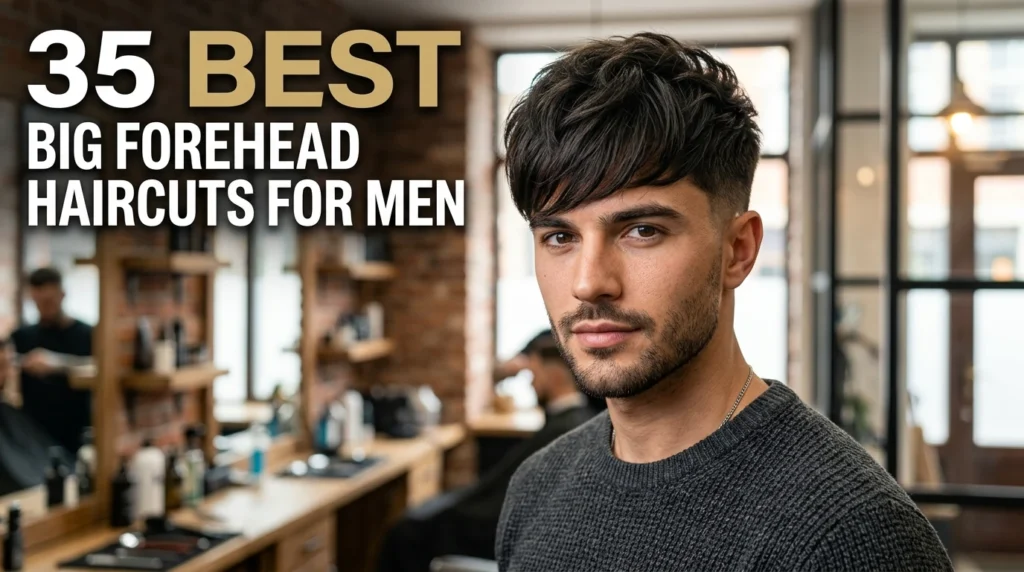
Stop worrying about your high forehead. Here are 35 flattering haircuts for men with big foreheads — including exact barber scripts, guard numbers, and styling tips.
Let’s be real for a second. If you’re reading this, you’ve probably looked in the mirror and thought, “Is my forehead… big?”
Here’s the honest answer: maybe. And maybe that’s totally fine.
The four-finger rule is the easiest way to check. Place four fingers vertically between your eyebrows and your hairline.
- 3 fingers or less = average forehead
- 4 fingers = larger than average forehead
- 4+ fingers = you have what most people call a “big forehead” or sometimes jokingly a “fivehead”
Fact Source: According to hair restoration specialists, the male hairline normally lies 7-8 cm above the center of your eyebrows, and a forehead over 8 cm is considered large.
Another way to look at it: About 85% of men experience some form of male pattern baldness by age 50. That means your forehead might not actually be “big” — your hairline might just be moving back as you get older.
But here’s the thing. A proportional forehead is typically about the width of 3-4 of your fingers. But faces with longer proportions naturally have bigger foreheads that match their other features. That’s not a flaw. That’s just your face shape.
So before you stress about it, here’s what you need to know: Your forehead isn’t a problem to hide. It’s a feature to style around.
Some of the most attractive men in Hollywood have big foreheads — Brad Pitt, Tom Hardy, Jude Law, Timothée Chalamet. They just know how to work with it.
And now, so will you.
The 3-Second Decision Matrix: Which Forehead Haircut Is Right for YOU?
Before we jump into 35 different haircuts for men with big foreheads, let’s figure out which category fits you best.
| If You Want To… | Choose This Category | Best For |
| Hide or cover your forehead | Fringe Styles (Section 1) | High coverage, medium maintenance |
| Balance your face without hiding | Volume Styles (Section 2) | Natural proportion, higher maintenance |
| Spend less than 5 minutes styling | Short & Low-Maintenance (Section 3) | Minimal effort, wash-and-go |
| Stop hiding and own it completely | Embrace It (Section 4) | Confidence, best with a beard |
Quick Self-Assessment Questions
Ask yourself these three questions before you pick a style:
- How much time do you want to spend on your hair every day? (2 minutes vs. 15 minutes makes a big difference)
- Do you have a beard or can you grow one? (Beards are secret weapons for balancing big foreheads)
- What’s your hair type? (Straight, wavy, curly, thin, or thick — be honest)
Hair Type Cheat Sheet
| Your Hair Type | Your Best Bet |
| Straight or fine | Side part, Caesar cut, French crop |
| Wavy | Surfer cut, textured crop, bro flow |
| Curly | Curly fringe, curly undercut, tapered Afro |
| Thin or fine | Textured crop, Caesar cut, buzz cut |
| Thick | Textured quiff, pompadour, layered cut |
Face Shape Quick Guide
| Your Face Shape | What Works Best |
| Oval | You’re lucky — almost any style works |
| Round | Angled fringe or height on top |
| Square | Soft layers, side part, textured crop |
| Heart | Longer fronts, curtain bangs |
Now let’s get into the actual haircuts.
35 Best Haircuts for Men with Big Foreheads
If you want maximum forehead coverage, these forward-falling styles are your best friends. Here is a list of 35 Best Haircuts for Men with Big Foreheads 2026:
1. Textured Fringe
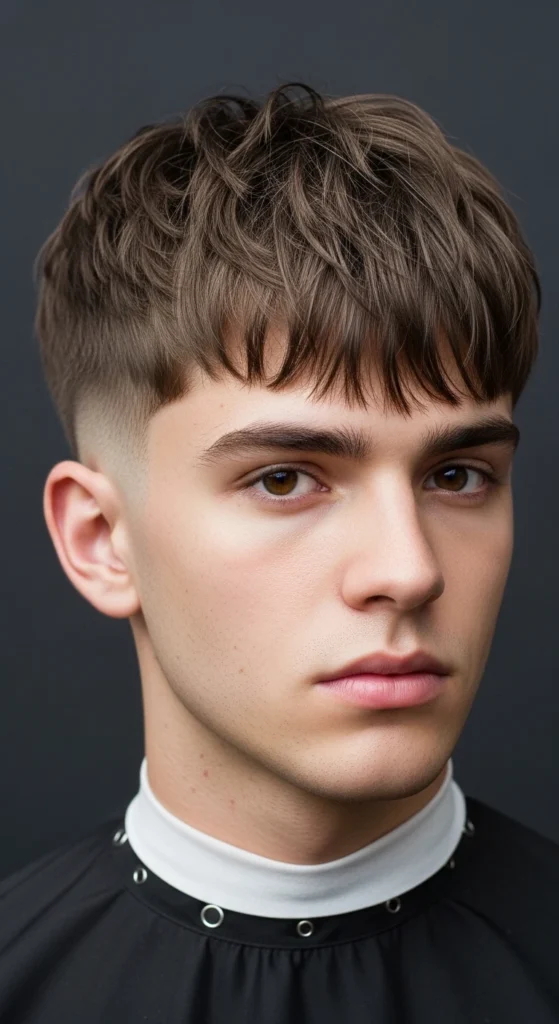
Why it works: The choppy bangs naturally cover extra forehead space while adding movement and shape. It’s one of the most popular big forehead haircuts right now, and for good reason.
Best for: Straight or wavy hair, oval faces, guys in their teens through 30s.
Maintenance level: Medium — you’ll need to style it daily with texture products.
What to tell your barber: “Leave length in front. Point cut the fringe for texture. Don’t blunt cut it.”
How to style it: Blow-dry your hair forward. Pinch small sections with texture powder. Shape with your fingers — don’t use a comb.
Celebrity example: Timothée Chalamet
Product to use: Texture powder gives you that lifted, separated look without weighing your hair down.
2. French Crop
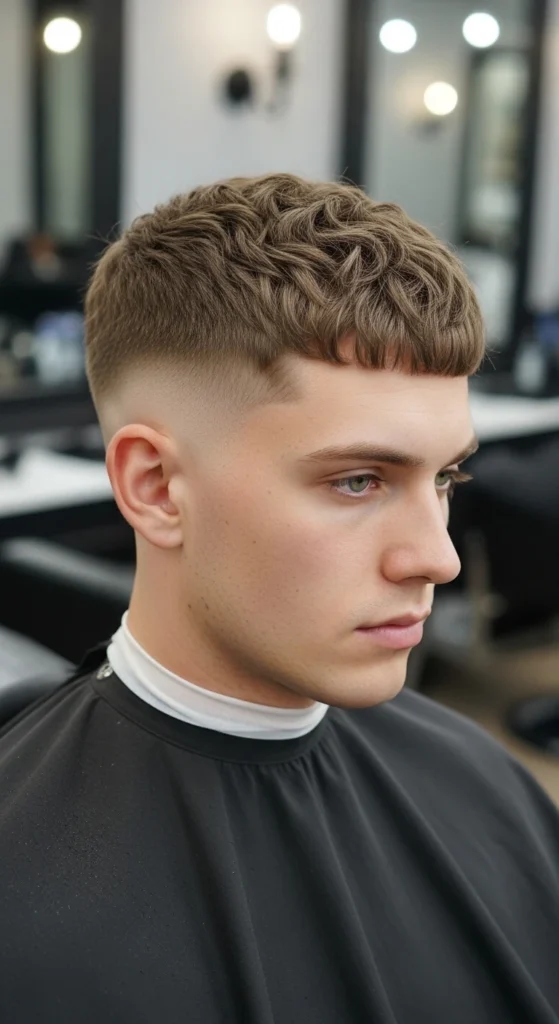
Why it works: The short, forward fringe helps lower your hairline and balance your face. It’s a classic for a reason.
Fact Source: According to barbering experts, the relationship between the bottom half of your head and the top half is critical. You need enough room for scissor work to build bulk around your temple and forehead. The French crop does exactly that.
Best for: Textured or wavy hair. Oval, round, or square faces. Works for all ages.
Maintenance level: Low to medium.
What to tell your barber: “Give me a fade on the back and sides starting under a #1 blade. Scissor-cut the top to finger length. Point cut for texture. I want to style it forward.”
How to style it: Blow-dry your fringe forward. Add texture clay. Keep it choppy — not too perfect.
Celebrity example: Paul Mescal
Pro tip: If you have very fine, straight hair (type 1A), the French crop can look a little flat. Ask your barber for extra texture or consider a different style.
3. Caesar Cut / Edgar Cut

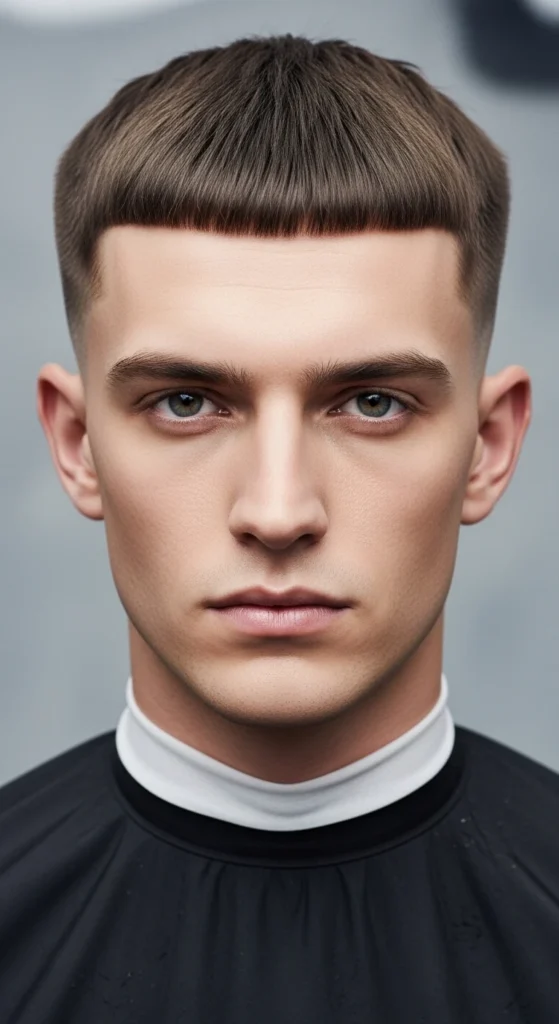
Why it works: The short, straight fringe sits low on your forehead and helps make it look smaller. It’s a clean, almost military-looking style that’s been popular for decades.
Fact Source: Barber experts explain that in recent years, there’s been a massive surge in popularity for Caesar cuts and blowout tapers. However, this is not a cut for men with receding hairlines. The contrast-heavy nature works best with thick, dark hair.
Best for: Thick hair. Oval faces.
Maintenance level: Low.
What to tell your barber: “Blunt fringe across the front. Keep sides longer than a French crop. Taper the sideburns down to skin.”
How to style it: Blow-dry your fringe forward. Use texture clay for hold. Keep it simple.
Celebrity example: The style is named after Julius Caesar, but modern versions are all over TikTok and Instagram as the “Edgar cut.”
4. Curtain Bangs
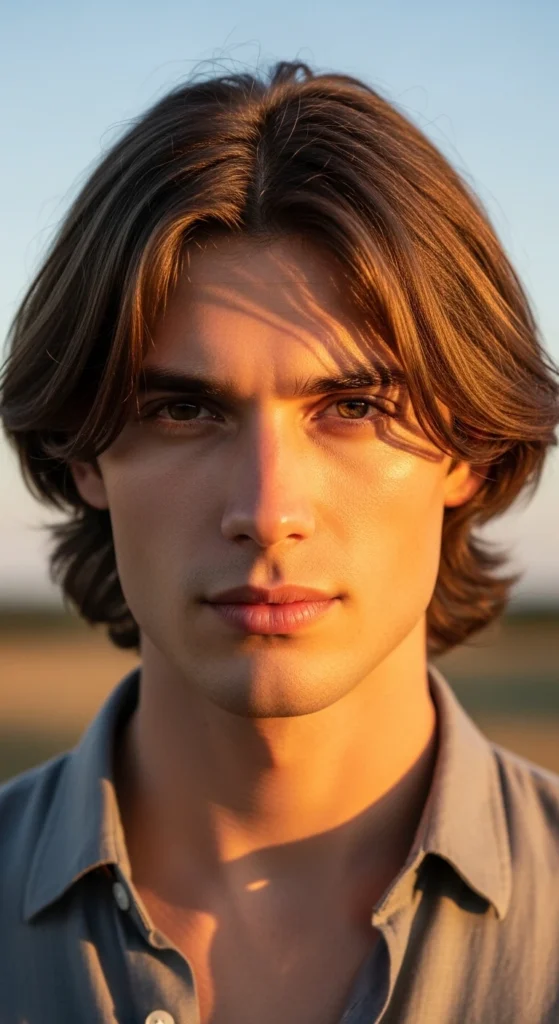
Why it works: The long front pieces frame your face and make your forehead look smaller. The center part makes it work with almost any hairline type.
Best for: Medium-length hair. Oval faces. Guys who want a romantic or poetic look.
Maintenance level: Medium.
What to tell your barber: “Create a center part. Keep the front pieces long enough to frame my face. Add light layers.”
How to style it: Blow-dry the front sections backward. Use styling cream for smoothness.
Celebrity example: Owen Wilson
5. Side Swept Fringe
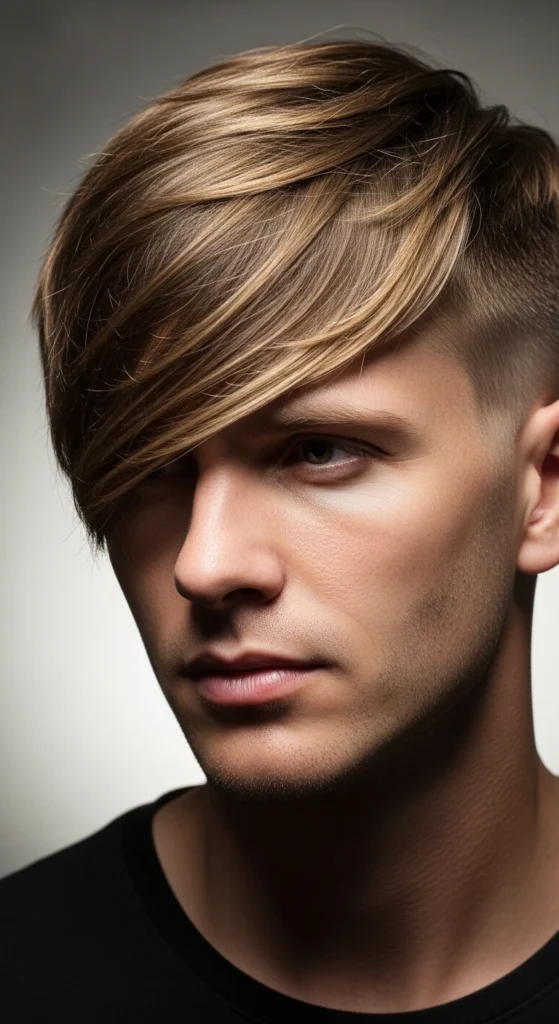
Why it works: The longer front section falls diagonally across your forehead, softening its height and creating a balanced, natural look.
Best for: Straight or wavy hair. Most face shapes.
Maintenance level: Medium.
What to tell your barber: “Longer front section. Point cut for texture. I want to guide it to one side.”
How to style it: Blow-dry your fringe in the direction you want it to fall. Use molding paste for control.
6. Angular Fringe
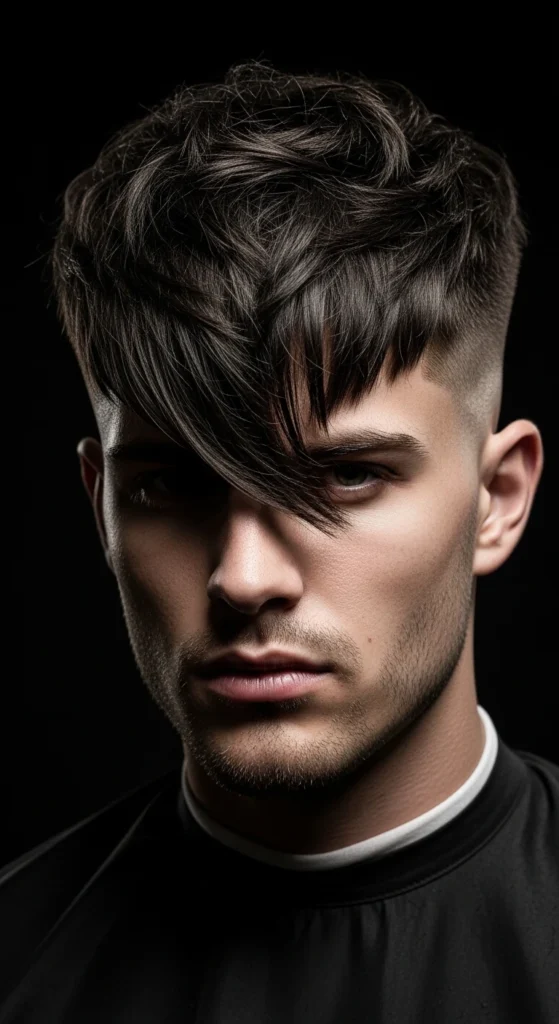
Why it works: This one creates a sharp, stylish shape while still softening your forehead height. It’s more modern and edgy than a traditional fringe.
Best for: Thick hair. Square faces. Guys who want an edgier look.
Maintenance level: Medium.
What to tell your barber: “Diagonal fringe from one side. Keep the top lightly textured.”
How to style it: Blow-dry forward and guide it diagonally. Use molding paste.
7. Curly Fringe
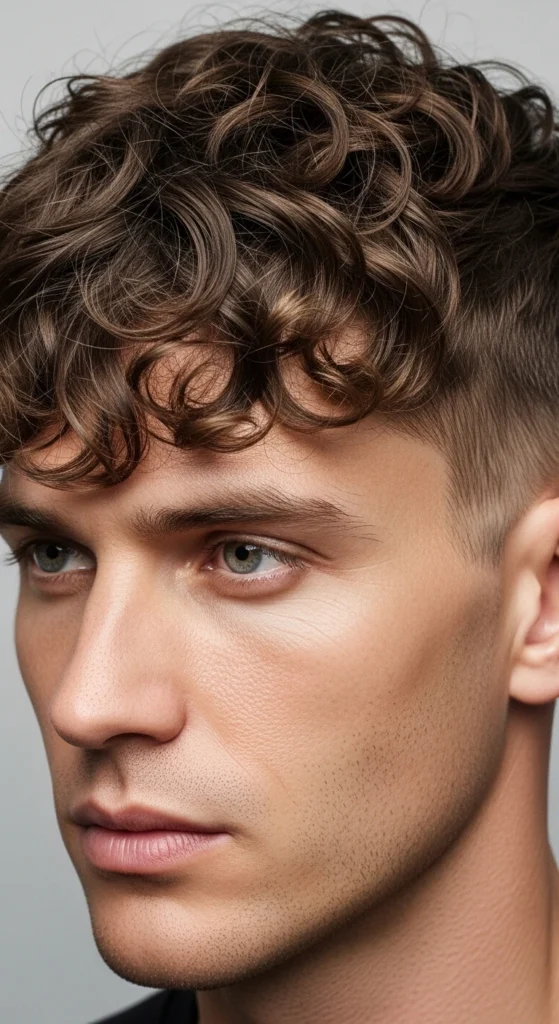
Why it works: Your curls fall forward and create soft, natural forehead coverage without looking forced. It works with your natural texture instead of fighting it.
Best for: Curly hair. Oval or round faces.
Maintenance level: Medium to high.
What to tell your barber: “Keep the top longer to show my curl pattern. Shorter sides for balance. Don’t shear my curls — shape them.”
How to style it: Blow-dry on low heat. Shape your curls with your fingers. Use styling cream.
8. Modern Mullet (with Fringe)
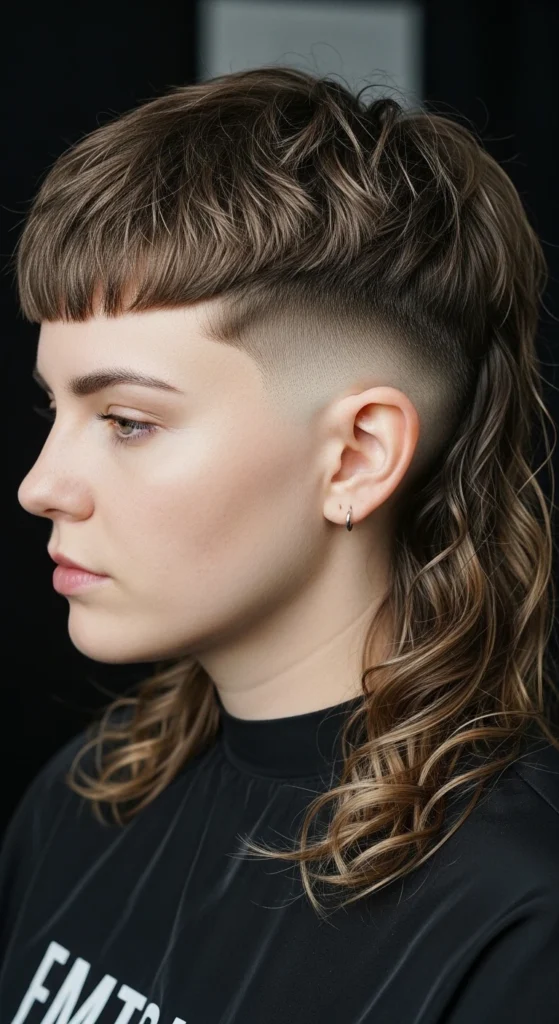
Why it works: Yes, the mullet is back — but not the 80s version. The modern mullet has a short, choppy fringe that sits low on your forehead, faded tight sides, and longer length in the back. The fringe covers your forehead while the longer back draws attention downward.
Best for: Wavy or curly hair. Guys with an adventurous style.
Maintenance level: Medium to high.
What to tell your barber: “Short choppy fringe in front. Faded tight sides. Keep length in the back.”
How to style it: Blow-dry the top forward. Use molding paste for texture.
9. Textured Quiff
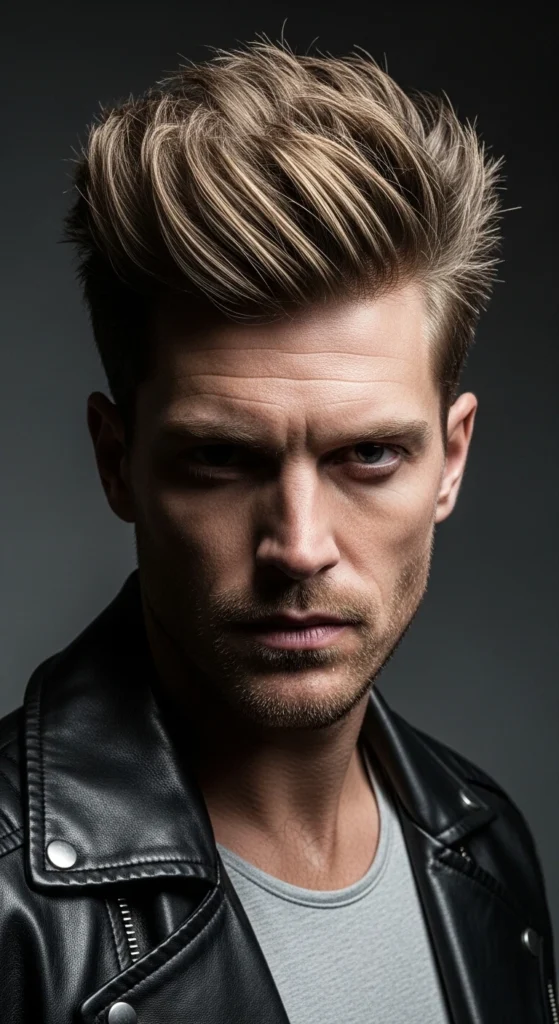
Why it works: The lifted front adds height while the messy layers help balance your face. You’re not hiding your forehead — you’re making it look proportional.
Best for: Thick or straight hair. Oval or diamond faces.
Maintenance level: High — you’ll need to blow-dry and use products daily.
What to tell your barber: “Leave the top longer. Shape it upward. Shorter sides for a clean outline.”
How to style it: Blow-dry the front with your fingers lifting up. Use texture clay for soft separation.
10. Pompadour
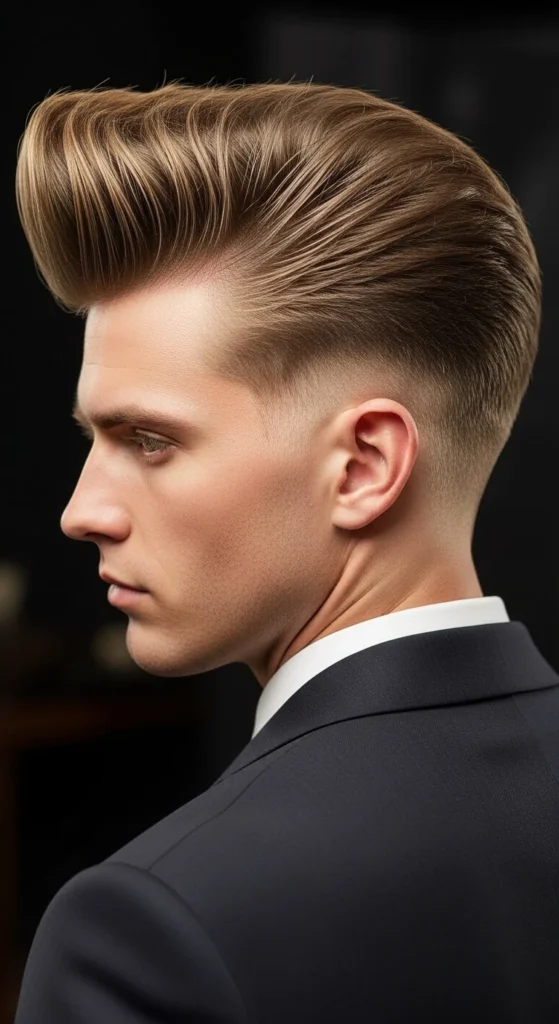
Why it works: This classic style creates a focal point on top of your head, drawing attention away from your forehead. It works best as a quiff variation — not too high, or you’ll make your face look longer.
Best for: Thick hair. Oval faces. Formal or professional settings.
Maintenance level: High.
What to tell your barber: “Keep length on top to create height. Taper the sides. Rounded front.”
How to style it: Blow-dry upward with a round brush. Use pomade for hold and shine.
11. Blowout Fade
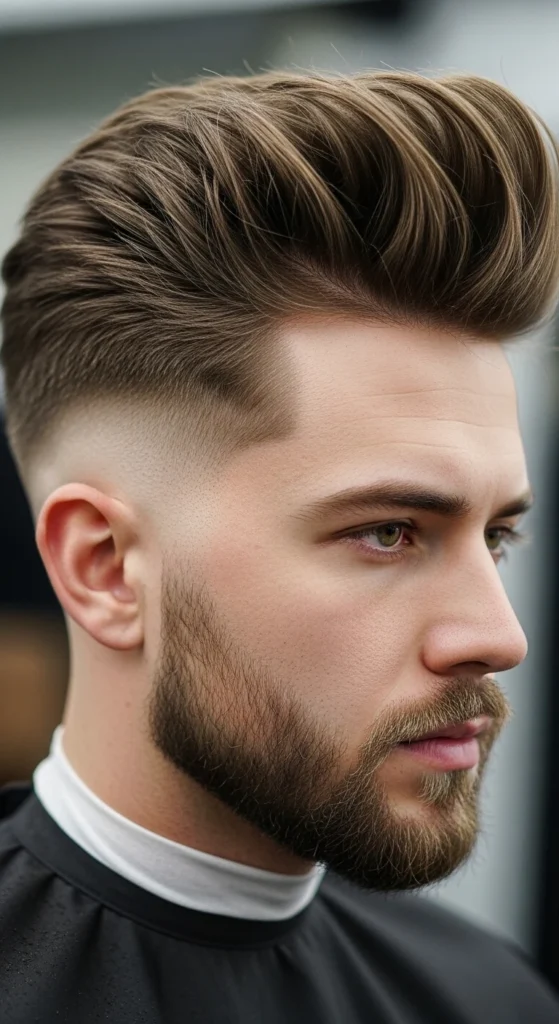
Why it works: This style adds volume up top while keeping your sides clean and tight. The height draws attention upward, and the clean fade keeps everything looking sharp.
Best for: Straight or thick hair. Diamond or oval faces.
Maintenance level: Medium.
What to tell your barber: “Low fade on the sides. Leave length on top for blowout volume.”
How to style it: Blow-dry with a round brush for height. Use texture powder.
Celebrity example: Zayn Malik
12. Brush Up Fringe
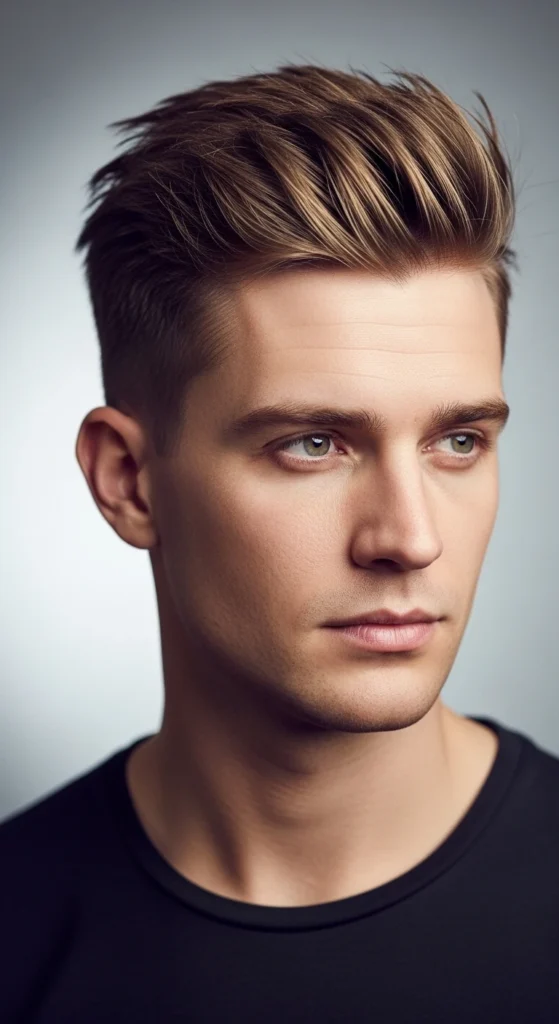
Why it works: Lifting your roots creates height that shifts focus upward from your forehead. It’s like a quiff but more casual and easier to style.
Best for: Most hair types.
Maintenance level: Medium.
What to tell your barber: “Keep length on top. Short sides. Add texture for lift.”
How to style it: Blow-dry upward. Brush with your fingers. Use matte clay.
13. Bro Flow
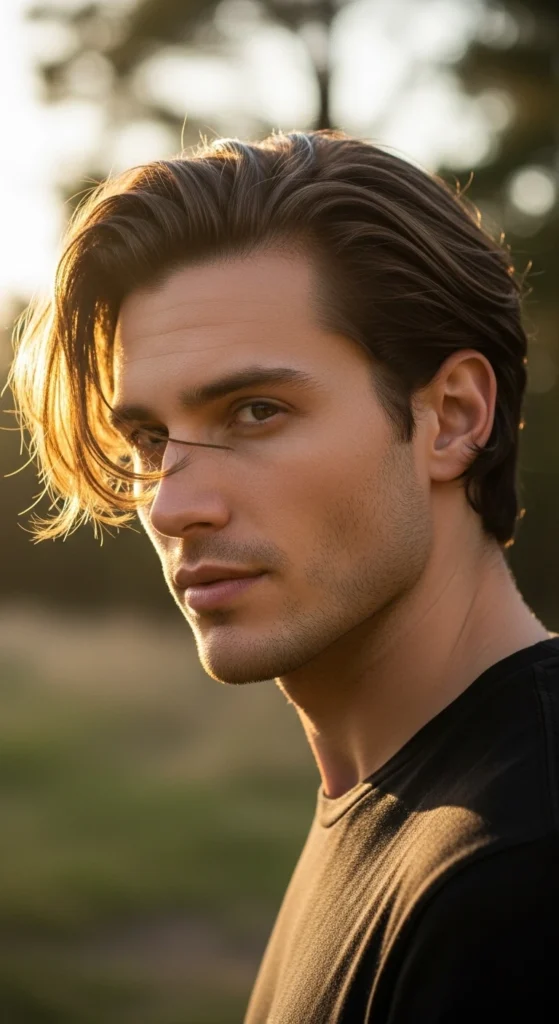
Why it works: Your hair grows long enough to bend back naturally, creating soft waves that fall away from your face. This shape helps cover your forehead while giving you a relaxed, classic look.
Best for: Wavy or straight hair. Medium length.
Maintenance level: Medium.
What to tell your barber: “Medium length all over. Layers for movement. Natural fall.”
How to style it: Blow-dry while brushing back. Use styling cream.
14. Medium Layered Cut
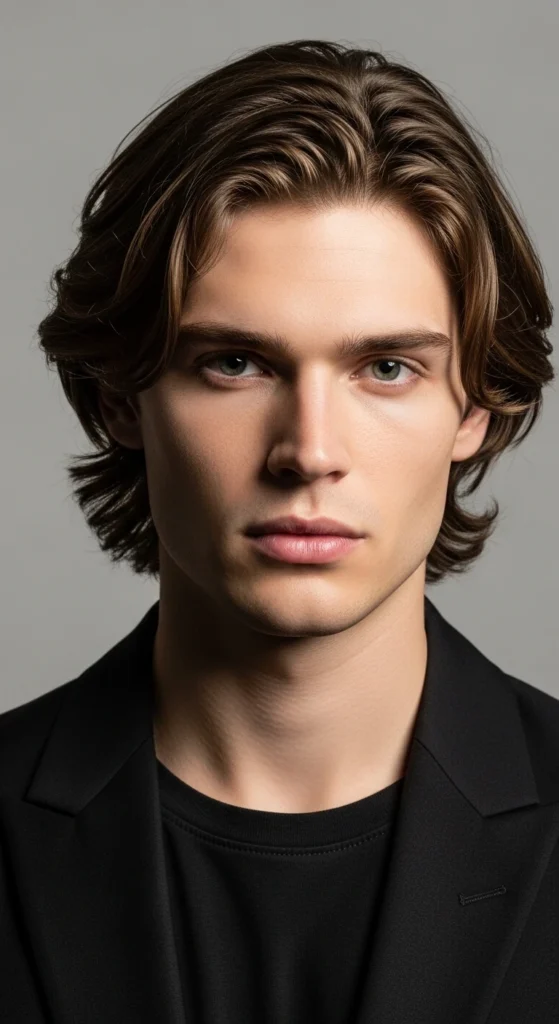
Why it works: The longer top and soft layers add lift and make your face look more balanced. It’s a simple, no-fuss style that works for guys who don’t want anything too dramatic.
Best for: Wavy hair. Longer face shapes.
Maintenance level: Low to medium.
What to tell your barber: “Medium length. Soft layers for movement. Don’t put too much weight on top.”
How to style it: Blow-dry upward with your fingers. Use sea salt spray for texture.
15. Crew Cut
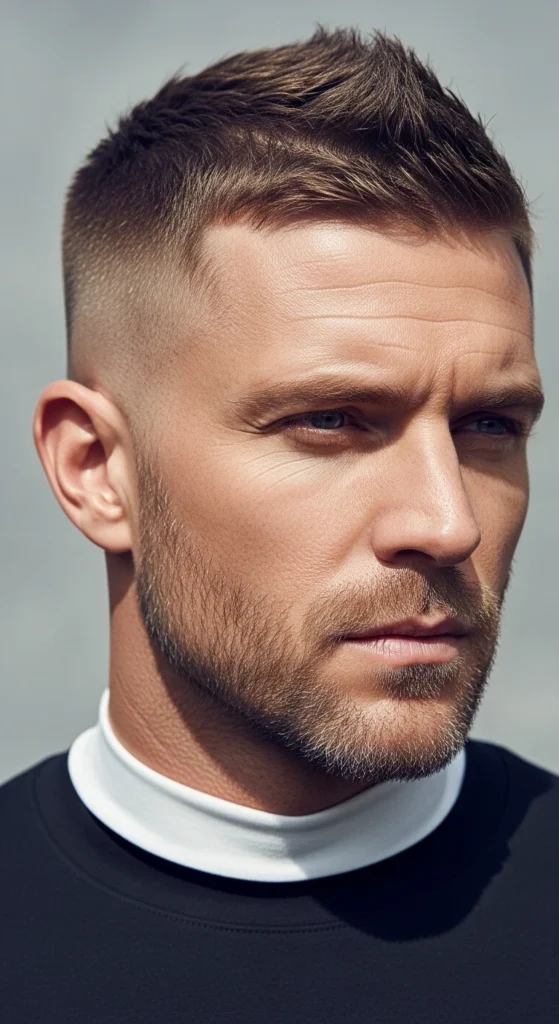
Why it works: It’s a clean, short hairstyle with the top slightly longer and the sides tight. Here’s the secret that most guys don’t realize: sometimes the best way to deal with a large forehead is to stop trying to hide it and just embrace it.
Fact Source: Barbering experts explain that the classic crew cut is most effective when the top is trimmed to a #4 clipper guard with sides and back trimmed to a #1. This contrast in length gives a nice silhouette that emphasizes your lower jaw — which is perfect for oval and triangular face shapes.
Best for: Oval, square, round, or diamond faces. All hair types.
Maintenance level: Very low.
What to tell your barber: “#4 clipper guard on top. #1 clipper on the sides and back.”
How to style it: Blow-dry the top forward for light volume. Use molding paste if you want a little texture. Or just let it be.
Celebrity example: Brad Pitt
16. Buzz Cut
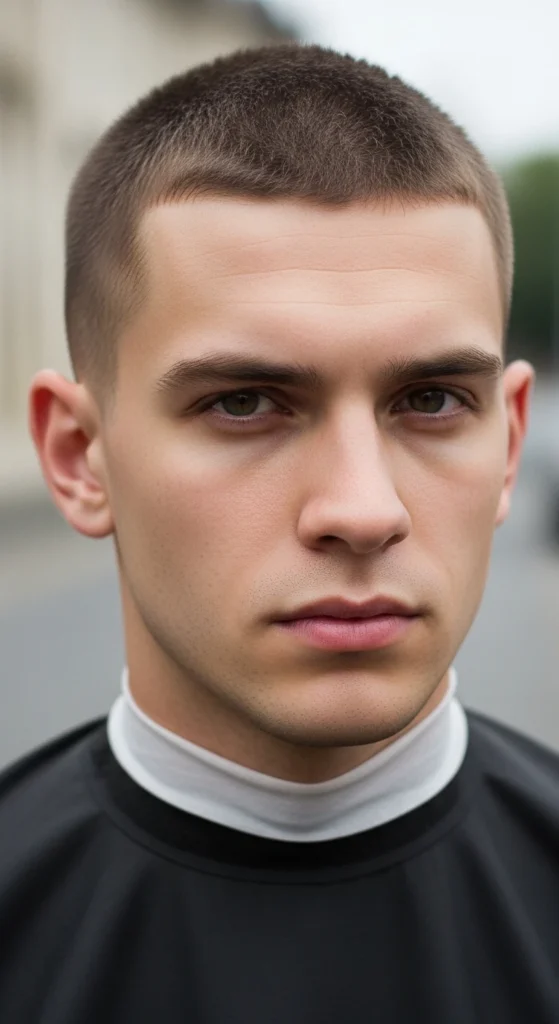
Why it works: You might think a buzz cut makes a big forehead look bigger. But here’s the truth: a buzz cut actually reduces the contrast between your scalp and your forehead, making the transition less noticeable. Plus, it exudes confidence.
Fact Source: Hair experts say a quality buzz cut can do wonders for your overall appearance, especially when it plays off the contours of your face.
Best for: Oval, square, or diamond faces. Confident men who don’t want to mess with their hair.
Maintenance level: Very low.
What to tell your barber: “#2 or #3 guard over the entire scalp.”
How to style it: Nothing. Wash and go. That’s the point.
Celebrity examples: Tom Hardy, Brad Pitt, Zayn Malik, Channing Tatum
17. Ivy League Haircut
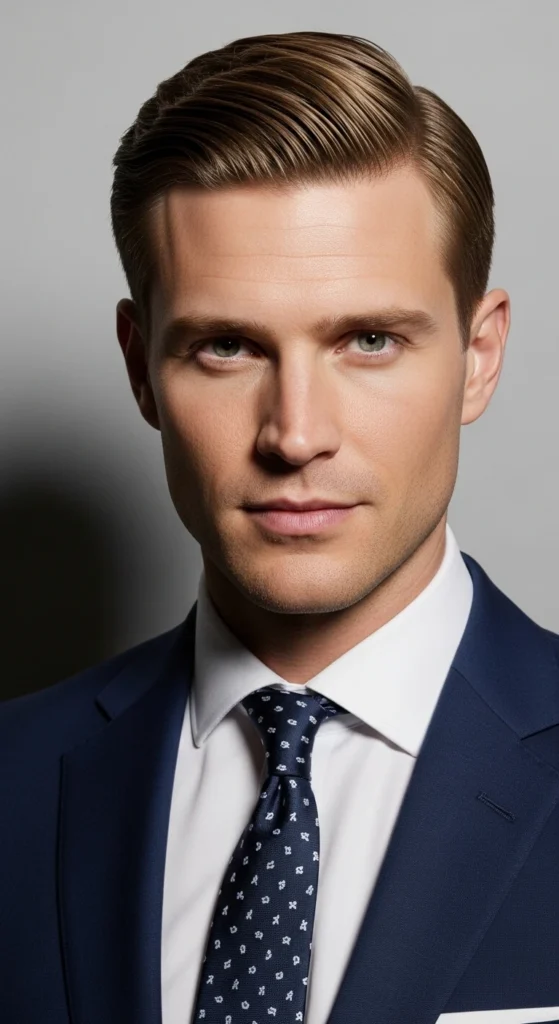
Why it works: Think of this as a slightly longer crew cut. The top is kept longer and gently brushed to the side, which softens your forehead area. It’s preppy, professional, and timeless.
Best for: Oval faces. Professional settings.
Maintenance level: Low.
What to tell your barber: “Slightly longer haircut than a crew cut on top. Side-swept. Short sides and back.”
How to style it: Blow-dry upward. Use styling cream for smooth control.
18. Taper Haircut
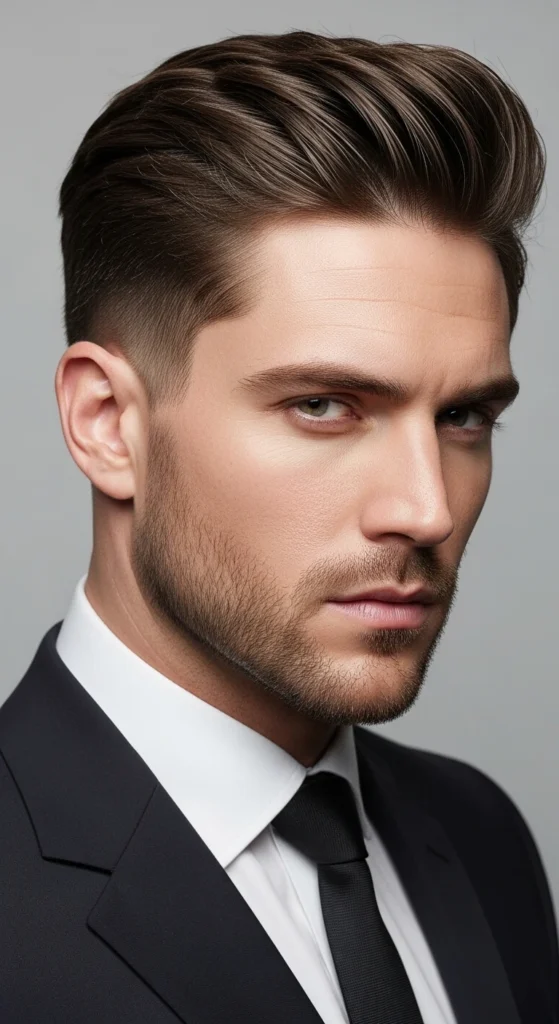
Why it works: This style keeps your sides short and close while leaving length on top that you can brush forward for coverage. The gradual shortening (that’s the “taper”) creates a clean, polished look.
Best for: All hair types.
Maintenance level: Low.
What to tell your barber: “Taper on the sides and back. Textured top that I can brush forward.”
How to style it: Blow-dry the front for a little lift. Use molding paste.
19. Spiky Haircut
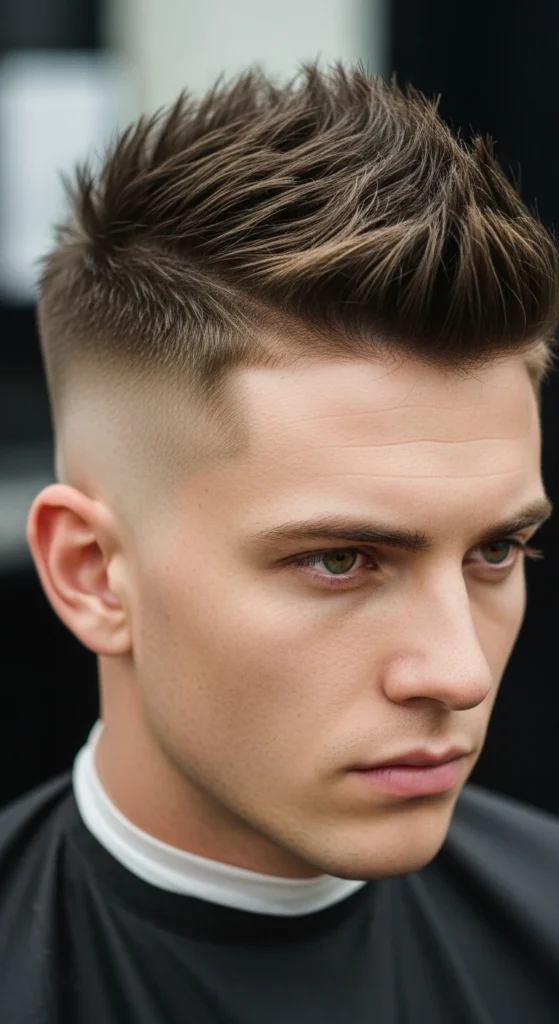
Why it works: The lifted, sharp pieces on top draw attention upward and create strong texture. Your eyes go to the spikes, not your forehead.
Best for: Straight hair. Younger guys.
Maintenance level: Medium.
What to tell your barber: “Short sides with a fade. Longer top shaped into spikes.”
How to style it: Blow-dry while lifting with your fingers. Use texture powder or gel to create and hold the spikes.
20. Side Part
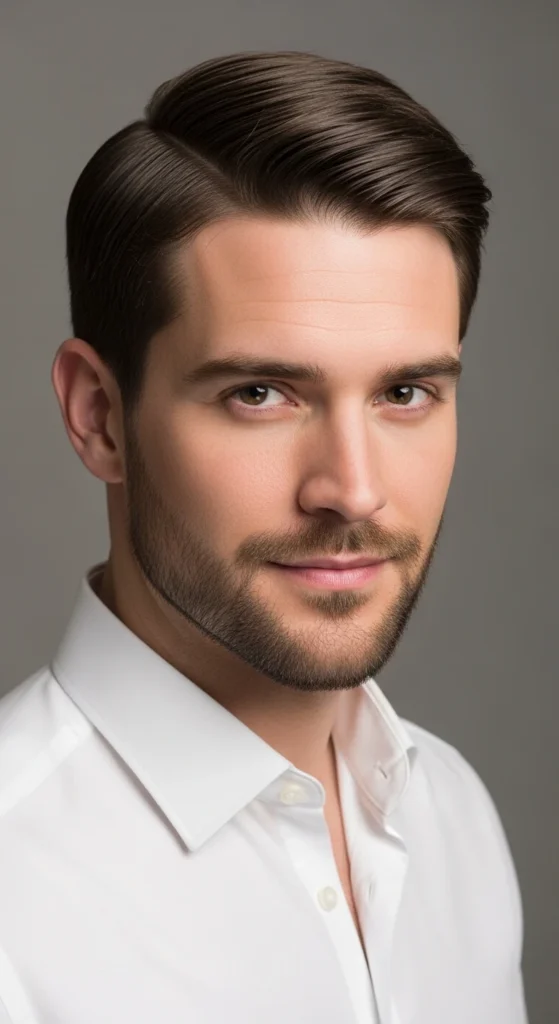
Why it works: The clean side sweep pulls attention to your eyes and adds balance to your face. Almost every guy looks great with a well-executed side part.
Best for: Straight or fine hair. Professional settings.
Maintenance level: Low.
What to tell your barber: “Strong part line on one side. Short and smooth on top. Short sides.”
How to style it: Blow-dry your hair to one side. Use pomade for natural shine.
Celebrity example: For a complete tutorial, visit our side part hairstyle guide.
21. Messy Crop / Bedhead Style
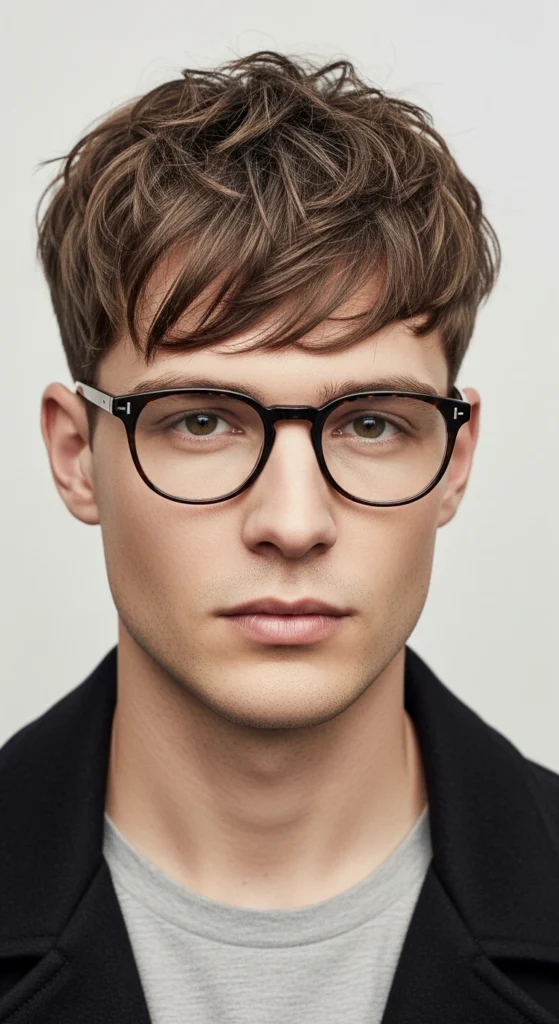
Why it works: The uneven, choppy fringe gently lowers your hairline while the broken layers add movement. It looks effortless — even though it takes a little effort to get right.
Best for: Wavy or curly hair. Casual style.
Maintenance level: Low.
What to tell your barber: “Uneven fringe. Rough broken layers on top. Faded tight sides.”
How to style it: Blow-dry forward. Use texture clay for definition.
Celebrity example: Harry Styles (his messier looks)
22. For Thin Hair: Textured Crop
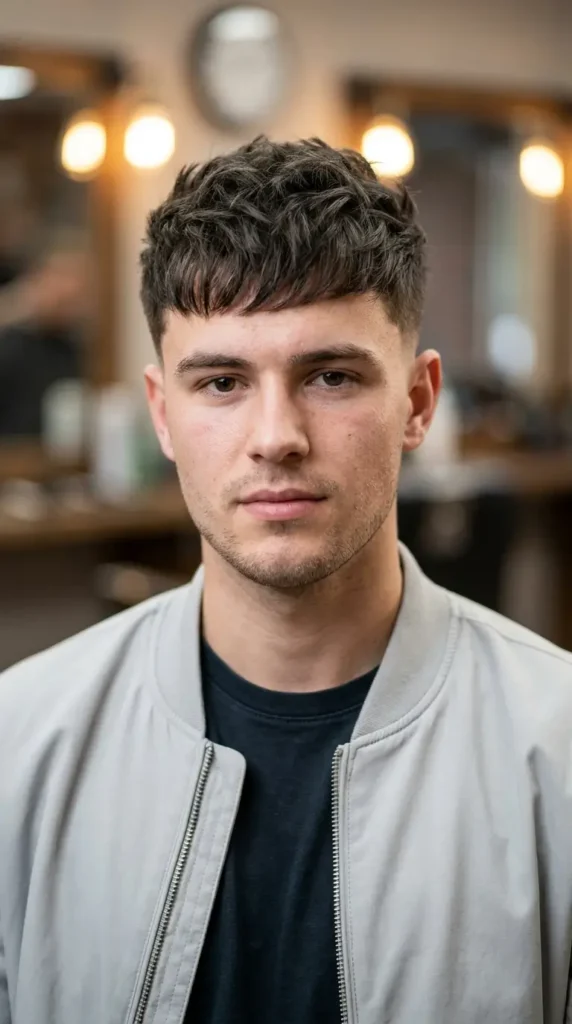
Why it works: Short, uneven fringe adds the appearance of density without requiring thick hair. The key is texture — blunt cuts will look flat, but point-cut texture creates the illusion of fullness.
Fact Source: Hair experts note that the worst hairstyles for big foreheads with thinning hair are slicked-back styles. They make your forehead seem broader and your hairline recession more obvious.
Best for: Fine or thin hair. Guys with receding hairlines.
Maintenance level: Low.
What to tell your barber: “Textured crop with short fringe. Don’t blunt cut it — point cut for texture.”
How to style it: Use volumizing shampoo. Blow-dry forward. Use texture powder for lift. Avoid heavy products — they’ll weigh your hair down.
23. For Curly Hair: Curly Undercut
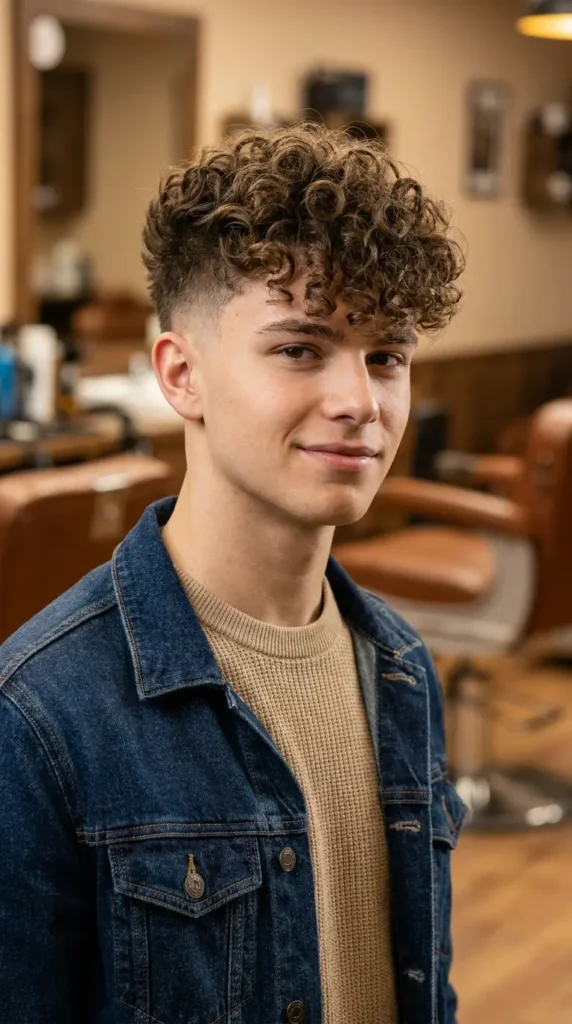
Why it works: Your curls create natural volume that covers your forehead. The undercut keeps your sides clean, so the focus stays on your curly top.
Best for: Curly hair types (3A through 4A).
Maintenance level: Medium.
What to tell your barber: “Keep length on top for my curls. Skin fade on the sides. Shape my curls — don’t use shears on them.”
How to style it: Diffuse dry (low heat). Use curl cream for definition.
24. For Wavy Hair: Surfer Cut
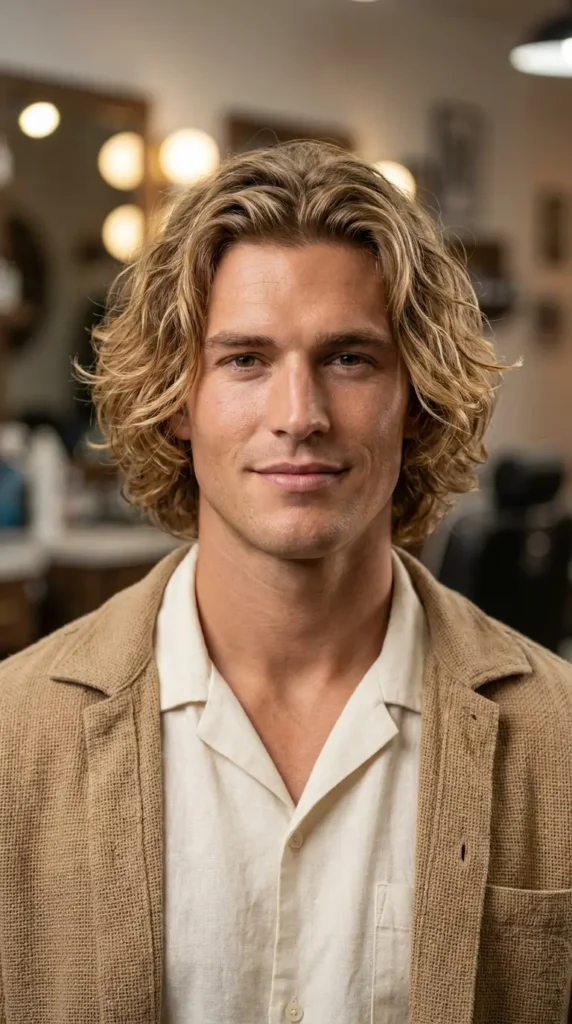
Why it works: Loose, wavy layers fall to the sides and frame your face. The middle part creates a soft curtain effect that balances your forehead without hiding it completely.
Best for: Wavy hair. Relaxed, beachy lifestyle.
Maintenance level: Low.
What to tell your barber: “Medium length with layers. Middle part. Soft waves.”
How to style it: Apply sea salt spray to damp hair. Blow-dry with your fingers. Let it finish naturally.
25. For Black / Afro Hair: Tapered Afro + Line-Up
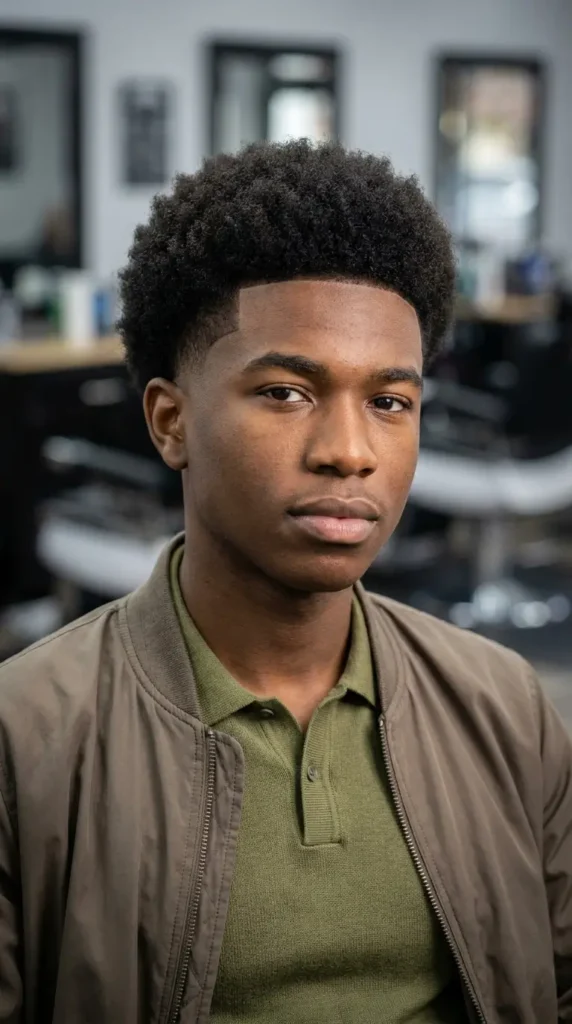
Why it works: Your natural volume creates coverage without trying. Keep your hair short, use a volumizing shampoo, and leave the front slightly longer so it extends over your forehead.
Best for: Type 4 hair (coily or kinky).
Maintenance level: Medium to high.
What to tell your barber: “Tapered Afro shape. Line up the front. Keep my hair moisturized.”
How to style it: Moisturize daily. Shape with a pick. Keep your line-up clean between barber visits.
Celebrity example: John Legend
26. For Thick Hair: Textured Quiff with Fade
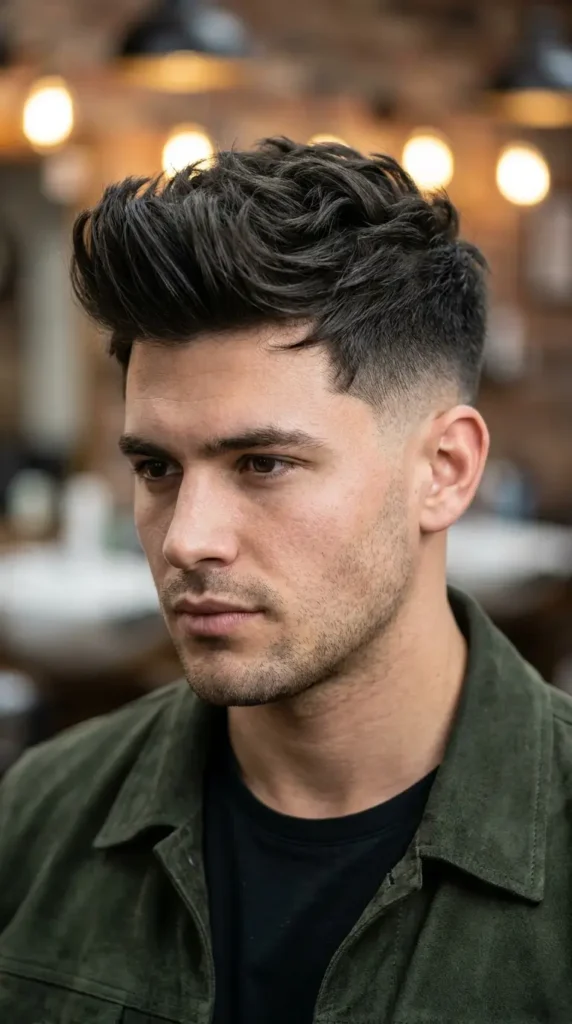
Why it works: Thick hair can get heavy and bulky. Layering removes the weight while keeping the volume you want. The quiff adds height that balances your forehead.
Best for: Thick or dense hair.
Maintenance level: Medium.
What to tell your barber: “Layer the top to reduce weight. Textured quiff shape. Fade on the sides.”
How to style it: Blow-dry for height. Use texture clay. Shape with your fingers.
27. Buzz Cut + Full Beard
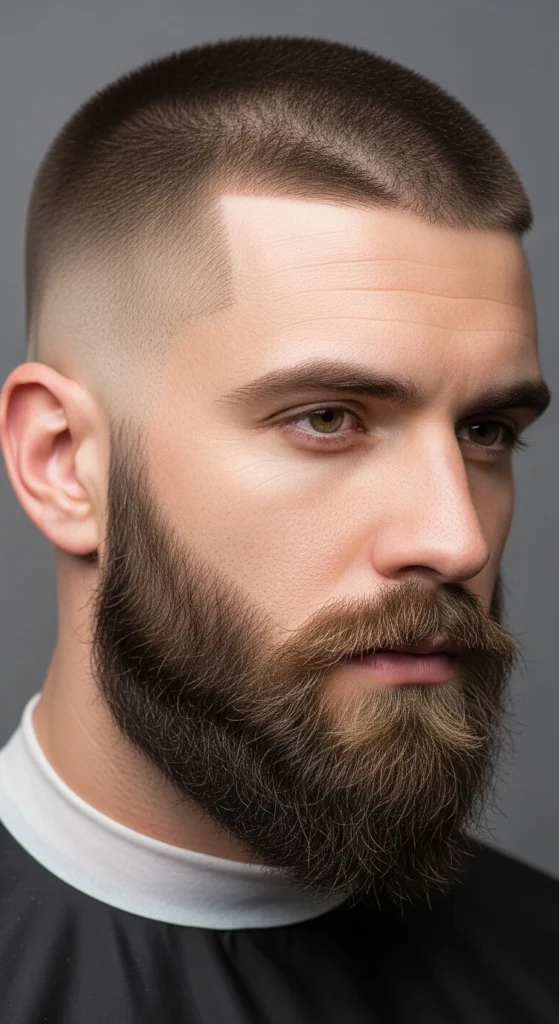
Why it works: This is the ultimate “own it” look. Your beard creates visual weight at the bottom of your face, which balances your forehead perfectly. A well-maintained beard or stubble can provide the visual balance your facial features need.
Best for: Men who can grow facial hair. Oval or square faces.
Maintenance level: Low for your hair. Medium for your beard.
What to tell your barber: “#2 guard on top. Skin fade on the sides. Keep my beard well-groomed.”
How to style it: Trim your beard regularly. Keep your head buzzed weekly. That’s it.
Celebrity example: Jason Statham
28. Clean Shave / Bald Head
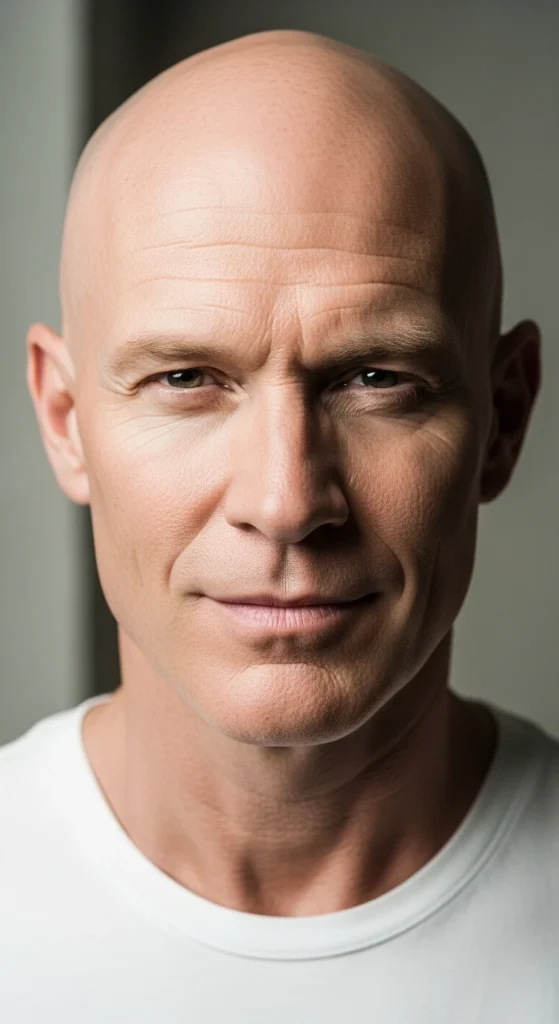
Why it works: If nobody can tell where your hairline begins, nobody will notice your forehead size. It’s that simple. The clean-shaven look works best on athletic men with round or oval faces.
Best for: Oval or round faces. Confident men.
Maintenance level: Medium — you’ll need to shave every 1-3 days to keep it smooth.
What to tell your barber: “Full head shave with a razor. Smooth finish.”
How to style it: Use a good razor and shaving cream. Shave every other day. Moisturize your scalp.
Celebrity example: Vin Diesel, Dwayne “The Rock” Johnson
29. High-and-Tight Fade with Line-Up
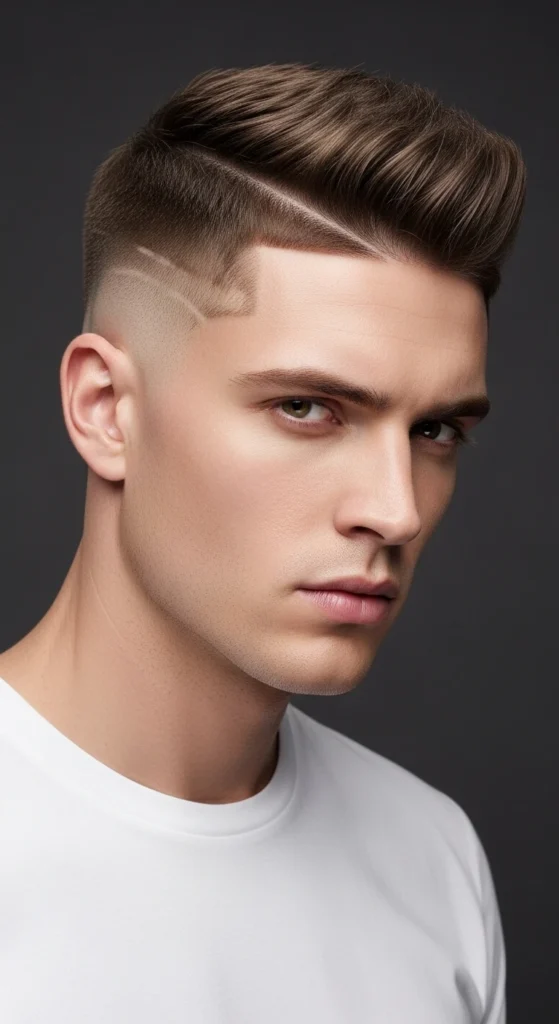
Why it works: The straight lines and sharp angles of this military-inspired cut distract from your forehead size. Your eyes go to the precise shape of the haircut instead.
Best for: Square faces. Professional or military settings.
Maintenance level: Low.
What to tell your barber: “High fade starting above my temples. Line up the front. Tight sides.”
How to style it: Very little daily styling. Just keep your line-up clean.
30. Slicked Back (Done Right)
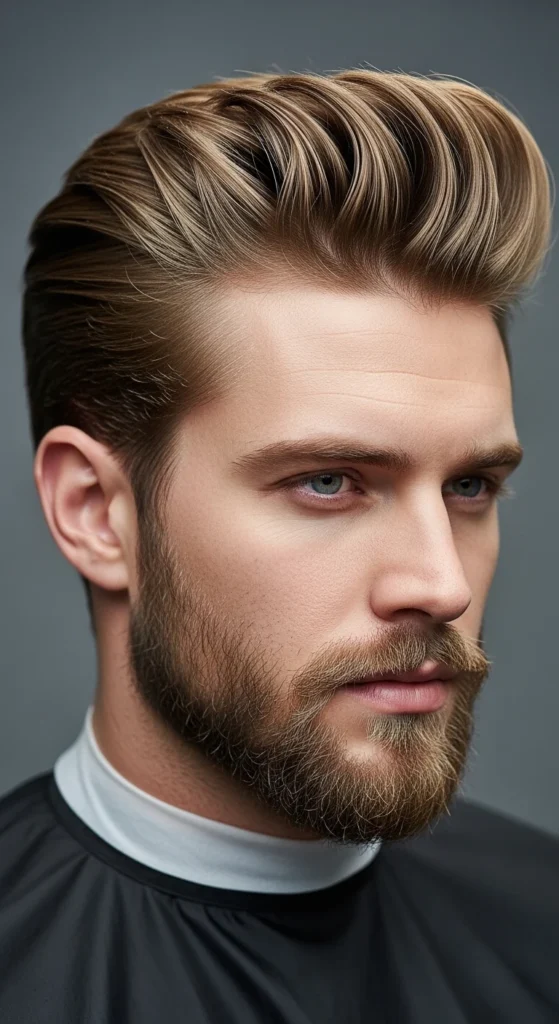
Why it works: This one comes with a warning label. Flat, slicked-back hair makes your forehead look enormous. But if you add volume in the front AND you have a beard to balance your face, slicked back can look intentional and confident rather than apologetic.
Warning: Only try this if you have a good beard and you’re committed to adding volume. Flat slicked back is one of the worst things you can do for a big forehead.
Best for: Men with beards. Oval faces.
Maintenance level: Medium.
What to tell your barber: “Keep length on top for volume. Don’t pull it back flat. Add texture.”
How to style it: Blow-dry with volume at the roots. Use pomade. Don’t flatten it.
31. Slicked Back Flat (No Volume)
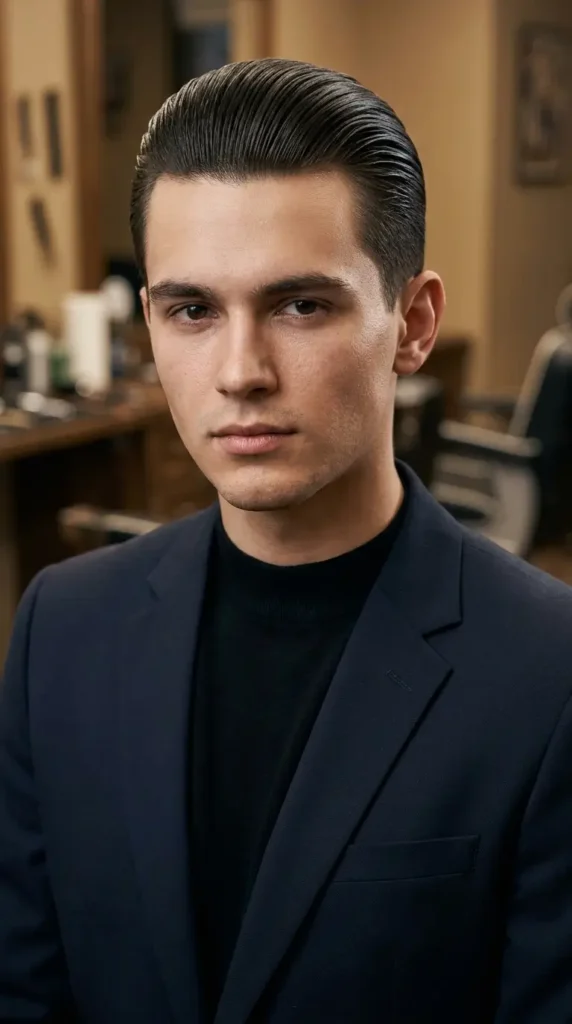
Why to avoid it: Pulling your hair straight back and flat against your head removes all volume and draws a straight line from your forehead to your crown. It makes a big forehead look even bigger.
Who falls for this: Guys who want a “clean” look without realizing the consequence.
Instead try: Slicked back WITH volume at the roots and a beard for balance.
32. Center Part with Short Sides
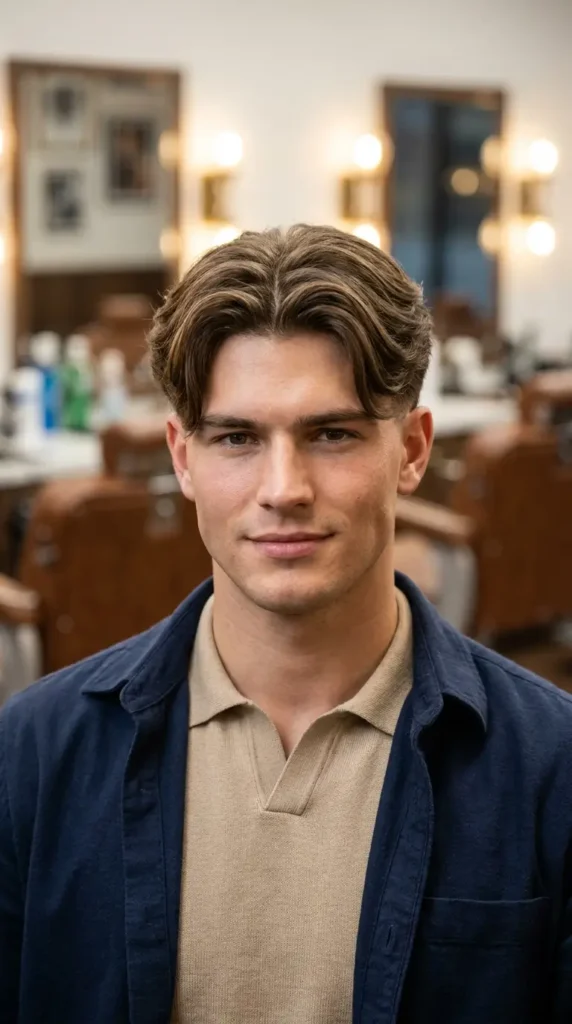
Why to avoid it: A center part creates a vertical line right down the middle of your head. When your sides are too short, that vertical line emphasizes your forehead height instead of minimizing it.
Who falls for this: Guys trying to copy 90s heartthrobs without enough length on the sides.
Instead try: Curtain bangs with MEDIUM length on the sides, not short.
33. Too-Short Fringe
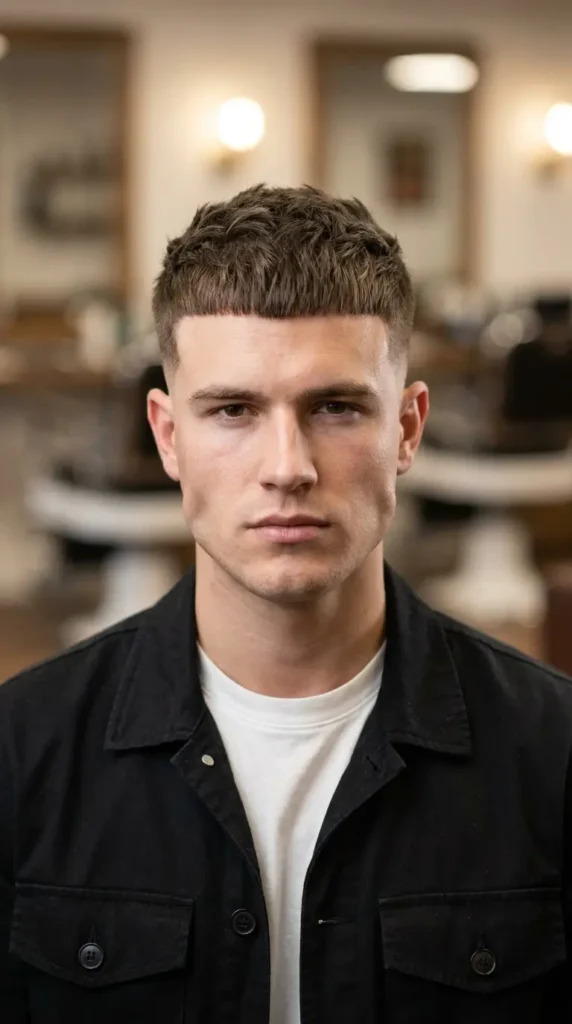
Why to avoid it: A fringe that only covers the top inch of your forehead doesn’t actually do anything. It looks unintentional and awkward, like you changed your mind halfway through the cut.
Instead try: A fringe that reaches at least to your eyebrows. Any shorter and it’s not doing its job.
34. Flat, No-Volume Styles
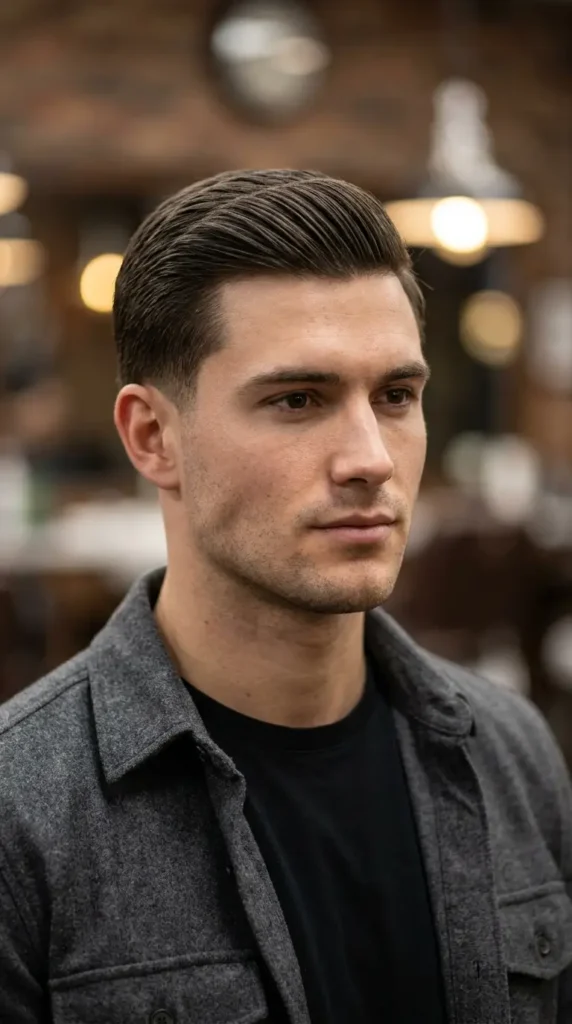
Why to avoid it: If your hair sits completely flat against your head, there’s nothing to distract from your forehead. It’s just… there. And so is your forehead.
Instead try: Add texture or volume on top. Even a little bit of lift makes a big difference.
35. Blunt Fringe on Curly Hair
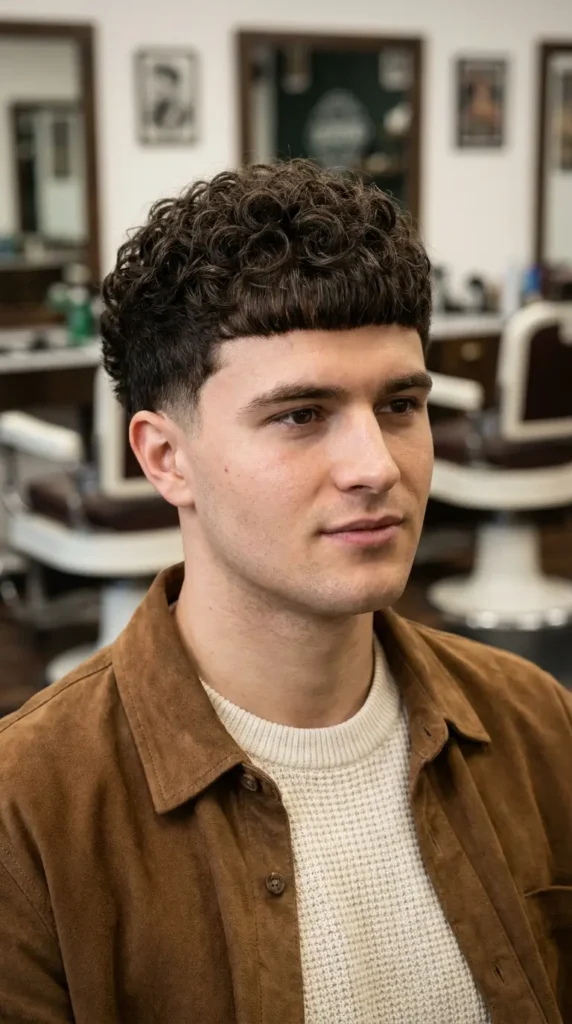
Why to avoid it: Cutting curly hair straight across creates a mushroom-shaped silhouette. It emphasizes roundness and makes your forehead look wider than it actually is.
Instead try: A point-cut, textured fringe that works WITH your curl pattern, not against it.
Fact Source: Hair experts confirm that slicked-back hairstyles make your forehead seem broader and your hairline recession more obvious.
The Complete Barber Communication Guide
The difference between a great haircut and a disaster is communication. Here’s exactly what to tell your barber.
Barber Guard Numbers Explained
Clipper guards are numbered. The higher the number, the longer the hair. Here’s what each number means:
| Guard Number | Length (mm) | Length (inches) | Best For |
| #0 | 1.5 mm | 1/16 inch | Skin fade, bald look |
| #1 | 3 mm | 1/8 inch | Tight fade, buzz cut base |
| #2 | 6 mm | 1/4 inch | Short sides, crew cut base |
| #3 | 10 mm | 3/8 inch | Longer crew cut top |
| #4 | 13 mm | 1/2 inch | Textured top length |
Knowing these numbers changes everything. You can tell your barber “#2 on the sides, #4 on top” and they’ll know EXACTLY what you want.
Exact Barber Scripts for Each Category
For a Fringe or French Crop:
“I want a #2 fade on the sides and back. Leave about 2 inches on top. Point cut the fringe — don’t blunt cut it. I want to style it forward. Don’t take the fringe too short — eyebrow length is perfect.”
For a Crew Cut:
“#4 clipper guard on top. #1 on the sides and back. Taper the sideburns. Leave a little length on top to style forward.”
For a Textured Quiff:
“Keep the top longer — about 3 inches. #2 fade on the sides. I want to blow-dry it up for volume. Point cut the top for texture.”
For a Buzz Cut:
“#2 guard all over. Skin fade around the ears. Clean up my hairline.”
For Curly Hair:
“Keep my curls on top longer — don’t shear them. #2 fade on the sides. Shape my curls — don’t cut them straight across.”
What NOT to Say to Your Barber
- ❌ “Just make it look good” — Too vague. Every barber has a different idea of “good.”
- ❌ “Give me something that covers my forehead” — Better to say “fringe” or “French crop.”
- ❌ “Short on sides, long on top” — This describes 90% of men’s haircuts. Be specific with guard numbers.
Reference Photos to Show Your Barber
Words are good. Photos are better. Here’s who to search for:
| Style You Want | Search This Celebrity |
| French crop | Paul Mescal |
| Textured fringe | Timothée Chalamet |
| Buzz cut | Tom Hardy |
| Crew cut | Brad Pitt (early 2000s) |
| Caesar cut / Edgar cut | Search “Edgar haircut” |
| Curtain bangs | Owen Wilson |
Save a photo to your phone. Show your barber. No confusion. No disappointment.
Quick Comparison Table — 35 Styles at a Glance
| Style | Coverage | Maintenance | Best Hair Type | Best Face Shape | Barber Keywords |
| Textured Fringe | High | Medium | Straight/Wavy | Oval | Point cut, texture powder |
| French Crop | High | Low-Medium | Textured/Wavy | Oval/Round/Square | Fade, forward fringe |
| Caesar Cut | High | Low | Thick | Oval | Blunt fringe, blowout taper |
| Curtain Bangs | Medium | Medium | Medium length | Oval | Center part, face-framing |
| Side Swept Fringe | High | Medium | Straight/Wavy | Most | Diagonal, soft texture |
| Crew Cut | Low | Very Low | Any | Oval/Square/Round | #4 top, #1 sides |
| Buzz Cut | None | Very Low | Any | Oval/Square/Diamond | #2 guard |
| Textured Quiff | None (balances) | High | Thick/Straight | Oval/Diamond | Volume, blown out |
| Textured Crop | High | Low | Fine/Thin | Most | Uneven fringe, broken layers |
| Buzz Cut + Beard | None (embraces) | Low | Any | Oval/Square | #2 guard, full beard |
| Ivy League | Low | Low | Straight/Fine | Oval | Side-swept, preppy |
| Modern Mullet | High | Medium-High | Wavy/Curly | Oval | Short fringe, longer back |
| Pompadour | None (balances) | High | Thick | Oval | Height, rounded front |
| Blowout Fade | Medium | Medium | Straight/Thick | Diamond/Oval | Low fade, volume up top |
| Surfer Cut | Medium | Low | Wavy | Most | Middle part, beach waves |
How to Choose Based on Your Hair Type & Face Shape
Hair Type Quick Guide
| Your Hair Type | Best Styles For You | Products You’ll Need |
| Straight or fine | Side part, Caesar cut, French crop | Texture powder, matte clay |
| Wavy | Surfer cut, textured crop, bro flow | Sea salt spray, mousse |
| Curly | Curly fringe, curly undercut, tapered Afro | Curl cream, leave-in conditioner |
| Thin or fine | Textured crop, Caesar cut, buzz cut | Volumizing shampoo, texture powder |
| Thick | Textured quiff, pompadour, layered cut | Texture clay, thinning shears |
Face Shape Quick Guide
| Your Face Shape | Best Styles For You | What to Avoid |
| Oval | Almost any style — you’re lucky | Almost nothing |
| Round | Angled fringe, height on top | Blunt fringe, center part |
| Square | Soft layers, side part, textured crop | Hard lines, severe fades |
| Heart | Longer fronts, curtain bangs | Short blunt fringe |
Styling Tips & Best Products
Top 7 Products for Big Forehead Hairstyles
| Product | What It Does | Best For |
| Texture Powder | Lifts roots, adds volume without weight | Fringe, quiff, thin hair |
| Texture Clay | Gives hold with a matte finish | French crop, textured styles |
| Molding Paste | Provides control with natural movement | Crew cut, side part |
| Sea Salt Spray | Creates waves and beachy texture | Surfer cut, medium length |
| Pomade | Gives shine and medium hold | Side part, slicked styles |
| Styling Cream | Smooth control without stiffness | Curtain bangs, Ivy League |
| Volumizing Shampoo | Adds fullness from the roots | Thin or fine hair |
Step-by-Step Styling for Each Category
For Fringe Styles:
- Apply texture powder to your roots while hair is damp
- Blow-dry forward using your fingers (not a brush)
- Pinch small sections with texture clay
- Shape with your fingers — combs make it look too perfect
For Volume Styles:
- Apply mousse to damp hair
- Blow-dry upward with a round brush
- Add texture powder for extra lift
- Finish with a light hold product
For Short Styles:
- Towel dry your hair
- Apply matte paste or light cream
- Blow-dry forward for optional volume
- Finger-style — no comb needed
Real Talk — From Self-Conscious to Confident
Here’s something nobody else will tell you.
A lot of guys who worry about their “big forehead” aren’t actually worried about their forehead. They’re worried about what someone said to them once.
Maybe an ex made a comment. Maybe a kid in middle school was mean. Maybe you just got in your own head one day and never got out.
Here’s the truth: Your forehead is part of your face. It’s not a mistake. It’s not a flaw.
Brad Pitt has a big forehead. So does Tom Hardy. And Jude Law. And Timothée Chalamet. And they’re all considered some of the most attractive men in the world.
The difference between them and someone who hides under a hat every day isn’t their forehead size. It’s their confidence.
So here’s my advice to you:
Find a haircut from this list that makes you feel good. Go to a barber who listens. Show them a photo. Use the scripts I gave you.
And then stop worrying about your forehead.
Because honestly? Most people aren’t looking at your forehead. They’re looking at your eyes, your smile, your energy.
And if you walk into a room with a great haircut and your head held high? Nobody’s counting your fingers.
You’ve got this.
Final Verdict: Which Cut Should You Book Tomorrow?
If you want to hide your forehead → Book a French crop or textured fringe
If you want to balance your face → Book a textured quiff or blowout fade
If you want low maintenance → Book a crew cut or buzz cut
FAQs
What is the best haircut for a big forehead male?
A textured fringe, French crop, or medium-length haircut with volume on top works best. These styles either cover your forehead or balance your facial proportions.
Does a buzz cut make a big forehead look bigger?
No — if it’s done right. A buzz cut actually reduces the contrast between your scalp and your forehead, making the transition less noticeable. It works very well for oval, square, and diamond face shapes.
Can I get a fringe if I have thin hair?
Yes. A textured crop or point-cut fringe works great for thin hair. Just avoid blunt fringes and heavy products that weigh your hair down.
How do I ask my barber for a haircut that hides my forehead?
Ask for a “French crop” or “textured fringe.” Then say: “Leave length in front. Point cut the fringe. Fade the sides.” And bring a reference photo — it makes everything clearer.
Are big foreheads attractive on men?
Yes. Lots of people find big foreheads attractive. They can highlight strong facial features and suit clean, modern styles. The key is confidence and good grooming.
What is the four-finger rule?
If you can place four fingers vertically between your eyebrows and your hairline, you have a larger-than-average forehead. Three fingers or less is average. Four or more is considered a big forehead.
What type of fringe is best for a big forehead?
A textured fringe or side-swept fringe works best. These styles partially cover your forehead and add movement, which helps your face look more balanced.
Is a fade good for a big forehead?
Yes — when you pair it with a fringe or textured top. The fade keeps your sides clean while the front balances your face.
Can long hair work for a big forehead?
Yes. Layered lengths, curtain fringes, and natural waves all frame your face and make your forehead appear softer and less noticeable.
What haircuts should men with big foreheads avoid?
Avoid slicked-back flat styles, center parts with short sides, too-short fringes, and flat, no-volume styles. All of these make your forehead look bigger.
Conclusion
A big forehead is not a problem — it is just a feature that needs the right frame.
You now have 35 haircuts to choose from, covering every hair type, face shape, and lifestyle. Whether you want to cover your forehead with a French crop, balance it with a textured quiff, or own it completely with a buzz cut and beard — the option is here.
The formula is simple. Add coverage or volume on top. Keep sides clean and tight. Avoid flat, slicked-back styles that expose everything.
Pick your style, save two or three reference photos, and walk into your barber with the exact script. Say it word for word. Guard numbers, fringe length, everything.
Then build a simple product routine around three items — texture powder for lift, matte clay for hold, and sea salt spray if you have waves.
One last thing. Brad Pitt, Tom Hardy, Timothée Chalamet — they all have big foreheads. What they also have is confidence and a great haircut. That combination beats everything.
Your forehead is not the story. Your style is. Now go book the cut.