
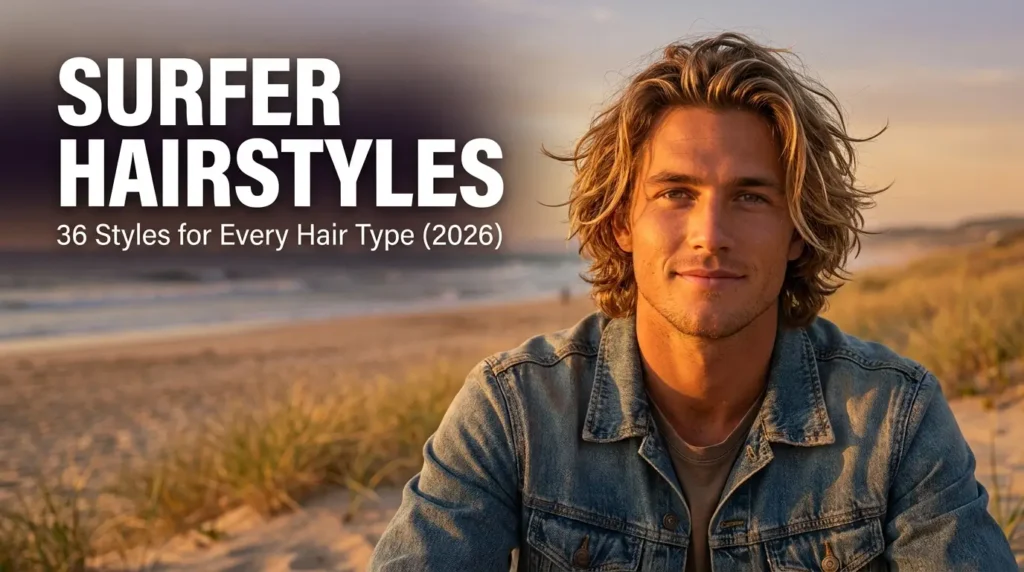
A surfer hairstyle is a casual, layered haircut that replicates the natural texture and movement created by spending time in the ocean. The style originated in 1960s Southern California, where surfers’ hair was literally shaped by salt water, UV rays, and coastal wind into tousled, sun-bleached, free-flowing locks. Modern surfer hairstyles intentionally recreate this effect through specific cutting techniques and lightweight styling products.
Five defining characteristics separate a surfer hairstyle from other men’s haircuts:
- Textured layers: strategic layering removes weight and creates natural movement
- Natural wave or movement: hair flows and bounces rather than sitting flat or rigid
- Medium-to-long length: typically 4 to 8 inches on top (though short and long variants exist)
- Sun-kissed or highlighted coloring: lighter ends or natural-looking highlights
- Intentionally undone finish: styled to appear unstyled, controlled but carefree
The key distinction between a surfer hairstyle and simply having messy hair is structure. Surfer hair achieves its effortless appearance through deliberate cutting techniques like point cutting, razor cutting, and internal layering. These techniques create movement at a structural level, so even without product, the hair falls with natural flow and texture.
Why does salt water create that iconic surfer texture? Sea salt spray, the most essential surfer hair product, works because magnesium sulfate crystals deposit on the hair shaft, creating microscopic roughness on the cuticle. This roughness produces grip, separation, and matte texture without synthetic polymers. Every commercial sea salt spray replicates this natural ocean effect.
Key Fact: Hair grows approximately 0.5 inch (1.25 cm) per month on average. Growing a surfer hairstyle from a short buzz takes 8 to 14 months depending on desired final length.
The evolution of surfer hair spans six decades:
- 1960s: Natural, sun-bleached long hair on California surfers
- 1970s: Blended with the shag cut, feathered layers emerged
- 1980s to 90s: Crossed over with skate and grunge culture
- 2000s to 2010s: More polished versions with products and highlights
- 2020s to 2026: Modern variations mixing classic texture with fades, wolf cuts, and Korean-influenced styling
Surfer Hairstyles: 36+ Styles for Every Hair Type
Surfer hairstyles work across three primary length categories: short (2 to 4 inches on top), medium (4 to 8 inches on top), and long (8+ inches on top). Each length produces a different aesthetic while keeping the core surfer DNA of texture, layers, and natural movement.
Short surfer hairstyles prove you don’t need long flowing locks to achieve beach-inspired style. These cuts maintain textured movement and piece-y definition in a compact, low-maintenance package.
1. Textured Surfer Crop
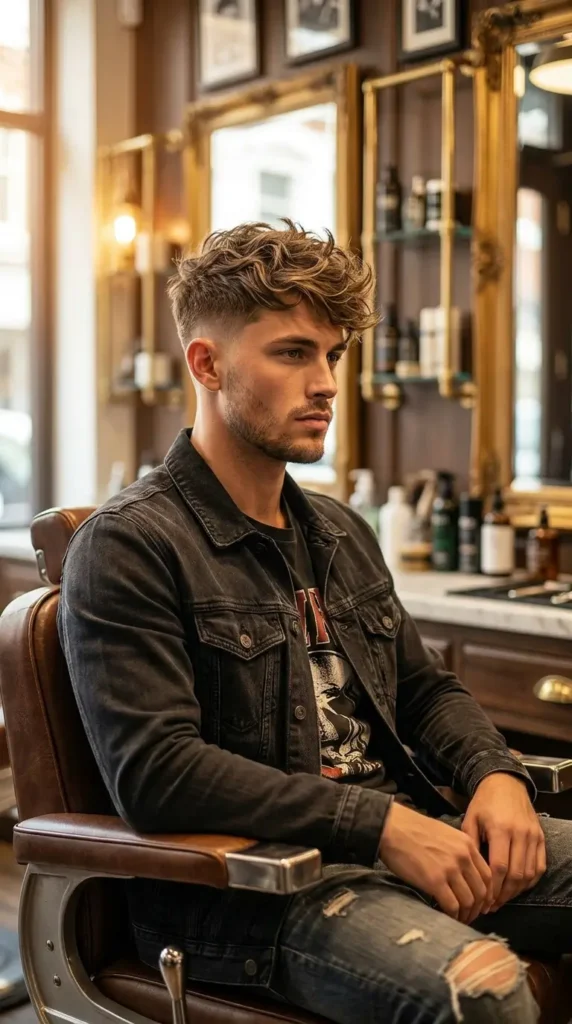
Short on sides (clipper guard #2 to #3), textured and choppy on top with a piece-y fringe. Best for all hair types and oval, round, or square faces. Style with matte clay on dry hair, warm a pea-sized amount between fingers and pinch the top for separation. This variation shares DNA with the classic textured crop but adds more length and wave emphasis on top.
2. Short Messy Beach Hair
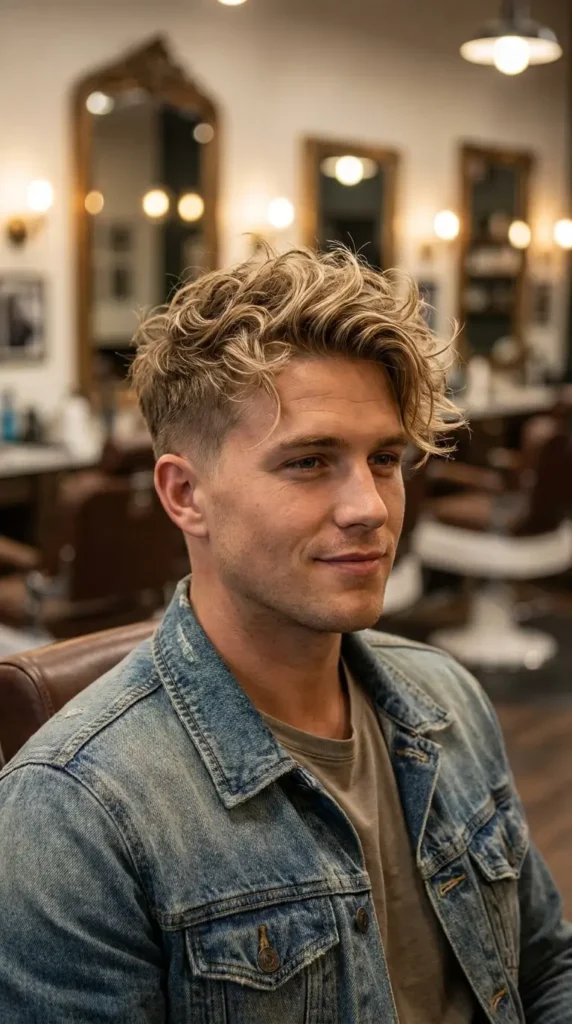
All-over short length (2 to 3 inches) with salt-spray texture throughout. Best for wavy or straight hair and all face shapes. Spritz sea salt spray on damp hair and finger-tousle until dry. Men who enjoy this aesthetic should also explore other short messy hairstyles for guys for additional inspiration.
3. Surfer Buzz Grow-Out
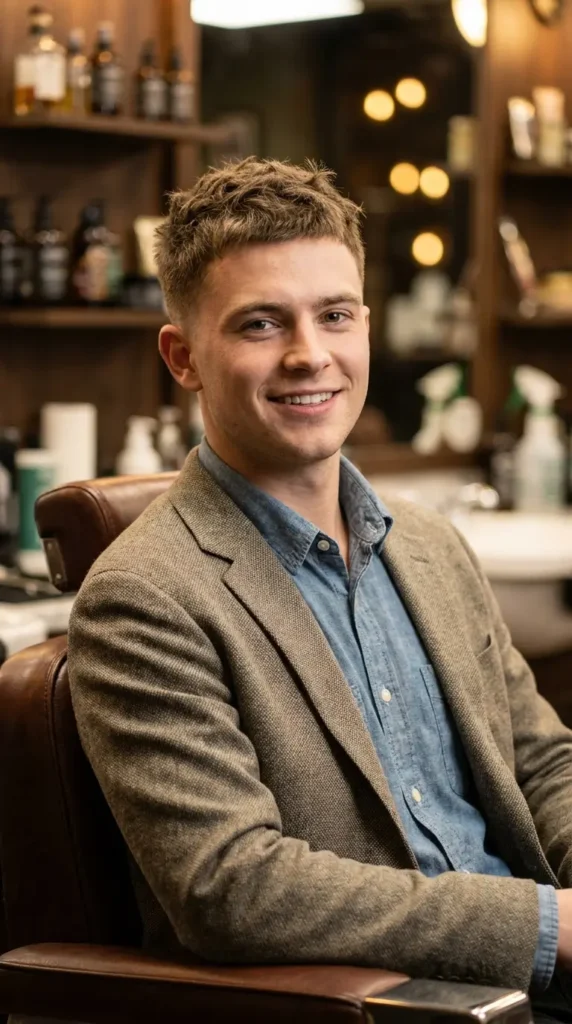
The 2 to 3 inch overgrown buzz cut where natural wave pattern begins emerging. Best for wavy hair and oval or square faces. Apply texturizing powder at roots for instant grit and volume.
4. Short Surfer Fade
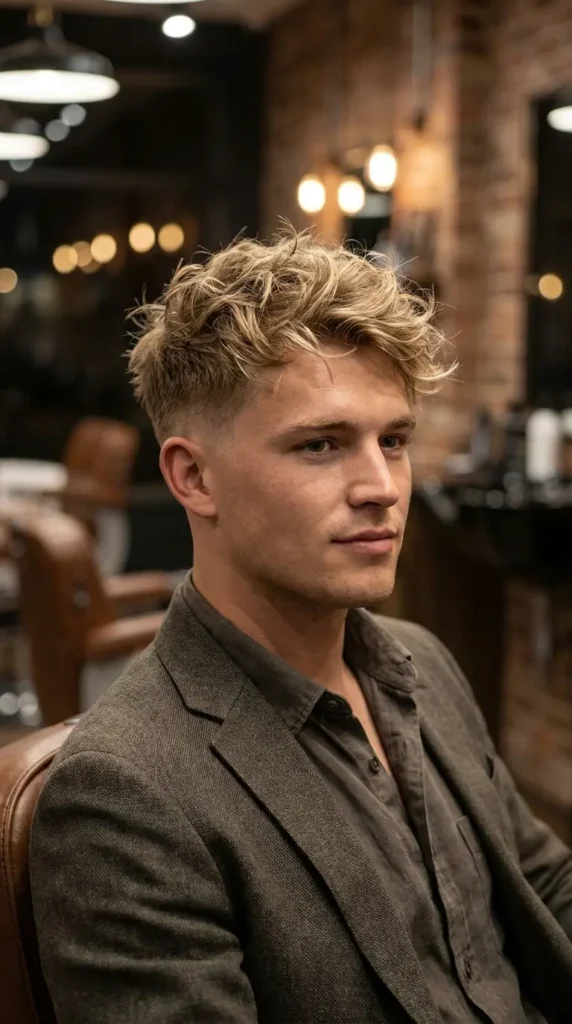
Textured top at 3 to 4 inches with a clean low or mid fade on the sides. Best for all hair types and round faces (adds height). Use lightweight matte paste on ends for piece-y definition.
5. Surf-Inspired French Crop
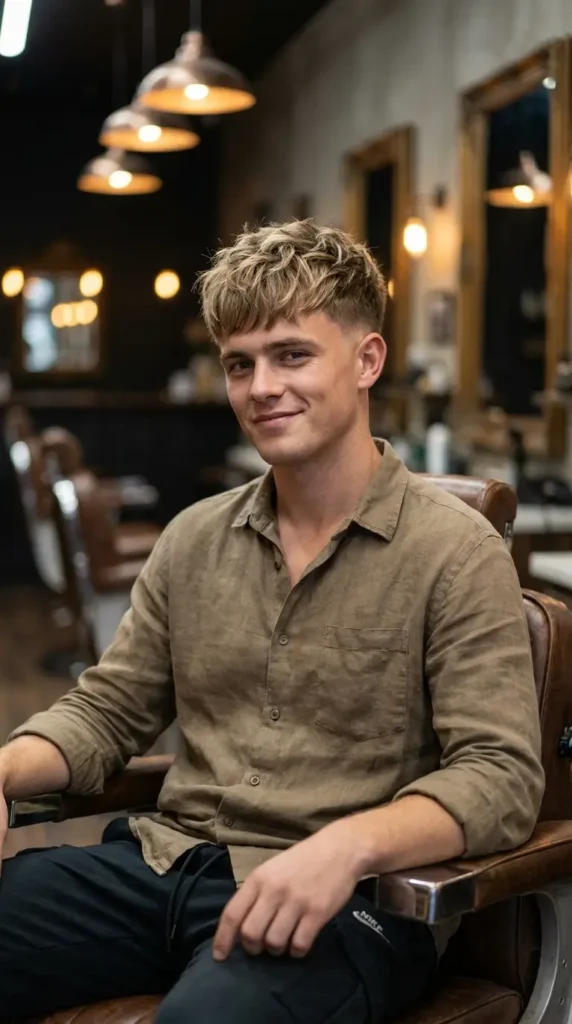
Forward-styled textured top with tapered sides, the fringe cut with point-cutting for an irregular, natural edge. Best for straight or wavy hair and oval, square, or heart faces. This variant builds on the classic French crop with fringe by introducing more texture and relaxed movement.
Tip: Short surfer cuts work best with texturizing powder at the roots. Apply a pea-sized amount to dry hair, massage into the scalp area, and tousle with fingers for instant volume and gritty separation that lasts 8 to 12 hours.
6. Classic Surfer Flow
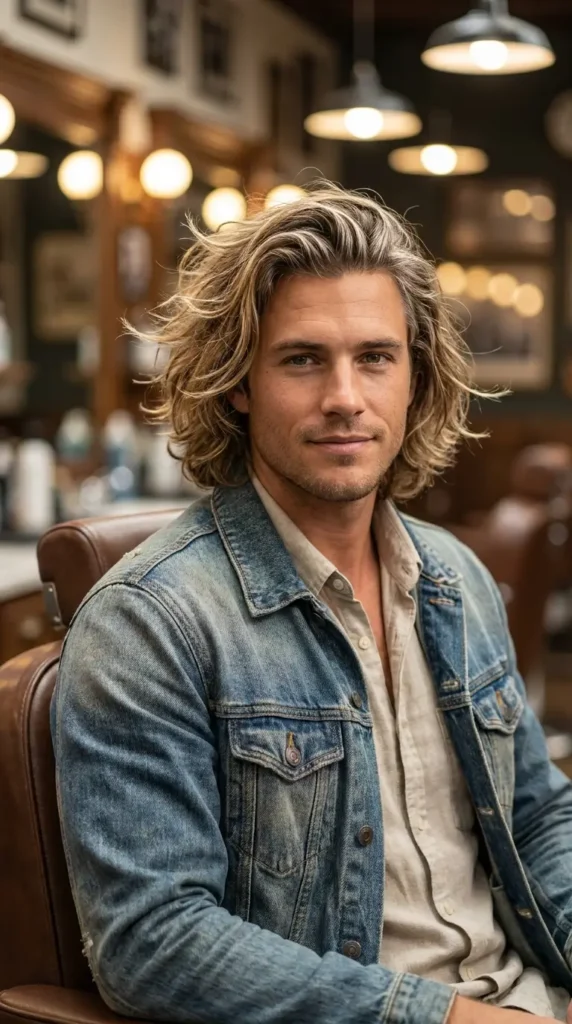
Ear-length or slightly longer, swept back or to the side with natural waves. The signature surfer hairstyle look. Best for wavy or straight hair and oval, oblong, or square faces. Apply sea salt spray to damp hair, push back from face, and air-dry. This is essentially the bro flow with added beachy texture and a more tousled finish.
7. Surfer Shag
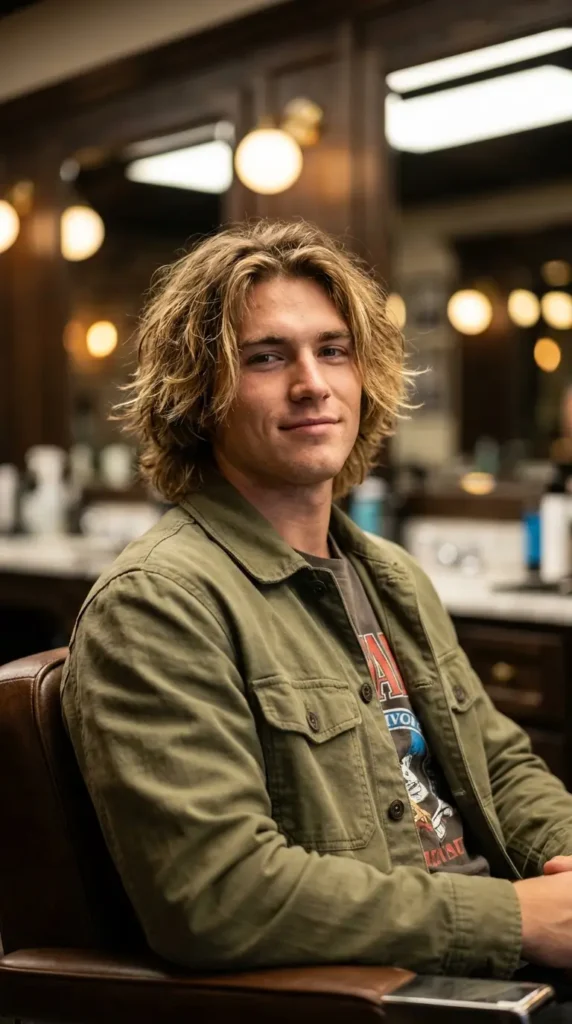
Heavy layering throughout with choppy face-framing pieces and full-bodied shape. Carries a rock-and-roll energy blended with beach culture. Best for thick or wavy hair and oval, square, or round faces. Work matte paste through the ends to create separation without weight. The foundation of this look is strategic layered haircuts for men taken to a more textured, undone extreme.
8. Surfer Curtain Bangs
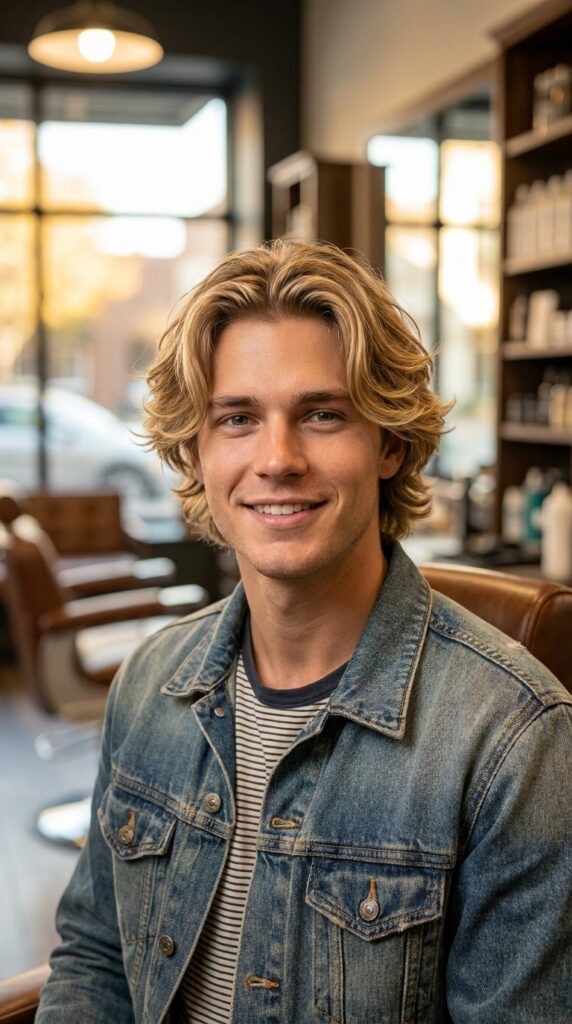
Center-parted fringe falling at or past eye level with textured layers behind the ears. Channels a 70s-inspired softness. Best for straight to wavy hair and oval, square, or heart faces. Use light hair oil on ends and a slight outward bend with fingers while drying. This variation is a beach-textured version of classic curtain bangs.
9. Medium Beach Waves
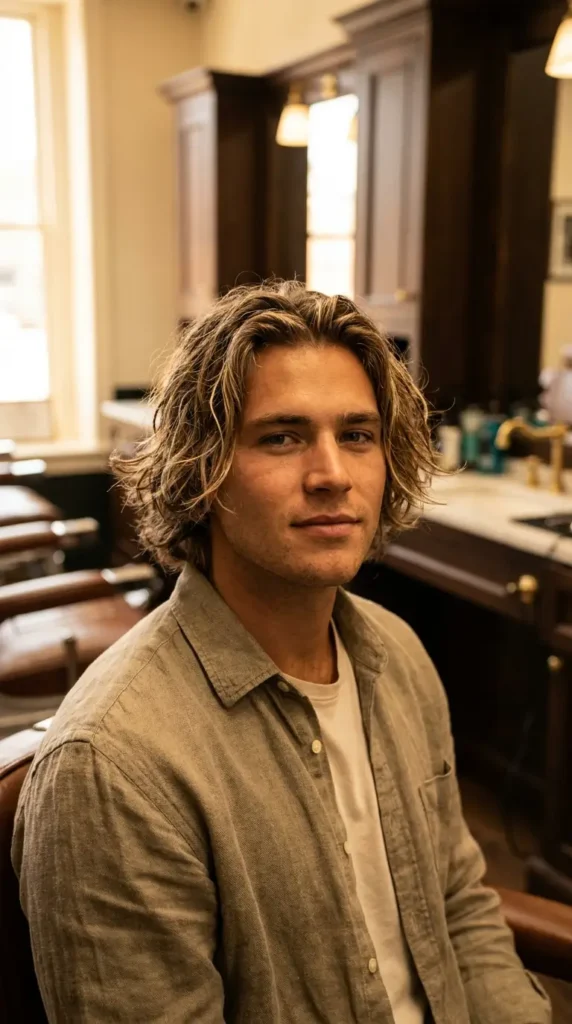
All-over wavy texture with no specific parting, completely finger-combed. The most effortless medium variant. Best for wavy hair and all face shapes. Sea salt spray plus scrunching plus air-drying, that’s the entire routine.
10. Surfer Wolf Cut
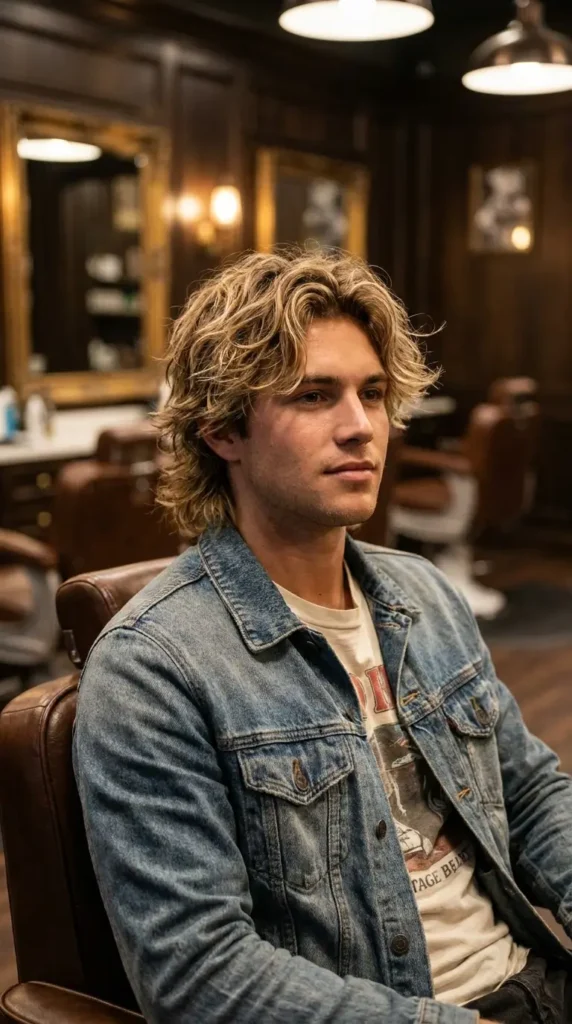
Heavy bangs with disconnected shorter back layers and volume concentrated on top. A hybrid between shag and mullet that’s fashion-forward and bold. Best for thick straight or wavy hair and oval, heart, or square faces. Texturizing spray at roots, ruffle for volume, let layers fall naturally. This style borrows its structural DNA from the wolf cut but leans into softer, beachier texture.
11. Messy Surfer Flow
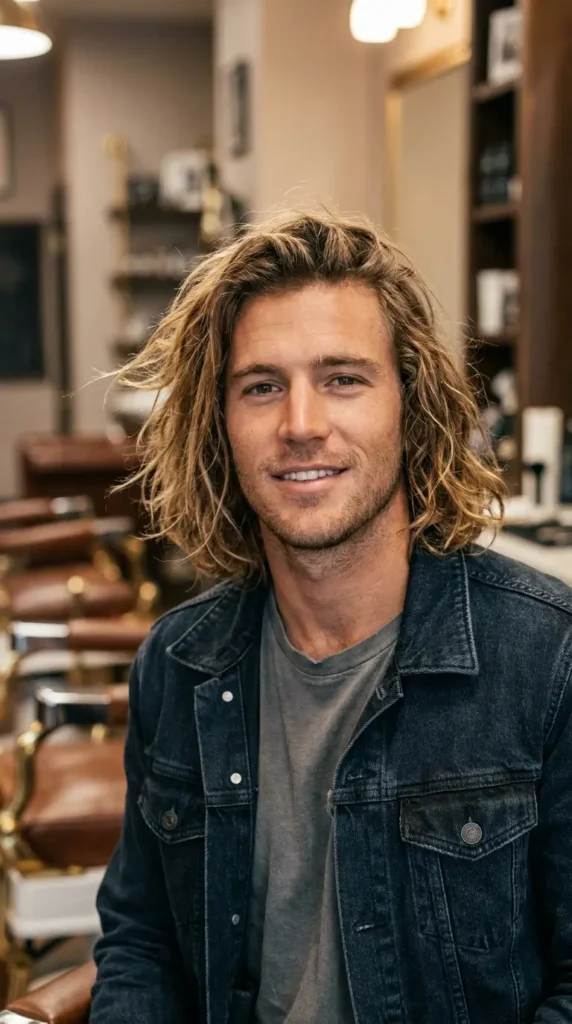
Less structured than classic flow, more tousled and bed-head influenced. Best for wavy or curly hair and all face shapes. Minimal product, sea salt spray only, finger-tousle, air-dry exclusively.
12. Textured Surfer Layers
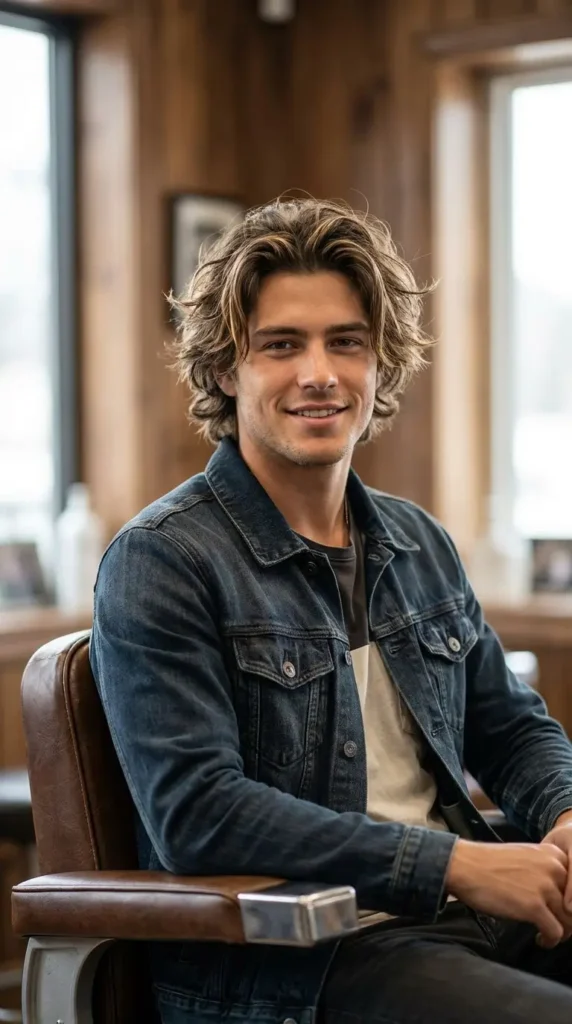
Strategic layering for movement without full shag commitment. A more refined, workplace-friendly version. Best for all hair types and all face shapes. Light-hold mousse on damp hair, blow-dry on low heat with fingers lifting at roots.
Tip: For medium surfer hair, ask your barber for internal layers rather than just external layers. Internal layers remove weight from underneath to create hidden movement, while external layers create visible shape. The combination produces that signature surfer volume-with-flow effect.
13. Classic Long Surfer Hair
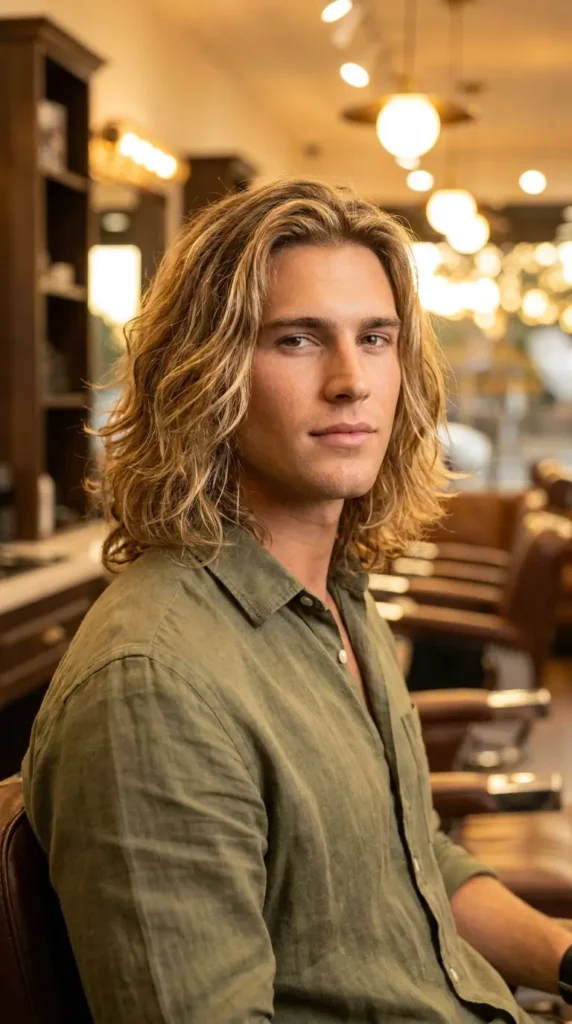
Past shoulders, naturally wavy, sun-kissed ends. Think Chris Hemsworth or Jason Momoa. Best for wavy or straight hair and oval or square faces. Leave-in conditioner on damp hair, finger-comb, air-dry completely.
14. Long Surfer Curls
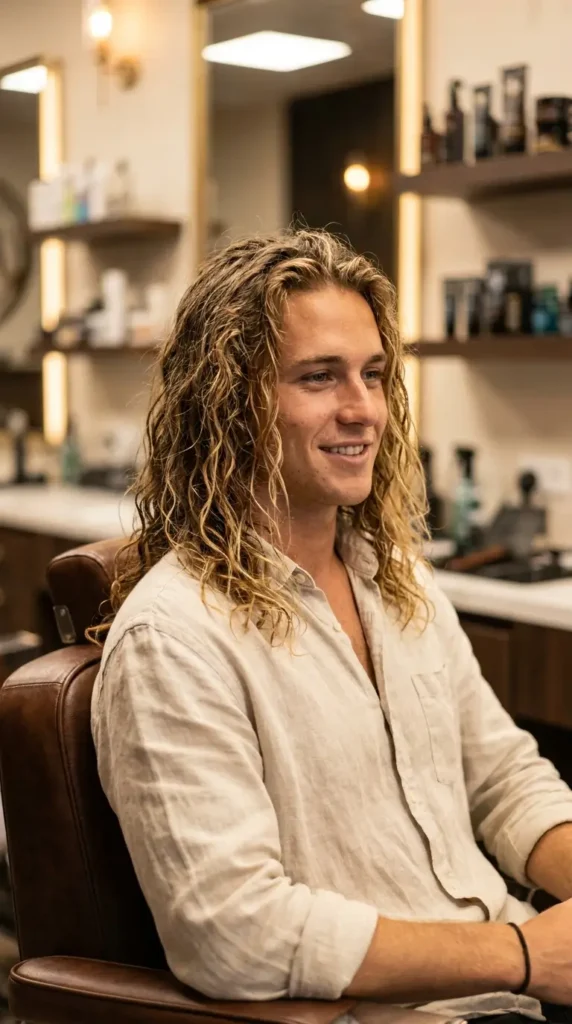
Natural curl pattern at extended length, wild, voluminous, and free. Best for curly hair (Type 3) and oval or oblong faces. Curl-defining cream on wet hair, scrunch upward, diffuse on low heat or air-dry.
15. Surfer Man Bun
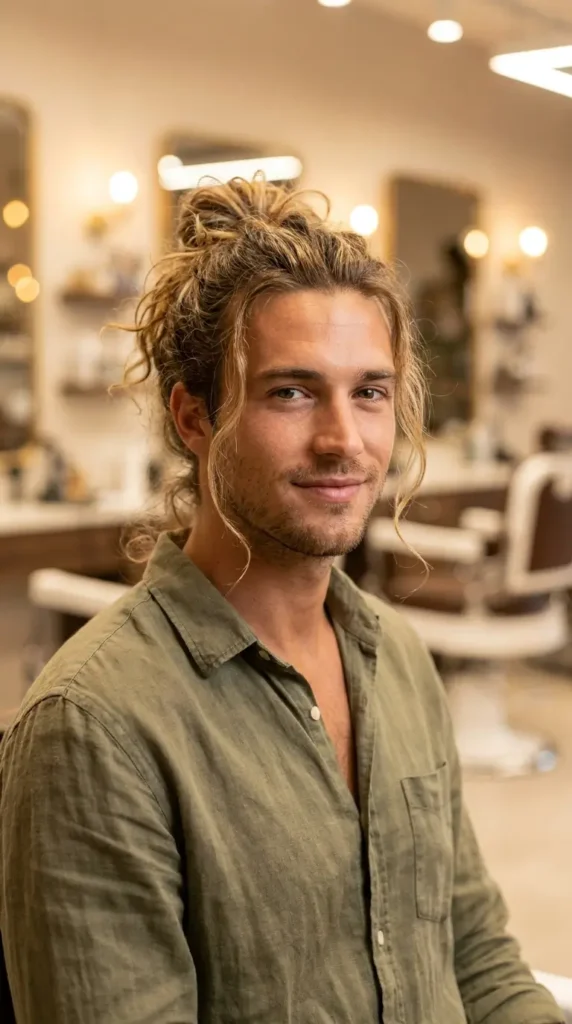
Long hair pulled back into a relaxed bun, functional for active days while showcasing surfer-length locks. Best for all hair types with 8+ inches of length. Keep it messy, pull through elastic only once on the second loop, leave face-framing pieces out. For detailed styling techniques, see our full guide on the man bun.
16. Long Layered Flow
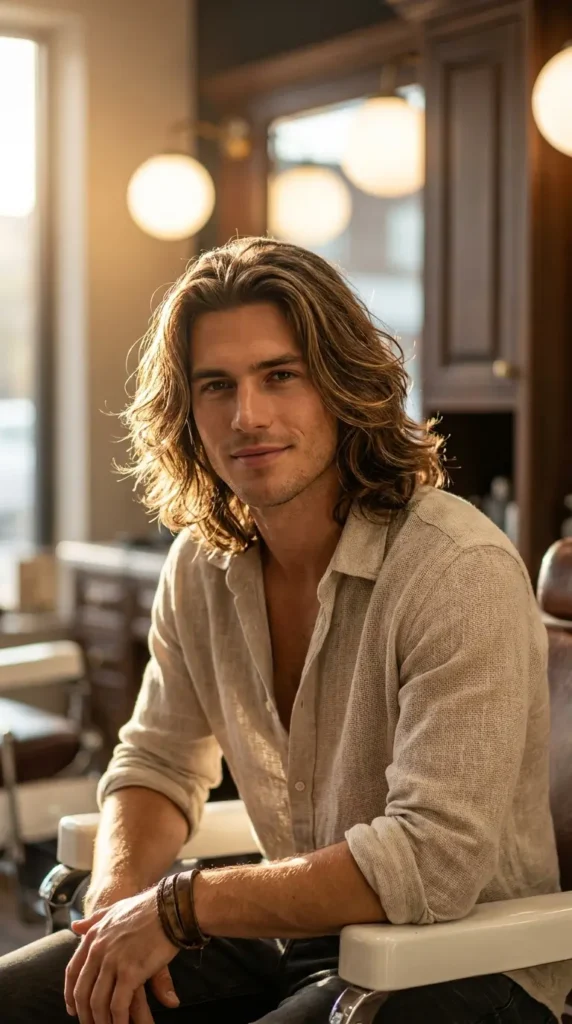
Heavy layers throughout preventing flat heaviness, maintaining movement at every angle. Best for thick or wavy hair and all face shapes. Lightweight styling cream through lengths, never at roots (avoids weighing down).
17. Long Surfer with Undercut
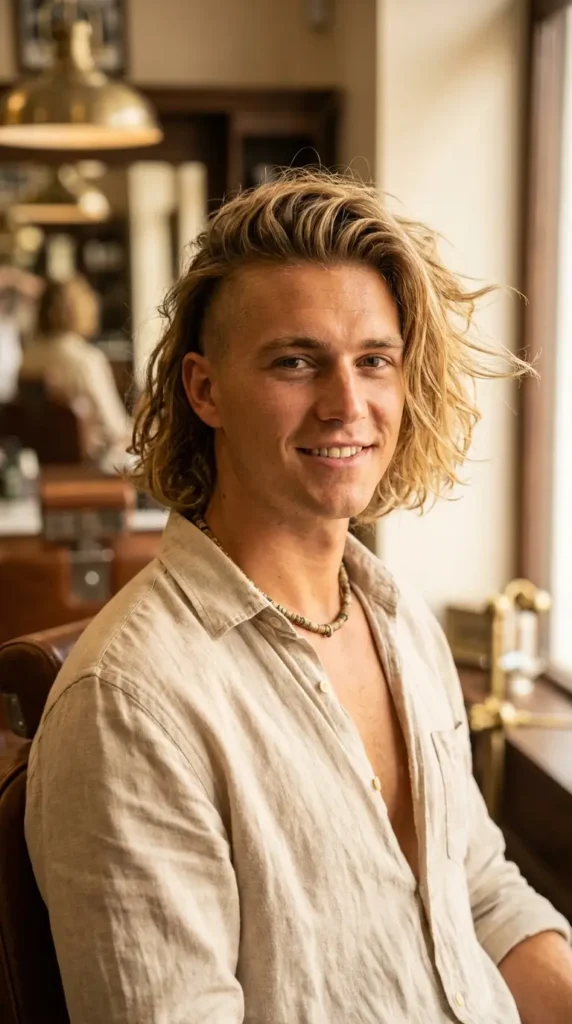
Length on top (8+ inches) with short faded or clippered sides for dramatic contrast. Best for thick hair and round or square faces. The contrast between long textured top and clean sides creates a modern, intentional look. This combination merges surfer length with the structural framework of undercut hairstyles for men.
18. Bohemian Surfer Hair
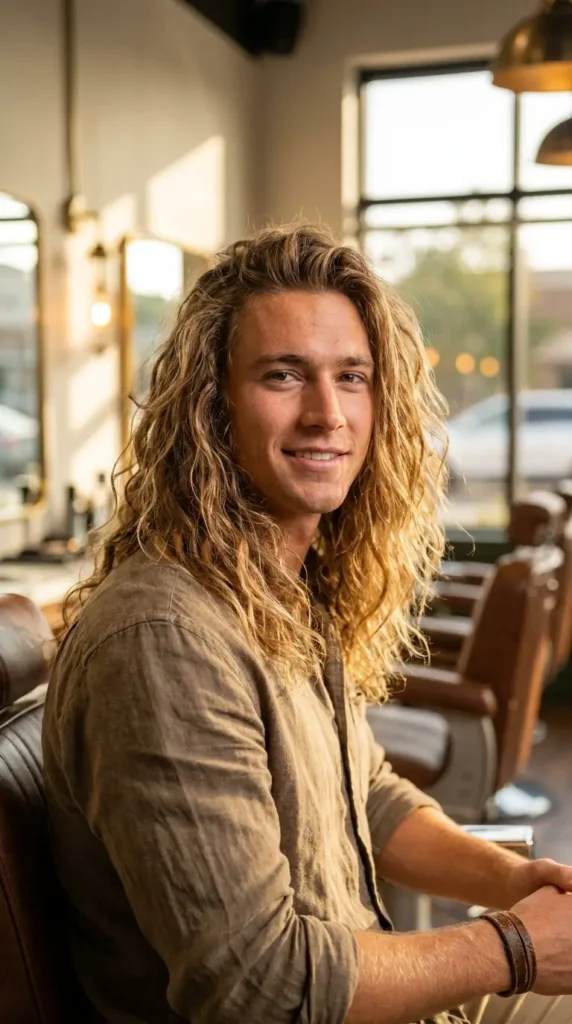
Extra-long, untamed, free-spirited. Minimal cutting, maximum natural expression. Best for wavy or curly hair and oval faces. Only product: leave-in conditioner for health, and occasional sea salt spray for texture.
19. Surfer Shag Haircut
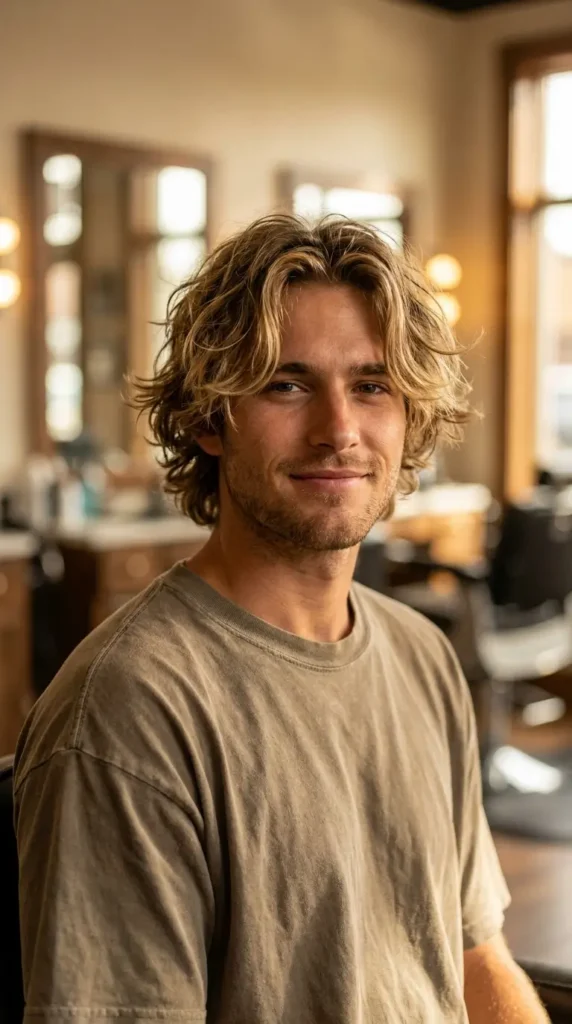
The surfer shag is a heavily layered cut with volume distributed throughout, choppy textured ends, and a full-bodied shape. It carries rock-and-roll energy blended with coastal culture.
What separates a surfer shag from a standard shag: A surfer shag uses lighter, more dispersed layers and softer face-framing. A standard shag (think 1970s Mick Jagger) features heavier, denser layering with more dramatic curtain framing.
- Best hair type: Thick or wavy hair
- Best face shapes: Oval, square, round
- Styling: Matte paste on ends, finger-separate layers, air-dry
- Celebrity reference: Owen Wilson
20. Surfer Curtains Hairstyle
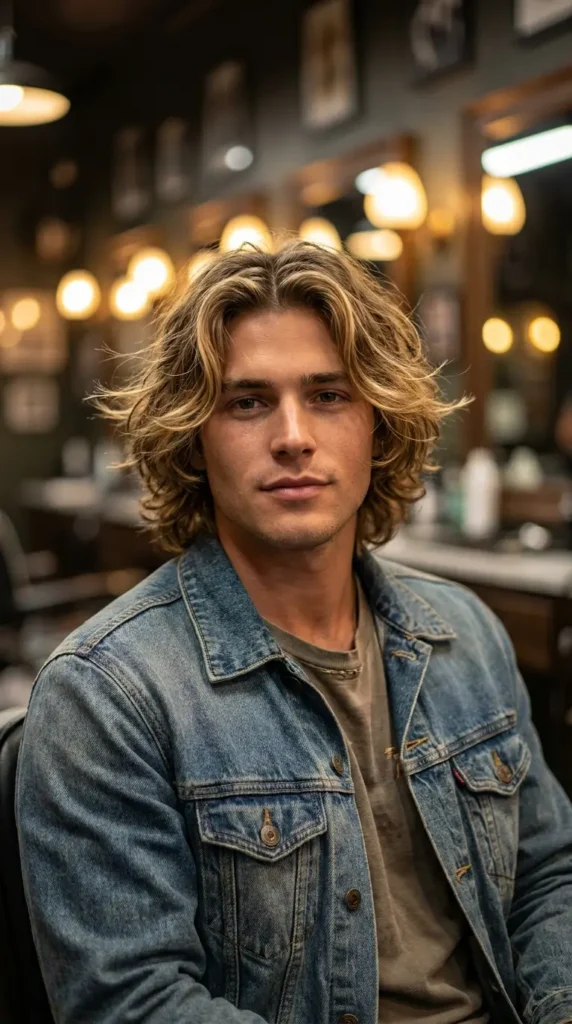
Center-parted fringe falling between eyebrow and cheekbone length (2 to 4 inches), framing the face with soft, textured layers. This is the beach-textured evolution of the classic curtain haircut, and one of the most searched surfer looks around.
This is the single most commonly combined element with other surfer hairstyles. Surfer curtains pair with shags, flows, fades, and medium messy textures. They work as both a standalone defining feature and a complementary add-on.
- Best hair type: Straight to wavy hair
- Best face shapes: Oval, square, heart (softens angular features)
- Styling: Light oil on ends, slight outward finger-bend while air-drying
21. Surfer Flow Hairstyle
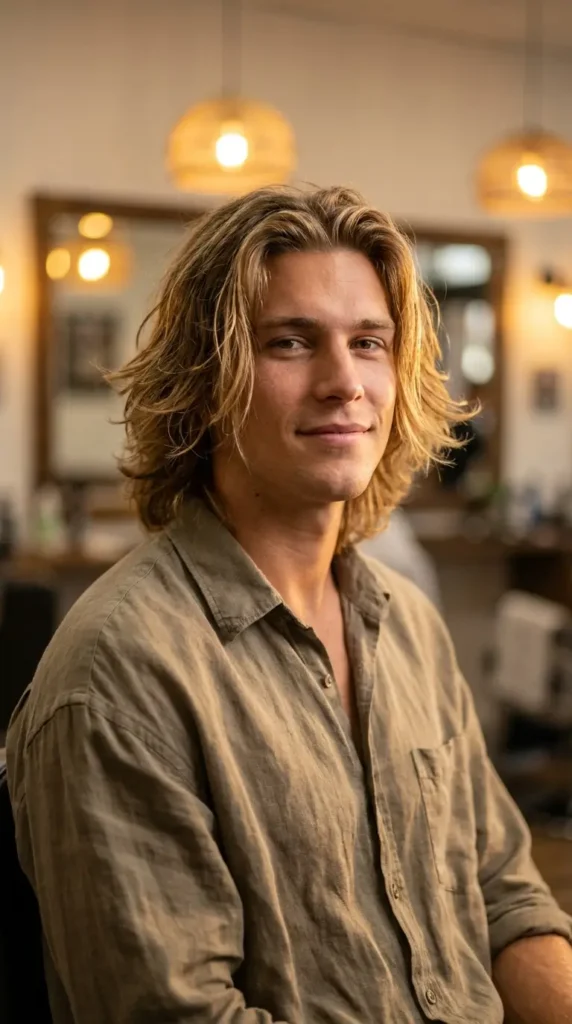
Medium-to-long hair swept back or to the side with natural movement and volume. No rigid structure, the hair moves freely and falls where it wants.
Surfer flow vs. hockey flow: Surfer flow has more texture and tousled disorder. Hockey flow is smoother, more uniform, and swept more dramatically to one side.
- Best hair type: Wavy or straight hair
- Best face shapes: Oval, oblong, square
- Styling: Blow-dry back from face on medium heat, apply light-hold pomade, finger-sweep into position
22. Surfer Middle Part
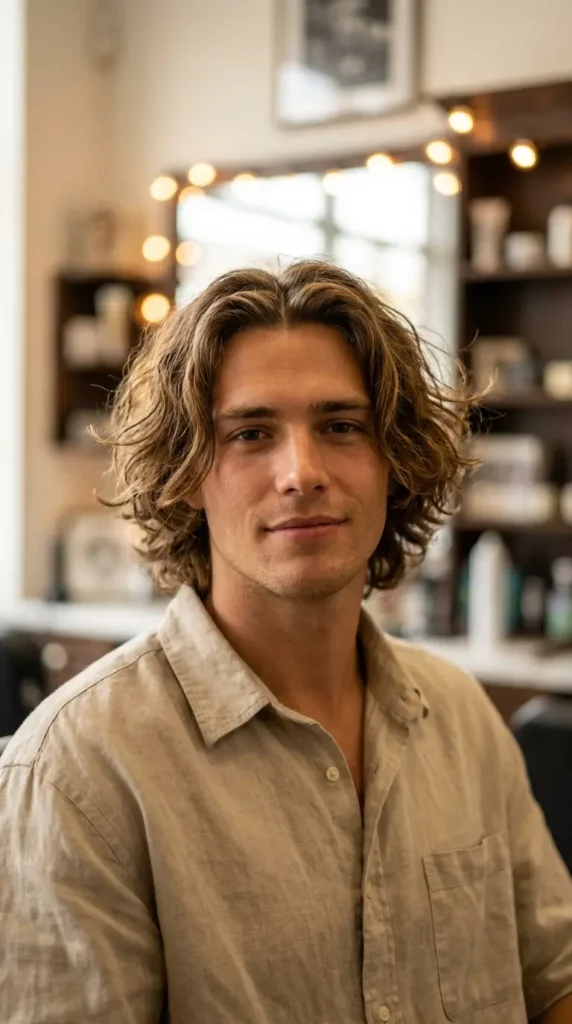
Hair parted at the center of the crown, falling equally on both sides with textured waves or layers. Clean, symmetrical, and face-framing. For a deeper dive into this parting style across different cuts, see our guide on the middle part.
Minimum length for a natural-looking middle part: 4 to 7 inches. Shorter than 4 inches and the hair won’t stay parted without heavy product.
- Best hair type: Straight to wavy hair
- Best face shapes: Oval, heart, diamond (creates symmetrical framing)
- Styling: Part on wet hair with wide-tooth comb, texturizing cream both sides, air-dry
23. Surfer Mullet Haircut
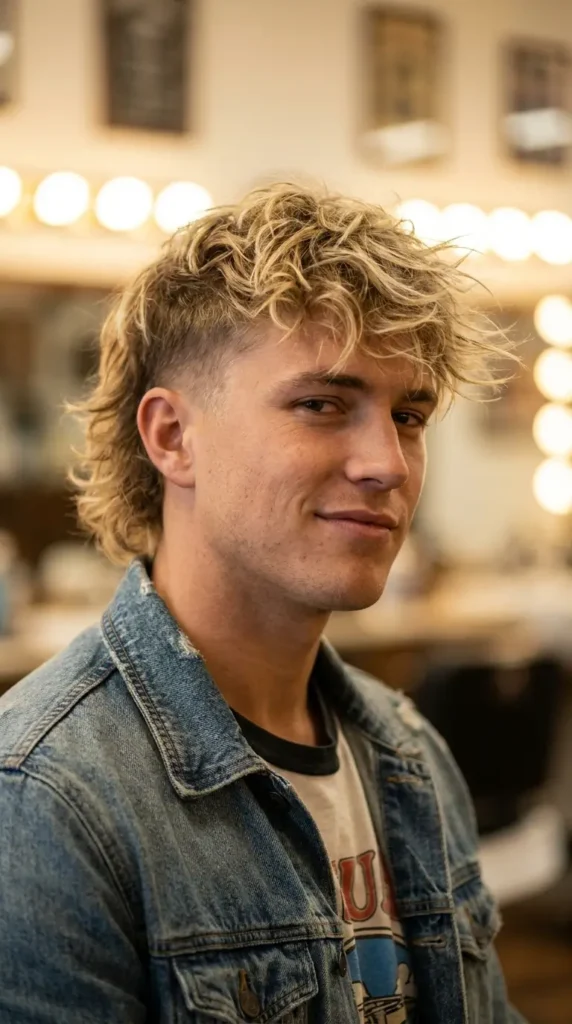
A disconnected cut with shorter textured top and sides and a longer layered back. Business in front, party in back, with a surfer twist. This is the beach-culture interpretation of the modern mullet.
The modern surfer mullet is softer and more layered than its 1980s ancestor. Popular among Australian surfers and the professional surf circuit, John John Florence has sported variations during competitions.
- Best hair type: Straight or wavy hair
- Best face shapes: Heart, square, oval
- Styling: Texturizing paste focused on the longer back layers for separation and definition
24. Surfer Wolf Cut Hairstyle
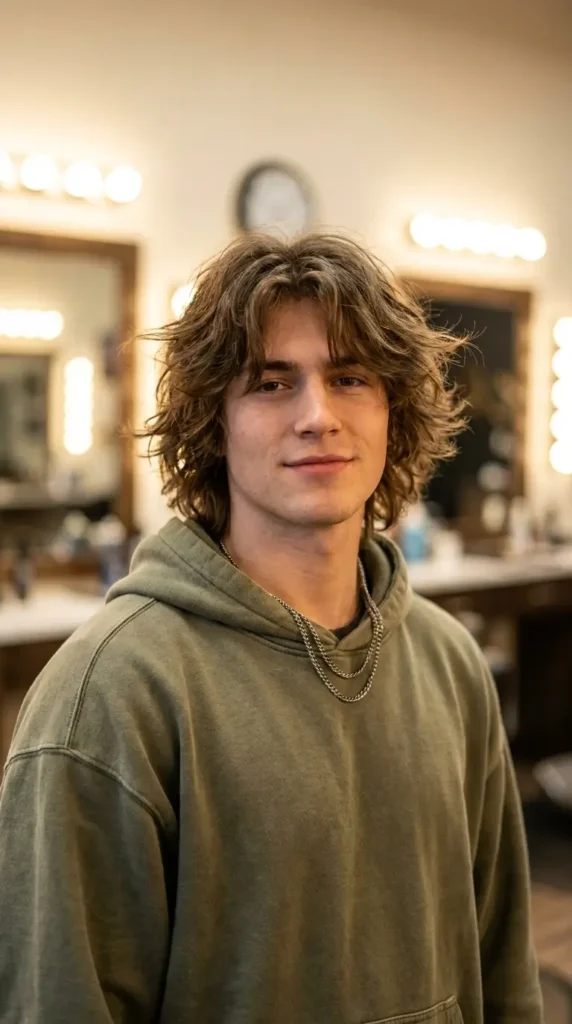
A hybrid between shag and mullet, heavy layered bangs, dramatic volume on top, shorter disconnected back layers. The most fashion-forward surfer variant.
Wolf cut vs. surfer shag (key differences):
- Wolf cut maintains shorter length at the back (creating a subtle mullet silhouette)
- Wolf cut features significantly heavier, curtain-like bangs that dominate the front
- Surfer shag distributes layers more evenly from front to back
- Best hair type: Thick straight or wavy hair
- Best face shapes: Oval, heart, square
- Styling: Texturizing spray at roots for volume, let heavy layers fall naturally
- Trending context: TikTok-driven resurgence in 2024 to 2026, dominant among Gen Z males
25. Surfer Fringe Haircut
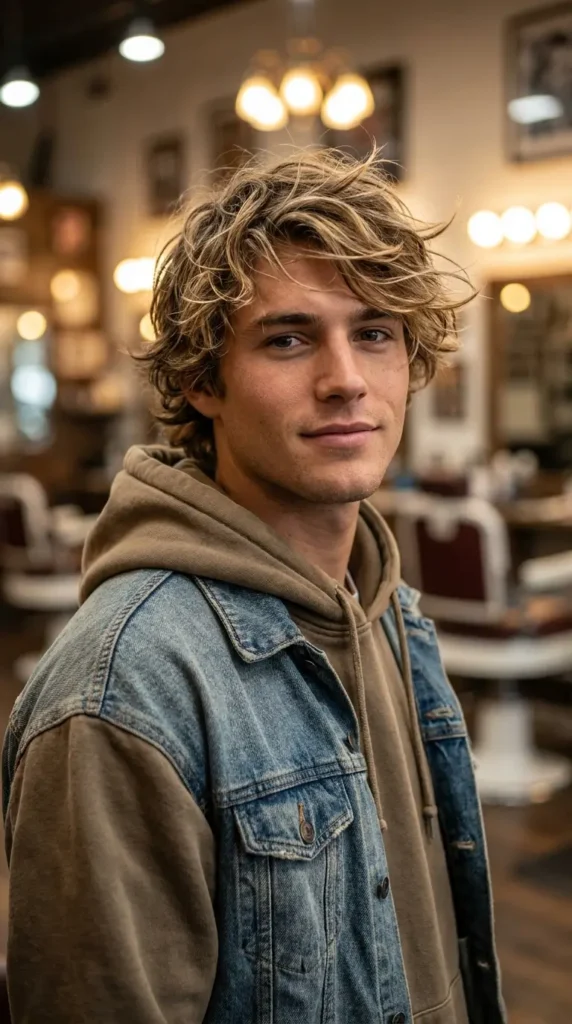
Textured, piece-y fringe falling across the forehead. Heavier than wispy bangs, lighter than full curtain bangs. Creates a casual, brow-skimming frame. This style sits between a messy fringe and a textured fringe, borrowing the relaxed disorder of the former and the deliberate piece-y definition of the latter.
Variations include: side-swept surfer fringe, straight-across textured fringe, and choppy asymmetric fringe.
- Best hair type: Straight or wavy hair
- Best face shapes: Oval, square, oblong (adds width to narrow faces)
- Styling: Dry clay for weight and texture, push forward and slightly to one side
26. Beach Wave Hairstyle
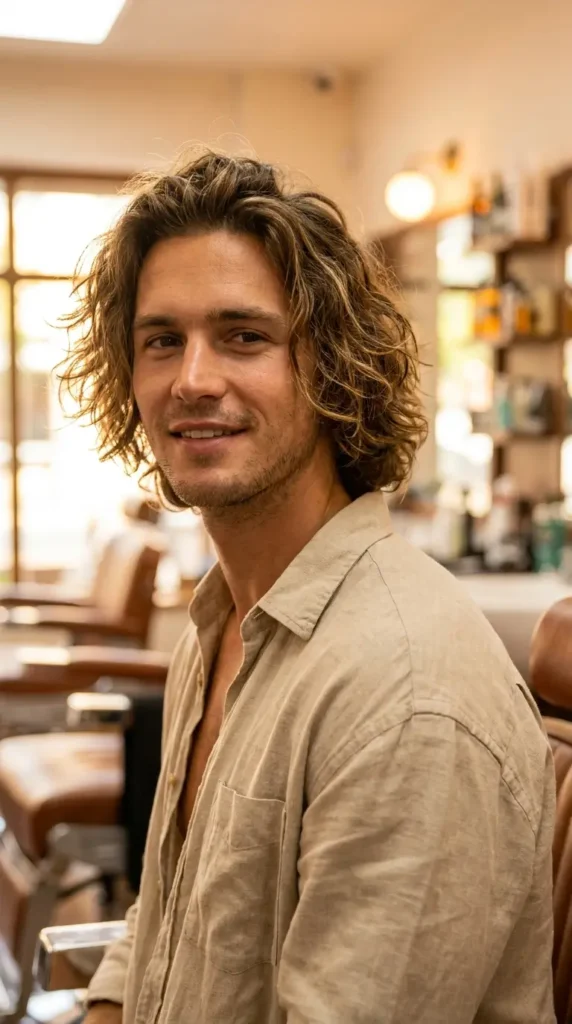
Beach waves are a texture goal rather than a specific cut, loose, S-shaped waves that mimic the effect of ocean water on hair. Achievable on all hair types through different methods.
For wavy hair: Enhance existing pattern with sea salt spray, scrunch, and air-dry. For straight hair: Overnight braiding method, or diffuse with texturizing cream. For curly hair: Stretch curls slightly with blow-dry while applying sea salt spray for a looser pattern.
- Best hair type: All hair types (technique varies)
- Best face shapes: All face shapes
- Product: Sea salt spray applied to damp hair from 6 to 10 inches away, 3 to 4 sprays per section
27. Messy Surfer Hair
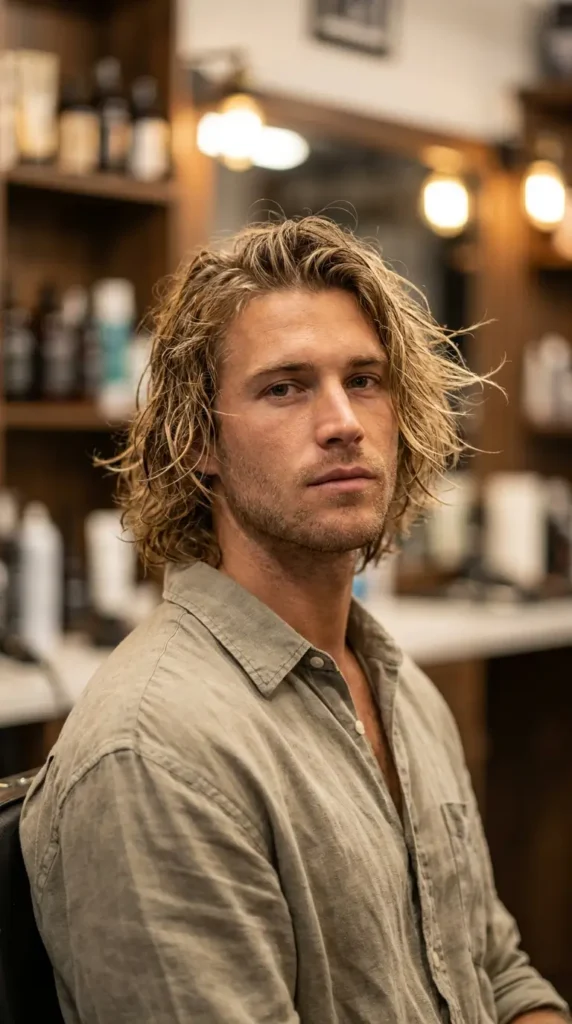
The most casual, unstructured interpretation, appears completely unstyled but is achieved through deliberate product and technique choices. Men drawn to this aesthetic will also appreciate the broader world of scruffy hairstyles for men for similar effortlessly rugged inspiration.
Key distinction: Messy surfer hair is NOT neglected hair. The surfer version has clean, healthy strands with controlled disorder and intentional shape. Neglected hair is dry, damaged, shapeless, and unkempt.
- Best hair type: Wavy or curly hair (requires less manipulation)
- Best face shapes: All face shapes
- Styling: Sea salt spray only, no comb or brush, finger-tousle, air-dry exclusively
28. Surfer Hairstyle with Low Fade
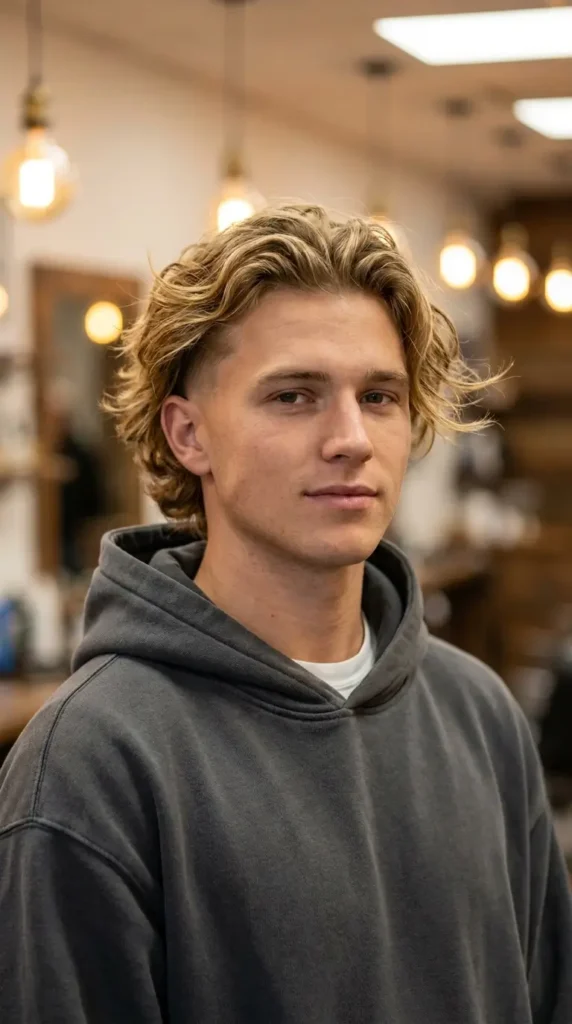
The fade begins 0.5 to 1 inch above the ear. This creates a subtle, conservative transition that maintains natural appearance.
- Clipper specifications: Starts at #0.5 or #1 guard at the bottom, blends to #3 to #4 at the transition point
- Best for: Professional environments, school dress codes, first-time fades
- Pairs best with: Medium surfer flow, curtain bangs, textured crop
- Effect: Clean perimeter without dramatic contrast
This is the surfer-textured version of a classic low taper fade, same gradual transition, but with a longer, more textured top.
29. Surfer Hairstyle with Mid Fade
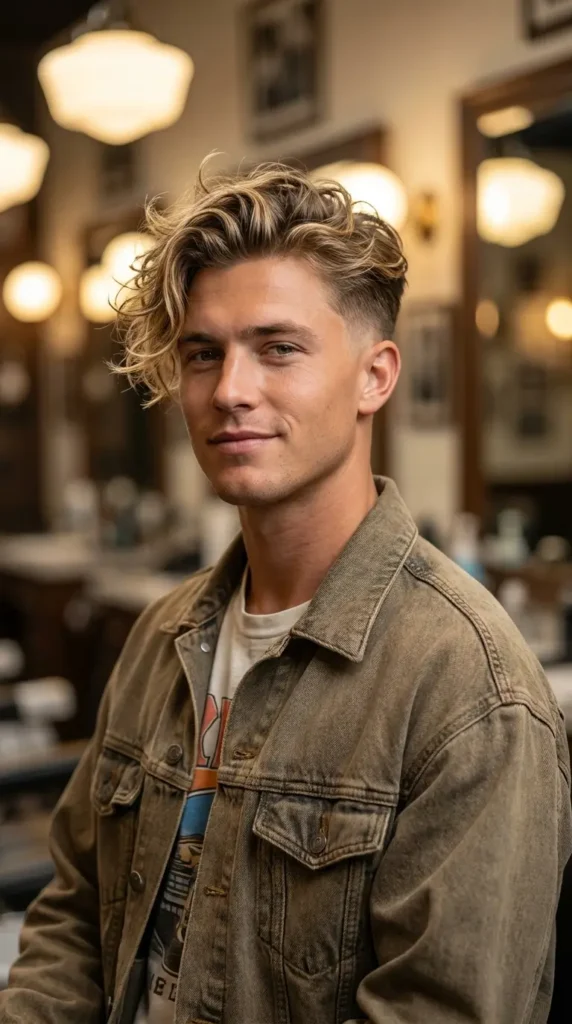
The fade begins at or slightly above the temple line. This creates a noticeable but balanced contrast, the most popular option. For a detailed look at this fade height across different styles, see our mid fade guide.
- Clipper specifications: Starts at #0 or #0.5 at the bottom, blends up to the temple area
- Best for: Most versatile, casual and semi-formal settings, most face shapes
- Pairs best with: Surfer shag, messy texture, beach waves
- Effect: Emphasizes the textured top, adds visual height to round faces
30. Surfer Hairstyle with High Fade
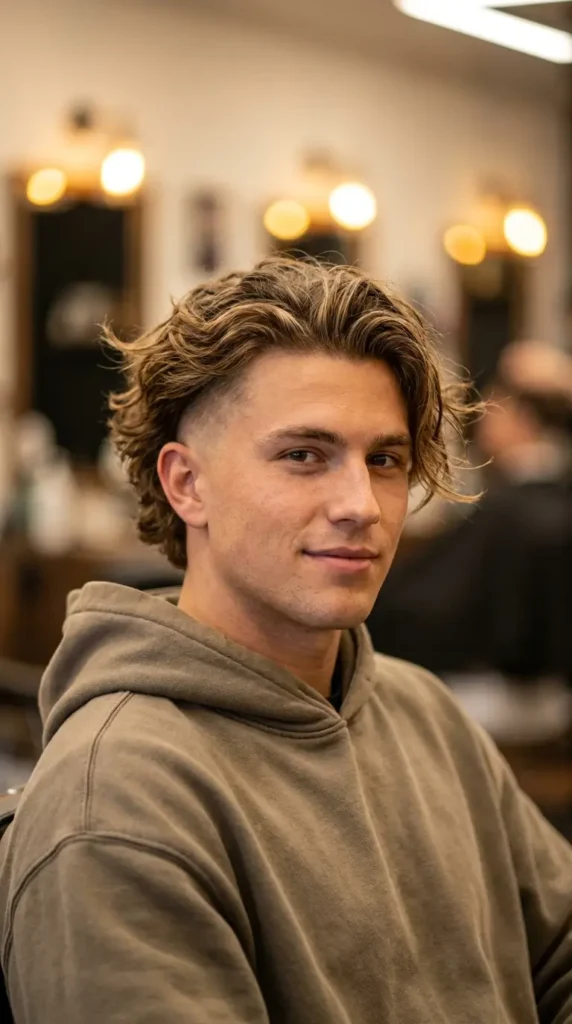
The fade begins above the temple, creating dramatic contrast between short sides and textured top.
- Clipper specifications: Starts at #0 (skin) at the bottom, blend line high near the parting line
- Best for: Bold, fashion-forward looks, hot climates, maximum impact
- Pairs best with: Short surfer crop, textured pompadour, piece-y fringe
- Effect: All visual attention on the textured top
At its most aggressive, this becomes a skin fade on the sides with full surfer texture on top, maximum contrast for men who want a bold statement.
31. Surfer Hairstyle with Taper Fade
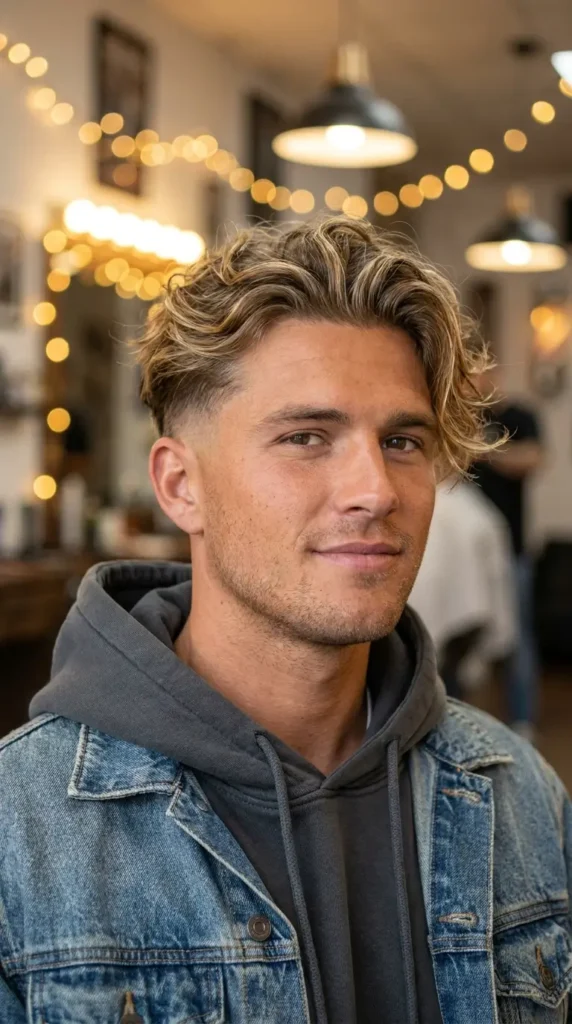
A gradual, natural-looking length reduction without exposing skin. The most authentic surfer-adjacent fade option. For a deeper understanding of how taper heights affect the overall look, compare options in our high taper fade guide.
- Clipper specifications: Shortest point at #2 to #3 guard, blends naturally into the top without skin
- Best for: Men wanting clean sides without the “faded” look
- Pairs best with: Surfer flow, long hair, classic bro flow, man bun
- Effect: Groomed and intentional without breaking the natural surfer aesthetic
Tip: Request a taper fade instead of a skin fade for the most authentic surfer appearance. True surfer hair rarely features dramatic skin-showing fades, because the style’s DNA is natural and unforced. A taper maintains that philosophy while keeping the perimeter clean.
32. Surfer Hairstyle for Straight Hair (Type 1)
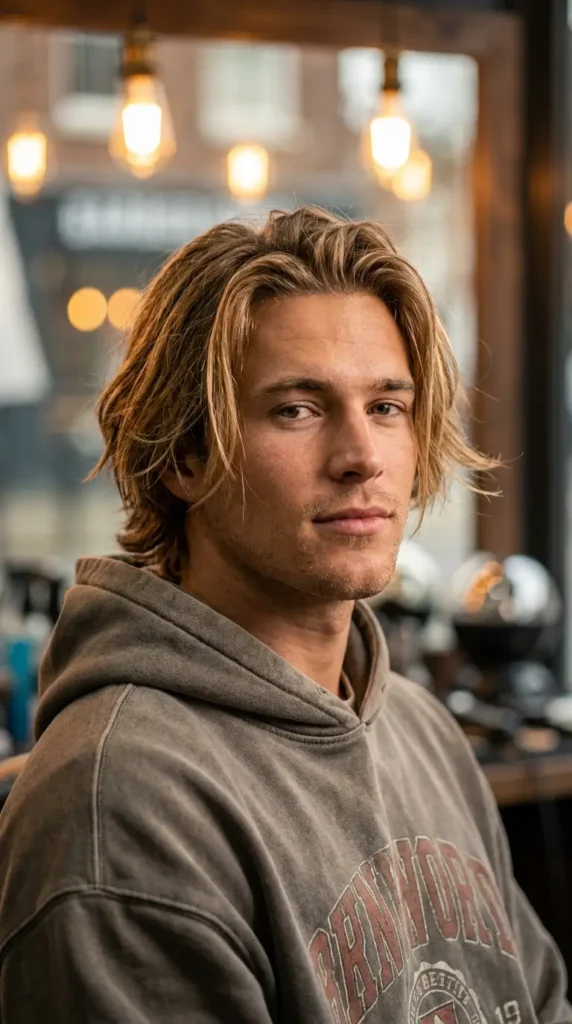
Can you get a surfer hairstyle with straight hair? Yes, with the right cut and technique.
Straight hair needs more layering than other textures because without layers, straight strands hang flat and lifeless. Layers create the illusion of movement that wavy and curly hair achieves naturally.
Best cutting technique: Request razor cutting. A razor creates softer, more irregular edges on each strand that catch light differently and move independently. This produces visual texture even on naturally straight hair, something blunt scissor cuts cannot achieve.
Best variations: Curtain bangs (they fall naturally on straight hair), textured crop (product-driven texture), layered flow (blow-dry adds bends).
Daily styling routine:
- Sea salt spray on damp hair (3 to 4 sprays per section)
- Scrunch vigorously upward while drying
- Blow-dry on medium heat with diffuser, or try the overnight braiding method for no-heat waves
- Finish with matte clay on ends for piece-y separation
Product priority: Texturizing powder (root volume), sea salt spray (grip and separation), matte clay (end definition)
33. Surfer Hairstyle for Wavy Hair (Type 2)
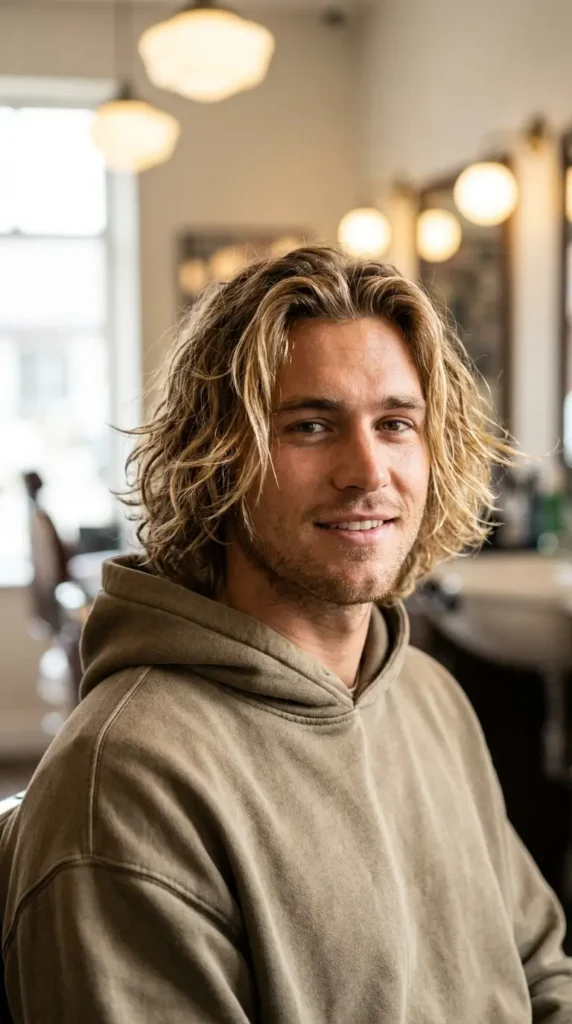
Wavy hair is the ideal texture for surfer hairstyles. It requires the least manipulation and produces the most naturally authentic result. Men with natural waves should explore our full wavy hairstyles for men guide for additional style options that complement the surfer aesthetic.
- Type 2A (slight bend): Enhance with sea salt spray for more definition
- Type 2B (defined S-waves): Already perfect, minimal product needed
- Type 2C (nearly curly): Control volume with leave-in conditioner, enhance with light cream
Best cutting technique: Combination of point cutting (texturizes ends into irregular shapes) and slide cutting (removes internal weight without shortening length).
Daily styling routine:
- Sea salt spray on damp hair
- Scrunch upward 3 to 4 times per section
- Air-dry without touching (20 to 40 minutes)
- Done
That’s it. Wavy-haired men often need nothing more than step 1 through 3 for authentic surfer texture.
Product priority: Sea salt spray (enhance existing waves), leave-in conditioner (hydration and frizz control on humid days)
34. Surfer Hairstyle for Curly Hair (Type 3)
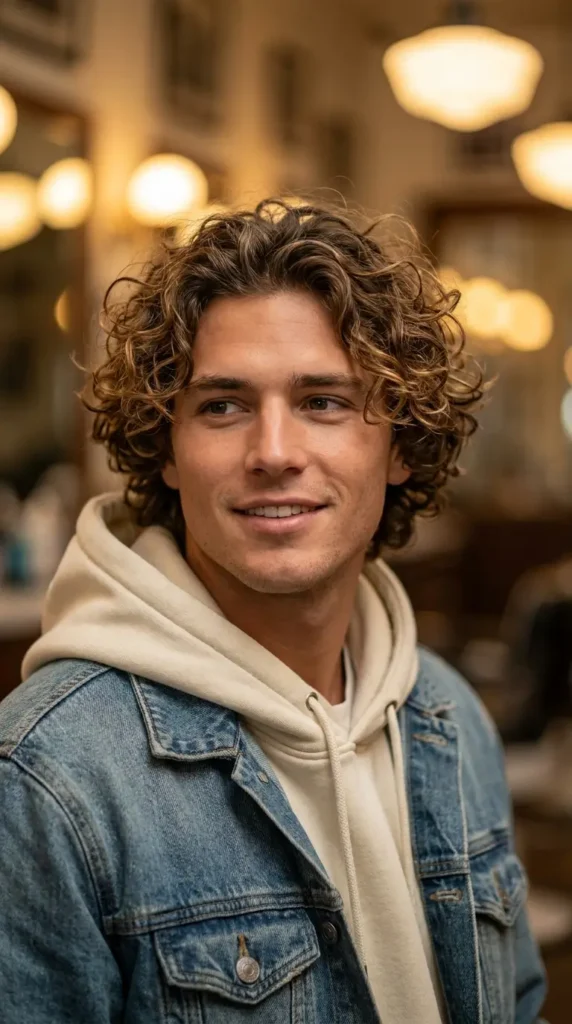
Curly hair provides built-in texture, the challenge is managing volume and definition, not creating texture from scratch.
Best cutting technique: Dry cutting is essential for curly hair. Cutting wet curly hair leads to uneven results because curls spring up differently when dry. Dry cutting shows the barber the true final shape and length.
Tip: Always cut curly surfer hair dry. Wet curly hair can appear 2 to 4 inches longer than its dry state, meaning a wet cut often results in hair that’s drastically shorter than intended once it dries and springs up.
Best variations: Messy surfer curls, long curly flow, surfer shag (layers control volume), curly curtain bangs.
Daily styling routine:
- Curl-defining cream on wet hair (quarter-sized amount)
- Scrunch upward to encourage curl formation
- Diffuse on low heat (high heat causes frizz), or air-dry
- Never brush dry curls, only detangle with wide-tooth comb on wet, conditioned hair
Product priority: Curl-defining cream (definition without crunch), leave-in conditioner (moisture), light gel (hold without stiffness)
Wash frequency: 1 to 2 times per week maximum. Curly hair dries faster because its coiled shape prevents natural sebum from traveling down the shaft.
Curly-haired men interested in combining this texture with a fade should see our specialized guide on low taper fade curly hair for detailed pairing advice.
35. Surfer Hairstyle for Thick Hair
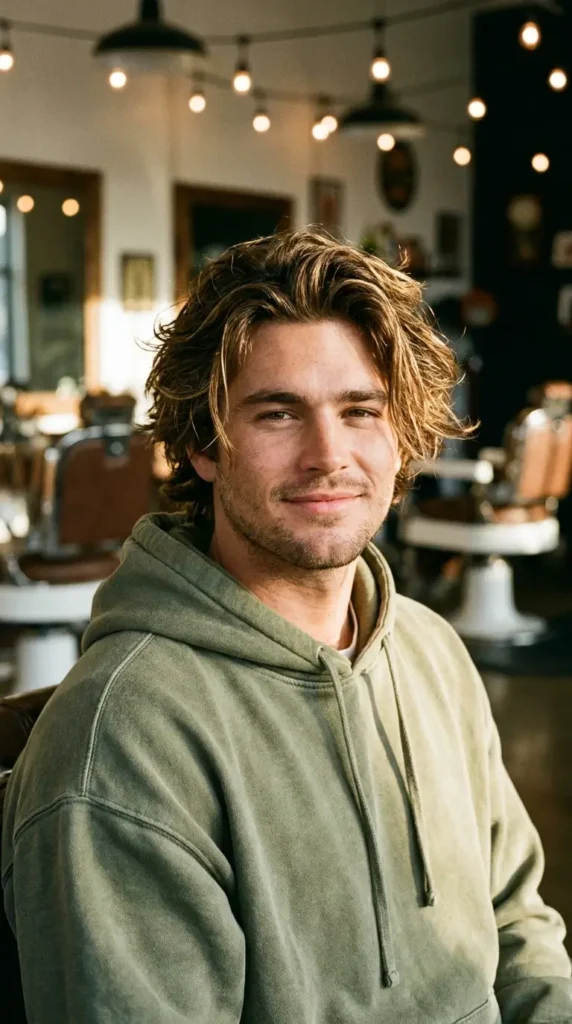
Thick hair has more strands per square centimeter than average, creating excessive bulk and weight that kills the natural movement surfer cuts depend on.
Solution: Strategic thinning and internal layering to remove 20 to 30 percent of bulk while maintaining full length.
Best cutting techniques for thick hair:
- Thinning shears, specialized scissors with teeth that remove bulk from mid-shaft
- Channel cutting, deep weight removal taking chunks from underneath
- Internal graduation, hidden layers underneath the surface that lighten weight without visible thinning
Best variations: Any surfer style works if properly thinned. Surfer shag and wolf cut are particularly flattering because their heavy layering naturally suits thick hair’s abundance.
Product priority: Lightweight products exclusively. Heavy pomades and waxes weigh thick hair down. Use texturizing spray (weightless texture) and light-hold cream (control without heaviness). Avoid petroleum-based waxes.
36. Surfer Hairstyle for Thin or Fine Hair
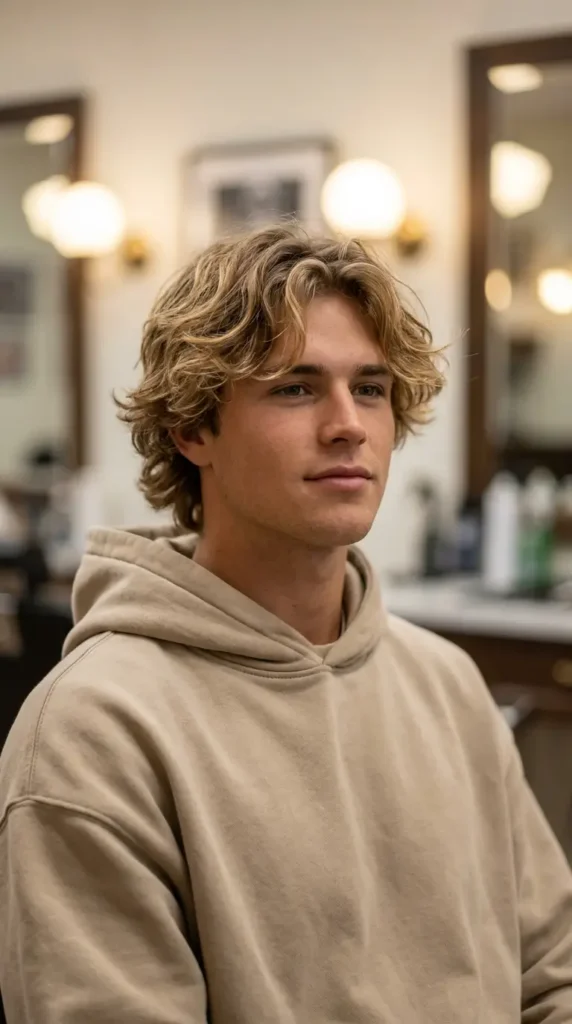
Fine hair has fewer strands per area with smaller strand diameter. It needs volume illusion and extremely careful product selection.
Best cutting techniques for fine hair:
- Point cutting at the ends (creates tapered tips that appear thicker)
- Texturizing at ends only, never thin fine hair mid-shaft (there’s nothing to spare)
- Shorter length (4 to 6 inches maximum) with concentrated layering at the crown for lift
Best variations: Textured surfer crop, short beach waves, surfer curtain bangs (hair falls forward covering any sparse areas on top).
Product priority: Volumizing powder (instant root lift without weight), texturizing powder (grip), mousse (body). Avoid oils, heavy creams, and anything that coats and flattens.
Amount: Use 50 percent less product than recommended for other hair types. Fine hair weighs down immediately with excess product.
Tip: Apply texturizing powder only at the roots of fine hair, never on the lengths. A pea-sized amount massaged into the scalp creates 8+ hours of volumized, gritty texture that makes fine hair appear significantly fuller.
Best Surfer Hairstyle for Your Face Shape
The same surfer hairstyle variation looks dramatically different on different face shapes. Matching the right variant to your face geometry ensures the style enhances your features.
| Face Shape | Best Surfer Variations | What to Avoid |
|---|---|---|
| Oval | All variations work | Nothing specific |
| Round | Volume on top, surfer flow, high fade | Width at temples, flat sides |
| Square | Soft shag layers, curtain bangs | Very blunt cuts, extremely short sides |
| Oblong | Side volume, fringe, short-medium length | Excessive top height, very long hair |
| Heart | Curtain bangs, jaw-length layers | Full top volume with no fringe |
| Diamond | Medium waves, side-swept fringe | Fully slicked back (exposes narrow forehead) |
Oval Face
The most versatile face shape for surfer hair. Balanced proportions mean virtually every style flatters, from short textured crops to long flowing locks. No adjustments needed. For additional short style options tailored to this face shape, see our short haircuts for oval faces guide.
Round Face
Goal: Add vertical height and reduce width perception. Best choices: surfer flow pushed back from the face, high or mid fade with textured top (adds visual height), volume concentrated at the crown. Avoid: equal-length all-around cuts, flat sides, chin-length layers that add horizontal width. Our comprehensive guide on hairstyles for round heads covers additional slimming techniques beyond surfer cuts.
Square Face
Goal: Soften angular jaw and forehead lines. Best choices: textured shag with soft layers, curtain bangs (softens forehead corners), medium messy waves with natural fall. Avoid: very short crops that expose the full jaw’s angularity.
Oblong Face
Goal: Reduce vertical perception and add width. Best choices: fringe or bangs (breaks up forehead height visually), side volume, short-to-medium surfer cuts. Avoid: very long surfer hair that adds further length, excessive crown height.
Heart-Shaped Face
Goal: Balance wider forehead with narrower jaw. Best choices: curtain bangs (camouflage forehead width), jaw-length layers (add visual width at the jaw), medium textured crop. Avoid: slicked-back styles that expose the full forehead width without any balance below. Men with larger foreheads should also review our big forehead haircuts for men for additional strategies.
Diamond Face
Goal: Soften prominent cheekbones and balance narrow forehead and chin. Best choices: medium waves with side-swept fringe, textured flow, chin-length layers. Avoid: fully pulled-back styles exposing narrow temples.
Surfer Hairstyles for Every Age Group
Surfer Hairstyle for Teens and School
The most common concern for teenage guys: “Will this pass my school’s dress code?”
School-friendly surfer variations: Textured surfer crop (short enough for any dress code), medium curtain bangs at moderate length (above eyebrows when styled), short textured beach hair. These maintain surfer aesthetics without triggering length-related dress code violations.
The trending teen surfer look (2025 to 2026): “Fluffy surfer hair” dominates social media among 16 to 22 year olds. It’s maximum root volume with soft, bouncy texture. Achieved by blow-drying upside down with volumizing mousse, then finger-tousling. Quick, easy, and requires under 3 minutes of active styling.
Products for teens: Sea salt spray (affordable at $8 to $15, simple to use) and volumizing mousse (adds body without complexity). Both available at any drugstore.
Practical considerations: Needs to survive sports and PE, should require under 3 minutes of morning routine, and should look intentional rather than neglected. For a wider range of age-appropriate options, browse our full guide to teenage boys haircuts.
Surfer Hairstyle for College and Young Men (20s)
Peak versatility period. No dress code constraints, maximum experimentation tolerance, and the social environment that rewards style experimentation.
Best variations: Surfer shag, wolf cut, long flow, surfer mullet, bold fade combinations, Korean-influenced lighter layers.
Current trends for this age group:
- Korean-influenced surfer styles (lighter layers, softer texture, less bulk, two-block haircut influence)
- The “clean surfer” aesthetic (well-maintained despite appearing messy)
- Surfer flow paired with short stubble beard
Surfer Hairstyle for Men 30+
The surfer aesthetic adapts into a more refined, tailored execution, still laid-back but more polished.
Best variations: Textured flow with taper (not skin fade), side part surfer, shorter textured crop, medium waves with clean perimeter.
Professional adaptation: The “clean surfer”, textured top with well-maintained sides that transitions seamlessly from weekend to workplace without appearing out of place.
Addressing thinning: If hair is thinning at the crown, shorter surfer variants (textured crop, short beach waves) work better than long styles that may expose sparse areas. Volumizing powder at the crown creates the illusion of density. Men experiencing more significant recession should explore our hairstyles for receding hairline guide for specialized strategies.
How to Get a Surfer Hairstyle
What to Tell Your Barber (Exact Script)
Clear communication prevents misunderstandings and ensures you walk out with the style you imagined. Use this framework, adapt the length specifications to your chosen variation.
THE SURFER HAIRSTYLE BARBER SCRIPT
Overall vision: “I want a textured, layered surfer style with natural movement. It should look effortless and slightly messy, not polished or structured.”
Top length (choose one):
- “Keep 4 to 6 inches on top” (medium surfer)
- “Keep 6 to 8 inches on top” (surfer flow)
- “Keep 2 to 4 inches on top” (short surfer crop)
Sides (choose one):
- “Scissor-blend the sides into the top, no clippers, keep it natural” (classic surfer)
- “Low taper fade starting at a #2 guard, blend into the length on top” (modern surfer fade)
- “Leave the sides long enough to tuck behind my ears” (long surfer)
Layering: “I want layers throughout for movement. Point-cut the ends so they’re textured and irregular, not blunt.”
Fringe (choose one):
- “Leave the front long enough to reach my cheekbones when pulled down. Part it in the center.” (surfer curtains)
- “Textured fringe that falls across my forehead. Piece-y, not blunt.” (surfer fringe)
- “I push everything back from my face.” (surfer flow, no fringe)
Back and neckline: “Natural taper at the nape, not blocked, not shaved. Just a soft, natural fade-out.”
Final instruction: “I want it to look like I didn’t try too hard. Messy but intentional.”
Additional communication tips:
- Bring 2 to 3 reference photos showing the same style on different hair types. This helps your barber understand the aesthetic rather than one person’s specific genetics.
- Tell your barber your daily routine: “I spend about 3 minutes on my hair in the morning” helps them adjust the cut’s maintenance requirements.
- Ask what maintenance schedule they recommend for your specific cut.
How to Grow Into a Surfer Hairstyle (Month-by-Month Guide)
Based on the average hair growth rate of 0.5 inch per month:
Month 1 to 2 (Starting at 1 to 2 inches): Overgrown buzz phase. Hair begins showing natural growth direction. Action: Do not cut. Use texturizing powder for style during this phase. Wear hats if needed.
Month 3 to 4 (Reached 2.5 to 4 inches): Awkward stage begins. Hair is too short to style back, too long to stand up neatly. Action: Push everything forward as a textured fringe. Consider a headband for difficult days.
Month 5 to 6 (Reached 4 to 5 inches): First barber visit for shape. Tell barber: “Light layering on the top and a neckline cleanup only. Don’t reduce length.” This transforms the awkward growth into intentional movement.
Month 7 to 9 (Reached 5 to 6.5 inches): Hair reaches ear-length. You can begin parting (middle or side). Second trim: light layer refresh, point-cut ends, clean up perimeter. The surfer shape becomes clearly visible.
Month 10 to 12 (Reached 6.5 to 8 inches): Full medium surfer hairstyle achieved. Hair tucks behind ears, flows with movement, holds product well. Get the proper shaping cut, full layering, texturizing, fade or taper if desired.
Month 13 to 16 (Reached 8 to 10 inches): Approaching long surfer territory. Maintenance trims every 10 to 12 weeks from this point forward.
Managing the Awkward Stage
The awkward stage (months 2 to 5) is the number one reason men give up on growing surfer hair. Here are six strategies that get you through:
- Textured fringe push-forward, push everything forward as a messy fringe during the worst weeks
- Headbands and bandanas, functionally appropriate for surfer style (headwear is part of the culture)
- Hats, baseball caps, beanies (seasonal), bucket hats rotate based on context
- Mini trims for shape, trim only sides and back every 4 to 6 weeks to keep the growing top proportional
- Stronger-hold product, during the awkward phase, use firm-hold clay to force direction until length allows natural fall
- Tuck behind ears, once hair reaches ear-lobe length (approximately month 5 to 6), tucking eliminates most awkward appearance
Every man with surfer hair, including every celebrity you’ve admired with this style, went through this phase. It’s temporary. The result is permanent.
How to Style a Surfer Hairstyle
Best Products for Surfer Hair
| Product | What It Does | Best For | How Much | When to Apply |
|---|---|---|---|---|
| Sea salt spray | Creates grit, separation, matte texture | All types, especially straight/wavy | 3 to 5 sprays per section, held 6 to 10 inches away | Damp hair |
| Texturizing cream | Enhances waves, light hold, controls frizz | Wavy and curly hair | Dime-sized amount between palms | Damp hair |
| Matte clay | Piece-y definition, strong hold, matte finish | Short-to-medium cuts | Pea-sized amount warmed between fingers | Dry hair |
| Volumizing mousse | Root lift, body, lightweight hold | Fine or thin hair | Golf-ball sized foam | Damp hair at roots |
| Curl-defining cream | Defines curl pattern, reduces frizz | Curly hair (Type 3) | Quarter-sized amount | Wet hair |
| Texturizing powder | Instant root volume, gritty matte texture | Fine hair, second-day refresh | Tiny pinch at roots only | Dry hair |
| Leave-in conditioner | Hydration, detangling, protection | All types, especially sun-exposed | 2 to 3 pumps through lengths | Damp hair |
Golden rule: Less is more. Surfer hair looks best with minimal visible product. Overloading kills the effortless aesthetic. Start with half the amount you think you need and add more only if necessary.
Step-by-Step Daily Styling Routine
Step 1: Wash (or don’t). Use sulfate-free shampoo 2 to 3 times per week. On non-wash days, simply wet hair in the shower and apply conditioner to ends only.
Step 2: Towel-dry gently. Squeeze excess water with a microfiber towel or old t-shirt. Never rub vigorously, rubbing causes frizz by roughening the hair cuticle and lifting its protective scales.
Step 3: Apply primary product to damp hair. Choose based on your texture: sea salt spray (straight or wavy), curl cream (curly), or volumizing mousse (fine hair). Distribute evenly with fingers.
Step 4: Shape with fingers. Push hair in desired direction, back for flow, forward for fringe, parted for curtains. Use a wide-tooth comb for parting only.
Step 5: Dry. Air-dry for the most natural result (20 to 40 minutes) or diffuse on low heat (5 to 10 minutes). For straight hair wanting waves: scrunch upward repeatedly while drying.
Step 6: Finish on dry hair. Apply a small amount of matte clay or texturizing cream to ends only for definition and separation. Tousle with fingers for final shape.
Total active time: 3 to 5 minutes. Passive drying: 20 to 40 minutes (or 5 to 10 with dryer).
How to Get Fluffy Surfer Hair
The fluffy surfer aesthetic is the dominant trend among teenage and college-age men in 2025 to 2026. It means maximum root volume with soft, bouncy texture, lightweight and full, not heavy or flat.
The Fluffy Technique:
- Apply golf-ball sized amount of volumizing mousse to roots of freshly washed, damp hair
- Flip your head completely upside down
- Blow-dry roots on medium heat (not high, high causes frizz and damage) for 2 to 3 minutes while scrunching
- Flip head back upright
- Use fingers to arrange the top layer into position
- Apply a small pinch of texturizing powder at the crown for extra lift
- Do not touch excessively after, handling reduces volume
Key difference from regular surfer styling: Fluffy surfer hair uses more heat than standard surfer hair, but only at the roots. The lengths stay air-dried for natural texture underneath the volumized crown.
Best for: Medium length (5 to 7 inches), straight to wavy hair, teens and young men.
How to Get Beach Waves for Men
Four methods ranked from easiest to most permanent:
Method 1, Sea Salt Spray (Easiest, Daily): Spray 3 to 5 times per section on damp hair, scrunch vigorously upward, air-dry without touching until fully dry. Best on: wavy hair (enhances existing pattern). Results last one day.
Method 2, Overnight Braiding (No Heat, Daily): Wash hair at night, towel-dry until damp, braid into 2 to 4 loose braids (more braids means tighter waves), sleep, unbraid in morning, apply light clay and finger-separate. Best on: straight hair. Results last one day.
Method 3, Twist and Blow-Dry (Moderate Heat, Daily): Apply texturizing cream to damp hair. Twist 1-inch sections away from face. Blast each twist with medium-heat blow-dryer for 10 seconds. Release. Repeat throughout head. Best on: all hair types wanting consistent waves. Results last one day.
Method 4, Texturized Perm (Permanent, Salon): Professional salon treatment using large-diameter rods to create permanent soft waves. Lasts 3 to 6 months. Costs $80 to $200 depending on location and hair length. Requires sulfate-free shampoo to maintain. Best on: straight hair wanting waves without daily effort.
How to Maintain Surfer Hair
Washing Frequency and Shampoo Selection
Optimal washing frequency: 2 to 3 times per week for straight and wavy hair. 1 to 2 times per week for curly hair.
Why not daily? Over-washing strips sebum, your hair’s natural oil, which creates the lived-in texture surfer hair depends on. Daily washing produces clean but lifeless, flat hair that requires more product to style.
Shampoo type: Sulfate-free exclusively. Traditional sulfates (like sodium lauryl sulfate) strip too aggressively, raising the hair cuticle and causing frizz and dryness.
Between-wash routine: Wet hair in shower, apply conditioner to ends only (skip roots to avoid flatness), rinse after 1 to 2 minutes. On oily days, apply dry shampoo at roots for oil absorption and volume refresh.
Trim Schedule for Surfer Hair
Recommended frequency: Every 10 to 12 weeks for surfer haircuts.
This is longer than the typical 4 to 6 weeks recommended for short structured cuts. Surfer hair benefits from length, and frequent cutting fights the natural growth-and-flow aesthetic.
What to request at maintenance trims: “Shape only, point-cut the ends to remove any splits, refresh the layers lightly, and clean up my neckline. Don’t reduce overall length.”
Signs you need a trim:
- Visible split ends traveling up the shaft
- Loss of shape, hair looks uniform and heavy rather than layered
- Layers have grown out into one length
- Ends feel dry and rough despite conditioning
Protecting Hair from Sun, Salt, and Chlorine
Sun damage: UV radiation breaks down protein bonds in the hair’s cortex, causing dryness, brittleness, and color fading. Solution: UV-protection spray before extended sun exposure. Leave-in conditioner with UV filters provides daily protection.
Salt water (ocean): Beneficial in small amounts (adds natural texture), damaging in prolonged exposure (dehydrates the cortex). Solution: Rinse with fresh water within 30 minutes of leaving the ocean. Apply leave-in conditioner immediately after rinsing.
Chlorine (swimming pool): Strips color, causes extreme dryness, can create a green tint on light or highlighted hair. Solution: Wet hair with clean water before entering the pool. Pre-saturated hair cannot absorb as much chlorinated water. Use clarifying shampoo immediately after pool swimming.
Weekly deep conditioning: Apply a deep conditioning mask once per week for 5 to 10 minutes. This replenishes moisture and protein lost to environmental exposure.
Night care: A silk or satin pillowcase reduces friction damage during sleep. Cotton pillowcases create friction that roughens the cuticle and causes frizz overnight.
Surfer Hairstyle vs. Wolf Cut vs. Shag
These three styles are the most commonly confused with each other. Here’s exactly how they differ:
| Feature | Surfer Hairstyle | Wolf Cut | Shag |
|---|---|---|---|
| Core identity | Natural, windswept texture | Heavy bangs plus mullet-shaped back | All-over dramatic layering |
| Layer density | Medium, enough for movement | Heavy, dramatic weight removal | Heaviest, maximum texture everywhere |
| Back length | Same as or longer than top | Shorter than top (mullet silhouette) | Uniform proportion front to back |
| Bangs | Optional (curtain or none) | Mandatory, thick, heavy fringe | Usually present, wispy or heavy |
| Vibe | Coastal, relaxed, effortless | Edgy, fashion-forward, bold | Rock-and-roll, 70s, artistic |
| Maintenance level | Lowest, embrace natural fall | Medium, layers need regular shaping | Medium, heavy layers need refreshing |
| Cultural origin | 1960s California surf culture | 2020s TikTok and K-pop | 1970s rock music scene |
| Best hair type | All types | Thick straight or wavy | Thick wavy |
Who should choose which:
- Choose surfer hairstyle for maximum ease, natural appearance, and versatility across contexts
- Choose wolf cut for a bold, trend-driven statement with dramatic shape
- Choose shag for maximum volume, artistic expression, and rock-inspired energy
Many men search for “surfer hairstyle” but actually want a wolf cut (or vice versa) because the terms get conflated on social media. Always show your barber specific reference photos rather than relying on names alone.
Celebrities with Surfer Hairstyles
Use these as reference photos at the barber, choose someone with a similar hair type to yours for realistic expectations.
| Celebrity | Surfer Sub-Style | Hair Type | Key Characteristics |
|---|---|---|---|
| Chris Hemsworth | Long surfer flow | Thick, wavy | Sun-kissed, past shoulders, natural waves, swept back |
| Jason Momoa | Long textured wild flow | Thick, wavy | Extra-long, untamed, heavily layered, dark with highlights |
| Timothée Chalamet | Medium curtain bangs | Fine, wavy | Shorter, softer, refined, Gen Z surfer aesthetic |
| Jacob Elordi | Surfer flow with volume | Thick, wavy | Medium-long, voluminous, swept back |
| Zac Efron | Short-to-medium messy beach | Medium, straight-wavy | Textured, shorter, piece-y, controlled surfer |
| Owen Wilson | Classic blonde surfer shag | Medium, wavy | Shoulder-length, shaggy layers, natural blonde |
| Austin Butler | Textured surfer flow | Medium, wavy | Post-Elvis era, messy medium length, swept to side |
| John John Florence | Authentic professional surfer | Medium, wavy | Actual pro surfer, sun-bleached, mid-length, ocean-shaped |
How to use celebrity photos effectively at the barber:
- Choose someone with similar hair type and texture to yours (not just a style you like aesthetically)
- Understand that a photo of Jason Momoa’s thick wavy mane won’t translate to fine straight hair
- Bring 2 to 3 photos showing different angles of the same style
Surfer Hairstyle Trends in 2025 to 2026
Six trends currently shaping surfer hairstyles:
1. The “Clean Surfer”, a polished, well-maintained version with tapered sides and conditioned, glossy waves. Moves away from purely disheveled toward intentional and refined.
2. Korean-Influenced Surfer Hair, lighter layers, softer texture, less bulk. Influenced by the two-block cut (shorter disconnected sides, longer textured top with curtain elements). Popular among Asian and Asian-American men adapting the surfer look to naturally straighter, thicker hair. Men interested in this crossover should explore Korean haircuts for men and short Asian male haircuts for additional context.
3. Fluffy Surfer Aesthetic, maximum root volume, soft bouncy texture. Dominant on TikTok among males aged 16 to 22. Achieved through upside-down blow-drying and volumizing mousse.
4. Surfer Mullet Revival, continuing to gain popularity, especially influenced by Australian and Brazilian surf communities. Modern versions are softer and more layered than 1980s predecessors.
5. Sustainable Styling Products, growing preference for eco-friendly, clean-ingredient products without sulfates, parabens, or synthetic fragrances.
6. Surfer Hair Plus Beard Pairing, short stubble combined with medium surfer flow is the dominant combination across trend reporting and social media in 2025 to 2026. Men with buzz cuts looking to try a buzz cut with beard pairing may find surfer flow with stubble a natural next step as their hair grows out.
Common Surfer Hairstyle Mistakes (and How to Fix Them)
1. Using heavy, shiny products. The problem: Glossy gels and high-shine pomades kill the matte, natural surfer aesthetic. The fix: Switch to matte-finish products exclusively, clay, paste, powder, sea salt spray. Never gel.
2. Over-layering. The problem: Too many layers makes hair look thin, shapeless, and wispy. The fix: Ask for “long internal layers for movement” rather than “lots of short layers everywhere.” Balance is key.
3. Washing hair daily. The problem: Strips the natural oils that create lived-in texture. The fix: Reduce to 2 to 3 washes per week. Use dry shampoo at roots between washes for freshness.
4. Ignoring face shape. The problem: A style that doesn’t complement your proportions draws attention to imbalances. The fix: Use the face shape guide above.
5. Giving up during the awkward stage. The problem: Cutting length during months 2 to 5 resets the timeline completely. The fix: Follow the month-by-month guide above. Only trim the neckline and sides. Push through with headbands, hats, and stronger-hold products until length allows natural fall.
6. Brushing dry wavy or curly surfer hair. The problem: Destroys curl pattern and creates a frizz ball. The fix: Only detangle with a wide-tooth comb on wet, conditioned hair. Use fingers exclusively on dry hair.
DIY Sea Salt Spray Recipe
Commercial sea salt sprays cost $12 to $25 per bottle. This homemade version costs under $3 and works identically.
Ingredients:
- 1 cup warm water
- 1 to 2 tablespoons fine sea salt (dissolves faster than coarse)
- 1 teaspoon coconut oil or argan oil (counteracts salt’s drying effect)
- ½ teaspoon leave-in conditioner (adds slip for finger-combing)
- 2 to 3 drops essential oil for scent, optional (eucalyptus or peppermint work well)
Instructions:
- Dissolve sea salt completely in warm water (stir until no crystals remain)
- Add coconut oil and conditioner
- Shake vigorously for 30 seconds
- Add essential oil drops
- Pour into a spray bottle
Shelf life: 2 to 3 months stored in a cool place (no preservatives). Usage: Shake before each spray (oil naturally separates). Apply 3 to 5 sprays per section from 6 to 10 inches away on damp hair.
Why it works: The dissolved salt crystals deposit on the hair shaft creating texture and grip. The oil prevents the excessive drying that pure salt water would cause. The conditioner adds enough slip that hair doesn’t become straw-like.
FAQs
What is a surfer hairstyle?
A surfer hairstyle is a textured, layered haircut characterized by natural movement, tousled waves, and a windswept appearance inspired by 1960s California surf culture. The style mimics the effect of salt water, sun, and wind on hair, creating an effortless, carefree look achieved through specific layering techniques and lightweight styling products. Typical length ranges from 4 to 8 inches on top with layers throughout for movement.
Can I get a surfer hairstyle with straight hair?
Yes. Straight hair achieves surfer texture through razor cutting (creates irregular edges with built-in movement), layering (prevents flat heaviness), and products like sea salt spray and texturizing powder. Additional techniques include overnight braiding for no-heat waves and blow-drying with a diffuser while scrunching for natural bends.
What fade goes best with a surfer hairstyle?
A taper fade provides the most authentic surfer appearance because it maintains natural gradual blending without dramatic skin exposure. For more contrast, a low fade (starting 0.5 to 1 inch above the ear) keeps things conservative and professional. For maximum boldness, a mid fade (temple level) creates eye-catching contrast while remaining versatile. Understanding the difference between low fade vs high fade helps determine which contrast level suits your personal style.
Surfer hairstyle vs. wolf cut, what’s the difference?
A surfer hairstyle has medium, evenly distributed layers with optional bangs and a natural back length. A wolf cut has heavy mandatory bangs, dramatic layering concentrated at the crown, and a shorter back (creating a subtle mullet shape). Surfer means relaxed and natural. Wolf cut means bold and fashion-forward. The wolf cut originated from TikTok in the 2020s, the surfer cut from 1960s California coastal culture.
How do I get a surfer curtains hairstyle?
Ask your barber to leave the front section long enough to reach your cheekbones when pulled down, then part it in the center. This is essentially curtain bangs with a beachier, more textured finish. Apply light hair oil or sea salt spray to damp hair and use your fingers to create a slight outward bend on each side while it dries. It works best on straight to wavy hair and suits oval, square, or heart-shaped faces.
How do I maintain surfer hair between barber visits?
Wash 2 to 3 times per week with sulfate-free shampoo. On non-wash days, wet hair and apply conditioner to ends only. Refresh texture with a quick spritz of sea salt spray and finger-tousle. Use a deep conditioning mask once weekly. Sleep on a silk or satin pillowcase to prevent overnight frizz. Schedule maintenance trims every 10 to 12 weeks for layer refreshing and split-end removal.
Is a surfer hairstyle good for school?
Yes, multiple surfer variations comply with standard school dress codes. The textured surfer crop (2 to 4 inches), short beach waves, and moderate-length curtain bangs (above eyebrows when styled) all maintain the surfer aesthetic without triggering length-related violations. These styles require under 3 minutes of morning styling, survive physical activity, and look intentional rather than unkempt.
What face shape is best for a surfer hairstyle?
Oval faces are the most versatile, virtually every surfer variation flatters this shape. However, surfer hairstyles work for all face shapes with the right variation. Round faces benefit from surfer flow with volume on top and a mid taper fade for height. Square faces suit soft shags and curtain bangs. Heart-shaped faces look best with jaw-length layers and face-framing fringe.
How do I get surfer hair if my hair is curly?
Curly hair already provides the built-in texture that surfer cuts depend on. Request dry cutting (ensures accurate final length since curls spring up when dry), ask for layers to control volume, and use curl-defining cream instead of sea salt spray. Diffuse on low heat rather than air-drying for faster results. Avoid brushing dry curls, use fingers or a wide-tooth comb on wet hair only. Men with curly hair who want a fade pairing should explore options for high fade curly hair combinations.
How do I style surfer hair for a formal event?
Apply a light-hold pomade (not matte clay) to damp hair and finger-sweep everything back from the face for a slicked back surfer flow. The natural texture still shows through, but the swept-back direction adds polish. Alternatively, create a deep side part and sweep the textured top across, this gives a smart-casual appearance that reads as intentional and refined. Avoid over-styling, the surfer aesthetic’s appeal at formal events is that it looks effortlessly put-together.
What is the best surfer hairstyle for beginners?
The medium textured surfer flow (5 to 6 inches on top, scissor-blended sides) is the easiest entry point. It’s forgiving of imperfect styling, works with most hair types, requires only sea salt spray and finger-tousling, and looks intentional even on lazy days. For men not ready to commit to length, the short textured surfer crop (3 to 4 inches on top with a low taper fade) offers the surfer aesthetic with minimal growth commitment.
Does a surfer hairstyle work with Asian hair?
Yes, with adaptation. Asian hair tends to be straighter, thicker per strand, and grows more forward and downward. The best approach: request a Korean-style interpretation with lighter internal layers to reduce bulk, a two-block foundation (shorter disconnected sides), and texturizing cream rather than sea salt spray (which can make very straight hair look stringy rather than wavy). Blow-drying with a round brush adds the bends and movement that straight Asian hair doesn’t produce naturally.
Conclusion
A surfer hairstyle is more than a haircut, it’s an approach to grooming that prioritizes natural texture, effortless movement, and laid-back confidence over rigid structure and heavy styling. Whether you choose a short textured crop with a clean taper fade, a medium curtain-banged flow, or a long bohemian mane, the surfer aesthetic adapts to your hair type, face shape, age, and lifestyle without demanding hours of daily maintenance.
The key principles remain consistent across every variation:
- Work with your natural texture, enhance what your hair already does rather than fighting it
- Keep products lightweight and matte, sea salt spray, texturizing cream, and matte clay are your foundation
- Prioritize layers over length alone, strategic layering through point cutting and razor cutting creates the movement that defines this style
- Wash less, not more, 2 to 3 times per week preserves the natural oils that give surfer hair its signature lived-in character
- Communicate clearly with your barber, bring reference photos, specify measurements in inches, and request textured ends rather than blunt cuts
Surfer hairstyles have endured for over six decades because the core philosophy never goes out of style. From the sun-bleached waves of 1960s California to the fluffy, Korean-influenced, TikTok-driven variations trending in 2026, this style continues evolving while staying rooted in the same carefree coastal spirit that made it iconic.
Bring the barber script from this guide to your next appointment. Start with the variation that matches your current hair length and texture. Apply the styling routine that fits your daily time budget. And remember, the best surfer hair looks like you didn’t try too hard, even when you know exactly what you’re doing.