
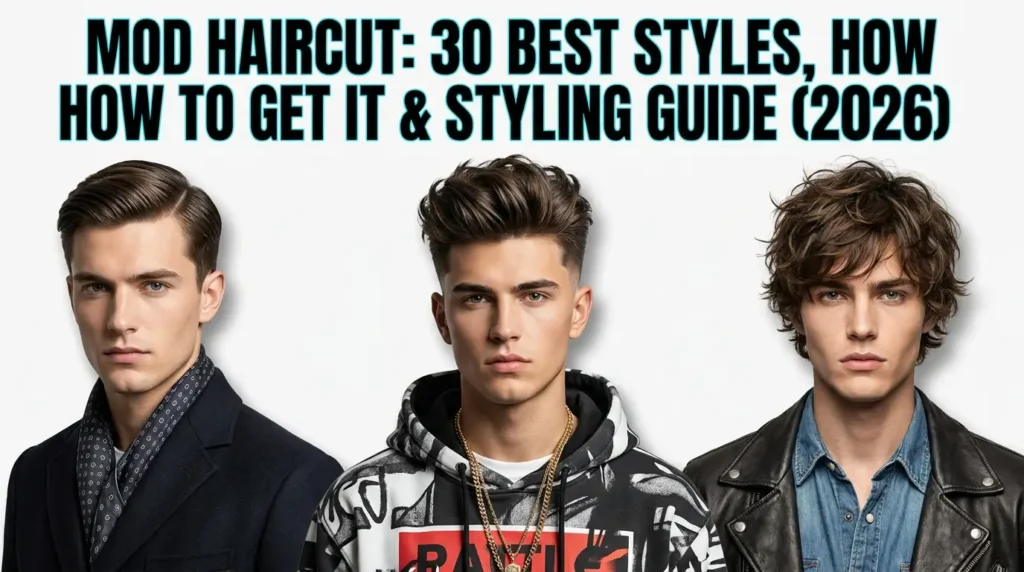
The mod haircut is a medium-length, scissor-cut men’s hairstyle featuring textured layers, a forward-falling fringe, and natural volume at the crown. It started in 1960s Britain as part of the Modernist youth movement and has been revived multiple times through music, film, and fashion culture. In 2026, the mod remains one of the most requested styles in barbershops across the country.
The mod sits within the medium-length, textured family of men’s haircuts, longer than a crop, shorter than a flow, and more structured than a shag. This guide covers every variation, face shape recommendation, hair type adaptation, barber communication script, styling technique, and product recommendation you need. Whether you want a classic 60s shape or a modern textured version, you will find exactly what you need below.
30 Best Mod Haircut Styles and Variations
The mod haircut is not one single look. It is a family of related styles that share core structural DNA: textured layers, a defined fringe, scissor-cut sides with visible length, and natural movement. Below are the 30 most popular variations for 2026.
1. Classic Mod Cut
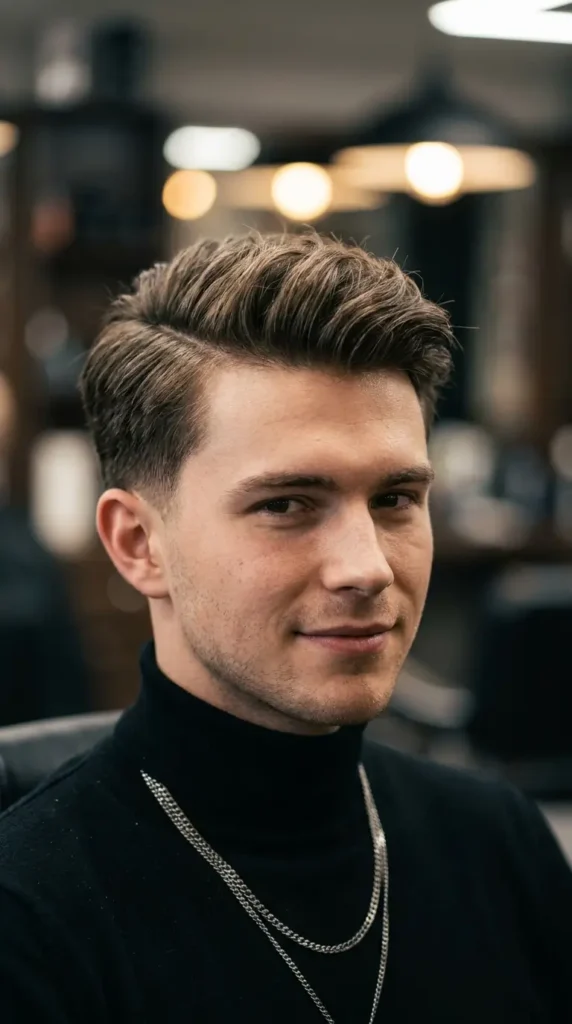
The classic mod stays faithful to the 1960s original. A smooth, rounded silhouette with a straight or softly side-swept fringe that hits mid-forehead. Hair measures 4-5 inches on top and 2-3 inches on sides. The shape is rounded and intentional, with gentle volume throughout and no sharp angles.
This suits oval and square face shapes best. Straight to slightly wavy hair works perfectly here.
Celebrity reference: Paul Weller during The Jam era.
Style it with a round brush blow-dry forward and a light styling cream for smooth, flexible hold.
2. Modern Mod Cut
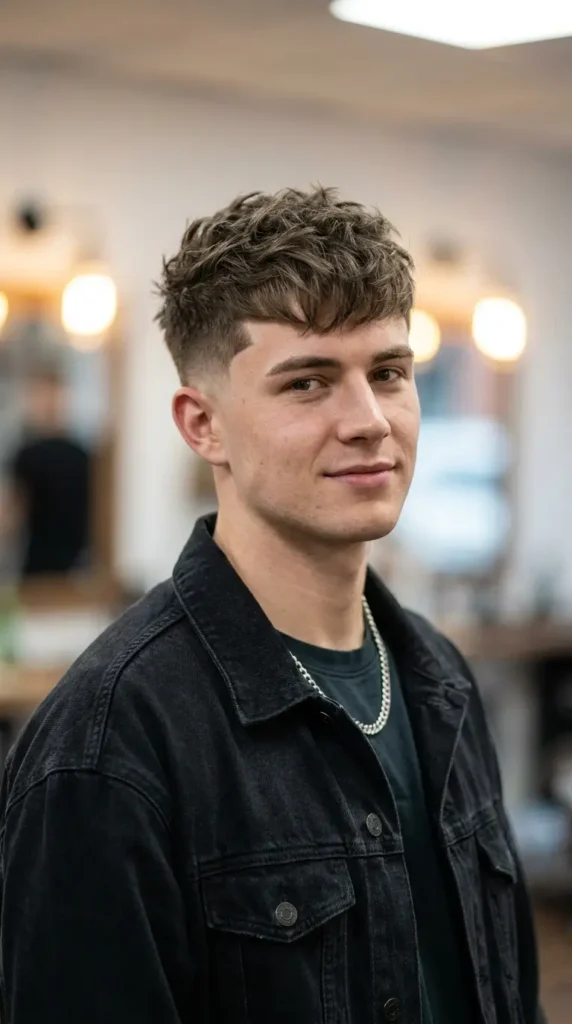
The modern mod updates the proportions. Edges are shorter and cleaner, with soft texture concentrated on top. The fringe sits straight across or slightly to one side. The overall effect is understated and refined rather than dramatic.
This works on all face shapes and is especially good for straight and fine hair.
Celebrity reference: Jacob Elordi at the 2023 Priscilla premiere.
Finger-dry with a small amount of matte clay for natural definition.
3. Textured Mod Cut
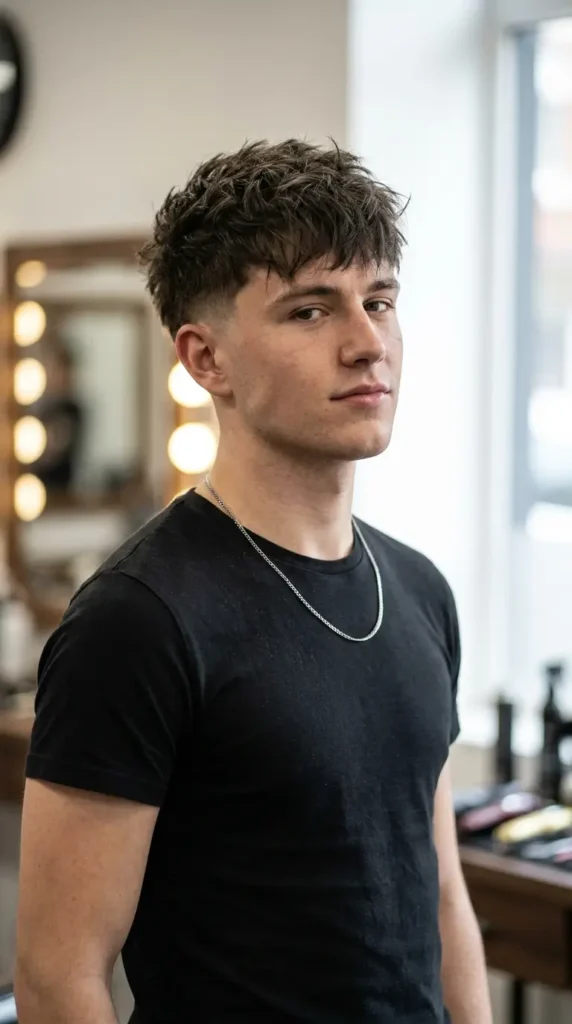
Short, uneven layers create depth, separation, and visible movement throughout the top. The fringe has a choppy, piece-y quality rather than a solid, heavy block of hair, connecting it to the broader textured fringe family of styles. This is one of the most versatile and currently popular variations.
Oval and heart-shaped faces look great with this. Straight to wavy hair types excel here.
Celebrity reference: Paul Mescal across 2023-2025 red carpet appearances.
Use texture powder at the roots for lift and pinch the ends with matte clay for separation.
4. Messy Mod Cut
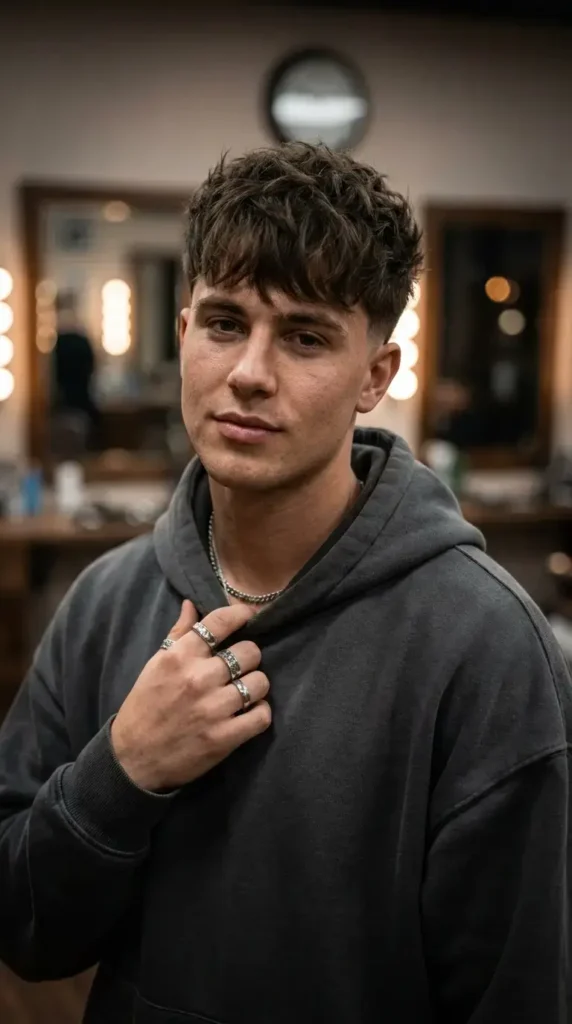
Loose, uneven layers with an intentionally undone, lived-in feel. The fringe falls forward casually without precision, placing this squarely within messy fringe territory, but with more structural intention. Sides and back stay slightly longer than a modern mod. The goal is to look like you did not try, even though you did.
This softens square and oblong faces beautifully. Wavy hair excels here naturally.
Celebrity reference: Liam Gallagher through the entire Oasis era and 2025 reunion tour.
Sea salt spray on damp hair, rough-dry with fingers, and deliberately avoid over-styling.
5. Shaggy Mod Cut
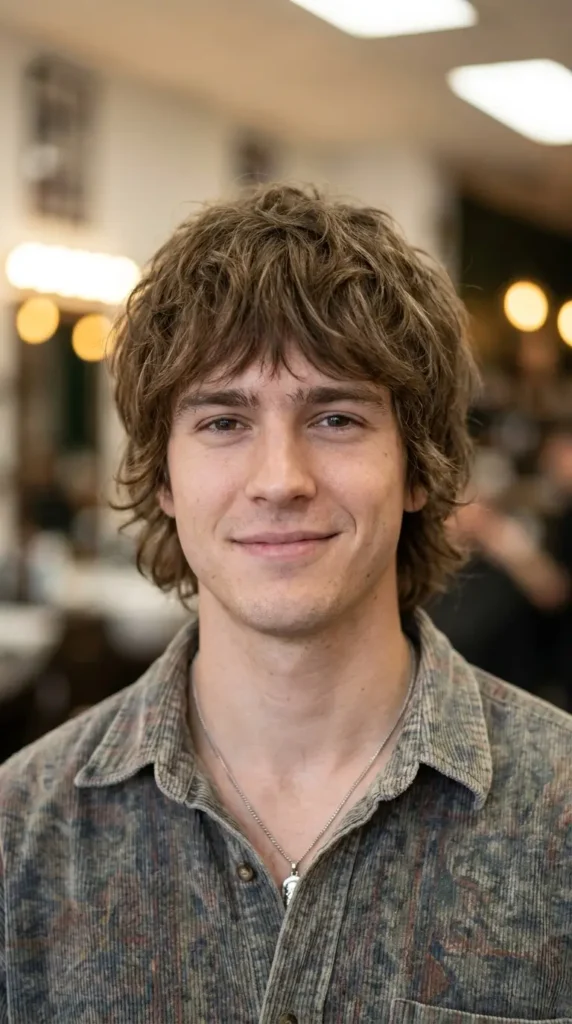
Longer layers throughout creating a relaxed, full shape with natural volume. The fringe blends into the layers rather than sitting as a separate, defined element. This is the mod for men who want length and movement without the structure of a classic cut.
Oval and diamond face shapes look best. Wavy and slightly curly hair add natural life to this variation.
Celebrity reference: Harry Styles during 2022-2023 touring.
Air-dry or diffuse on low heat. Apply light styling cream for control without stiffness.
6. Short Mod Cut
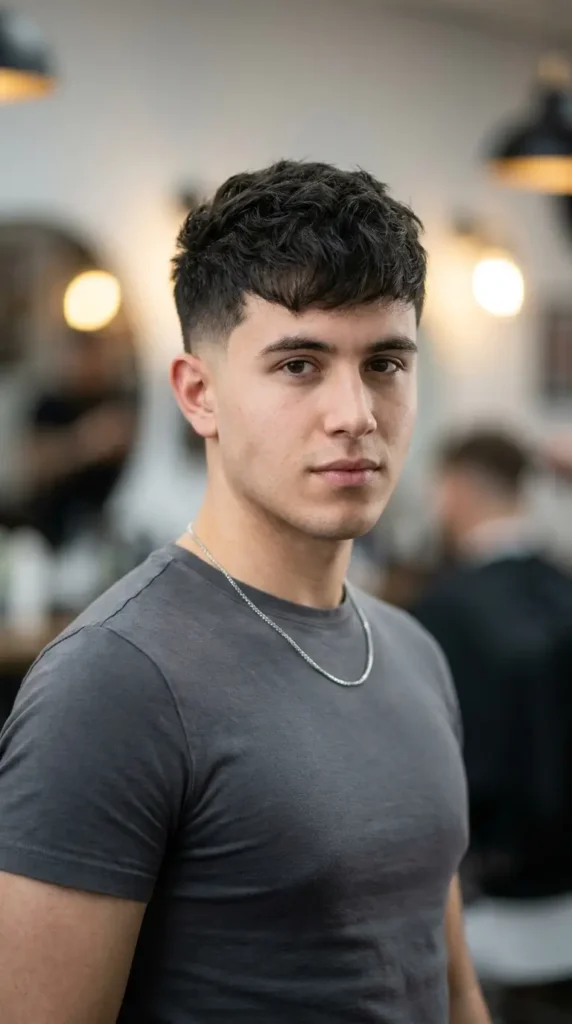
The shortest variation in the mod family. Neat, close-to-head shape with soft, short layers and either a micro-fringe or a straight fringe above the eyebrows. Sides and back stay clean and rounded.
This elongates round faces. It works well for fine and thin hair because the shorter layers preserve density.
Celebrity reference: Adam Driver in Megalopolis (2024).
Minimal effort required. Finger-shape after towel-drying with a small amount of clay.
7. Long Mod Cut
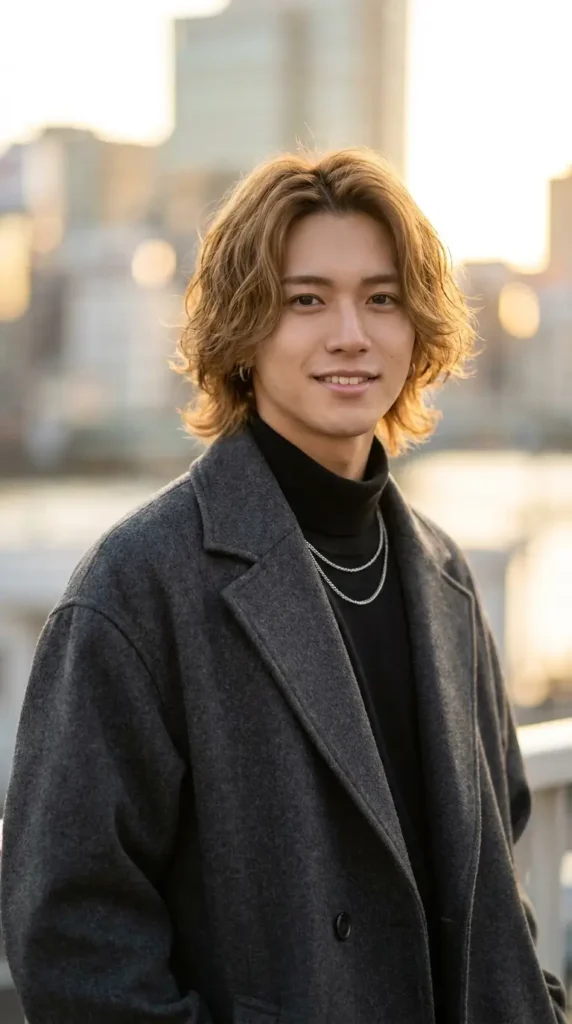
Extended length throughout: 5-6 inches on top, 3-4 inches on sides. Natural movement dominates. The fringe reaches past the eyebrows and can be pushed to one side. This is for men who want the mod character at a shaggier length.
Oblong and oval faces suit this best. Straight and wavy hair maintain control at this length.
Celebrity reference: Austin Butler in longer-hair phases (2024).
Blow-dry with a round brush for direction. Finish with light-hold wax for shape.
8. Mod Mullet
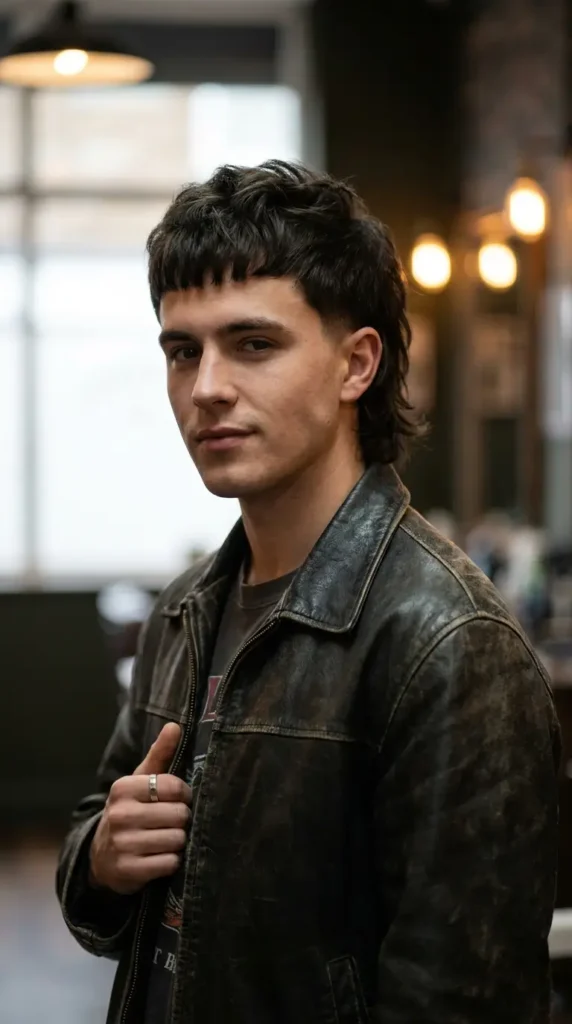
A hybrid style that takes mod character at the front and extends it into modern mullet territory at the back. The front maintains a tidy mod shape, textured top, defined fringe. But the back extends 2-3 inches longer than a standard mod, creating a deliberate contrast between the structured front and relaxed back.
Square and oval faces suit this bold option.
Celebrity reference: Inspired by Rod Stewart’s 1970s evolution of the mod into glam territory.
Molding paste for front control. Let the back fall naturally.
9. 60s Mod Cut
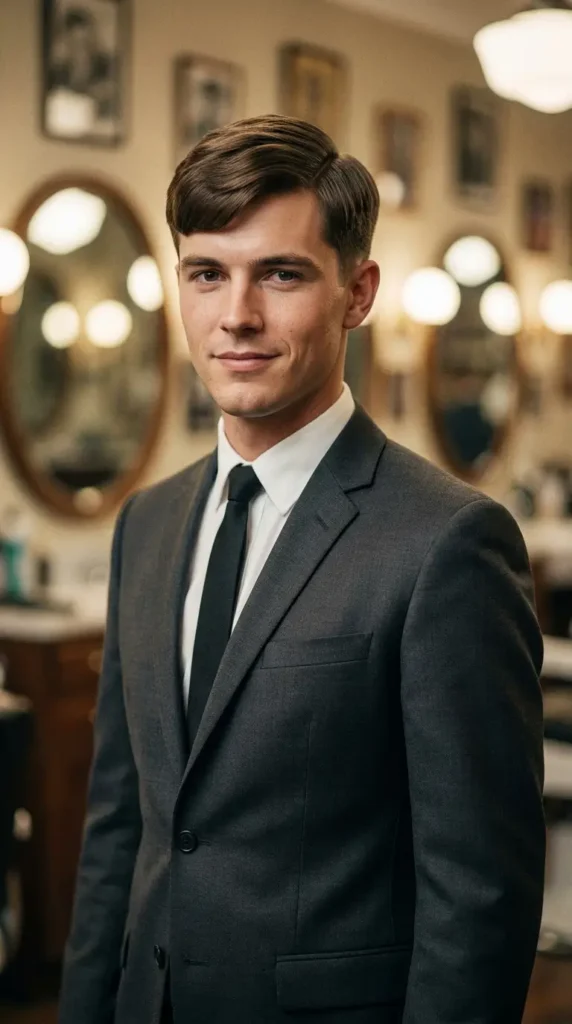
A rounded, helmet-like shape with soft graduated layers and a loose fringe that grazes the eyes. Faithful to the era, smooth flow, no sharp angles, gentle volume throughout. This is the museum-quality mod.
All face shapes work. Straight hair creates the cleanest version of this shape.
Celebrity reference: The Small Faces and The Who in their mid-1960s prime.
Blow-dry smooth with a nozzle attachment. Finish with light styling cream.
10. 90s Mod Cut
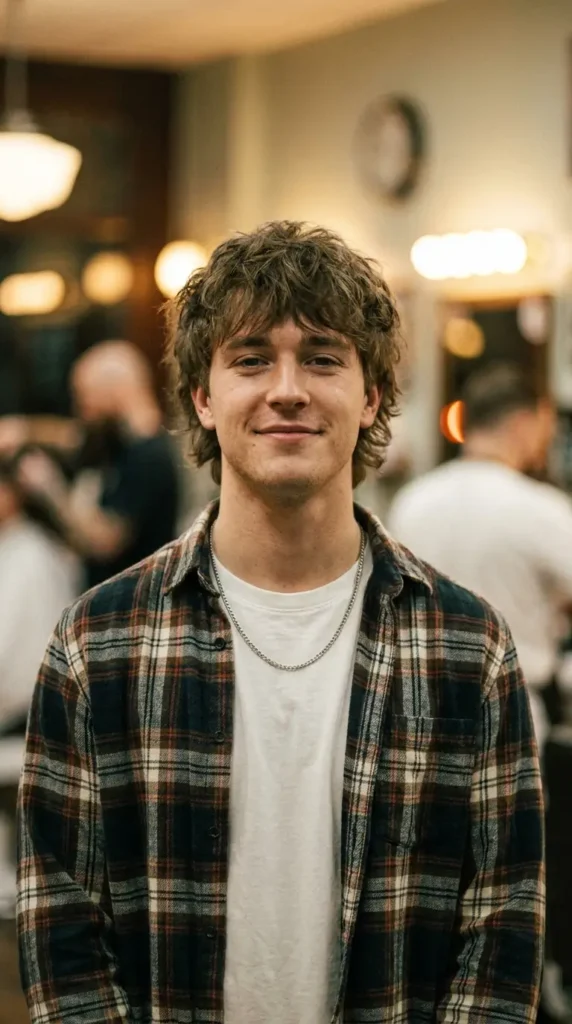
Choppy layers with a low-sitting, soft fringe. Sides are slightly longer than the modern mod, creating a rounded shape. The feeling is sharp but relaxed, Britpop in haircut form.
Square and heart-shaped faces benefit from the softening effect. Straight to slightly wavy hair works best.
Celebrity reference: Noel Gallagher, Damon Albarn (Blur).
Blow-dry lightly. Shape with fingers and texture clay for definition.
11. Choppy Mod Cut
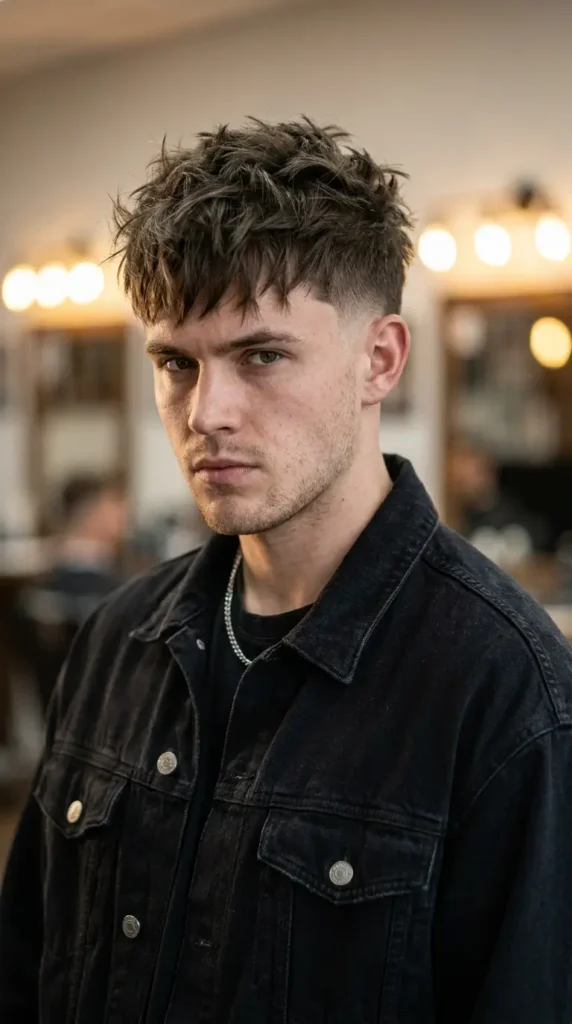
Uneven, broken-up layers create visible texture and lightness throughout. The fringe is thin and wispy rather than dense. The overall look feels light and airy, with movement in every direction.
Round faces benefit from the vertical visual interest this creates. Thick hair loves this cut because the choppiness removes bulk naturally.
Texture powder for lift and separation. Finger-tousle for an effortless finish.
12. Wavy Mod Cut
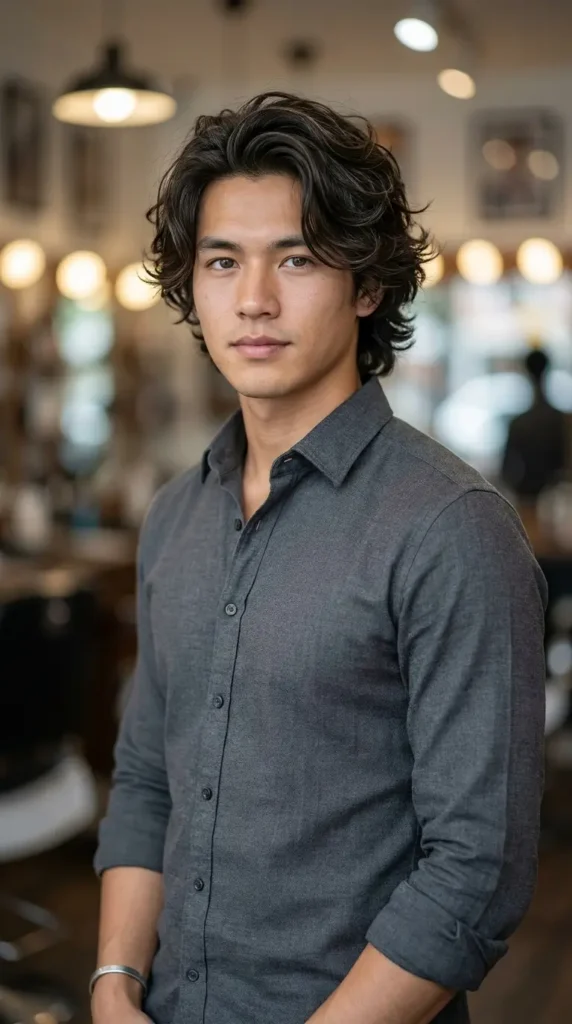
Natural waves are enhanced by layering into a soft, rounded shape. The fringe blends into the wave pattern instead of fighting it. Cut slightly longer than straight-hair versions to account for wave contraction. For more options that work with this texture, browse our full wavy hairstyles for men guide.
Oval and diamond faces look excellent. Naturally wavy hair (Type 2A-2B) is ideal here.
Sea salt spray to enhance the wave. Air-dry or diffuse on low heat.
13. Curly Mod Cut
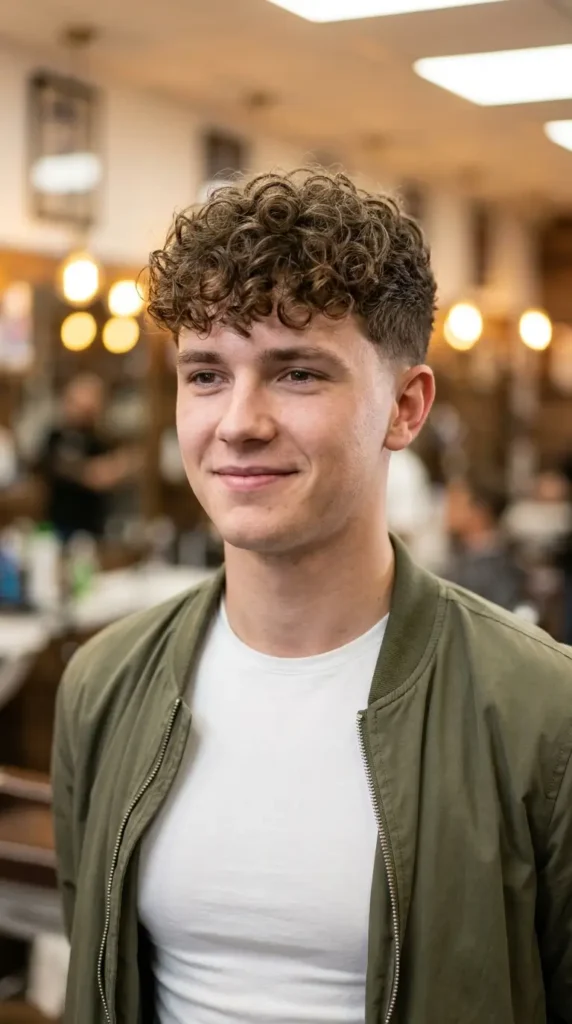
Loose curls shaped into a rounded mod silhouette with volume control. The fringe falls in individual curl clusters. Internal layering removes bulk while maintaining exterior length.
Key Point: Cut 1.5-2 inches longer overall to account for curl shrinkage when dry. Curly hair can shrink 25-50% from wet to dry length, making communication about desired dry length essential during the consultation.
Oval faces suit this. Naturally curly hair (Type 2C-3B) is the target.
Celebrity reference: Timothée Chalamet demonstrates how curly texture works beautifully within a mod structure.
Leave-in conditioner. Finger-diffuse. Avoid touching while drying.
14. Fluffy Mod Cut
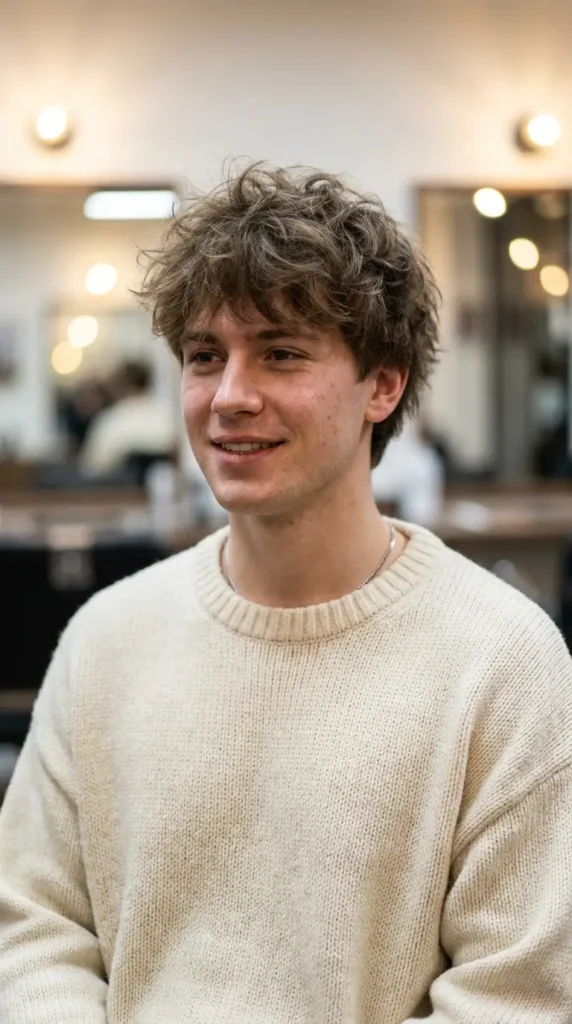
Airy, lifted layers with significant volume at the crown and a loose, bouncy fringe. Light and full rather than dense. This feels soft and touchable, connecting with the broader fluffy hair trend that continues gaining momentum.
Oblong faces benefit from the width this adds. Fine hair that needs a volume boost thrives here.
Volumizing mousse on damp hair. Blow-dry upward at roots. Texture powder for extra lift.
15. Layered Mod Cut
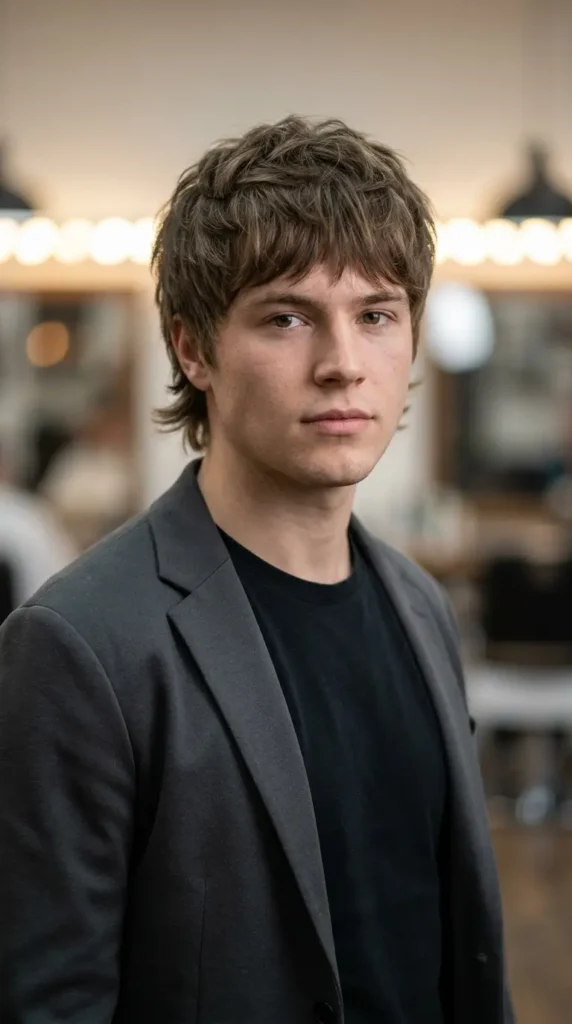
Visible soft layers throughout creating dimensional shape and easy movement, a standout within the broader category of layered haircuts for men. The fringe rests gently on the forehead. Sides and back maintain a rounded form without being heavy.
All face shapes work. Medium-density straight or wavy hair is ideal.
Round brush blow-dry. Light texture clay to highlight layer separation.
16. Mod Cut with Taper
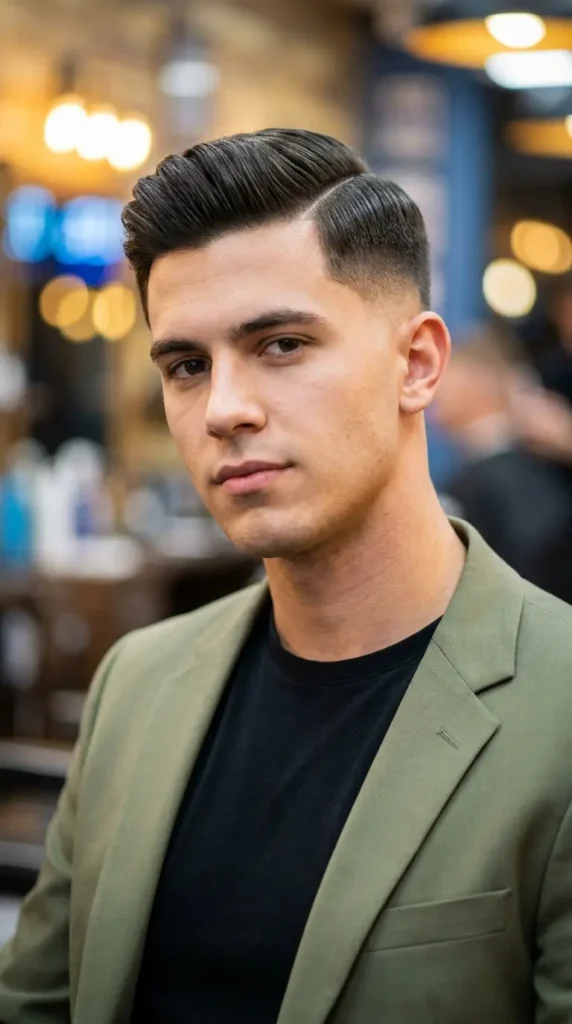
Classic mod shape on top. Sides and back taper down smoothly using scissors, not clippers. This creates clean contrast between the textured top and neat perimeter while maintaining the all-scissor-cut identity of a proper mod.
Round and square faces benefit from the structure. This is the most workplace-appropriate variation.
Molding paste for top control. Sides lay naturally after blow-drying.
17. Mod Cut with Fade
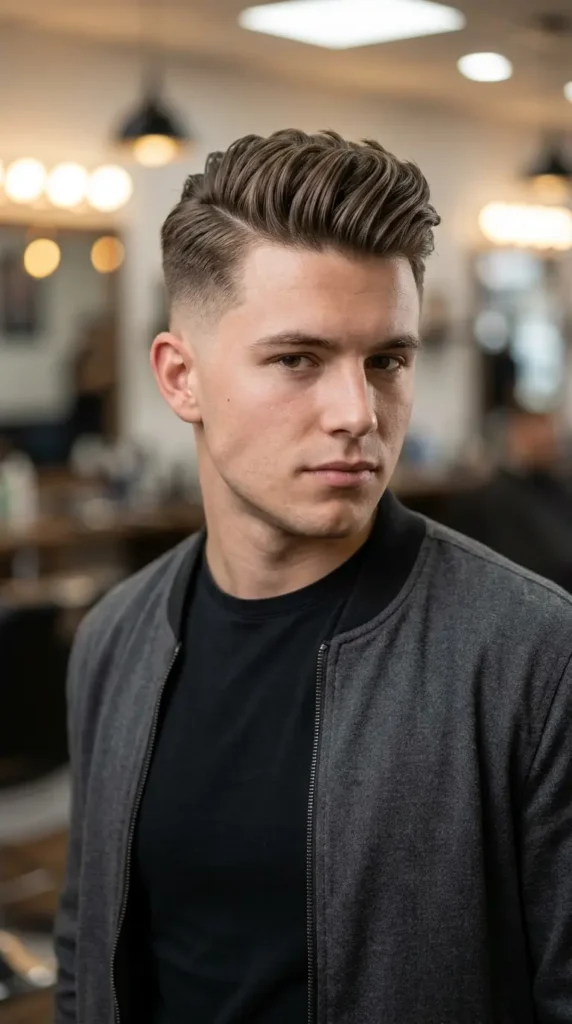
A modern hybrid that breaks tradition. The textured mod top is paired with a skin fade or low fade on the sides. This creates more contrast than any traditional mod and blends mod texture with contemporary barbering.
Round faces benefit from the height created by clean sides. This suits men who want mod character on top without the sides length.
Matte clay for the textured top. Sides need no product after the fade.
18. Mod Fringe Cut
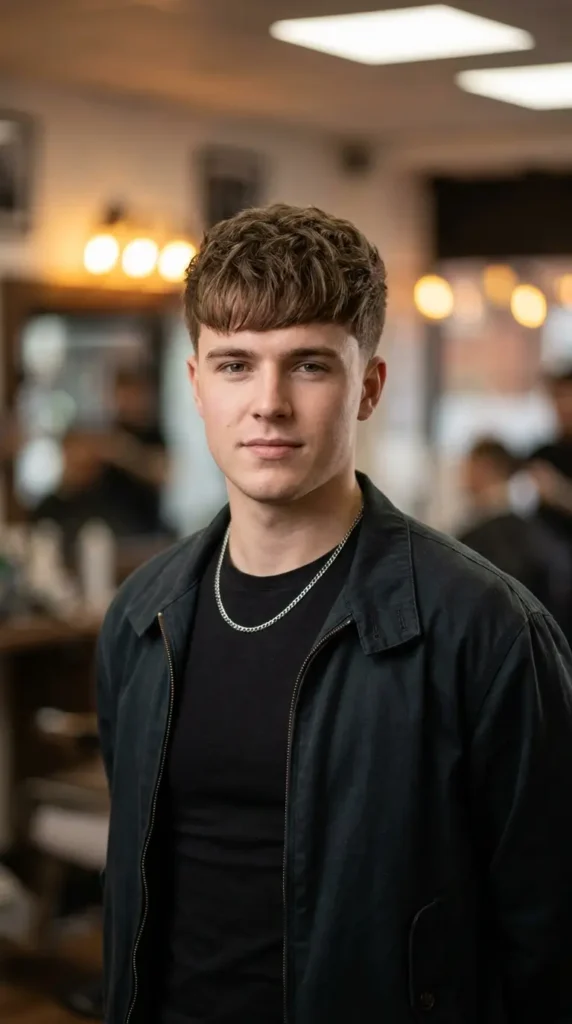
Fringe-forward style where the front section is the dominant visual element. The fringe is heavier, denser, and more defined than other variations. Everything else supports the fringe as the focal point. This is one of the strongest entries in the fringe hairstyles for men category.
Heart-shaped faces benefit most because a fuller fringe balances a wider forehead.
Blow-dry the fringe forward with a nozzle. Set with a cool shot. Light styling cream for hold.
19. Spiky Mod Cut
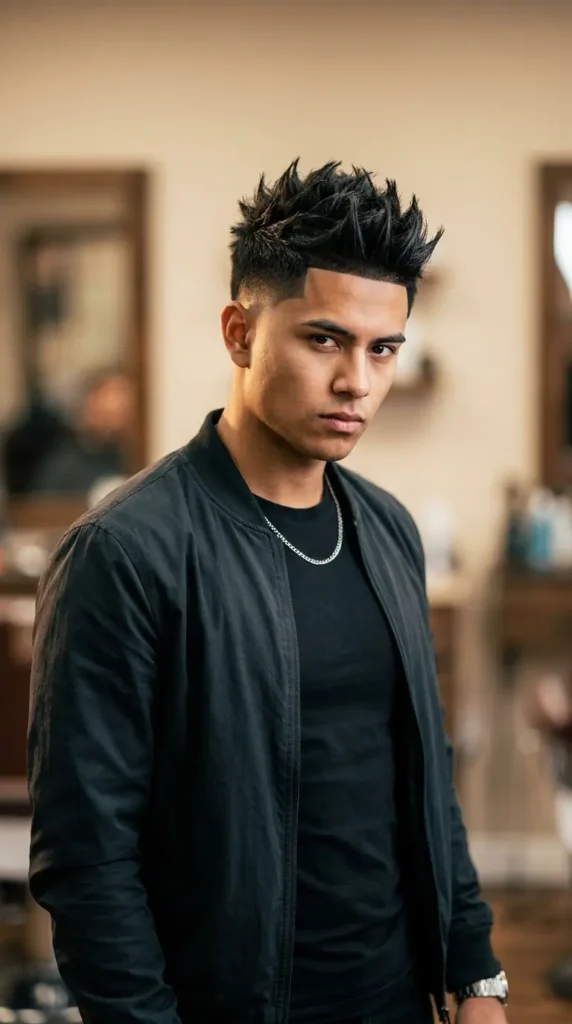
Choppy, lifted layers with sharp, textured tips creating bold height and vertical movement. Rougher and more aggressive texture than other mod variations. This has energy and attitude.
Round faces love the vertical lift. Straight to slightly wavy hair responds best to spiked styling.
Blow-dry upward while lifting sections. Texture clay for spike definition.
20. Wolf Mod Cut
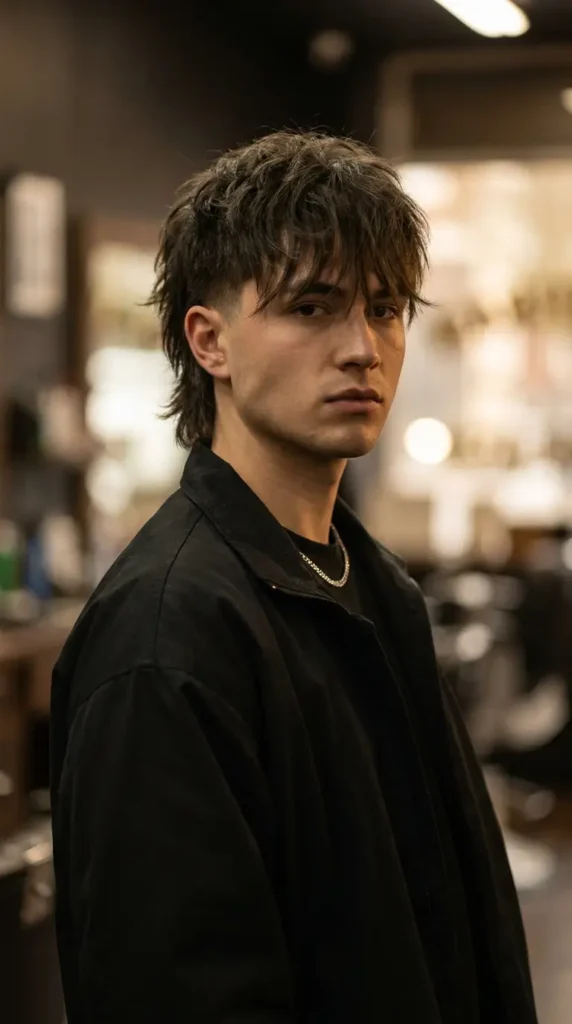
A fusion style combining the mod’s front structure with the wolf cut‘s heavy layering and longer back. Shaggier layers through the back and sides. Looser and wilder than a traditional mod but still maintains the fringe and crown volume that define the mod family.
Oval and diamond faces suit this. Wavy to curly hair adds natural life.
Light styling cream for smooth layers. Air-dry for natural texture.
21. Medium-Length Mod Cut
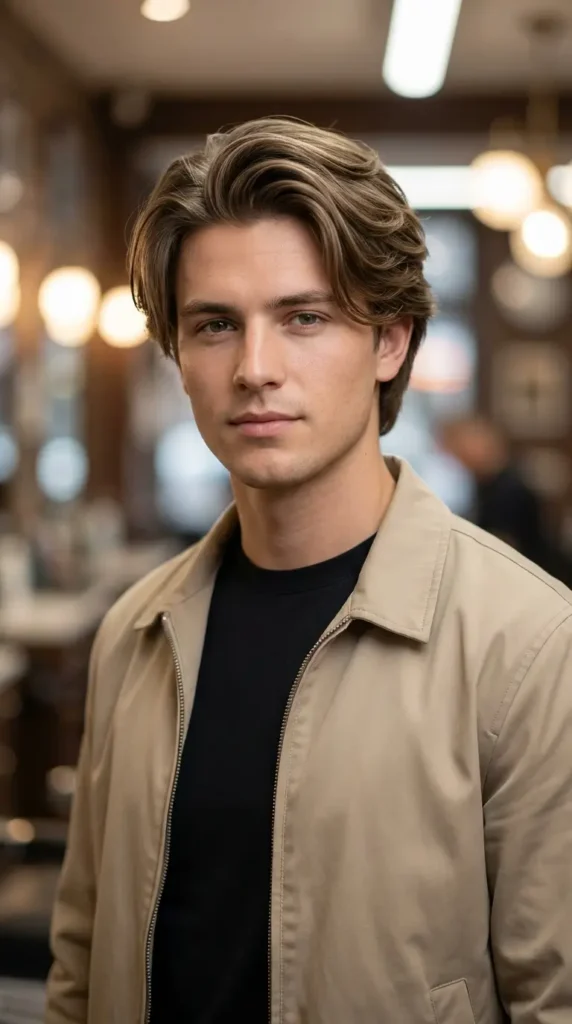
The balanced, versatile option. Roughly 4-5 inches throughout with a soft fringe and slightly longer back. This offers maximum styling flexibility, you can wear it messy, smooth, textured, or slicked depending on the day.
All face shapes. All hair types with appropriate internal layering.
Blow-dry with fingers for a casual finish. Styling cream for smooth control.
22. Mod Cut for Thick Hair
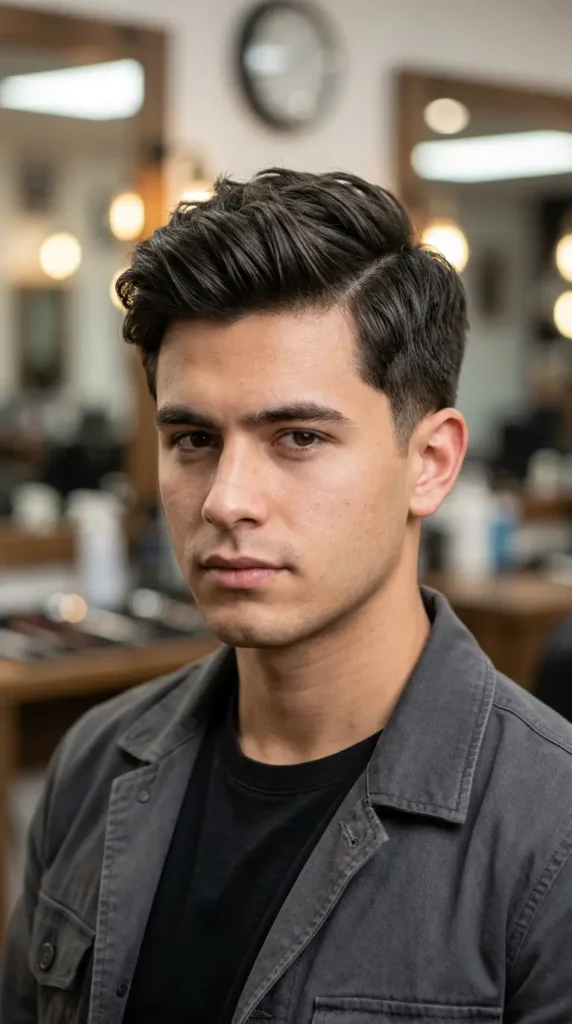
Thick hair needs internal bulk removal to achieve the mod’s light, moving silhouette. Thinning shears work throughout the interior while the exterior shape stays clean. Razoring at the ends adds lightness.
Tip: Request internal texturizing at every maintenance trim. Thick hair builds density faster between appointments, and the mod shape gets heavy quickly without regular weight removal.
Use lightweight products only. Sea salt spray and texture powder. Avoid heavy clays.
23. Mod Cut for Thin or Fine Hair
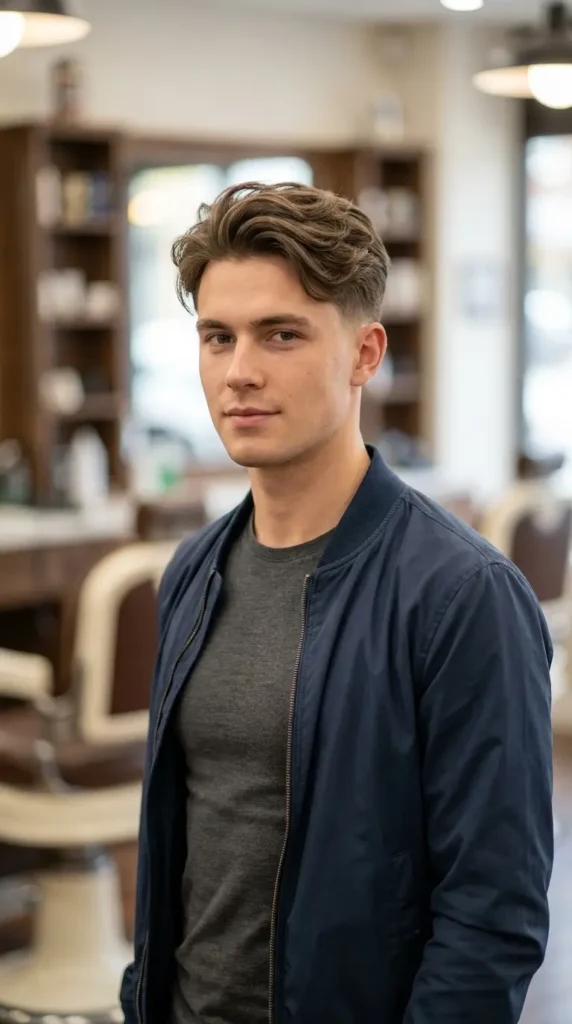
The opposite approach: preserve every strand of density. Blunt cutting maintains thickness. Minimal internal layering. Shorter layers only at the crown create lift, and the fringe is kept slightly denser for visual fullness.
Tip: Avoid thinning shears entirely on fine hair. You need every strand to maintain the shape.
Volumizing mousse at roots. Texture powder for body. Round brush blow-dry for maximum lift.
24. Side-Swept Mod Cut
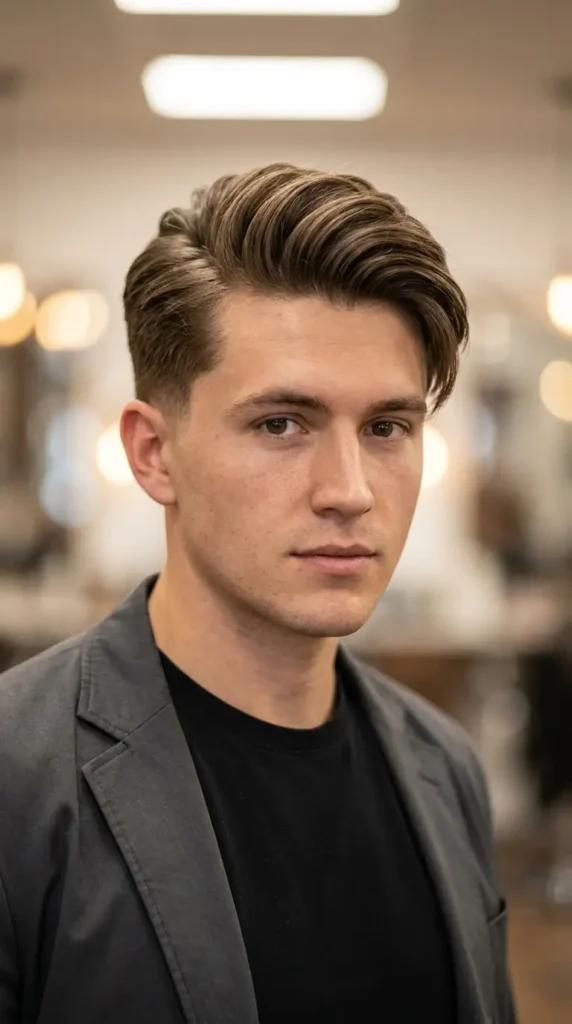
The fringe sweeps dramatically to one side rather than falling straight forward. This creates an asymmetric visual line across the forehead that adds movement and dynamism. The sides stay slightly longer to accommodate the directional flow, and the back tapers softly.
Diamond and heart-shaped faces benefit from the diagonal line breaking up facial width. Straight to slightly wavy hair holds the side-swept direction best.
Celebrity reference: Alex Turner during the AM era of Arctic Monkeys.
Blow-dry fringe to one side with nozzle. Lock direction with a light matte clay worked through the fringe.
25. Mod Cut with Sideburns
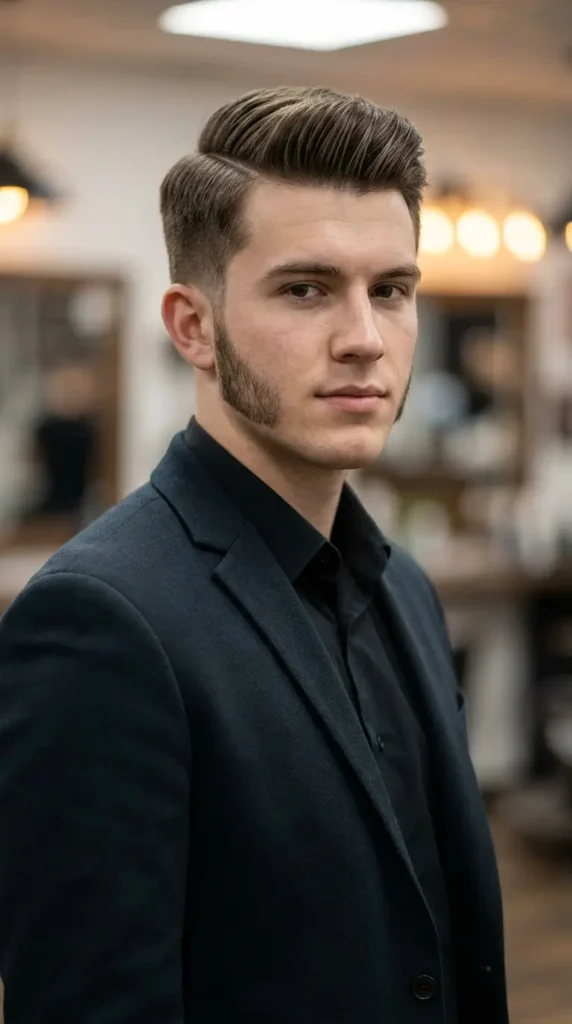
A deliberate mod variation that emphasizes longer sideburns as a style element. The sideburns extend to mid-ear or below, connecting the face-framing side pieces into a unified shape. The top maintains standard mod layers and fringe, but the sideburns give the whole cut a 1960s authenticity.
Oval and oblong faces suit this. All hair types work, sideburns grow the same regardless of top texture.
Style the top as usual. Keep sideburns groomed with a trimmer to maintain clean edges.
26. Feathered Mod Cut
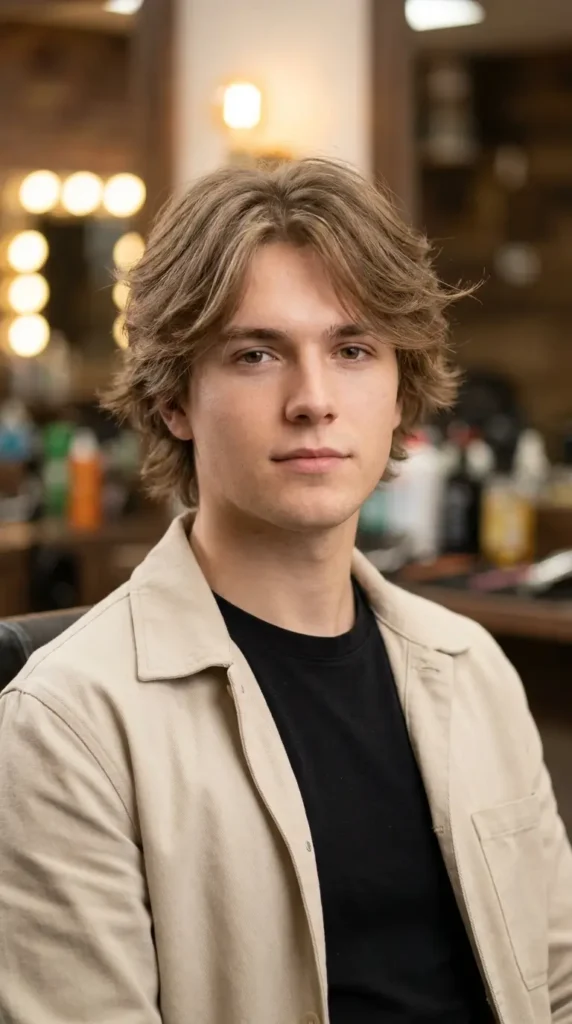
Soft, feathered edges throughout the entire cut create a light, wispy perimeter. Instead of blunt or choppy ends, every strand tapers to a delicate point. The silhouette is the same rounded mod shape, but the texture feels airier and more delicate.
Oval and square faces look great. Straight to slightly wavy, fine-to-medium density hair responds best to feathering.
Blow-dry gently on low heat. Light styling cream for smoothness. Avoid heavy products that collapse feathered ends.
27. Disconnected Mod Cut
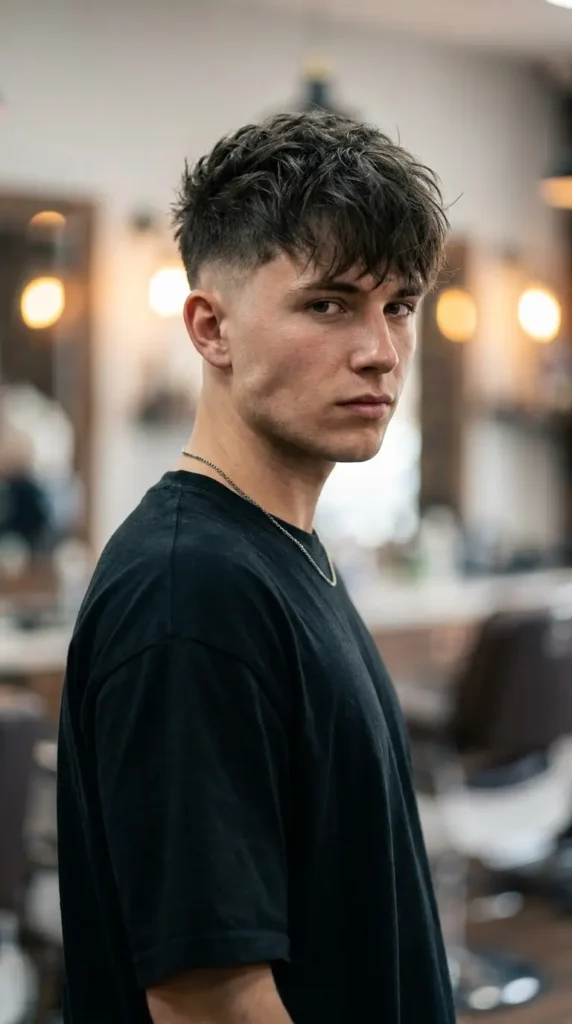
The top maintains full mod character, textured layers, defined fringe, crown volume, but a slight disconnection separates it from shorter sides. Unlike a traditional mod where length graduates smoothly from top to sides, this variation has a visible line of contrast. Not as extreme as an undercut, but more defined than a classic mod blend.
Round faces love the structured contrast. Straight and thick hair shows the disconnection most clearly.
Matte clay on top for texture. Sides lay flat naturally after blow-drying.
28. Mod Cut with Curtain Transition
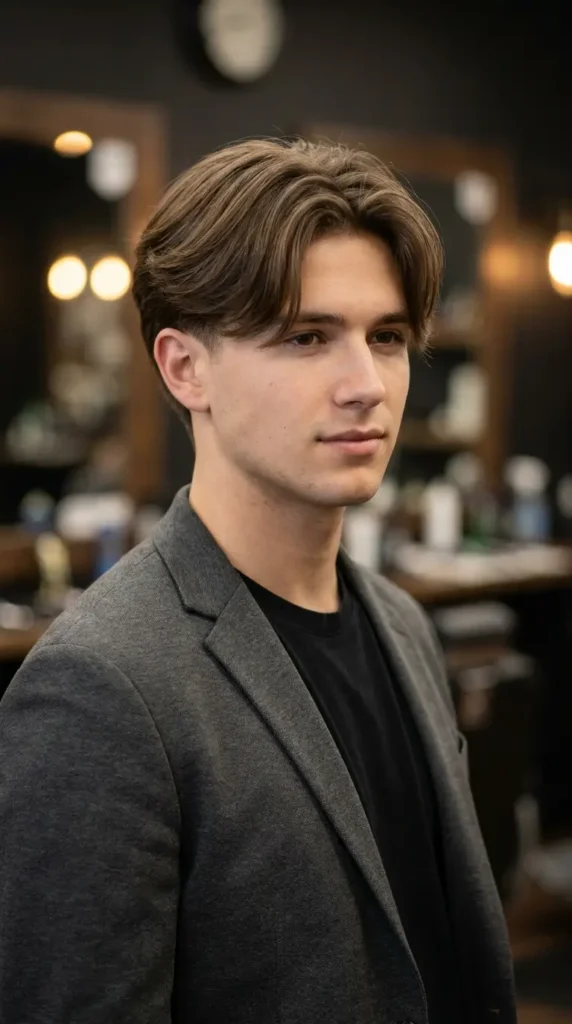
A hybrid that blends mod fringe character with a subtle center-parting tendency. The fringe is cut in a mod-forward style but styled with a slight center opening, creating a relaxed, half-mod half-curtain effect. This works for men who want mod texture without a full forward fringe commitment.
All face shapes. Wavy hair creates the most natural curtain-transition effect.
Sea salt spray for texture. Finger-part the fringe loosely while damp. Allow to air-dry for relaxed separation.
29. Micro-Fringe Mod Cut
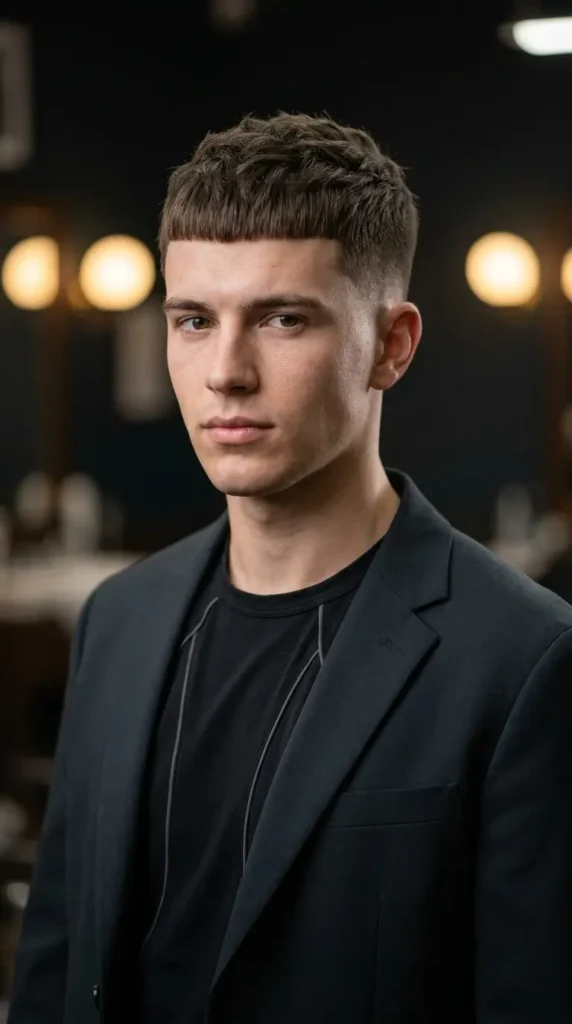
The boldest fringe variation. The fringe is cut very short, hitting mid-forehead or higher, creating a striking, fashion-forward look. The rest of the cut maintains standard mod layers and side length, but the micro-fringe gives it an editorial, avant-garde quality.
Oval faces handle this best because the exposed forehead does not upset balanced proportions. Best on straight hair where the short fringe lays flat rather than sticking up.
Minimal product needed on the fringe. Light clay through mid-lengths and back for texture.
30. Mod Perm Cut
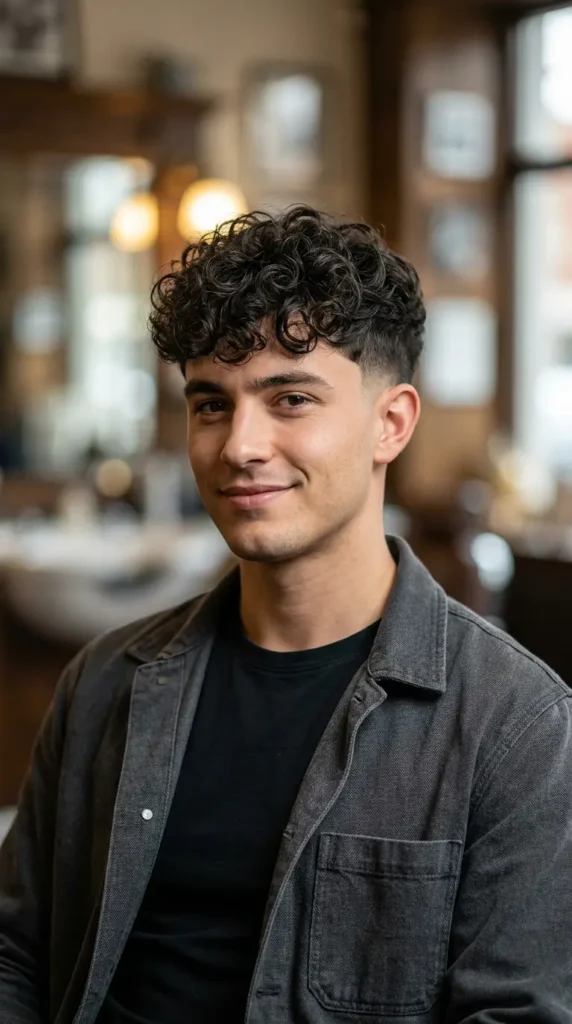
A permed curl pattern shaped into the mod silhouette. For men with naturally straight hair who want the curl-enhanced volume of a curly mod without having natural curls. The perm creates defined spirals that are then cut and shaped into the rounded mod form with internal layering for control.
Oval and heart-shaped faces suit this. Only appropriate for hair that is currently straight and healthy enough to withstand the chemical perm process.
Curl-defining cream. Scrunch upward. Air-dry or diffuse. Avoid brushing, finger-separate only.
History and Origin of the Mod Haircut
The mod haircut carries more cultural weight than most men’s styles. Understanding where it came from helps you appreciate why it keeps coming back, and why it looks the way it does.
The 1960s: Birth of the Modernist Look
The word “mod” is short for “Modernist.” In the late 1950s and early 1960s, young working-class men in London rejected the dull, conservative fashion of post-war Britain. They looked to Italian and French style for inspiration, sharp suits, slim trousers, and carefully styled hair that was longer and more intentional than anything their fathers wore.
Carnaby Street and Soho became the epicenters of this new movement. The music scene fueled it further. The Who, Pete Townshend, Keith Moon, and Roger Daltrey, became the visual icons of mod culture. The Small Faces, led by Steve Marriott, embodied the look perfectly: textured, layered hair with a defined fringe and natural movement.
Key Point: The Beatles wore a “mop top,” a uniform-length, bowl-shaped cut with no internal layering. This is NOT the same as a mod haircut. The mod has textured layers, variation in volume, and a more structured silhouette. This is a common confusion worth clarifying with your barber.
The Mods vs. Rockers clashes on Brighton beach in 1964 cemented mod identity in British culture forever.
The Evolution: 1970s to 1990s
Through the 1970s, the mod cut evolved into shaggier, feathered territory. Rod Stewart and David Bowie pushed it toward longer, wilder shapes.
Paul Weller revived the classic mod look in the late 1970s and early 1980s with The Jam. The 1979 film Quadrophenia, based on The Who’s rock opera, brought mod culture back to mainstream attention.
Then came the 1990s. Liam and Noel Gallagher of Oasis brought the messy mod to a global audience during the Britpop era. Alex Turner continued the tradition into the 2000s with Arctic Monkeys.
The 2024-2026 Resurgence
The Oasis reunion announcement in August 2024 triggered immediate renewed interest in the mod haircut. TikTok barbers declared it a top trend, and celebrities like Jacob Elordi, Paul Mescal, and Timothée Chalamet wore variations on red carpets throughout 2024 and 2025.
In 2026, the mod remains firmly trending because it balances retro nostalgia with modern low-maintenance appeal. It looks intentional without looking over-styled, exactly what most men want right now.
Mod Haircut vs. Other Styles: Key Differences
One of the biggest frustrations when researching the mod haircut is confusion with similar styles. Here is exactly how the mod differs from its closest relatives.
Mod Cut vs. Shag Haircut
The mod has a more structured silhouette with a defined fringe that sits as a separate element. The shag is heavily layered throughout with a deconstructed, messier shape and curtain-like front pieces rather than a forward fringe. The mod maintains intentional roundness. The shag deliberately breaks it apart.
Mod Cut vs. Wolf Cut
The mod is cleaner and rounder with a shorter back and more refined overall feeling. The wolf cut uses heavy internal layers, a dramatically longer back, and grunge influence. Think polished-casual (mod) versus deliberately wild (wolf cut).
Mod Cut vs. Curtain Bangs
Direction is the difference. A mod fringe falls forward or to one side as a unified element. Curtain bangs part at the center and drape symmetrically to both sides. Completely different framing effect on the face.
Mod Cut vs. Textured Crop
The mod has medium length with scissor-cut sides that maintain visible length. The textured crop is shorter overall with clipper-faded sides and a more rigid, compact shape. The mod keeps length through the sides. The crop removes it.
Mod Cut vs. Mullet
The mod distributes length evenly in a continuous flow from front to back. The mullet deliberately disconnects, short front and sides with a long back. The mod is harmonious. The mullet is intentionally contrasting.
Mod Cut vs. French Crop
Both have a forward fringe, but the French crop is significantly shorter overall with tightly clipper-faded sides and back. The mod fringe is longer with more texture and movement. The French crop fringe is typically blunt and uniform. The mod fringe is layered and piece-y.
Quick Comparison Table:
| Feature | Mod Cut | Shag | Wolf Cut | Textured Crop | French Crop |
|---|---|---|---|---|---|
| Overall length | Medium | Medium-Long | Long | Short-Medium | Short |
| Fringe | Forward/side | Curtain/parted | Forward | Forward (short) | Blunt forward |
| Sides | Scissor-cut | Scissor-cut | Scissor-cut | Clipper fade | Clipper fade |
| Layer intensity | Moderate | Heavy | Very heavy | Light | Minimal |
| Silhouette | Rounded, neat | Deconstructed | Wild, elongated | Compact | Tight, angular |
Which Mod Haircut Suits Your Face Shape?
Your face shape determines which mod variation will look most flattering. Here is specific guidance for each shape.
Oval Face
Nearly all mod variations work on oval faces. The balanced proportions need no correction, the haircut enhances natural symmetry regardless of which version you choose. Experiment freely. This is the most versatile face shape for mod styling. For more options designed specifically for this shape, explore our short haircuts for oval faces guide.
Best picks: Classic mod, modern mod, 60s mod, textured mod, essentially any variation.
Round Face
The goal is creating vertical visual interest and elongating the face. Longer textured fringe draws the eye downward. Height at the crown creates the illusion of length. Avoid very short, rounded mod cuts that mirror your face shape. For a complete breakdown of styles designed to slim and elongate, see our full guide to hairstyles for round faces.
Best picks: Textured mod, spiky mod, mod with taper, fluffy mod, disconnected mod.
Tip: Keep the fringe longer than eyebrow level to maximize the elongation effect.
Square Face
The goal is softening the angular jawline. Textured, relaxed layers create softness that balances a strong jaw. Side-swept fringe works better than straight-across fringe for square faces because it breaks the horizontal line.
Best picks: Messy mod, wavy mod, layered mod, shaggy mod, feathered mod.
Heart-Shaped Face
The goal is balancing a wider forehead with a narrower chin. A fuller, slightly longer fringe reduces the visual dominance of the forehead. Face-framing side pieces at jaw level add perceived width at the lower face.
Best picks: Mod fringe cut, medium-length mod, classic mod, mod perm.
Oblong or Rectangular Face
The goal is adding width and reducing perceived length. Volume at the sides counters facial length. A shorter fringe that hits mid-forehead, not below the eyebrows, visually shortens the face rather than elongating it further.
Best picks: Fluffy mod, shaggy mod, short mod, mod with sideburns.
Diamond Face
The goal is adding fullness at the forehead and jawline to balance prominent cheekbones. Layers at the temple area and jaw-level side pieces fill the narrower zones.
Best picks: Textured mod, layered mod with face-framing pieces, medium-length mod, side-swept mod.
Best Mod Haircut for Your Hair Type
Hair type determines how the mod needs to be cut and styled to achieve the right shape. Here is how each texture works with the mod structure.
Straight Hair (Type 1)
Straight hair is classic mod territory. The style was originally designed for this texture, and it responds perfectly to the structure. Standard mod cutting technique works without modification. Weight and shape are easily controlled.
Best variations: Classic mod, modern mod, 60s mod, choppy mod, micro-fringe mod, side-swept mod.
Styling note: Without any styling, very straight hair can look flat. A 3-minute blow-dry with forward direction transforms the shape from lifeless to intentional. Sea salt spray adds grip and piece-y texture.
Wavy Hair (Type 2A-2B)
Wavy hair has a natural advantage. The built-in movement and texture enhance the mod silhouette without requiring much effort. Cut 0.5-1 inch longer than desired final length because waves contract as they dry. Point-cutting enhances the natural wave pattern.
Best variations: Wavy mod, messy mod, textured mod, shaggy mod, curtain-transition mod.
Styling note: Sea salt spray amplifies waves. Air-drying is completely viable, no blow-dryer required. Wavy mod haircuts often look their best on day 2 when natural oils enhance texture.
Curly Hair (Type 2C-3B)
Curly hair absolutely works with a mod, it just needs modification. Cut 1.5-2 inches longer to account for curl shrinkage when dry. Internal layering removes bulk without shortening the exterior. The fringe must be long enough to show the curl pattern instead of sticking straight out.
Best variations: Curly mod, shaggy mod, long mod, mod perm (for added uniformity).
Styling note: Diffuse on low heat rather than blow-drying with a round brush. Leave-in conditioner controls frizz. Never brush a curly mod when dry, finger-separate only.
Key consideration: Communicate with your barber about desired DRY length, not wet length. The difference can be dramatic with tighter curl patterns.
Thick or Dense Hair
The challenge with thick hair is heaviness. Bulk overwhelms the mod’s light, moving silhouette. Internal thinning with thinning shears removes weight throughout the interior while keeping the exterior shape intact. Razoring at ends adds lightness.
Best variations: Textured mod, choppy mod, mod for thick hair, shaggy mod, disconnected mod.
Styling note: Use lightweight products only, sea salt spray and texture powder. Heavy clays and pomades flatten thick hair under its own weight.
Thin or Fine Hair
The opposite challenge: you cannot afford to lose density. Blunt cutting preserves thickness. Minimal internal layering, or none at all. Strategic shorter layers only at the crown create lift. The fringe is kept slightly denser for visual fullness.
Best variations: Short mod, modern mod, fluffy mod, mod fringe cut, feathered mod.
Styling note: Volumizing mousse at roots before blow-drying. Texture powder for body without weight. Avoid thinning shears completely.
How to Ask Your Barber for a Mod Haircut
Getting the mod you want depends entirely on how well you communicate with your barber. Here is exactly how to do it.
Bring a Reference Photo That Matches Your Hair
Find 2-3 photos of the exact variation you want. This is the single most important step.
Critical rule: Choose photos of someone with a similar hair texture and density to yours. A thick-haired model’s mod will look completely different on fine hair. Hair color also affects how a cut appears in photos.
Save photos to your phone before the appointment. Do not rely on finding them in the chair.
Use These Specific Terms
Instead of just saying “I want a mod haircut,” which means different things to different barbers, use structural language:
- “Scissor-cut only, no clippers on the sides”
- “I want [X inches] on top with a forward-falling fringe to [mid-forehead / eyebrow level / above eyebrows]”
- “Soft internal layers for texture and movement, not blocky weight”
- “Point-cut the ends for a piece-y, textured finish”
- “Taper the sides with scissors, I want visible length through the sides, not a fade”
- “Keep the face-framing pieces to [ear level / below ear / above ear]”
Tip: If your barber is not familiar with the term “mod cut,” describe the structure instead. Structure-based communication (“textured scissor-cut layers, defined fringe, length through the sides, volume at the crown”) works universally regardless of what the barber calls the style.
Discuss Length and Shape Specifics
Be precise about measurements:
- Top length: 3.5-5.5 inches for most mod variations
- Side length: 1.5-3 inches (scissor-cut)
- Fringe: Where should it fall? Mid-forehead, eyebrow-grazing, or above eyebrows?
- Back: Tapered, rounded, or slightly longer?
- Internal texture: Do you want thinning? (Yes for thick hair, no for fine hair)
What to Expect During the Appointment
A proper mod haircut takes 35-50 minutes, longer than a clipper cut because scissors-only work requires more time and precision. Your barber will section the hair and work through different elevation angles section by section.
Expect point-cutting and potentially razor-texturizing at the ends. A good barber will blow-dry and style after cutting to show you the final shape and teach you how to recreate it at home.
Tip: Book a consultation appointment first if you are making a dramatic change from your current cut. Many barbers offer free 10-minute consultations to discuss options before committing.
How to Style a Mod Haircut (Step-by-Step)
A mod haircut takes 5-8 minutes to style with a blow-dryer, or 2 minutes with the air-dry method. Here is the complete routine.
Step 1: Start with Towel-Dried, Damp Hair
Wash your hair or wet it thoroughly. Towel-dry until it is about 70-80% damp, not dripping wet, but not dry either. Damp hair accepts product evenly and responds to directional blow-drying.
Tip: Squeeze excess water gently. Never rub aggressively with a towel, that causes frizz and breakage over time.
Step 2: Apply a Pre-Styler
Take a pea-sized amount of your chosen pre-styler. Warm it between your palms until it emulsifies (becomes spreadable). Work through hair from roots to ends using your fingers.
Focus extra product at the crown (where you want volume) and the fringe (where you want direction).
Product choices:
- Sea salt spray for texture and wave enhancement
- Volumizing mousse for root lift and body
- Styling cream for smooth control and frizz reduction
Step 3: Blow-Dry for Direction and Volume
Attach the nozzle concentrator to your blow-dryer. Set to medium heat, medium speed.
- Fringe: Direct forward. Push hair toward the forehead from the crown while drying.
- Crown: Lift roots upward with your fingers while drying from underneath, this creates root lift and volume.
- Sides: Direct backward and slightly downward for a natural lay.
- Total time: 4-6 minutes.
- Final step: Finish with 10 seconds of cool air (the cool shot button) to set the shape in place.
Step 4: Apply a Finishing Product
Warm a fingertip-sized amount of your chosen finisher between your palms. Work through mid-lengths and ends only, avoid roots because product at the roots causes flatness.
Pinch and twist individual pieces for separation and definition. Tousle the fringe into your preferred position, forward, side-swept, or slightly lifted.
Product choices:
- Matte clay for hold and texture (medium hold, zero shine)
- Texture powder for lift and grip (light hold, high volume)
- Fiber paste for flexible reshaping throughout the day (medium hold)
Air-Dry Alternative (No Heat Method)
Not everyone wants to blow-dry daily. Here is the heat-free approach:
- Apply sea salt spray generously to damp hair
- Scrunch and tousle with fingers to create texture
- Direct fringe forward with fingers and leave to dry naturally (15-25 minutes)
- Once dry, apply a small amount of texture powder for lift
The result is a more relaxed, lived-in finish compared to the blow-dried version. This works best for wavy and curly hair types.
Second-Day Styling (Day 2+ Without Washing)
Mod haircuts often look better on day 2 when natural oils add texture and weight.
- Refresh with dry shampoo at roots for volume
- Re-tousle with fingers
- Add a tiny amount of clay only if needed
- No re-wetting or re-drying required
Tip: Wash your hair every 2-3 days, not daily. Over-washing strips the natural oils that actually help mod styling.
Best Products for Mod Haircuts
The right product makes the difference between a mod that falls flat and one that holds its shape all day. Here is what each product type does and when to use it.
Sea Salt Spray (Pre-Styler)
Best for: Messy mod, wavy mod, shaggy mod, air-dry styling.
Adds grip, enhances natural wave, creates piece-y separation. Apply on damp hair before drying. Light hold.
Volumizing Mousse (Pre-Styler)
Best for: Fluffy mod, fine/thin hair, any variation needing root lift.
Builds volume from the root without weight. Apply on damp hair before blow-drying. Light to medium hold.
Matte Clay (Finisher)
Best for: Textured mod, choppy mod, modern mod, spiky mod.
Medium hold with zero shine. Creates defined texture and separation. Apply on dry hair as the final step.
Texture Powder (Finisher)
Best for: Fine hair, fluffy mod, any style needing instant root volume.
Absorbs oil, creates instant lift and grip at roots. Sprinkle on dry hair and work in with fingers. Light hold with high grip.
Fiber Paste (Finisher)
Best for: Classic mod, medium-length mod.
Reworkable hold that allows restyling throughout the day without reapplying. Apply on dry or slightly damp hair. Medium hold with flexibility.
Styling Cream (All-Rounder)
Best for: 60s mod, classic mod, straight hair mod cuts.
Smooths frizz, adds subtle shine, maintains natural movement. Apply on damp hair before drying. Light hold.
Dry Shampoo (Maintenance)
Best for: All variations on day 2 and day 3 between washes.
Absorbs oil at roots, refreshes volume, extends time between washes. Apply on dry hair at roots only.
Products to Avoid
- Heavy pomade: Flattens texture and creates unnatural shine incompatible with the mod look
- Strong-hold gel: Creates stiffness that eliminates natural movement
- Oil-based heavy products: Weigh down layers and kill volume
How to Maintain a Mod Haircut
A mod haircut is low to medium maintenance. Here is how to keep it looking sharp between appointments.
Trim Frequency
- Structured mod variations (modern, classic, mod with taper): Every 5-6 weeks
- Messier variations (shaggy, messy, long mod): Every 7-8 weeks
The fringe grows out fastest. It usually needs attention before the rest of the cut.
At maintenance appointments, ask: “Reshape the fringe, clean up the nape, and thin the interior.”
Cost-saving tip: A maintenance trim takes 15-20 minutes versus 35-50 for the initial cut. Many barbers charge less for reshape appointments.
Washing and Daily Care
- Wash every 2-3 days, not daily
- Use sulfate-free shampoo to preserve natural moisture
- Condition from mid-lengths to ends only (not roots)
- Weekly deep conditioning for longer mod variations
Heat Protection
Apply heat protectant spray before every blow-dry session. Medium heat is sufficient, high heat causes dryness and long-term damage. A weekly argan oil treatment maintains softness and reduces frizz for longer mod cuts.
Growing Out a Mod Haircut
One of the mod’s biggest advantages is that it grows out gracefully. Because the entire cut is scissor-based with graduated layering, there are no visible clipper lines or harsh edges that appear as the hair lengthens.
At 8-10 weeks without a trim, a short mod becomes a medium mod. A medium mod becomes a shaggy mod. The transitions are natural and often intentional.
If you want to grow it out, tell your barber: “Clean up but keep the length.”
Mod Haircut Styling Problems (Troubleshooting)
Even with the right cut, styling issues happen. Here are the most common problems and their fixes.
“My Fringe Keeps Splitting in the Middle”
Cause: A natural growth pattern or cowlick directs hair to both sides.
Fix: Blow-dry forward with the nozzle while hair is fully damp, you need to override the natural parting with heat direction. Apply a small amount of clay to the fringe base for directional hold.
Long-term solution: Ask your barber to cut the fringe slightly asymmetric to combat the split.
“My Mod Haircut Looks Flat”
Cause: Too much product, product applied at roots, or insufficient blow-drying.
Fix: Use texture powder at roots for instant lift. Blow-dry upward at the crown before drying forward.
Prevention: Apply finishing product to mid-lengths and ends only. Never put clay or paste directly on roots.
“My Layers Lose Definition by Afternoon”
Cause: Insufficient hold in the finishing product or humidity.
Fix: Switch from cream to matte clay (more hold). Use a light-hold hairspray mist from 12 inches away as a final seal after styling.
Prevention: The cool shot after blow-drying locks the shape. Texture powder refreshes midday.
“It Looks Like a Bowl Cut”
Cause: Insufficient internal layering. Too much weight sitting at the perimeter.
Fix: Return to your barber and request internal texturizing and point-cutting at the perimeter.
Prevention: Next cut, specifically say: “I need broken-up perimeter edges, not a solid weight line.”
Celebrity Mod Haircut Inspiration
Use these recognizable references when choosing your variation and communicating with your barber.
Jacob Elordi: Modern Mod
Worn at the 2023 Priscilla premiere and throughout 2024 press tours. Shorter, cleaner variation with minimal fringe and subtle texture on top. His version is understated and refined rather than dramatic, proof that the mod does not require bold length commitment.
Liam Gallagher: Messy Mod
His signature since the mid-1990s Oasis era. Choppy, flat layers with a short, blunt fringe and straight texture. The defining quality is zero-effort appearance, deliberately unstyled and rock-and-roll. He maintained this look through the 2025 reunion tour.
Paul Mescal: Textured Mod
Visible across 2023-2025 red carpets and press appearances. Slightly longer than Elordi’s with visible texture, natural wave enhancement, and piece-y fringe movement. He demonstrates that the mod works beautifully on wavy, not just straight, hair.
Alex Turner: Classic/60s Mod to Side-Swept Mod
Evolved through multiple mod variations across Arctic Monkeys eras. Earlier work: classic rounded mod with a heavy fringe. Later: side-swept, slicked mod variation. He shows how one person can wear multiple mod versions over a career.
Timothée Chalamet: Shaggy/Curly Mod
Naturally curly texture shaped into a longer mod silhouette. Fringe blends into curls. Volume throughout. Undone aesthetic. He is the best modern proof that curly hair is not just compatible with the mod, it can be the ideal texture for certain variations.
Tom Holland: Short/Modern Mod
Clean, conservative mod with subtle texture and a short fringe. Workplace-appropriate. This is the entry-level mod for men who want the character without the commitment. Accessible and easy to maintain.
Is the Mod Haircut Right for You?
Here is an honest assessment. Not every style works for every person, and the mod is no exception.
The Mod Works Best If You…
- Have straight, wavy, or loosely curly hair
- Are willing to spend 5-8 minutes styling daily (or 2 minutes for air-dry method)
- Want a versatile style that works casual and semi-formal
- Prefer a scissors-only cut without clippers
- Like textured, natural movement over rigid, structured styling
- Have enough density at the front to support a fringe
Consider a Different Style If You…
- Have significant thinning at the hairline or crown, choppy layers can draw attention to sparse areas
- Strongly dislike any hair touching your forehead, the fringe is a non-negotiable element
- Want a completely wash-and-go style with zero styling time
- Prefer a very short, military-style or corporate look, the mod’s length and texture will not align
If you have a larger forehead and want the mod specifically for fringe coverage, our big forehead haircuts for men guide includes the mod alongside other covering options.
Age and Workplace Suitability
The mod works from teens through early 40s without looking age-inappropriate. Paul Weller has worn mod-inspired styles into his 60s, proving the look adapts across decades when proportions suit the individual.
- Professional settings: Modern mod, mod with taper, short mod, all workplace-appropriate
- Creative industries: Any variation works
- Casual settings: Messy mod, shaggy mod, long mod, maximum personal expression
How to Grow Into a Mod Haircut
If your hair is currently too short for a mod, here is how to transition.
Starting from a buzz cut or very short hair: Expect 3-4 months of growth before a barber can shape mod structure. Average hair grows approximately 0.5 inches per month, and a mod needs minimum 3 inches on top and 1.5 inches on sides.
Starting from a faded or undercut style: The sides need 2-3 months to reach scissor-length. The top may already be long enough. The transition from clipped sides to scissor-length sides is the awkward phase.
Starting from a longer style: A barber can reshape immediately into a mod variation. No growing required.
During the grow-in phase:
- Tell your barber: “Clean-up trims only, maintain length, just trim the nape and around the ears”
- Use a headband, cap, or slicked-back styling during the awkward month 2-3 period
- Be patient. The mod is worth the wait.
Frequently Asked Questions
What is a mod haircut?
A mod haircut is a medium-length, scissor-cut men’s hairstyle featuring textured layers, a forward-falling fringe, and natural volume at the crown. It originated in 1960s British mod subculture and has been revived multiple times, most recently in 2024-2026 through the Oasis reunion and celebrity adoption.
Is the mod haircut still trending in 2026?
Yes, the mod haircut remains one of the most requested men’s styles in 2026. The Oasis reunion tour, TikTok barber endorsements, and celebrities like Jacob Elordi and Paul Mescal wearing variations have kept demand high since 2024.
What is the difference between a mod haircut and a shag?
A mod haircut has a more structured silhouette with a defined forward fringe, while a shag is more heavily layered with a deconstructed, messier shape and curtain-style front pieces. The mod maintains intentional roundness. The shag deliberately breaks it apart.
How long does hair need to be for a mod haircut?
You need minimum 3 inches on top and 1.5 inches on sides for the shortest mod variations. Most popular versions require 4-5 inches on top and 2-3 inches on sides. If starting from a very short cut, expect 3-4 months of growth.
Can you get a mod haircut with curly hair?
Yes, curly hair works well with a mod when the cut is adapted for curl behavior. Request 1.5-2 inches of extra length to account for curl shrinkage, ask for internal layering to control bulk, and use a diffuser instead of a round brush for styling.
How often should you trim a mod haircut?
Every 5-6 weeks for structured variations and 7-8 weeks for messier versions. The fringe grows out fastest and usually needs attention before the sides or back.
Is a mod haircut high maintenance?
A mod haircut is low to medium maintenance, requiring 5-8 minutes of daily styling with a blow-dryer or 2 minutes with an air-dry method. Compared to faded styles that need barber visits every 2-3 weeks, the mod’s scissor-cut structure grows out much more gracefully.
What should I tell my barber for a mod haircut?
Ask for a scissor-cut with textured layers on top, a forward-falling fringe to your desired length, and tapered (not clipped) sides. Bring 2-3 reference photos matching your hair texture and specify fringe length in inches.
Does a mod haircut work for round faces?
Yes. A longer textured fringe and height at the crown create vertical visual interest that elongates a round face. Choose textured, spiky, or tapered variations. Avoid very short, rounded cuts that mirror your face shape.
What products should I avoid with a mod haircut?
Avoid heavy pomade, strong-hold gel, and oil-based products. These create stiffness, unnatural shine, and weight that eliminate the mod’s defining characteristics: natural movement, texture, and light volume. Stick to matte clays, sea salt sprays, and texture powders.
How do I stop my mod fringe from going flat?
Apply texture powder at the fringe roots for instant lift, and blow-dry forward and slightly upward while damp. Avoid putting any heavy finishing product directly on fringe roots, this is the most common cause of flatness.
Can older men wear a mod haircut?
The mod works well into the early 40s, and shorter variations remain appropriate at any age. Paul Weller has worn mod-inspired styles for over four decades. The key is choosing proportions that suit your current face and lifestyle rather than forcing a variation designed for a 20-year-old.
What is the difference between a mod haircut and a curtain haircut?
A mod haircut has a forward-falling or side-swept fringe as a single directional element, while a curtain haircut parts at the center and drapes symmetrically to both sides. The mod creates asymmetric visual interest. The curtain creates balanced, symmetrical framing.
How is a mod haircut different from a slick back?
A mod haircut directs hair forward and to the sides with textured volume, while a slick back pushes all hair backward with product for a smooth, flat-against-the-head appearance. They are opposite directions of styling. Some mod wearers (like Alex Turner in later years) transition between both looks with the same cut length.
Is a mod haircut the same as a mullet?
No. A mod haircut distributes length evenly in a continuous flow from front to back, with textured layers throughout and no dramatic contrast between sections. A mullet deliberately disconnects, keeping the front and sides short while the back stays long. The mod is harmonious and blended; the mullet is intentionally contrasting. Some hybrid styles, like the mod mullet, combine both, but a standard mod is structurally different from a standard mullet.
What hair type works best for a mod haircut?
Straight hair works best for the classic and modern mod variations since it holds the rounded silhouette cleanly with minimal effort. Wavy hair is considered ideal for the style overall, since natural texture enhances the mod’s signature movement without much styling. Curly and thick hair also work well with proper internal layering to manage bulk, while fine hair does best with minimal layering to preserve density.
Which haircuts are allowed in Islam?
Islamic guidance on hair generally permits most conventional haircuts, provided the style does not imitate practices specifically associated with non-believers in a religious context or create extreme imbalance, such as shaving one side of the head while leaving the other long (known as Qaza). A mod haircut, with its even length and structured layering on both sides, falls within styles widely considered acceptable by Islamic scholars, though individuals should consult their own scholar or community guidance for specific rulings.