
Let’s be real for a second.
You looked in the mirror this morning and noticed your hairline isn’t where it used to be. Maybe the temples have crept back. Maybe you’ve got that M-shape forming. Maybe you’re worried people notice.
Here’s the truth almost no one tells you: a receding hairline is incredibly common, and it doesn’t have to define how you look or feel.
According to a study published in Dermatologic Surgery, male pattern hair loss affects 42% of men aged 18 to 49. By the time men reach their forties, more than half have some degree of moderate to extensive hair loss.
You’re not alone. And more importantly, you’re not out of options.
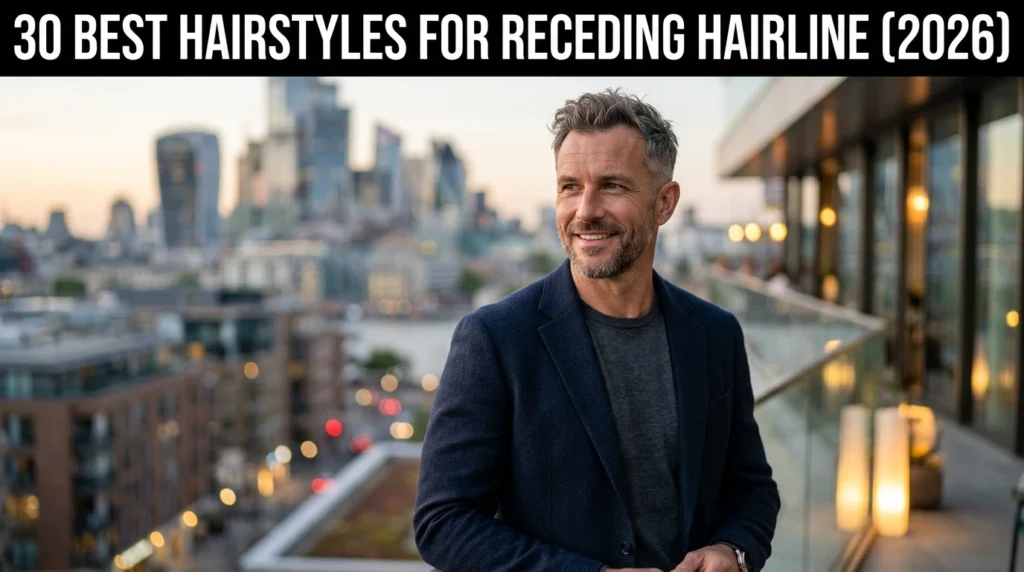
This guide covers 30 hairstyles that actually work with a receding hairline in 2026. Not styles that try to hide it like you’re ashamed. Styles that look intentional, confident, and sharp, backed by real barber scripts, styling tips, and product recommendations.
We also cover the 5 styles you should never try, how to identify your Norwood stage, and when a haircut alone isn’t enough.
Let’s get started.
First, Identify Your Hairline Stage (Norwood Scale)
Before you pick a haircut, you need to know exactly where you stand. Hair loss happens in stages. Different stages call for different styles.
Stage 1-2: Minor Temple Recession
Your hairline has moved back slightly at the corners. Most people won’t even notice. Best styles for you: textured crops, side parts, and soft quiffs.
Stage 3: Pronounced M-Shape
The temples are clearly set back, but you still have good density across the front. Best styles for you: French crop, textured fringe, and side-swept cuts.
Stage 4-5: Advanced Recession
Your frontal hairline has thinned significantly. The crown may also be affected. Best styles for you: buzz cuts, crew cuts, and high fades. For a detailed breakdown of the crew cut, check out our guide.
Stage 6-7: Extensive Hair Loss
The classic horseshoe pattern is forming. Best styles for you: clean shave or close buzz paired with a beard.
According to Mayo Clinic, the earlier you address hair loss, the more treatment options and styling choices you’ll have. Don’t wait until you’re at stage 6 to make a change.
The 30 Best Hairstyles for Receding Hairline
Below you’ll find 30 haircuts organized by category. Each one includes exactly what to tell your barber, which Norwood stage it works for, how long it takes to style, the best product to use, a pro tip, and which face shapes it flatters.
1. French Crop
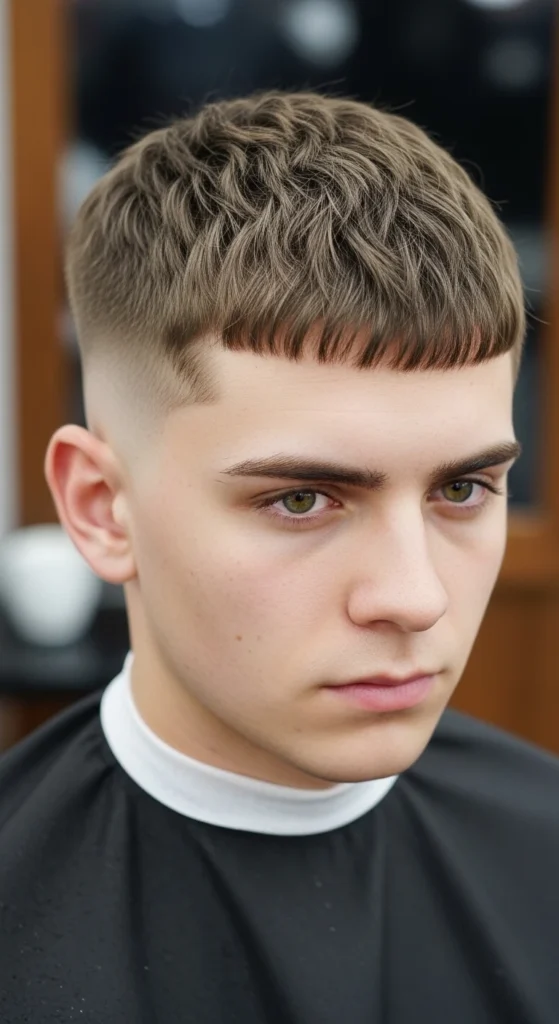
What to tell your barber: “Short back and sides with a skin fade. Leave one to two inches on top. Cut a choppy fringe that sits just above my eyebrows. Texturize the top with point cutting.”
Best for Norwood stages: 1, 2, and 3
Styling time: 3 minutes
Best product to use: Matte clay
Pro tip: Blow-dry your hair forward before applying any product. This helps the fringe sit exactly where you want it.
Best for face shapes: Oval, round, and square
2. Textured Crop
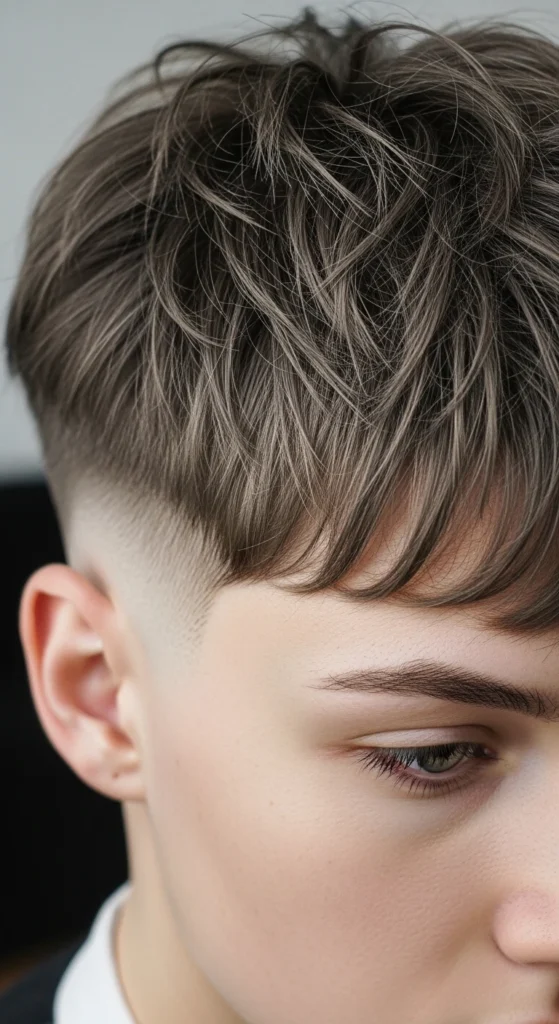
What to tell your barber: “Short fade on the sides. Leave one and a half inches on top. Use scissors to create choppy, uneven layers throughout. No hard lines anywhere.”
Best for Norwood stages: 1 and 2
Styling time: 2 minutes
Best product to use: Sea salt spray followed by matte paste
Pro tip: Spray sea salt spray on damp hair. Scrunch with your fingers. Let it air dry. That’s it.
Best for face shapes: All face shapes
Fact: According to hair styling experts at DiStefano Hair Restoration Center, textured crops photograph denser than longer, glossy styles because the choppy layers scatter light and reduce how much scalp shows through.
3. Caesar Cut
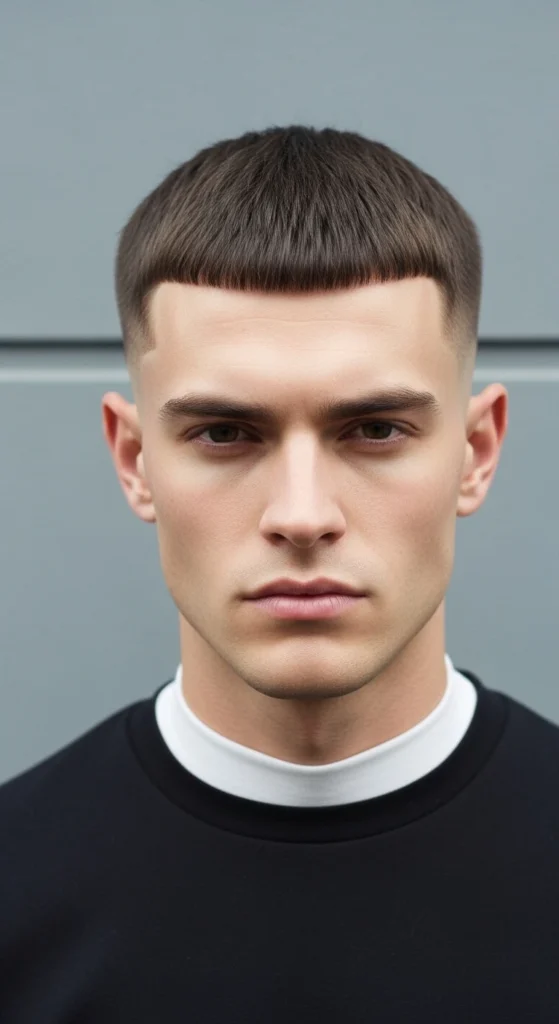
What to tell your barber: “Uniform short length on top, about one inch. Blunt fringe that sits horizontally across my forehead. Low fade on the sides.”
Best for Norwood stages: 2 and 3
Styling time: 1 minute
Best product to use: Molding paste
Pro tip: Keep the fringe dry and matte. A wet look makes recession much more obvious.
Best for face shapes: Oval and rectangular
For more inspiration, explore our complete guide to the Caesar cut.
4. Modern Crop Cut
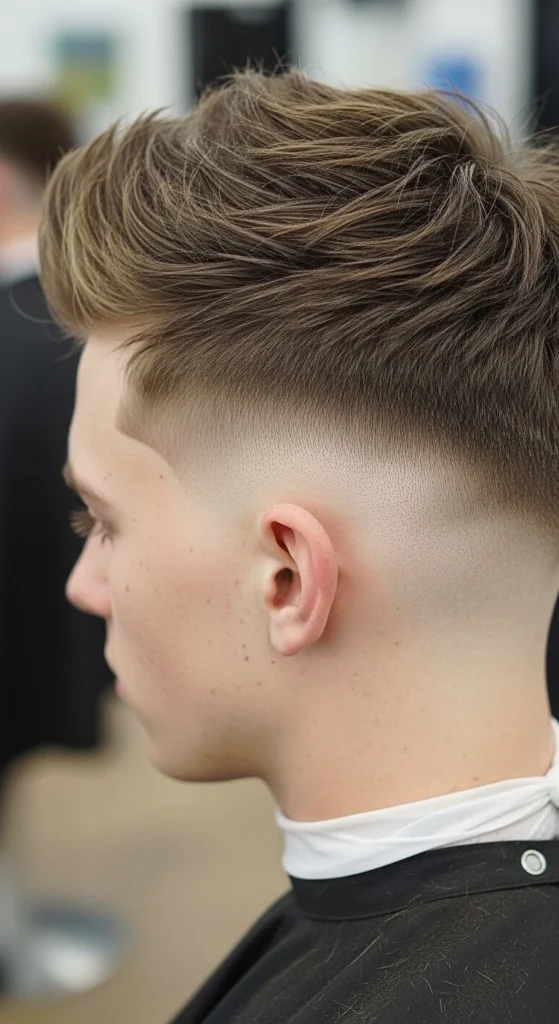
What to tell your barber: “High fade on the sides and back. Leave one and a half inches on top with heavy texture. No defined parting.”
Best for Norwood stages: 1 and 2
Styling time: 2 minutes
Best product to use: Texture clay
Pro tip: Use your fingers, not a comb. Fingers create a natural, piece-y finish. Combs make it look too perfect.
Best for face shapes: Oval and heart
5. Textured Brush Forward
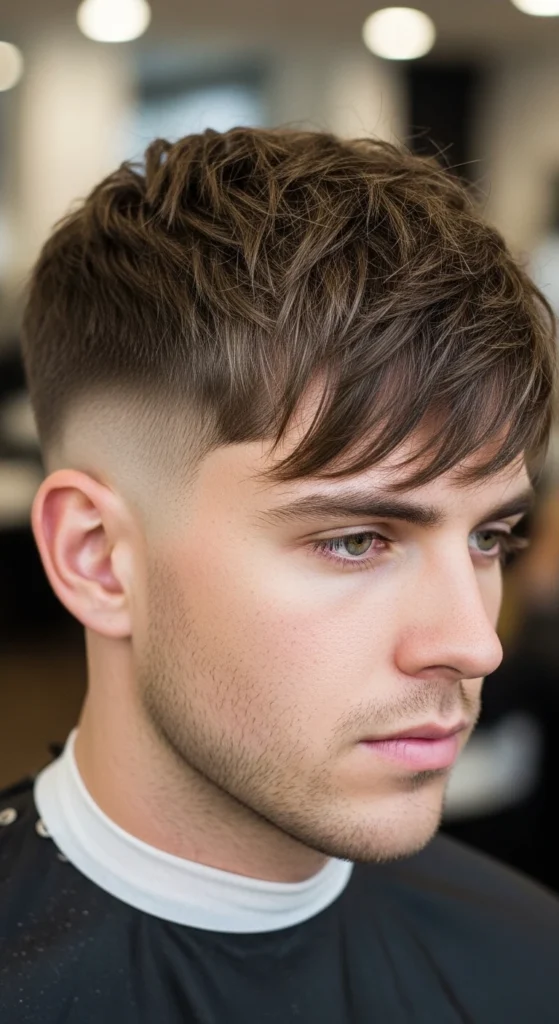
What to tell your barber: “Mid fade on the sides. Leave two inches on top. Cut with deep texture so it pushes forward easily. No hard fringe line.”
Best for Norwood stages: 2 and 3
Styling time: 3 minutes
Best product to use: Lightweight wax or clay
Pro tip: Apply product to damp hair. Blow-dry forward while scrunching with your fingers.
Best for face shapes: Round and square
6. Side-Swept Fringe
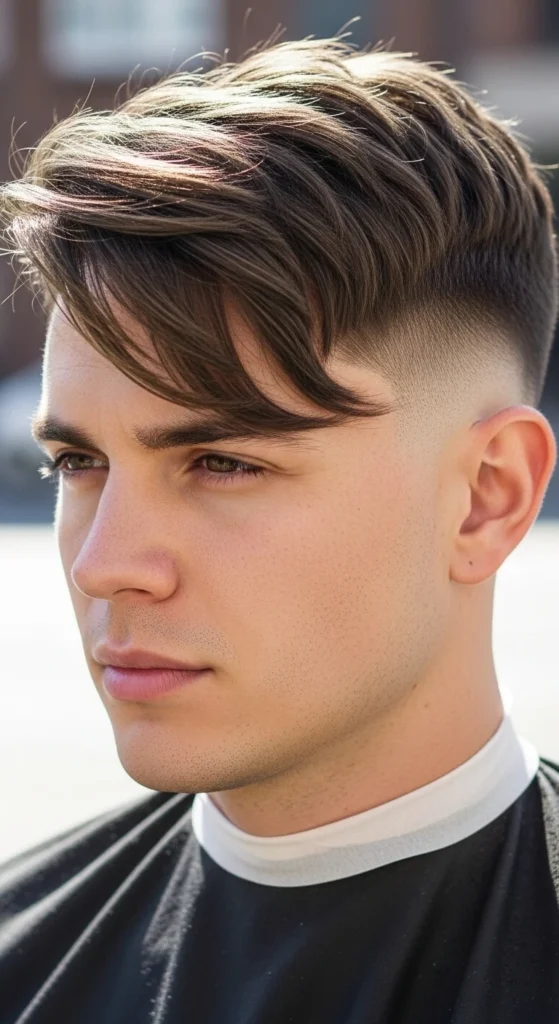
What to tell your barber: “Low fade on the sides. Leave two to two and a half inches on top. Cut so it naturally falls to one side. Point-cut the ends for softness.”
Best for Norwood stages: 1 and 2
Styling time: 3 minutes
Best product to use: Styling cream with low shine
Pro tip: Part your hair on your stronger side. This lets you sweep volume over the thinner temple.
Best for face shapes: Oval, square, and diamond
7. Tousled Mid-Length
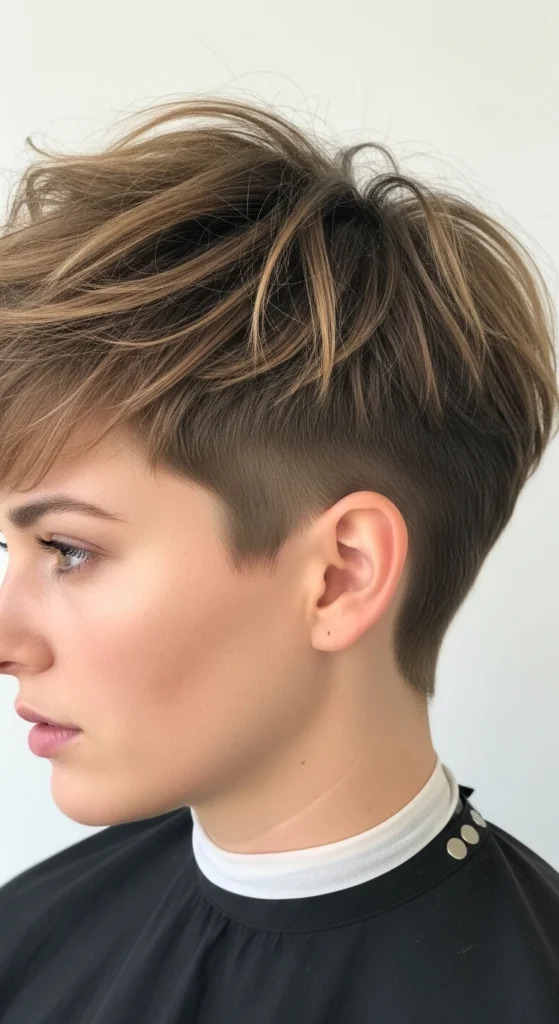
What to tell your barber: “Scissor cut on the sides, no skin fade. Leave two to three inches on top. Layer heavily for movement. Natural neckline.”
Best for Norwood stages: 1 and 2 (requires good density)
Styling time: 4 minutes
Best product to use: Sea salt spray
Pro tip: Air dry after spraying. Heat isn’t always better. Air drying gives you natural wave and volume.
Best for face shapes: Oval and heart
8. Curtain Hair
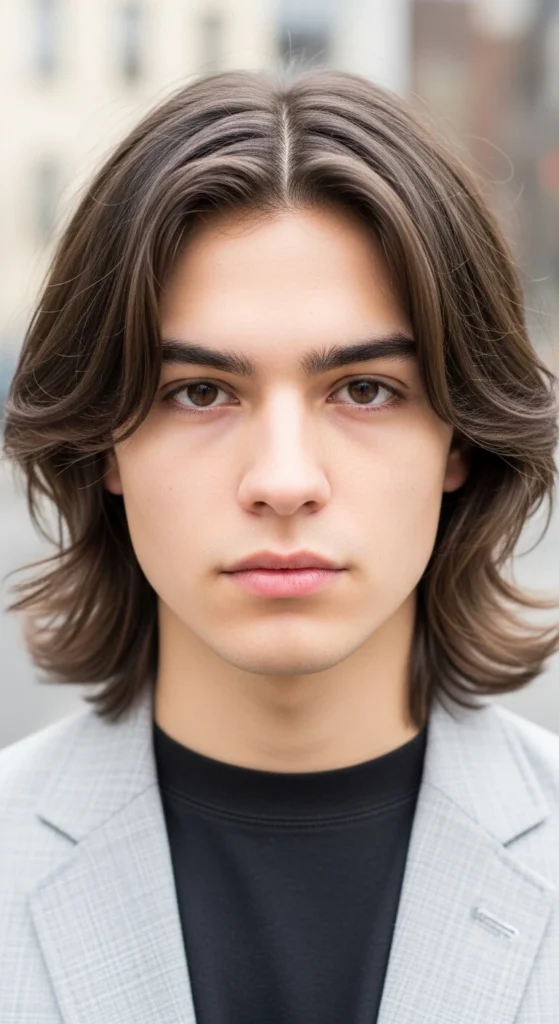
What to tell your barber: “Medium length all around. Centre part with longer fringe that sweeps to both sides. Layers for movement.”
Best for Norwood stages: 1 and 2
Styling time: 4 minutes
Best product to use: Lightweight styling cream
Pro tip: Blow-dry the fringe back and to the sides using a round brush. This creates that effortless curtain effect.
Best for face shapes: Oval and square
9. Shaggy Haircut
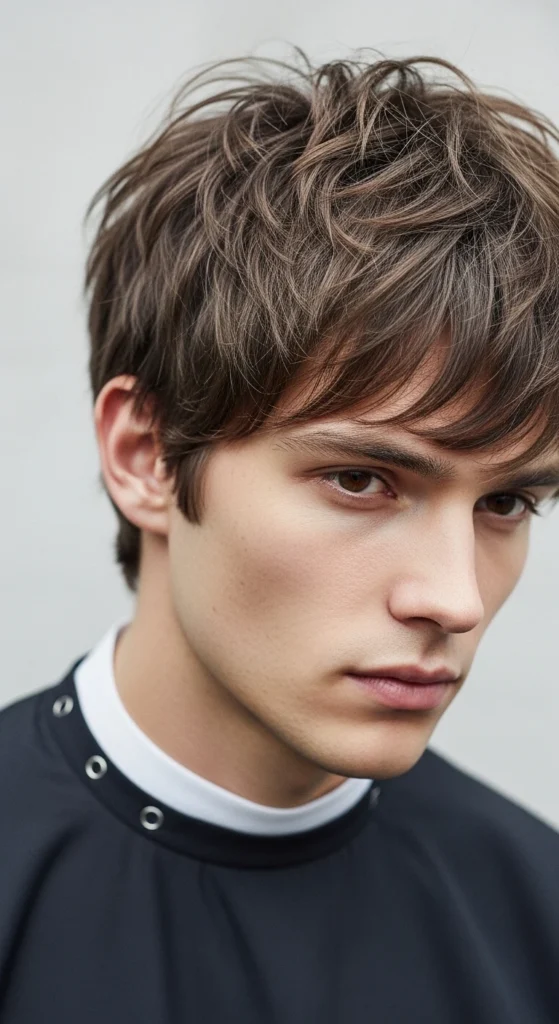
What to tell your barber: “Layered throughout with a messy fringe. Sides tapered, not faded. Keep the texture uneven and loose.”
Best for Norwood stages: 1 and 2
Styling time: 3 minutes
Best product to use: Texture spray
Pro tip: The messier, the better. A perfect haircut draws attention to the hairline. A messy one hides it.
Best for face shapes: Oval and rectangular
10. Flow Haircut
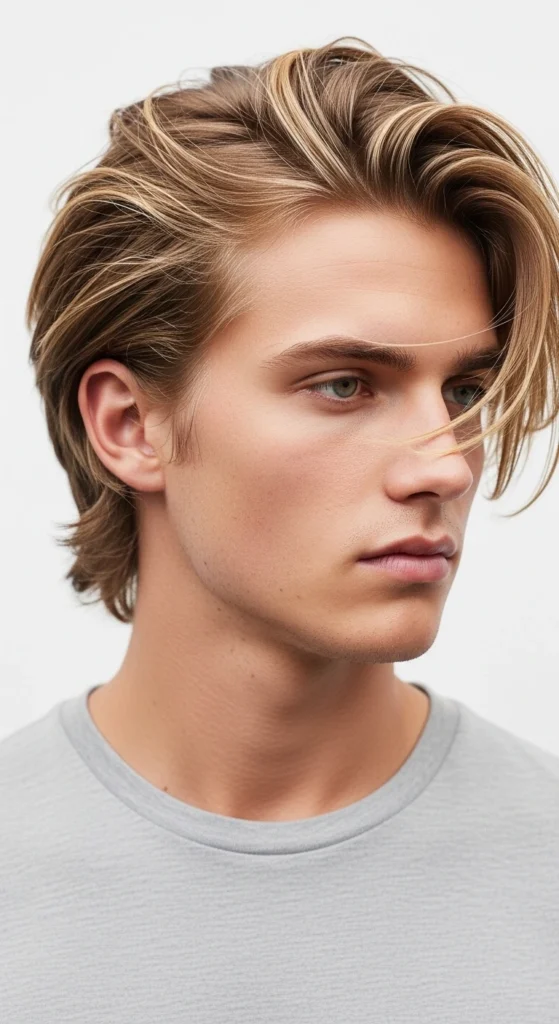
What to tell your barber: “Longer on top, about three inches. Shorter sides. Layers that sweep back naturally. No hard part.”
Best for Norwood stages: Stage 1 only (requires good density)
Styling time: 5 minutes
Best product to use: Volumizing mousse plus blow-dry
Pro tip: Use a round brush to create backward flow while blow-drying. This gives you that surfer-like movement.
Best for face shapes: Oval and diamond
11. Brushed-Up Quiff
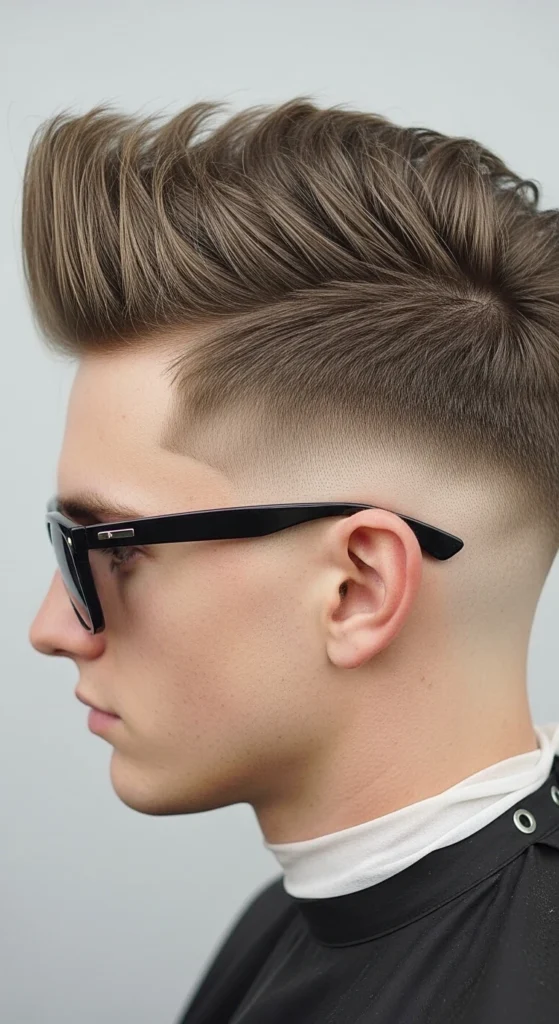
What to tell your barber: “High fade on the sides. Leave two and a half inches on top. Keep length at the front for height. Texturize throughout.”
Best for Norwood stages: 2 and 3
Styling time: 5 minutes
Best product to use: Volumizing powder followed by matte clay
Pro tip: Blow-dry straight up using a round brush before applying clay. The heat sets the height.
Best for face shapes: Oval, square, and round
12. Soft Quiff
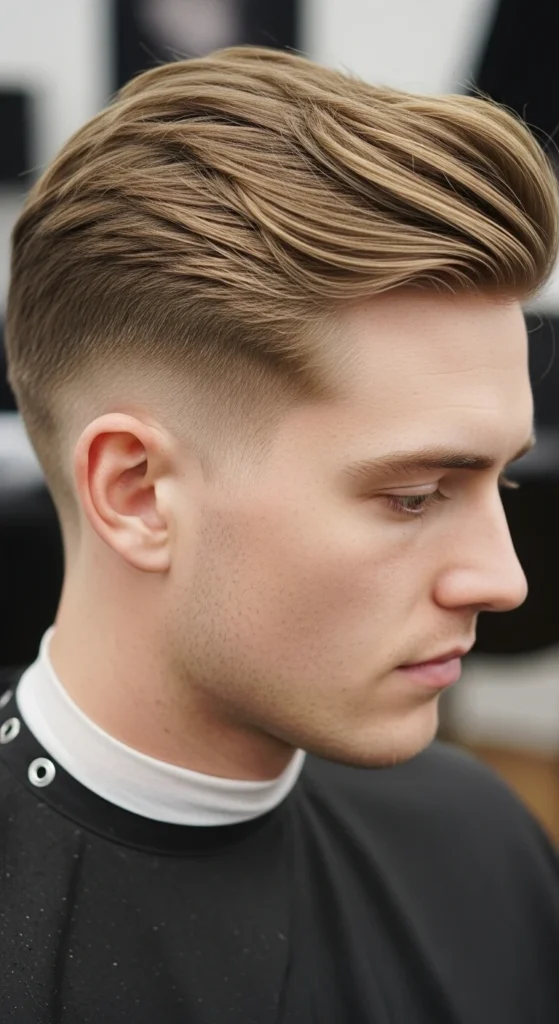
What to tell your barber: “Taper fade on the sides. Leave two inches on top. Less height than a traditional quiff. Natural, relaxed finish.”
Best for Norwood stages: 2 and 3
Styling time: 4 minutes
Best product to use: Molding paste
Pro tip: Don’t over-style. A little messiness looks more natural than a perfect wave.
Best for face shapes: All face shapes
13. Quiff with Taper
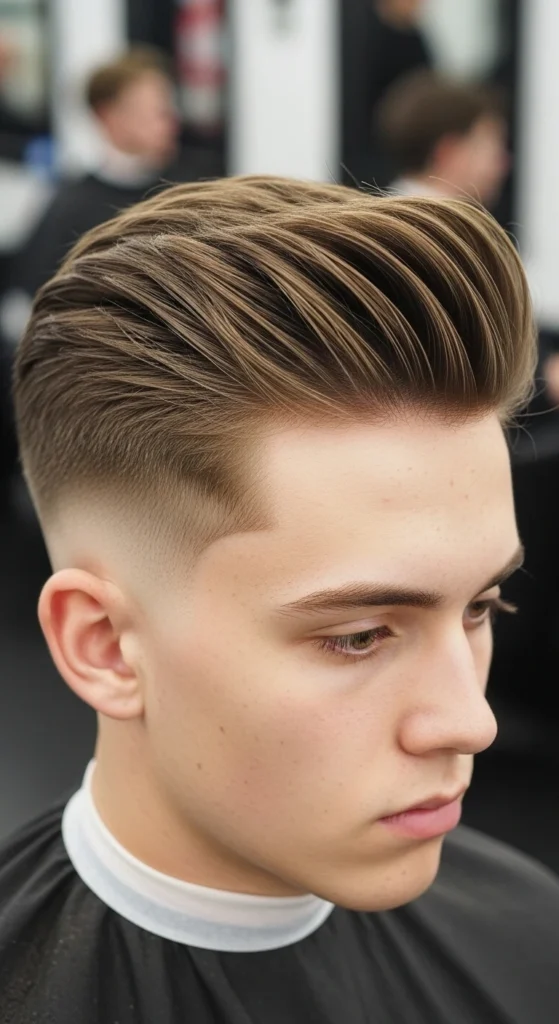
What to tell your barber: “Low to mid taper on the sides. Leave two inches on top. Disconnected quiff shape with softer edges.”
Best for Norwood stages: 2 and 3
Styling time: 4 minutes
Best product to use: Matte clay
Pro tip: Apply product to damp hair and blow-dry for maximum lift. Dry hair won’t hold as well.
Best for face shapes: Oval and rectangular
14. Modern Pompadour
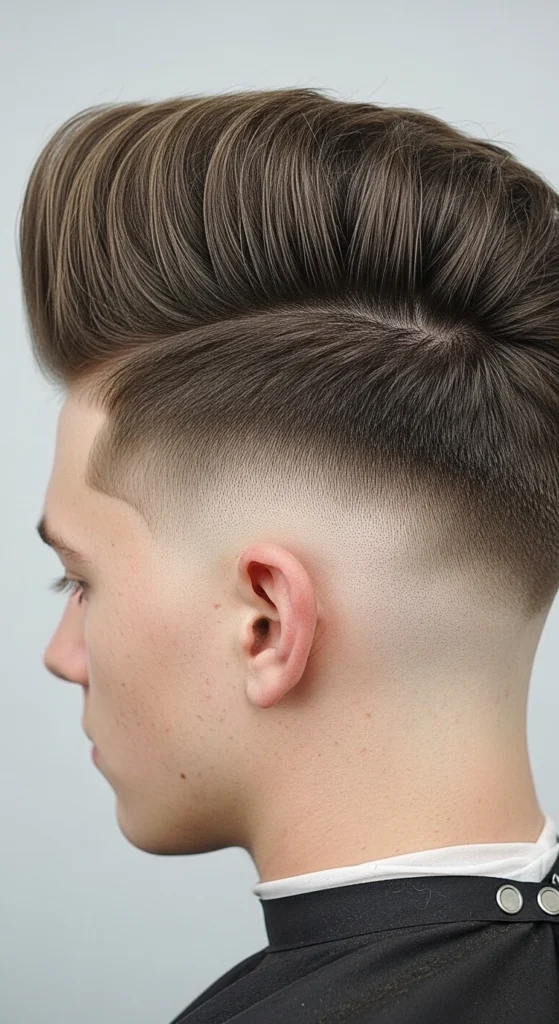
What to tell your barber: “Skin fade on the sides. Leave two and a half inches on top. Volume concentrated at the front, not the crown.”
Best for Norwood stages: Stage 2 only (requires good density)
Styling time: 6 minutes
Best product to use: Strong hold matte paste
Pro tip: Avoid high-shine products. A matte finish looks much thicker than a shiny one.
Best for face shapes: Oval and square
For a deeper dive into this classic style, visit our pompadour haircut guide.
15. Mini Pompadour
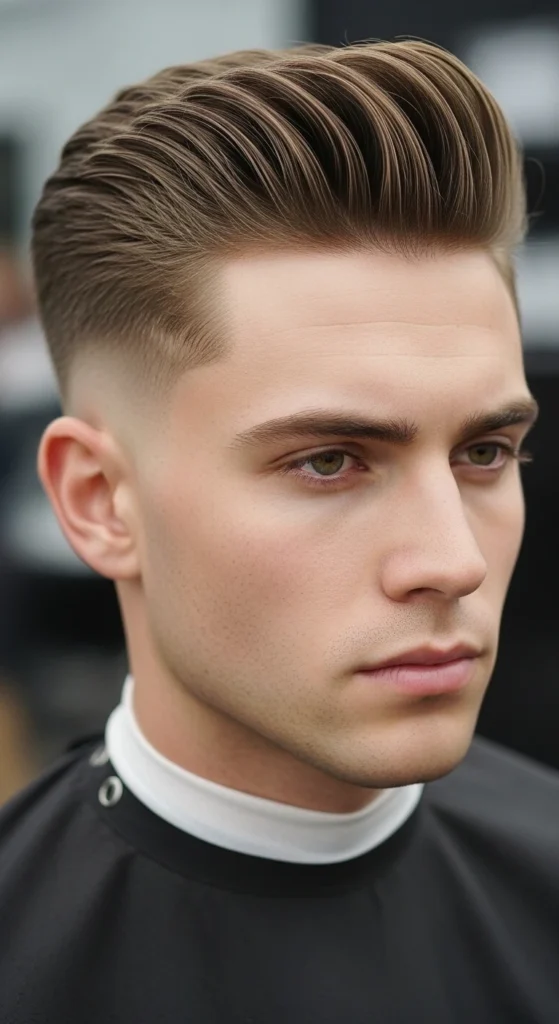
What to tell your barber: “Low fade on the sides. Leave one and a half to two inches on top. Subtle lift at the front only.”
Best for Norwood stages: 2 and 3
Styling time: 4 minutes
Best product to use: Lightweight clay
Pro tip: Less volume is more here. A massive pompadour draws attention to the hairline. A mini one just adds style.
Best for face shapes: Oval, round, and square
16. Faux Hawk
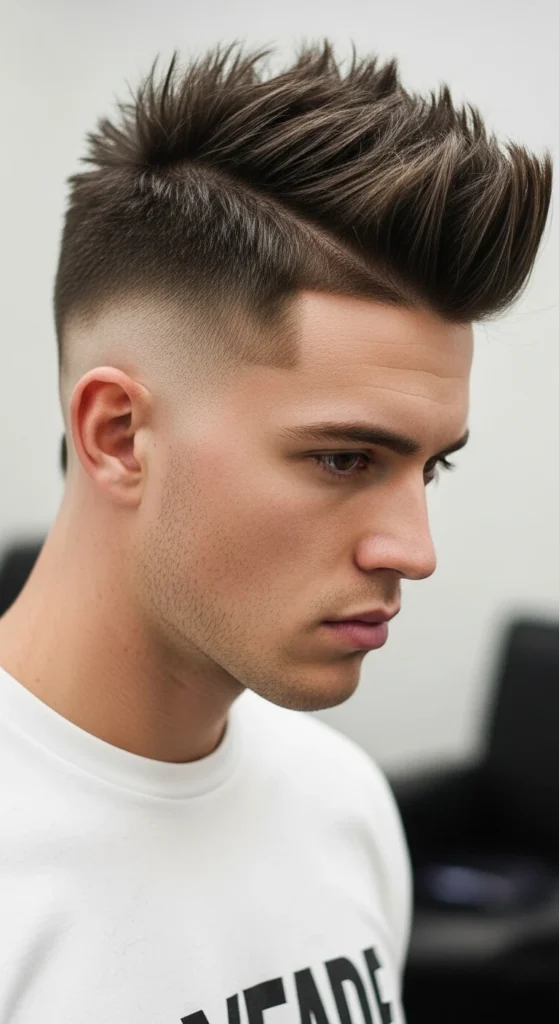
What to tell your barber: “High fade on the sides. Leave two inches along the centre ridge. Taper the ridge width from front to back.”
Best for Norwood stages: 2 and 3
Styling time: 4 minutes
Best product to use: Strong hold matte wax
Pro tip: The centre ridge pulls eyes away from temple recession. It’s a visual trick that works every time.
Best for face shapes: Oval, square, and diamond
Learn how to style this bold look with our faux hawk guide.
17. Modern Mohawk
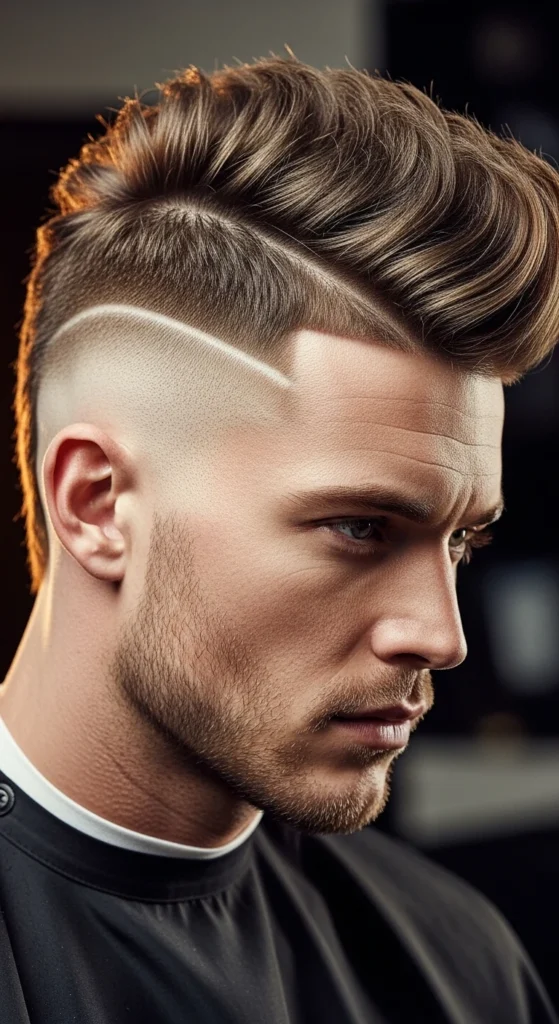
What to tell your barber: “Bald fade on the sides. Leave two to three inches along the centre. Width should be about two inches at the front, tapering back.”
Best for Norwood stages: 2 and 3
Styling time: 5 minutes
Best product to use: Maximum hold gel or clay
Pro tip: Keep the sides completely shaved. The contrast makes the style look intentional rather than desperate.
Best for face shapes: Oval and square
18. Spiky Hair
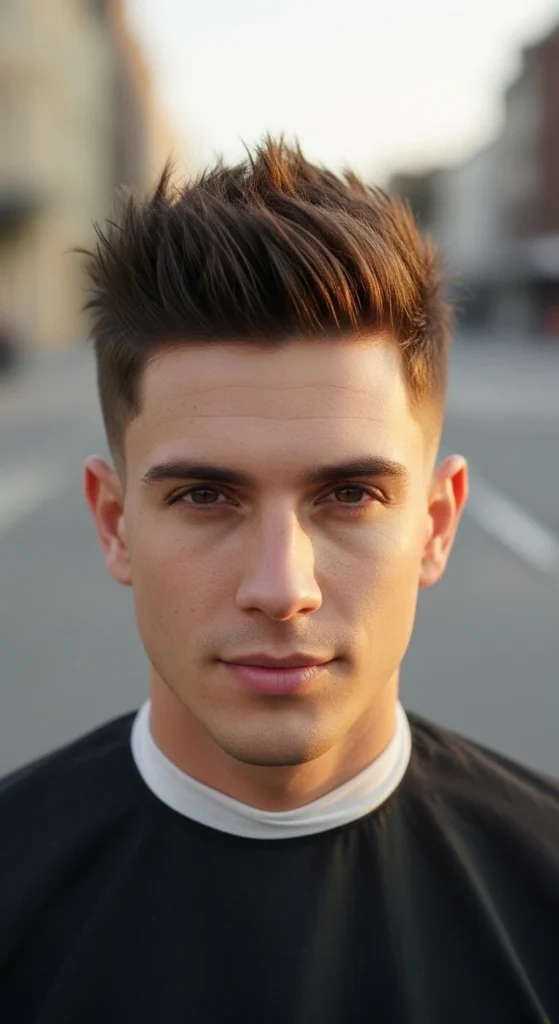
What to tell your barber: “High fade on the sides. Leave one inch on top. Cut with point cutting so spikes form easily.”
Best for Norwood stages: 2 and 3
Styling time: 2 minutes
Best product to use: Texturizing paste or fiber
Pro tip: Apply product to dry hair and mess upward with your fingers. Wet hair won’t spike the same way.
Best for face shapes: Oval, square, and heart
19. Buzz Cut (#2 guard)
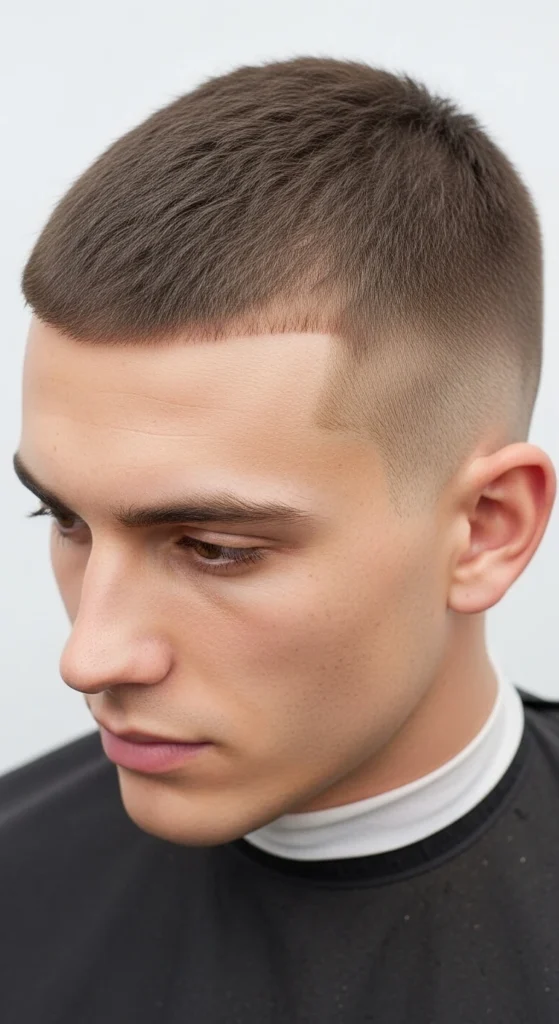
What to tell your barber: “Uniform number two guard all over. Natural hairline. No lineup. Blend at the neck.”
Best for Norwood stages: 3, 4, and 5
Styling time: 30 seconds
Best product to use: None needed. Or matte lotion for the scalp.
Pro tip: Start with a number three or four guard if you’re nervous. You can always go shorter. You can’t go longer once it’s cut.
Best for face shapes: Oval and square
Fact: According to Fabbon, the high and tight military cut is one of the most reliable styles for receding hairlines because it reduces contrast between scalp and hair, making thin areas far less noticeable.
For everything you need to know about going short, check out our buzz cut guide.
20. Crew Cut
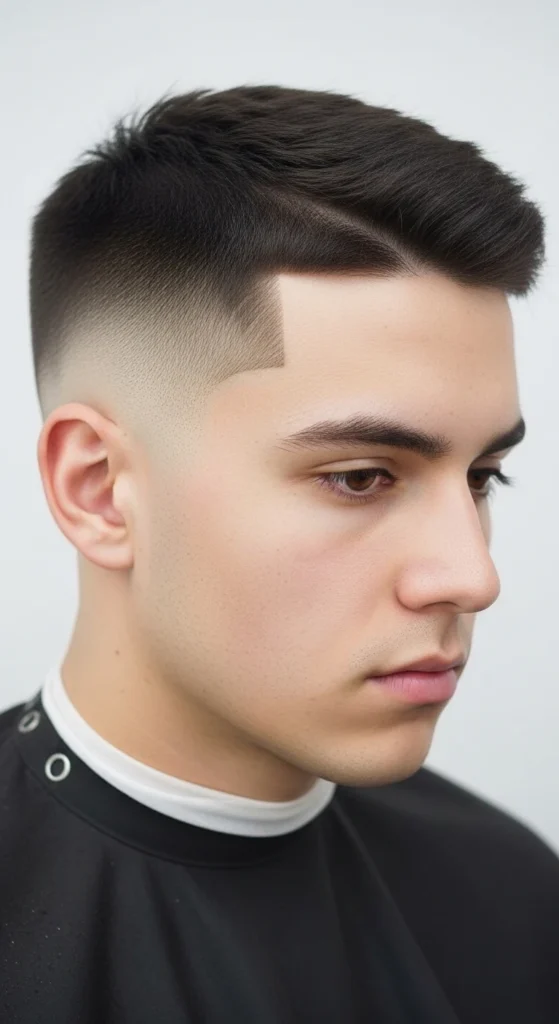
What to tell your barber: “Number two guard on the sides and back. Leave slightly longer on top, number three or four guard. Blend the transition.”
Best for Norwood stages: 3 and 4
Styling time: 1 minute
Best product to use: Light matte clay if desired
Pro tip: The slightly longer top softens the hairline compared to a uniform buzz. It’s a small difference that matters.
Best for face shapes: All face shapes
Find more styling tips in our complete crew cut guide.
21. High and Tight
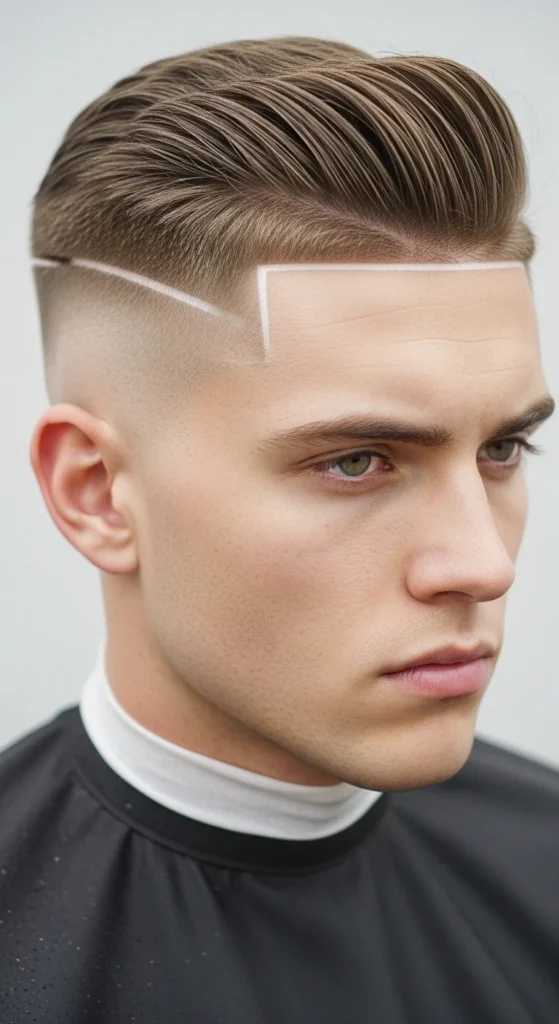
What to tell your barber: “Number one guard on the sides, fading to number two or three on top. Skin fade around the ears. Clean, military finish.”
Best for Norwood stages: 3, 4, and 5
Styling time: 30 seconds
Best product to use: None
Pro tip: Ask for a “high reg” fade if you want the shortest possible sides.
Best for face shapes: Oval, square, and angular
Explore the full range of high and tight variations on our site.
22. Butch Cut
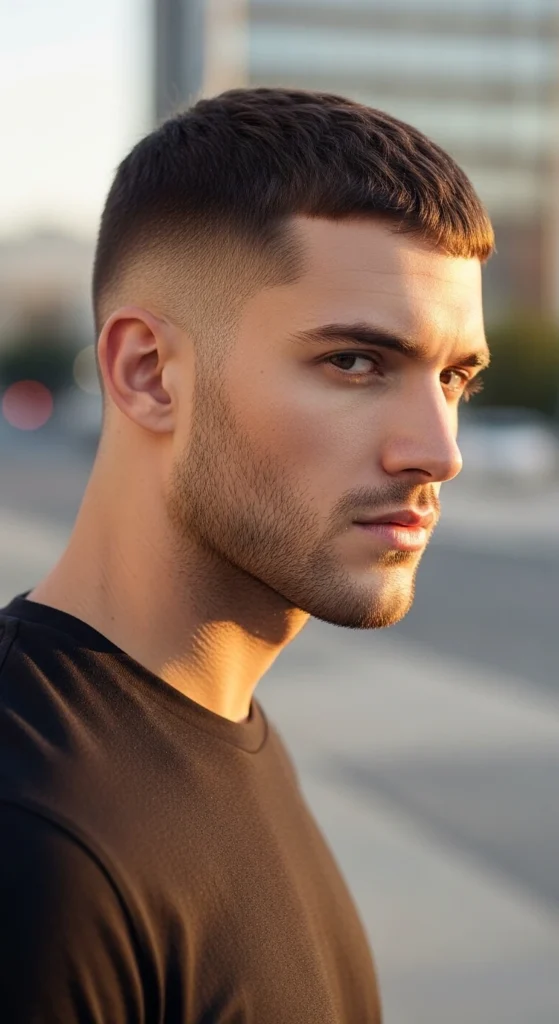
What to tell your barber: “Uniform number three guard all over. No fade. Just even length everywhere. Natural edges.”
Best for Norwood stages: 3 and 4
Styling time: 30 seconds
Best product to use: None
Pro tip: This is a great transition style if you’re not ready for a full buzz cut.
Best for face shapes: Oval and round
23. Close Cut
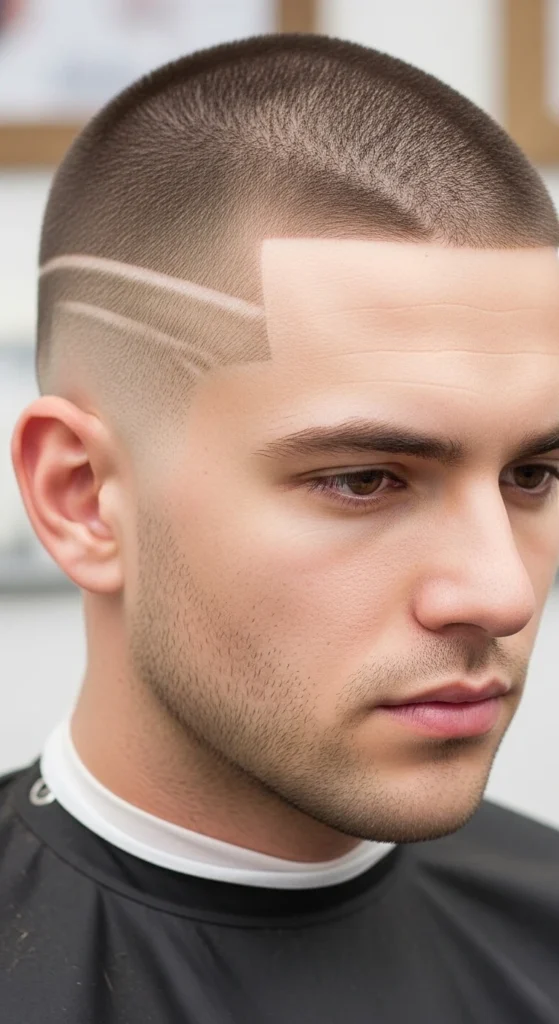
What to tell your barber: “Very short all over. Number one or two guard. No graduation. What you see is what you get.”
Best for Norwood stages: 4 and 5
Styling time: 30 seconds
Best product to use: None
Pro tip: This style says “I own my hairline.” Confidence is the secret ingredient here.
Best for face shapes: Oval and square
24. Buzzed Skin Fade
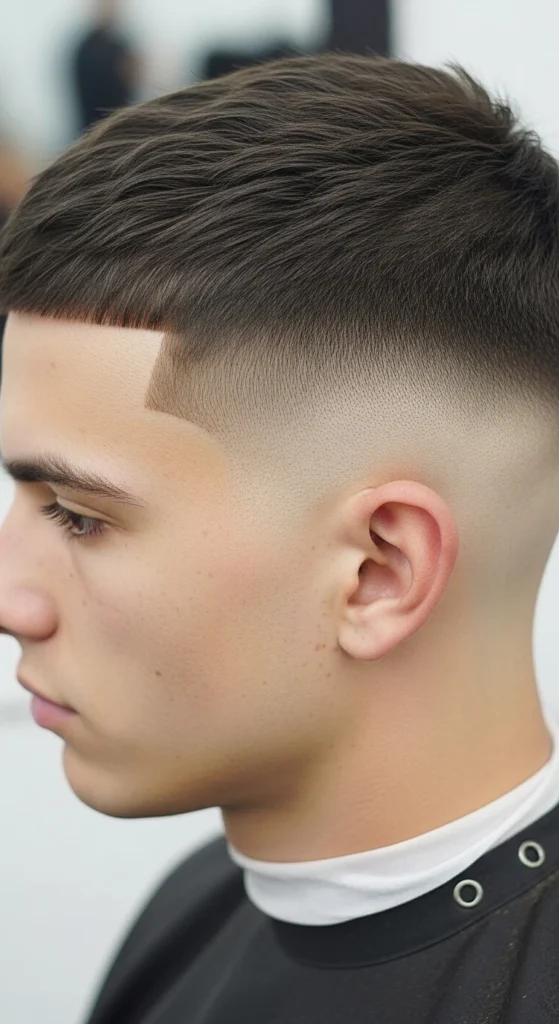
What to tell your barber: “Skin fade on the sides and back. Number two guard on top. Sharp blend line at the temples.”
Best for Norwood stages: 3, 4, and 5
Styling time: 1 minute
Best product to use: Matte lotion for scalp sheen
Pro tip: The skin fade creates such sharp contrast that your hairline becomes a design feature instead of a problem.
Best for face shapes: Oval, square, and diamond
25. Clean Shave with Stubble
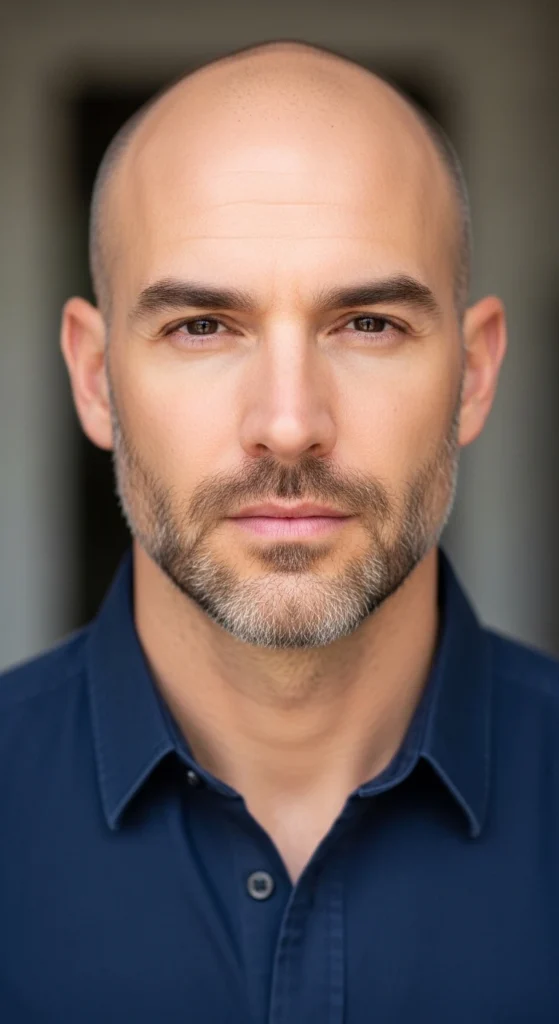
What to tell your barber: “Full head shave with a razor. Keep two to three days of beard stubble.”
Best for Norwood stages: 5, 6, and 7
Styling time: 5 minutes for shaving
Best product to use: Shaving cream, moisturizer, and sunscreen
Pro tip: The beard is essential here. A shaved head without facial hair can look unbalanced. Stubble shapes the jaw.
Best for face shapes: All face shapes
26. Close Buzz with Full Beard
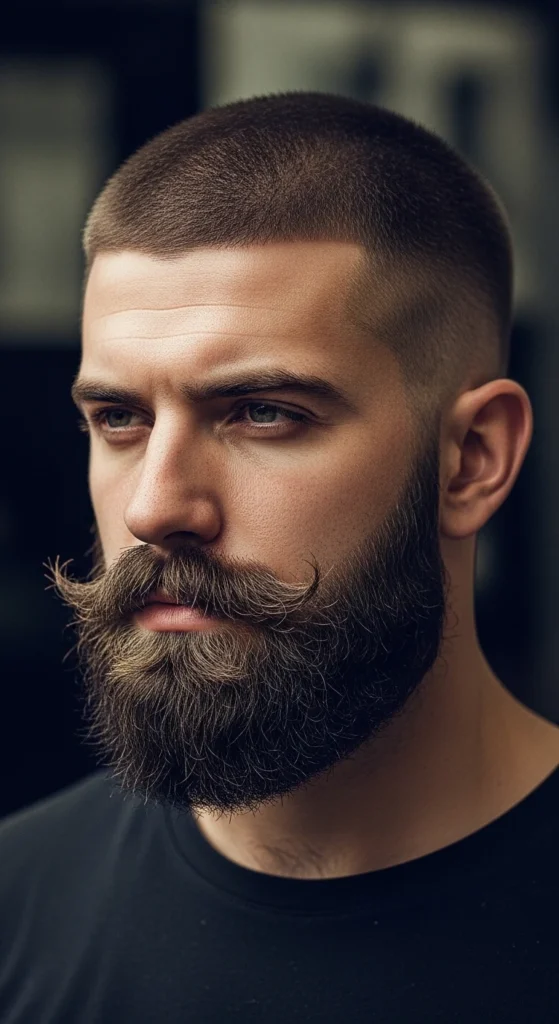
What to tell your barber: “Number one guard on the head. Beard trimmed to number three guard. Keep beard lines clean.”
Best for Norwood stages: 4, 5, and 6
Styling time: 3 minutes
Best product to use: Beard oil
Pro tip: The contrast between a buzzed head and a full beard is extremely flattering. It’s a classic look for a reason.
Best for face shapes: Oval, square, and round
Fact: A study published in the National Institutes of Health database found that traction alopecia from tight hairstyles affects 71.7% of individuals with hair loss in some populations. Avoid tight buns, braids, and dreadlocks if you have a receding hairline.
27. High Fade
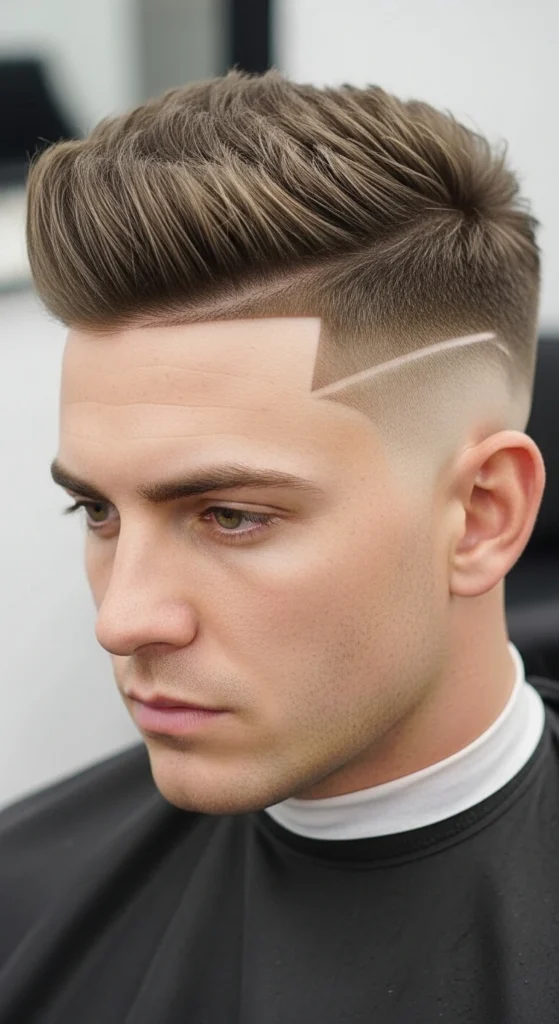
What to tell your barber: “Skin fade starting above the temples. Leave one inch on top, textured. Sharp blend line.”
Best for Norwood stages: 2, 3, and 4
Styling time: 2 minutes
Best product to use: Matte clay
Pro tip: A high fade makes your hairline look intentional rather than receding. It’s a visual trick that works.
Best for face shapes: Oval and square
28. Low Taper Fade
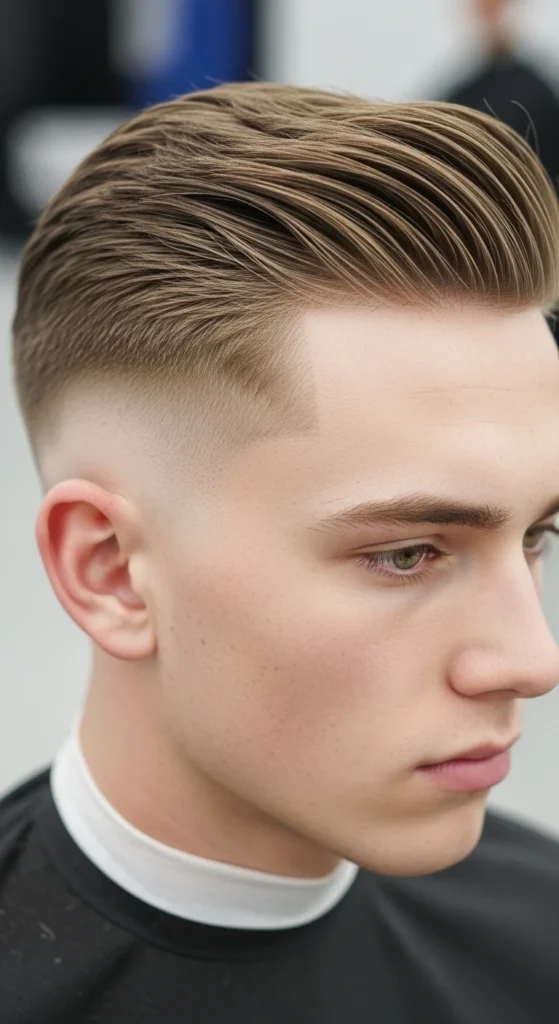
What to tell your barber: “Gradual fade starting at the ears. Longer on top, about two inches. Natural blend, no hard lines.”
Best for Norwood stages: 2 and 3
Styling time: 3 minutes
Best product to use: Styling cream
Pro tip: This is more conservative than a high fade. Good for professional settings where you want to look polished but not edgy.
Best for face shapes: All face shapes
Learn more about this versatile style in our low taper fade guide.
29. Mid Fade
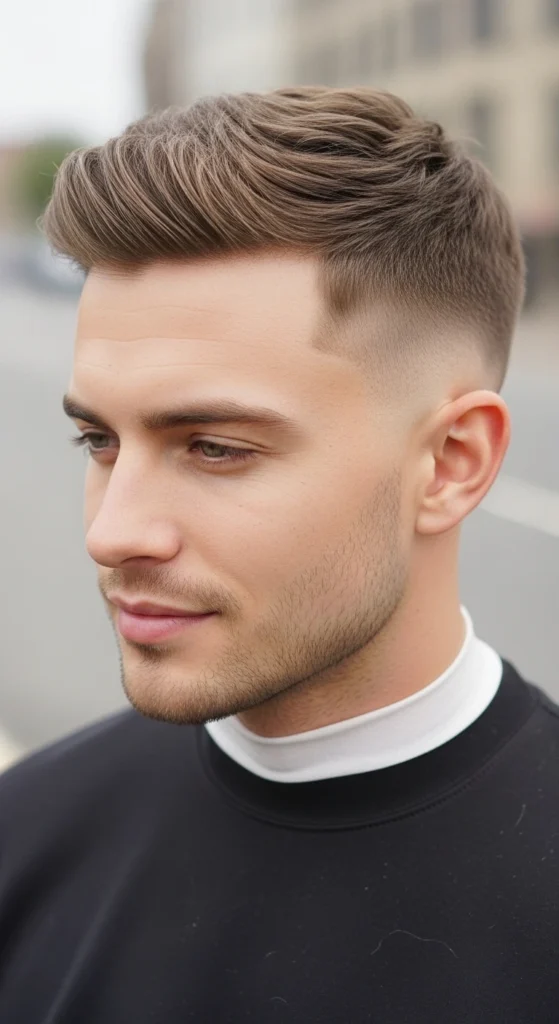
What to tell your barber: “Fade starting midway up the temples. One and a half inches on top. Balanced blend.”
Best for Norwood stages: 2, 3, and 4
Styling time: 2 minutes
Best product to use: Texture clay
Pro tip: The mid fade is the most versatile option. It works for almost every face shape and hair type.
Best for face shapes: All face shapes
For a complete breakdown, visit our mid fade guide.
30. Burst Fade
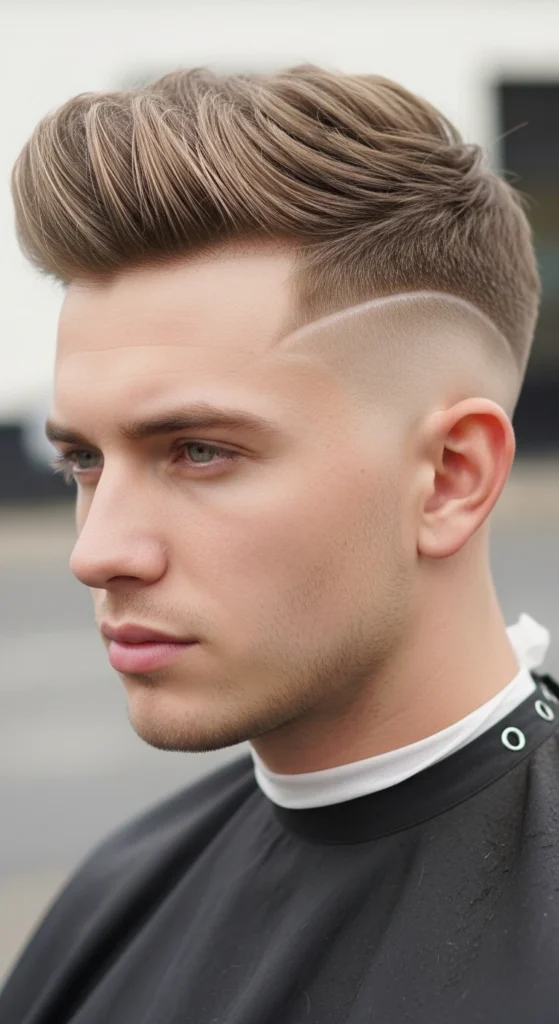
What to tell your barber: “Fade that arcs around the ear like a crescent. Short back and sides. Textured top.”
Best for Norwood stages: 2 and 3
Styling time: 3 minutes
Best product to use: Matte paste
Pro tip: Ask for a “burst fade mohawk” if you want extra edge. The curved fade line is a conversation starter.
Best for face shapes: Oval, square, and diamond
Explore the unique look of the burst fade on our site.
5 Hairstyles You Should NEVER Try with a Receding Hairline
Not every haircut works. Some styles actively make a receding hairline look worse. Avoid these five at all costs.
1. The Classic Combover
Why to avoid it: Attempting to cover bald spots with long strands from the side doesn’t hide thinning. It highlights it. Combovers look desperate rather than confident.
Better alternative: A short textured crop or a buzz cut.
For a modern take on side-swept styles, see our comb over fade guide.
2. Slicked-Back (Wet Look)
Why to avoid it: High-shine products separate individual strands. Separated strands mean more scalp shows through. Pulling hair back also exposes your hairline fully instead of softening it.
Better alternative: A matte finish with forward-moving texture.
3. High Pompadour (Dramatic)
Why to avoid it: Drawing height directly at the hairline puts a spotlight on recession. This style only works for men with absolutely zero temple loss.
Better alternative: A mini pompadour or a brushed-up quiff with matte finish.
4. Centre Part (Long Hair)
Why to avoid it: Parting your hair down the middle opens up the temples. An M-shape becomes a giant V-shape. The contrast between long sides and a thin front is jarring.
Better alternative: A side part or a textured fringe.
5. Dreadlocks or Tight Braids
Why to avoid it: Constant tension on the hairline causes traction alopecia. That’s a fancy way of saying tight styles pull your hairline back even further. The weight of dreads makes the problem worse over time.
Better alternative: Short natural styles or loose twists.
How to Choose the Right Cut for Your Hairline
Use this simple decision guide.
Step one: How far has your hairline receded?
- Minor temples only, Category 1 (Textured Hiders)
- Pronounced M-shape, Category 2 (Volume Creators)
- Significant thinning, Category 3 (Buzz Family)
- Very little left, Category 4 (Bald + Beard)
Step two: What’s your hair density?
- Thick hair, any category works
- Medium hair, Categories 1, 2, or 3
- Thin hair, Categories 3 or 4 only
Step three: What’s your face shape?
- Oval face, almost anything works
- Round face, choose height on top like a quiff or faux hawk
- Square face, choose soft texture like a French crop or textured fringe
- Heart face, choose side-swept styles
Step four: How much time do you want to spend?
- One to two minutes, buzz cuts or crops
- Three to four minutes, textured styles or fades
- Five or more minutes, quiffs or pompadours
What to Tell Your Barber: Complete Script Guide
Bringing a photo is always best. But if you can’t, use these exact scripts.
| Hairstyle | Exact Words to Say |
|---|---|
| French Crop | “Short back and sides with a skin fade. One to two inches on top with a choppy fringe. Texturize the top.” |
| Buzz Cut | “Number two guard all over. Natural hairline. Blend at the neck.” |
| Quiff | “High fade on the sides. Two and a half inches on top. Blow-dry for height.” |
| High Fade | “Skin fade above the temples. One inch textured top. Sharp blend line.” |
| Crew Cut | “Number two guard on sides. Number three or four on top. Blend the transition.” |
| Textured Crop | “Short fade on sides. One and a half inches on top. Choppy layers. No hard lines.” |
Pro tip: Save two or three photos of your desired cut on your phone. Show them to your barber before they start.
Best Products for Each Hairstyle
| Hairstyle Category | Best Product | Why It Works | Products to Avoid |
|---|---|---|---|
| Textured crops | Matte clay | Adds grip with no shine | Shiny pomade |
| Quiffs and volume styles | Volumizing powder plus clay | Lifts roots without weight | Heavy wax |
| Buzz cuts | Matte scalp lotion | Reduces shine, moisturizes skin | Greasy gel |
| Fades | Texture spray | Light hold with natural movement | High-shine gel |
| Slick styles (rare) | Low-shine pomade | Control without wet look | High-shine products |
Fact: According to Mayo Clinic, minoxidil is FDA-approved for hereditary hair loss and is typically the first-choice treatment. You should apply it for at least one year before assessing whether it’s working for you.
The Beard Factor: Why Facial Hair Changes Everything
Here’s something most hairstyle guides don’t tell you.
When you lose hair on top, adding a beard rebalances your entire face.
A well-groomed beard pulls attention downward. Stubble softens the contrast between your head and your face. A full beard paired with a buzzed head is one of the most confident looks a man can wear.
Pro tip: Keep your beard lines clean. A messy beard with a receding hairline looks unkempt. A sharp beard looks intentional and stylish.
If you can’t grow a full beard, well-maintained stubble works just as well.
When a Haircut Isn’t Enough: Medical Options
Sometimes styling around a receding hairline isn’t enough. Maybe you want to keep your hair. Maybe you want to stop the recession before it gets worse.
Here are the most common medical options.
| Treatment | Type | How You Get It | How Long Until Results |
|---|---|---|---|
| Minoxidil (Rogaine) | Topical foam or liquid | Over the counter | 6 to 12 months |
| Finasteride (Propecia) | Oral pill | Prescription only | 6 to 12 months |
| Dutasteride (Avodart) | Oral pill | Prescription, used off-label for hair loss | 6 to 12 months |
| PRP (Platelet-Rich Plasma) | Injections | In-office procedure | 3 to 6 months |
Key point: Starting treatment early delivers the best results. See a dermatologist for a proper diagnosis before starting anything.
Frequently Asked Questions
Can a receding hairline grow back naturally?
Without treatment, a receding hairline does not grow back on its own. However, medications like minoxidil and finasteride can slow or stop recession. In some cases, they can promote partial regrowth. See a dermatologist for a proper diagnosis.
How do I style my hair with a receding hairline?
Keep the sides short with a little length on top, buzz cut, crew cut, or Caesar cut are your best bets. Brush hair forward and keep the sides clean. Use matte products since shine makes the hairline more noticeable.
How to look attractive with a receding hairline?
Grow a beard, it balances the face and adds a masculine edge. A fit body, clean grooming, and confident posture do more than any hairstyle. Look at Jason Statham or Dwayne Johnson, a receding hairline clearly hasn’t hurt them.
How attractive is a receding hairline?
Honestly, neutral to positive. Studies show men with receding or shaved heads are often perceived as more dominant and mature. It’s just one feature, overall grooming and confidence matter far more.
What hairstyles should I avoid?
- Comb-over: worst choice, looks obvious and desperate
- Long hair on top: actually highlights the hairline more
- Side part: exposes receding temples directly
- Fluffy/voluminous styles: the contrast makes the hairline stand out even more
What’s worse, thinning or receding?
Thinning is harder to deal with. A receding hairline has a defined shape you can work with, buzz it or shave it and it looks intentional. Thinning shows the scalp all over, looks patchy, and is much harder to style around.
Is a buzz cut good for a receding hairline?
Yes. A buzz cut reduces contrast between your scalp and your hair. This makes thinning areas far less noticeable. It’s one of the most recommended styles for men with advanced recession.
What’s the difference between a mature hairline and a receding one?
A mature hairline shifts back about half an inch to three-quarters of an inch symmetrically. This usually happens in a man’s early twenties. A receding hairline keeps progressing. It often forms an M-shape or an uneven pattern. If you’re not sure which one you have, see a dermatologist.
Does long hair make a receding hairline worse?
Long hair doesn’t cause recession. But it can make recession more noticeable. Long, straight hair falls flat and exposes thin areas. If you want to keep long hair, add texture and avoid centre parts. Better yet, keep the length on top but add choppy layers.
Should I grow a beard if my hairline is receding?
Yes. A beard balances your facial features. It draws attention away from your hairline. Many men with receding hairlines look their best with a buzzed head and a well-maintained beard.
What’s the best product for thinning hair?
For styling: matte clay, sea salt spray, or volumizing powder. For treatment: minoxidil which is available over the counter, or finasteride which requires a prescription. Talk to a dermatologist before starting any treatment.
How often should I cut my hair with a receding hairline?
Every three to four weeks. Regular trims keep your edges clean. They also stop your style from looking unkempt. Short styles actually need more frequent maintenance than longer ones.
Fact: According to Mayo Clinic, minoxidil promotes hair regrowth in approximately 66% of men who use it as directed. Finasteride is another FDA-approved option available by prescription.
What is the best hairstyle for a receding hairline?
There isn’t one single best style, it depends on your Norwood stage. For minor recession (stages 1-2), a French crop or textured crop works well because it keeps enough length to soften the temples. For moderate recession (stages 3-4), a crew cut or high fade reduces the contrast between hairline and hair, making it far less noticeable. For advanced recession (stages 5+), a close buzz cut or clean shave paired with a beard is the most reliable option, since there’s no hairline left to draw attention to.
Can a receding hairline look good?
Yes, absolutely, when it’s paired with the right cut. A receding hairline styled with intention (a clean fade, a short buzz, or a well-groomed beard) reads as a deliberate choice rather than something you’re trying to hide. The men who pull this off best aren’t fighting their hairline, they’re cutting around it and owning the look with confidence.
Conclusion
A receding hairline is not a problem to solve. It is a challenge to style around, and now you have everything you need to do exactly that.
You have 30 haircuts organized by Norwood stage, face shape, and lifestyle. You have the exact barber scripts to walk in and get what you want. You have the product guide to make it look great every single day. And you have the five styles to avoid so you never make a haircut mistake again.
Here is the single most important thing to remember:
Confidence beats hair density every time.
The men who look best with receding hairlines are not the ones with the most hair left. They are the ones who stopped fighting it, chose the right cut, and wore it with complete confidence.
Your next step is simple. Identify your Norwood stage.
Pick two or three styles from this guide that match your lifestyle and face shape. Save the photos. Walk into your next barber appointment with the script ready.
One appointment can change how you see yourself in the mirror.
And if you want to go further, if you want to actually address the recession rather than just style around it, talk to a dermatologist about minoxidil or finasteride. The earlier you start, the more options you keep open.
You are not losing your hair. You are gaining a reason to find a better haircut.