


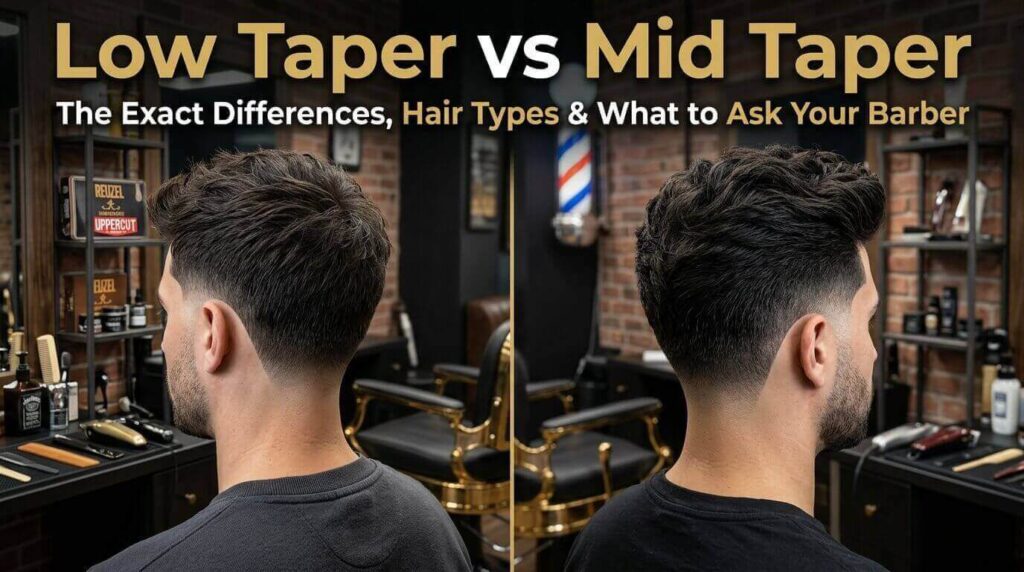
You walk into the barbershop, sit down in the chair, and the barber asks: “Low taper or mid taper?” And just like that, your mind goes blank. Both sound the same. Both look similar in photos. But pick the wrong one and you walk out with a haircut that just doesn’t feel right.
That confusion ends today. This complete guide breaks down everything you need to know about the low taper vs mid taper: what they are, how they look, which one suits your face shape and hair type, and exactly what to tell your barber so you never leave the chair disappointed.
What Is a Taper Fade?
Before diving into the comparison, you need to understand one thing: “taper” and “fade” are not the same thing, though people use them interchangeably all the time.
Taper vs Fade: The Key Difference
A taper is a technique where hair gradually shortens from the top of the head down to the sides and neckline. Think of it like slowly turning down a volume knob, the transition is gradual and natural.
A fade is more aggressive. The hair is blended down to the skin level, creating a sharp, dramatic contrast. It is faster and bolder.
A taper fade combines both techniques, you get the gradual shortening of a taper along with the clean skin-level contrast of a fade. When people say “low taper” or “mid taper,” they are almost always referring to a taper fade.
The Three Types at a Glance
Every taper fade is defined by one thing: height, meaning where the fade begins on the sides of your head.
| Type | Where It Starts | Look | Best For |
|---|---|---|---|
| Low Taper | Just above the ear / sideburns | Subtle, natural, clean | Professional, classic styles |
| Mid Taper | Temple level / mid-ear | Modern, sharp, defined | Trendy, bold, casual looks |
| High Taper | Above the temple | Bold, dramatic contrast | Statement styles, thick hair |
Why Is the Taper Fade So Popular in 2026?
The taper fade has exploded in popularity throughout the 2020s for a simple reason: it is the most versatile men’s haircut ever created. It works on every face shape. It works on every hair type. It works in the office and at the weekend. TikTok and Instagram have made barbershop transformation videos go viral, and the taper fade is always the star. That is not changing in 2026.
Low Taper: Everything You Need to Know
The low taper is the subtler, more understated option. If you want a haircut that looks clean and polished without screaming for attention, the low taper is your answer.
Where Does It Start?
The low taper begins just above the ears and around the neckline, the very lowest portion of your hairline. The barber tightens the sideburns and cleans up the neckline, but leaves most of the side hair completely intact.
One important term to know: the “C-cup.” This is the natural curve of your hairline at your temples. In a low taper, the C-cup remains fully intact. Your face’s natural frame is fully preserved. Only the very bottom edges are cleaned up.
How Does It Look?
From the side, the low taper keeps almost the same volume from top to bottom, the only difference is a clean, sharp line at the very bottom. It is understated and elegant. The “fresh cut” feeling lasts longer because the grow-out is much slower and more gradual.
Advantages of the Low Taper
- Professional and office-friendly: No excessive scalp exposure means it fits conservative environments perfectly, corporate offices, schools, formal events.
- Extremely versatile styling: Side part, slicked back, brushed forward, natural curls, the low taper works with everything. Change your top style and the low taper adapts.
- Slow grow-out: Because the fade starts so low, regrowth blends naturally into the hairline. You can comfortably go 3 to 4 weeks between barber visits.
- Perfect for beginners: If you have never had a taper before, starting with a low taper is the safest choice. Minimal risk, maximum clean.
- Great for thin hair: A low taper preserves density on the sides, making hair look thicker overall.
Disadvantages of the Low Taper
- Mushroom effect risk: If you have very thick, straight hair and the barber does not blend perfectly, the heavy weight line can create a mushroom or bowl-cut appearance. Always go to an experienced barber.
- Not ideal for round faces: Extra volume on the sides can make a round face look even wider. Round face shapes may benefit more from a mid taper.
- Less dramatic: If you want a bold, head-turning haircut, the low taper may feel too quiet for your taste.
Who Is the Low Taper Best For?
- People in professional or formal environments
- First-time taper customers
- Those who prefer a natural, subtle look
- Oval, square, long, or heart-shaped faces
- People who want to stretch time between barber visits
- Anyone with thinning or fine hair
Mid Taper: Everything You Need to Know
The mid taper is the perfect middle ground between classic and bold. It is not too subtle, not too extreme, and it is the most requested taper style in barbershops across the world right now.
Where Does It Start?
The mid taper begins at the temple, roughly at the mid-point of the ear, where the sideburn meets the temple. From there, the barber blends upward and also cleans the neckline below.
Compared to the low taper, the mid taper removes significantly more hair from the sides. The C-cup is partially or fully removed, meaning the temple area shows more skin or very short hair. This is what creates the sharper, more defined look.
How Does It Look?
From the front, the mid taper creates a clearly defined contrast between your shorter, tighter sides and the hair on top. The top looks dominant. The sides look clean and intentional. From the profile, you can see a distinct fade line sitting at the mid-ear level.
This is the haircut that goes viral on social media. It photographs beautifully and gives an instantly polished, modern appearance.
Advantages of the Mid Taper
- Bold and modern: The mid taper makes a statement. People will notice your haircut, in the best possible way.
- Highlights the top: Tighter sides make whatever is happening on top, curls, texture, length, stand out dramatically.
- Works for most face shapes: The added height at the sides vertically elongates the face, which flatters round, square, and oval faces.
- Pairs perfectly with trendy styles: French crop, textured fringe, buzz cut, pompadour, quiff, the mid taper elevates all of them.
- Great for thick or coarse hair: Removes weight from the sides so your hair does not look bulky or heavy.
Disadvantages of the Mid Taper
- Fast grow-out: The exposed temple area shows stubble very quickly. Within 10 to 14 days, the contrast softens and the haircut starts to look blurry. Frequent barber visits are essential.
- Higher maintenance cost: More frequent trims means more time and money. Factor this into your decision.
- Risk of gaunt look: If your face is already very angular, narrow, or long, a mid taper can make it look even more severe and gaunt. In these cases, a low taper is safer.
Who Is the Mid Taper Best For?
- People who want a bold, modern, trendy look
- Those with round, oval, or square faces
- People with thick, coarse, or straight hair
- Casual, social, or weekend-oriented lifestyles
- Those who can commit to regular barber visits every 2 weeks
- Anyone pairing their haircut with a styled top: crop, fringe, or buzz
Low Taper vs Mid Taper: Side-by-Side Comparison
Here is the complete breakdown in one table so you can compare both styles at a glance:
| Feature | Low Taper | Mid Taper |
|---|---|---|
| Fade starts at | Just above the ear / neckline | Temple / mid-ear level |
| C-cup (temple curve) | Fully preserved | Partially or fully removed |
| Side contrast level | Subtle, low contrast | Medium to high contrast |
| Overall look | Clean, natural, understated | Sharp, bold, defined |
| Best environment | Office, formal, professional | Casual, social, creative |
| Grow-out time | 3 to 4 weeks | 10 to 14 days |
| Maintenance level | Low | Medium to high |
| Best face shapes | Oval, square, long, heart | Round, oval, square |
| Best hair types | Fine, thinning, curly | Thick, coarse, straight |
| Scalp exposure | Minimal | Moderate |
The Single Biggest Difference
If you take nothing else from this guide, remember this: the entire difference between a low taper and a mid taper comes down to one word, height. The low taper blends at the bottom of your head. The mid taper blends in the middle. That height difference changes everything, the contrast, the look, the maintenance, and which face shapes it suits.
Common Mistakes People Make When Choosing
- Choosing from a photo without considering face shape: A haircut that looks incredible on someone else might not work on your face. Always factor in your face shape first.
- Asking for a mid taper when you want a low taper: Many men see a sharp haircut online, ask for the same, and end up with more scalp exposed than they expected. Be specific with your barber.
- Ignoring hair type: A low taper on thick straight hair without perfect blending looks very different from a low taper on curly hair. Know your hair type.
Which Taper Should You Choose for Your Face Shape?
Your face shape is one of the most important factors in choosing between a low taper and a mid taper. Here is a complete breakdown:
Round Face
Round faces have equal width and height with soft, curved features. A low taper can make the face look even wider because it keeps volume on the sides. A mid taper, or even a high taper, adds vertical lines that elongate the face and make it appear slimmer and more oval. Recommendation: Go with mid taper.
Oval Face
Oval faces are well-balanced with slightly more length than width and gently rounded features. Lucky you, almost every haircut works on an oval face. Both the low taper and mid taper look great. The low taper gives a classic, refined look. The mid taper gives a modern, sharp look. Choose based on your lifestyle and style preference. Recommendation: Either works, choose based on boldness desired.
Square Face
Square faces have a strong jawline, wide forehead, and angular features. A low taper softens those strong angles and keeps the face balanced. A mid taper can look sharp but may emphasize the width of the jaw. Recommendation: Low taper for a balanced look; mid taper if you want to lean into the angular aesthetic.
Long or Oblong Face
Long faces already have significant vertical length. A high taper or mid taper would stretch the face even further by adding height. A low taper keeps width on the sides which balances out the vertical length. Recommendation: Low taper, avoid anything high.
Heart or Diamond Face
Heart-shaped faces have a wide forehead that narrows to a pointed chin. Diamond faces have wide cheekbones with a narrower forehead and jaw. For both, a low taper draws attention away from a wide forehead and keeps the proportions balanced. A mid taper that exposes the temples can make the forehead look even wider. Recommendation: Low taper.
| Face Shape | Recommended Taper | Why |
|---|---|---|
| Round | Mid Taper | Adds vertical height, slims the face |
| Oval | Both work | Well-balanced face suits all styles |
| Square | Low Taper | Softens angular jawline |
| Long / Oblong | Low Taper | Adds width, balances vertical length |
| Heart / Diamond | Low Taper | Keeps width away from wide forehead |
Which Taper Is Best for Your Hair Type?
Your hair type matters just as much as your face shape. The same haircut on two different hair types can look completely different.
Curly Hair
Curly hair builds natural volume, especially at the sides. A low taper is generally the better choice for curly hair because it preserves that volume and lets the natural curl pattern on top be the star of the show. A mid taper on very curly hair can sometimes create a triangular silhouette, wide at the top, narrow at the sides, which can look disproportionate. Low taper lets curls breathe.
Straight or Fine Hair
Straight and fine hair can look flat and limp without the right structure. A mid taper adds definition and contrast that gives straight hair a sense of shape and intention. If you have very thick straight hair, a low taper risks the mushroom effect if not blended perfectly. A mid taper removes the weight from the sides that thick straight hair tends to build up. Recommendation: Mid taper for thick straight hair; low taper for fine straight hair.
Thick or Coarse Hair
Thick and coarse hair holds a lot of weight on the sides. This can make even a well-cut low taper look heavy and bulky after a week or two. A mid taper removes that side weight, creating a cleaner, more sculpted silhouette. For Black men with coarse hair, a mid taper paired with a crisp edge-up or line-up creates an incredibly sharp geometric look. Recommendation: Mid taper.
Thinning or Fine Hair
If your hair is thinning, you want to minimize scalp exposure as much as possible. A low taper is your best friend, it preserves the hair density on the sides, making your overall hair appear thicker. A mid or high taper with significant scalp exposure can make thinning hair look even more sparse. Recommendation: Low taper always for thinning hair.
| Hair Type | Recommended Taper | Why |
|---|---|---|
| Curly | Low Taper | Preserves natural volume and curl pattern |
| Thick Straight | Mid Taper | Removes side weight, avoids mushroom effect |
| Fine Straight | Low Taper | Avoids excessive scalp exposure |
| Thick / Coarse | Mid Taper | Reduces bulk, creates clean silhouette |
| Thinning | Low Taper | Preserves density, minimizes scalp show-through |
Best Hairstyle Combinations
The taper you choose should complement whatever style you are wearing on top. Here are the best pairings:
Low Taper + Blowout
This is one of the biggest trends of 2025-2026. The blowout creates massive volume on top, and the low taper keeps the sides full enough to match that volume without looking disconnected. The result is a balanced, effortlessly cool look. Perfect for men who like big, voluminous hair.
Low Taper + Mullet
The modern mullet has made a massive comeback, and the low taper is its perfect partner. The low taper cleans up the sides just enough while letting the length flow naturally in the back. The result is edgy but still controlled.
Low Taper + Side Part / Comb Over
The classic combination. A side part or comb over on top looks incredibly sharp and professional when paired with a clean low taper. This is the go-to for formal settings and business environments.
Mid Taper + French Crop / Textured Fringe
The sharp, tighter sides of the mid taper create perfect contrast with a messy, textured fringe falling over the forehead. This is arguably the most popular men’s hairstyle of 2026. Effortlessly stylish and incredibly easy to maintain on top.
Mid Taper + Buzz Cut
A buzz cut alone can look flat and shapeless. A mid taper transforms it into a polished, intentional style by adding a sharp gradient to the edges. The contrast between the buzzed top and the faded sides is clean and masculine.
Mid Taper + Pompadour or Quiff
The mid taper slims down the sides which gives perceived extra height to the pompadour or quiff on top. The contrast is dramatic and eye-catching. This combination works best on oval or square faces.
Maintenance: How Often Do You Need to Visit the Barber?
Maintenance is one of the most practical factors people overlook when choosing their haircut. Here is the honest breakdown:
Low Taper Maintenance
Because the fade starts so low, the regrowth happens at the very bottom of the hairline, an area that naturally blends with the skin. The low taper can comfortably last 3 to 4 weeks before it starts to look overgrown. Some men with slower hair growth can even stretch it to a month. This makes the low taper ideal for busy lifestyles and tighter budgets.
Mid Taper Maintenance
The mid taper is a high-maintenance haircut. As soon as stubble fills in the exposed temple area, usually within 10 to 14 days, the sharp contrast disappears and the haircut starts to look blurry and unkempt. To keep the mid taper looking fresh, you need a barber visit every 2 weeks. If you travel frequently or have a packed schedule, factor this in.
How to Keep It Fresh Between Visits
- Use a matte paste or sea salt spray to style your hair in a way that distracts from minor grow-out.
- Keep the neckline trimmed yourself using a small trimmer, this area shows first.
- Avoid over-washing, natural oils keep the hair structured and less frizzy, which makes grow-out look neater.
Styling Products: What Should You Use?
The right product completes the haircut. Here is what works best for each style:
For the Low Taper
- Matte clay or paste: Gives hold and texture without looking greasy. Perfect for natural, textured looks on top.
- Sea salt spray: Adds volume and a natural, effortless texture. Ideal for wavy or curly hair on top.
- Light pomade: For side parts and slicked-back styles. Use a water-based formula for a natural shine.
For the Mid Taper
- Medium-hold styling clay: Locks in the sharp, clean aesthetic without losing natural texture.
- Water-based pomade: Great for defined, sleek styles that match the sharpness of the mid taper sides.
- Texturizing cream: For textured crops and fringes, adds definition without stiffness.
Common Styling Mistakes to Avoid
- Using too much product: A small amount goes a long way. Over-applying makes hair look greasy and heavy.
- Using oil-based products on fine hair: These weigh fine hair down and make it look flat. Always go water-based.
- Skipping product entirely: Even a minimal amount of product keeps the style looking intentional rather than accidental.
What to Tell Your Barber: Exact Scripts
This is the section most people actually need. Walking into a barbershop and articulating exactly what you want is a skill. Here are word-for-word scripts you can use or even show to your barber directly.
Script for a Low Taper
“I want a low taper fade, please. Keep the C-cup fully intact, I don’t want any scalp showing at the temple. Just clean up the sideburns, blend them down, and tighten up the neckline. Keep as much length on the sides as possible. The fade should only start right above the ear and along the neckline.”
Script for a Mid Taper
“I want a mid taper fade. Start the fade at the temple, around the mid-ear level. Blend it smooth from there down to the neckline. I want clear contrast between the sides and the top. Keep the top at [your desired length] and make the sides tight.”
The Reference Photo Tip
The single most effective thing you can do before sitting in the barber’s chair is bring a reference photo. Open Google or
Styling Products: What Should You Use?
The right product completes the haircut. Here is what works best for each style:
For the Low Taper
- Matte clay or paste: Gives hold and texture without looking greasy. Perfect for natural, textured looks on top.
- Sea salt spray: Adds volume and a natural, effortless texture. Ideal for wavy or curly hair on top.
- Light pomade: For side parts and slicked-back styles. Use a water-based formula for a natural shine.
For the Mid Taper
- Medium-hold styling clay: Locks in the sharp, clean aesthetic without losing natural texture.
- Water-based pomade: Great for defined, sleek styles that match the sharpness of the mid taper sides.
- Texturizing cream: For textured crops and fringes, adds definition without stiffness.
Common Styling Mistakes to Avoid
- Using too much product: A small amount goes a long way. Over-applying makes hair look greasy and heavy.
- Using oil-based products on fine hair: These weigh fine hair down and make it look flat. Always go water-based.
- Skipping product entirely: Even a minimal amount of product keeps the style looking intentional rather than accidental.
What to Tell Your Barber: Exact Scripts
This is the section most people actually need. Walking into a barbershop and articulating exactly what you want is a skill. Here are word-for-word scripts you can use or even show to your barber directly.
Script for a Low Taper
“I want a low taper fade, please. Keep the C-cup fully intact, I don’t want any scalp showing at the temple. Just clean up the sideburns, blend them down, and tighten up the neckline. Keep as much length on the sides as possible. The fade should only start right above the ear and along the neckline.”
Script for a Mid Taper
“I want a mid taper fade. Start the fade at the temple, around the mid-ear level. Blend it smooth from there down to the neckline. I want clear contrast between the sides and the top. Keep the top at [your desired length] and make the sides tight.”
The Reference Photo Tip
The single most effective thing you can do before sitting in the barber’s chair is bring a reference photo. Open Google or Instagram, search “low taper fade” or “mid taper fade,” find one that matches what you want, and show it to your barber. This eliminates most miscommunication.
How to Avoid Getting the Wrong Cut
- Be specific about fade height: Say “low, starting just above the ear” or “mid, starting at the temple.” Never just say “fade.”
- Describe the contrast level: “I want subtle, not too much skin showing” vs “I want sharp, high contrast sides.”
- Mention your face shape concern: If you have a round face, tell your barber. A good barber will adjust accordingly.
- Ask to check mid-cut: Ask the barber to show you the sides in a mirror before finishing. Catch any issues early.
Final Verdict: Which One Is Better?
There is no universally “better” taper. The right choice depends entirely on you. Here is a simple decision framework:
| If you… | Choose… |
|---|---|
| Work in a professional / formal environment | Low Taper |
| Want a subtle, natural, understated look | Low Taper |
| Have a long, square, or heart-shaped face | Low Taper |
| Have curly, fine, or thinning hair | Low Taper |
| Cannot visit the barber more than once a month | Low Taper |
| Want a bold, modern, head-turning look | Mid Taper |
| Have a round or oval face | Mid Taper |
| Have thick, coarse, or straight hair | Mid Taper |
| Can visit the barber every 2 weeks | Mid Taper |
| Are pairing with a textured crop or fringe on top | Mid Taper |
The bottom line: if in doubt, start with a low taper. It is the safer choice and gives you a benchmark. Once you see how it looks and feels, you can decide whether you want to go higher next time. Most men who try the mid taper and love it started with a low taper first.
Frequently Asked Questions
What is the difference between a low taper and a mid taper?
The main difference is where the fade starts. A low taper starts just above the ear and along the neckline, keeping most of the side hair intact. A mid taper starts at the temple, higher up on the head, creating more contrast between the sides and the top. The mid taper looks sharper and bolder; the low taper looks cleaner and more natural.
Which taper is better for a professional setting?
The low taper is generally the better choice for professional and formal environments. It keeps side hair fuller with minimal scalp exposure, giving a polished but not overly casual or trendy appearance. A well-executed mid taper can also work in many workplaces, but the low taper is the safer, universally accepted choice for corporate settings.
Are low taper fades attractive?
Yes, absolutely. The low taper fade is one of the most attractive men’s haircuts for a simple reason, it makes everyone look cleaner, sharper, and more put-together without trying too hard.
Are taper and low taper the same?
Not quite. “Taper” is the general technique, hair gradually getting shorter down the sides and neckline. “Low taper” is a specific variation of that technique where the blending starts low, just above the ear, rather than higher up at the temple or crown. Every low taper is a taper, but not every taper is a low taper, it could just as easily be a mid or high taper depending on where the barber starts the fade.
Is a mid taper a high top?
No, these describe two different things. “Mid taper” refers to where the fade starts on the sides of your head, around the temple. “High top” refers to what’s happening on the top of your head, a style with significant length and volume built upward, often on coily or curly hair. You can actually pair the two together: a mid taper on the sides with a high top on top is a common and striking combination.
Is low or mid fade better?
Neither is objectively better, it depends on your lifestyle and features. A low fade is better if you want something subtle, work in a professional setting, have curly or thinning hair, or want to stretch time between barber visits. A mid fade is better if you want a bolder, more modern look, have a round face, have thick or coarse hair, or don’t mind visiting the barber every two weeks.
Is a low taper or mid taper better for curly hair?
For curly hair, the low taper is usually the better option. It preserves the natural volume and curl pattern on the sides, letting the curls on top take center stage. A mid taper on curly hair can sometimes create an unbalanced silhouette where the top looks disproportionately wide compared to the tightly faded sides.
How long does a mid taper last before it grows out?
A mid taper typically lasts 10 to 14 days before the exposed temple area starts to fill in with stubble, softening the contrast and making the haircut look less sharp. To maintain the clean look of a mid taper, most barbers recommend a trim every 2 weeks.
Which taper is right for a round face?
For round faces, a mid taper (or even a high taper) is generally recommended. The fade starting at the temple creates vertical lines that elongate the face and make it appear slimmer. A low taper can have the opposite effect, adding volume to the sides of the head and making a round face look even wider.
What is the difference between a low taper and a low taper fade?
These terms are often used interchangeably, but technically there is a subtle difference. A “taper” refers to the gradual shortening of hair without necessarily reaching the skin. A “taper fade” means the hair fades all the way down to the skin level. In modern barbershop language, when someone asks for a “low taper,” they almost always mean a low taper fade.
Which is better for thick hair, low taper or mid taper?
For thick hair, the mid taper is generally the better choice. Thick hair builds significant volume and weight on the sides. A mid taper removes that side weight, creating a cleaner and more balanced silhouette. A low taper on very thick hair can make the head look disproportionately wide, especially if the barber does not blend the weight line perfectly.
Conclusion
The low taper vs mid taper debate comes down to two things: your personal style and your practical lifestyle. The low taper is clean, versatile, slow to grow out, and professional. The mid taper is bold, sharp, modern, and statement-making, but requires more maintenance.
Use this guide, factor in your face shape and hair type, and walk into your next barbershop appointment with total confidence. Show your barber the exact script, bring a reference photo, and you will walk out with exactly the haircut you pictured.
Now go get that fresh cut.