



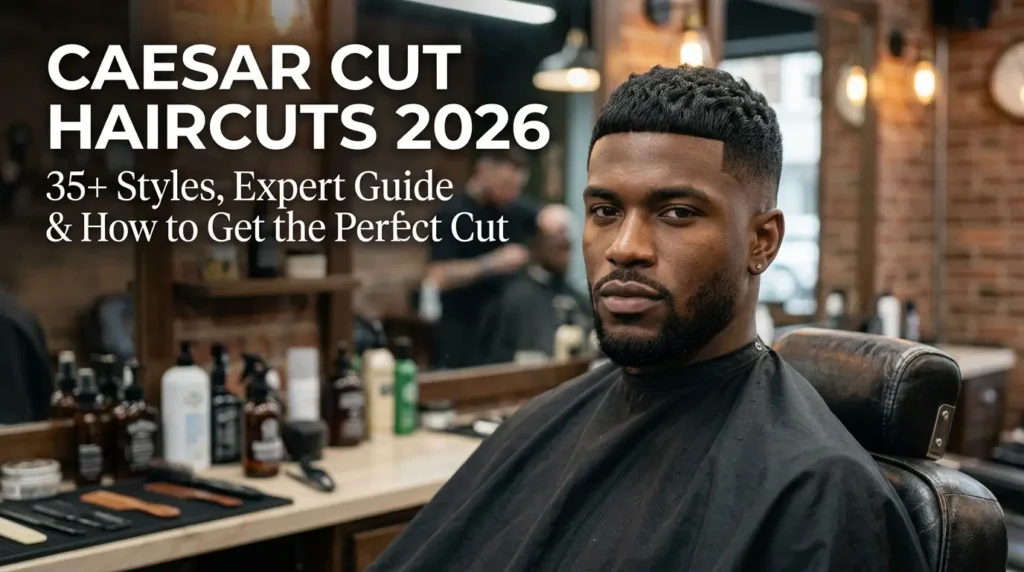
What Is a Caesar Cut?
A Caesar cut is a short men’s haircut with a horizontal fringe brushed forward and evenly trimmed sides, named after Julius Caesar who wore this style to conceal thinning hair. Modern versions include fades and texture while maintaining the signature forward-brushed bangs that define this timeless look.
The Caesar haircut is a classic men’s style characterized by a short, straight-across fringe with uniform length on top and neatly cropped sides. The hair is worn forward—not parted or slicked back—creating a distinctive horizontal line across the forehead that distinguishes it from other short hairstyles.
Key characteristics that define a Caesar cut:
- Forward-brushed fringe covering the hairline
- Even length across the top (typically 1-2 inches or 2.5-5 cm)
- Tapered or faded sides blending seamlessly into the top
- Low-maintenance styling requiring minimal product
- Structured silhouette that grows out cleanly between cuts
What makes this haircut particularly valuable is its ability to conceal thinning hair and receding hairlines. The forward fringe naturally covers the temples and creates the illusion of fuller, denser hair at the front—a benefit that made it popular with Julius Caesar himself and continues attracting men experiencing early hair loss today.
The original Caesar was blunt and uniform throughout. Today’s modern Caesar cut adds texture, movement, and fade variations while maintaining the signature fringe that defines the style. This evolution keeps the haircut relevant for men seeking both classic appeal and contemporary edge.
35+ Caesar Haircut Styles for Every Man
Choosing the right Caesar variation can feel overwhelming with so many options available. This comprehensive gallery covers every style worth considering, along with who each one works best for, celebrity examples for reference, and specific styling instructions.
Classic Caesar Cut

The classic Caesar features uniform length throughout with a blunt, horizontal fringe and no fade on the sides. This is the original style Julius Caesar himself reportedly wore in ancient Rome.
- Best for: Professional settings, beginners, low-maintenance seekers
- Celebrity example: George Clooney (1990s ER era), Sam Fender
- Hair types: Straight, slightly wavy
- Face shapes: Oval, square, diamond
- Styling: Apply small amount of matte clay, brush forward with fingers
- Maintenance: Trim every 4-5 weeks
- Styling time: 2-3 minutes daily
Modern Caesar Cut
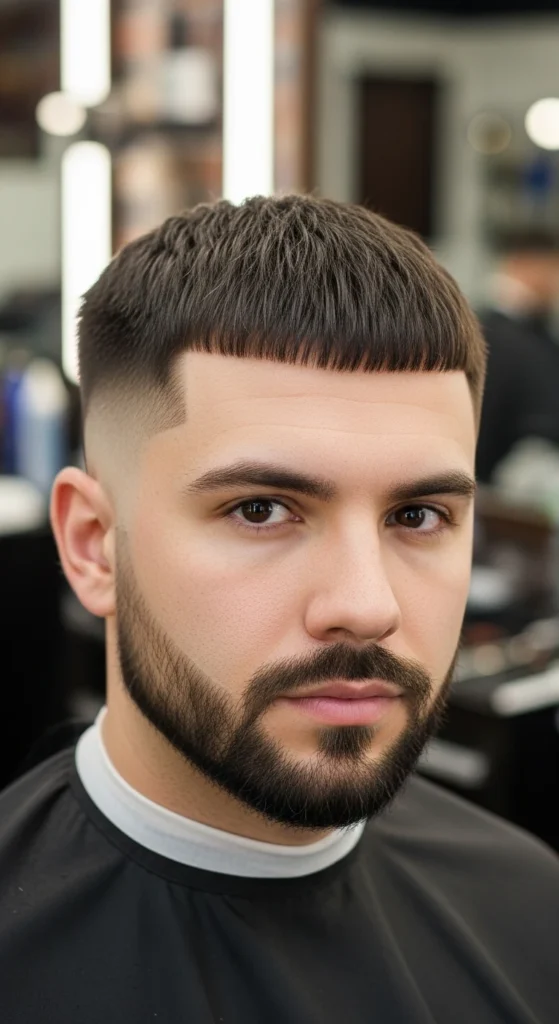
The modern Caesar haircut updates the classic with added texture on top and a subtle taper on the sides. The fringe appears softer and more natural rather than rigidly blunt.
- Best for: Younger men, trend-conscious individuals
- Celebrity example: Zac Efron
- Hair types: All hair types
- Face shapes: All face shapes
- Styling: Sea salt spray for texture, finish with texture clay
- Maintenance: Trim every 3-4 weeks
- Styling time: 3-5 minutes daily
Caesar Fade (Low Fade)
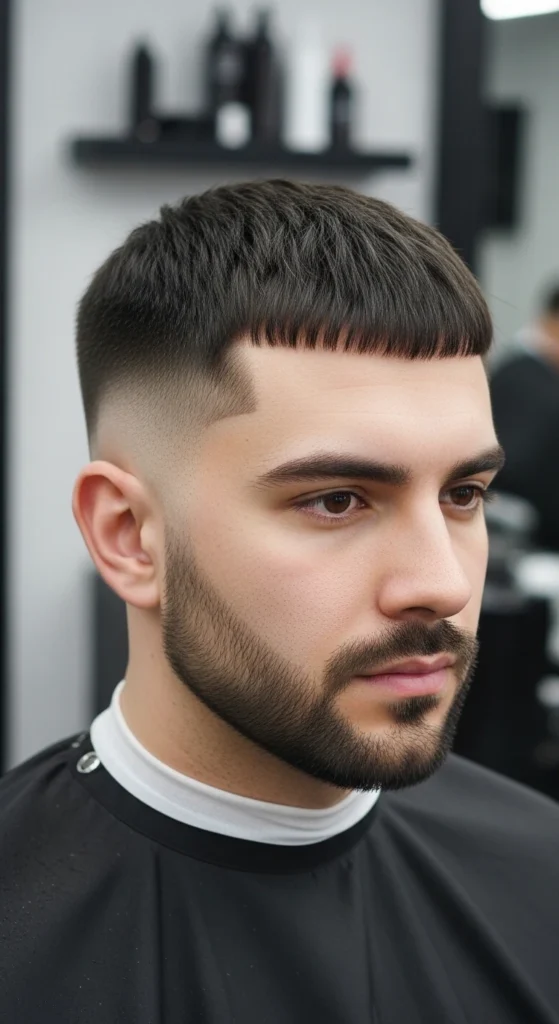
The low fade Caesar combines the classic top with a fade beginning just above the ears. This creates subtle contrast without dramatic transitions, making it appropriate for professional environments.
- Best for: Professional environments, first-time fade wearers
- Celebrity example: Tom Daley
- Hair types: Straight, wavy, slightly curly
- Face shapes: All face shapes
- Styling: Lightweight pomade, comb through forward
- Clipper guards: #1-2 at fade line, #4-6 on top
- Measurements: Fade starts 1 inch (2.5 cm) above ear
- Maintenance: Trim every 3-4 weeks, fade touch-up every 2-3 weeks
Caesar Mid Fade

The mid fade Caesar positions the fade at temple level, creating sharper contrast than the low fade while remaining balanced and wearable for most settings.
- Best for: Men wanting noticeable but not extreme contrast
- Celebrity example: Post Malone
- Hair types: All hair types
- Face shapes: Round, oval, heart
- Styling: Matte paste, finger-styled forward
- Clipper guards: #0.5-1 at fade line blending to #5-6 on top
- Measurements: Fade starts at temple level, approximately 2 inches (5 cm) above ear
- Maintenance: Fade refresh every 2-3 weeks
Caesar High Fade

The high fade Caesar cut starts the fade well above the temples, creating bold contrast that draws attention to the textured top and defined fringe.
- Best for: Statement makers, square and round face shapes
- Celebrity example: Justin Bieber
- Hair types: All types, especially thick hair
- Face shapes: Round (slims sides), square
- Styling: Texture powder for lift, shape fringe forward
- Clipper guards: #0-0.5 at fade line, blend to #6-8 on top
- Measurements: Fade starts 3+ inches (7.5+ cm) above ear
- Maintenance: Fade touch-up every 1-2 weeks
Caesar Skin Fade
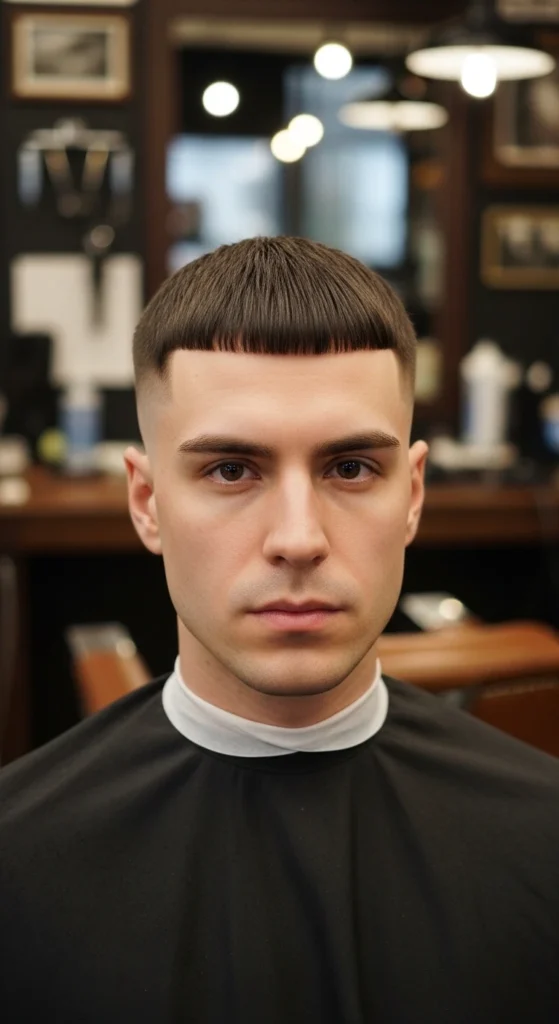
The skin fade Caesar takes fading to the extreme, transitioning down to bare skin for maximum contrast. This bold variation demands frequent maintenance but delivers striking visual impact.
- Best for: Bold style preference, men wanting maximum contrast
- Celebrity example: Junior Andre
- Hair types: All types
- Face shapes: Oval, square, diamond
- Styling: Keep top textured with styling clay
- Clipper guards: Foil shaver or #0 at skin, blend to #5-7 on top
- Maintenance: Touch-up every 1-2 weeks (stubble shows quickly)
Caesar Taper Fade
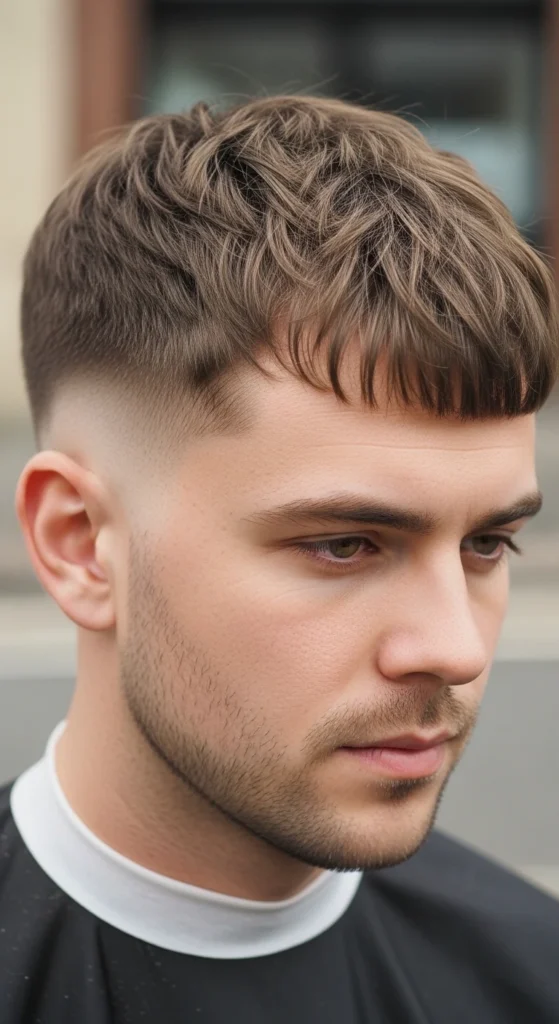
The Caesar taper fade uses scissors rather than clippers for a gradual, softer transition. This creates a more traditional, less dramatic look than clipper fades while maintaining clean lines.
- Best for: Professional settings, traditional preference, older men
- Hair types: All types
- Face shapes: All face shapes
- Styling: Light styling cream for natural movement
- Maintenance: Trim every 4-5 weeks
Caesar Drop Fade
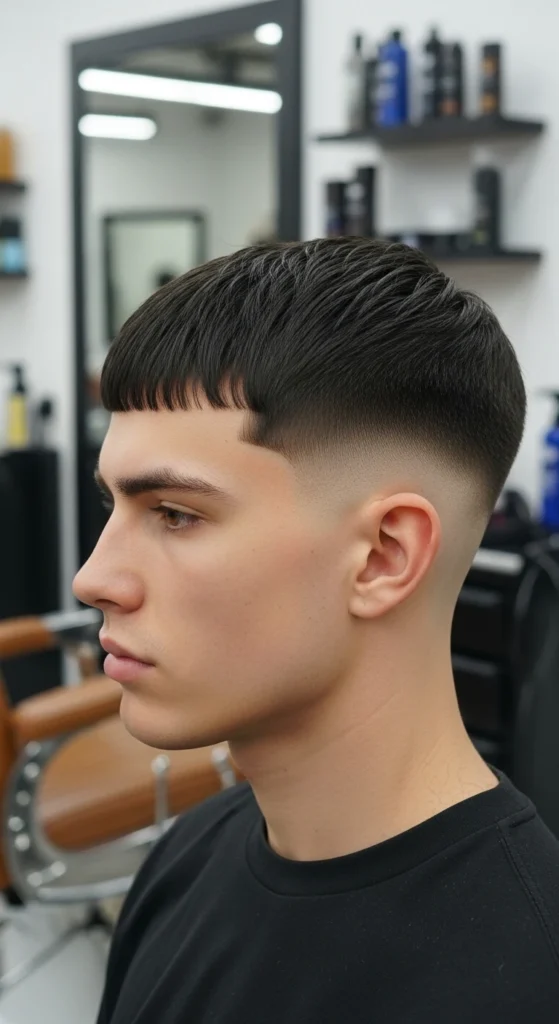
The drop fade Caesar features a fade line that curves down and behind the ear, creating a dynamic, three-dimensional shape around the head that follows natural head contours.
- Best for: Thicker or coarse hair, modern aesthetic preference
- Celebrity example: Zac Efron
- Hair types: Thick, coarse, wavy
- Face shapes: Oval, heart, diamond
- Styling: Textured fringe with matte clay
- Maintenance: Fade refresh every 2-3 weeks
Dark Caesar Cut
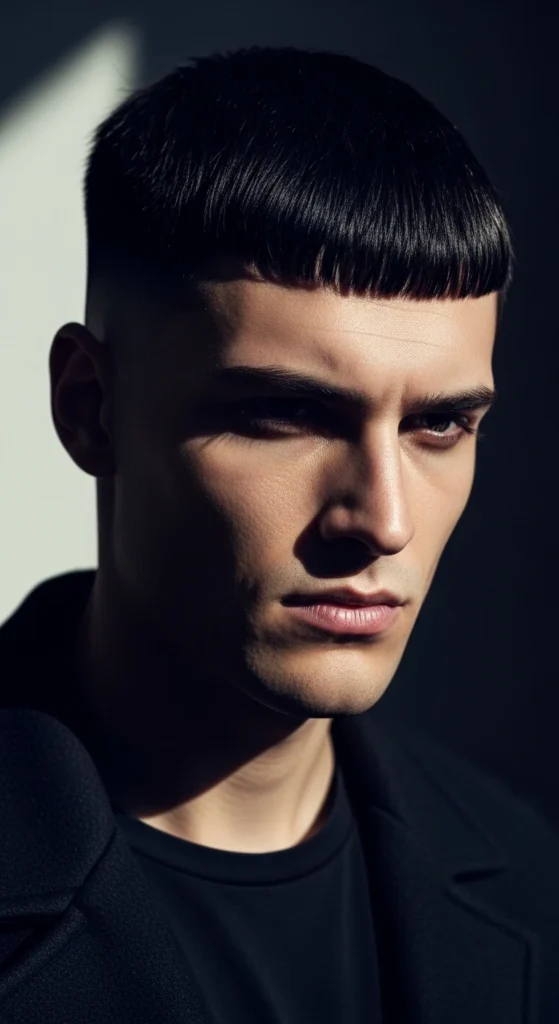
The dark Caesar haircut is specifically designed for Black men, featuring very short, dense hair (typically under 1 inch) with a low fade and sharp line-up around the hairline using a straight razor or trimmer.
- Best for: Coarse, textured natural hair (Type 4)
- Celebrity example: Drake
- Hair types: Type 4 coily/kinky hair
- Face shapes: All face shapes
- Styling: Moisturizing cream or curl-enhancing butter, soft bristle brush
- Clipper guards: #1-1.5 all over, clean line-up with trimmer
- Maintenance: Line-up every 1-2 weeks, shape-up every 2-3 weeks
Caesar with 360 Waves
The Caesar with 360 waves combines short Caesar length with the iconic circular wave pattern achieved through consistent brushing and compression. This style requires dedication but delivers impressive results.
- Best for: Naturally textured hair, dedicated wave enthusiasts
- Celebrity example: Usher
- Hair types: Type 3-4 curly/coily hair
- Face shapes: All face shapes
- Styling: Wave pomade, soft bristle brush in circular pattern, durag or wave cap overnight
- Maintenance: Daily brushing (minimum 15 minutes), durag/wave cap every night, trim every 2-3 weeks
- Products needed: Wave pomade, soft bristle brush, medium bristle brush, durag or wave cap
Light Caesar Cut
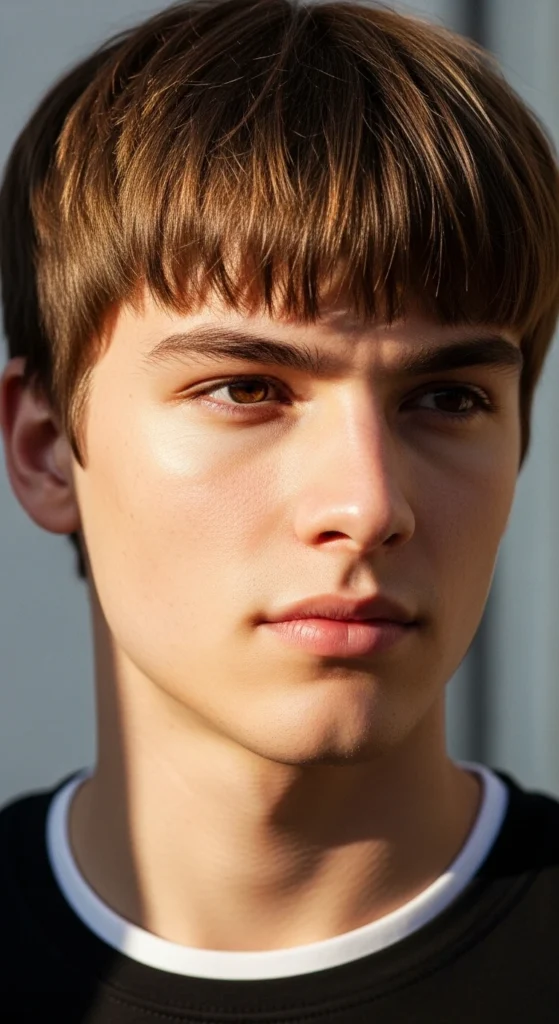
The light Caesar keeps hair slightly longer with a softer, less defined fringe. The overall appearance is more relaxed and approachable than sharper variations.
- Best for: Softer appearance preference, casual settings
- Hair types: Straight, wavy
- Face shapes: Angular faces (softens features)
- Styling: Lightweight mousse for subtle hold
- Maintenance: Trim every 4-5 weeks
Long Caesar Cut

The long Caesar haircut extends the top length to 3-4 inches (7.5-10 cm), creating a more pronounced fringe with greater styling versatility and dramatic visual impact.
- Best for: Men wanting styling options, thicker hair
- Celebrity example: Gerard Butler
- Hair types: Straight, wavy, thick
- Face shapes: Round (adds length), square
- Styling: Blow-dry forward, finish with styling cream or light pomade
- Maintenance: Trim every 3-4 weeks
Short Caesar Cut
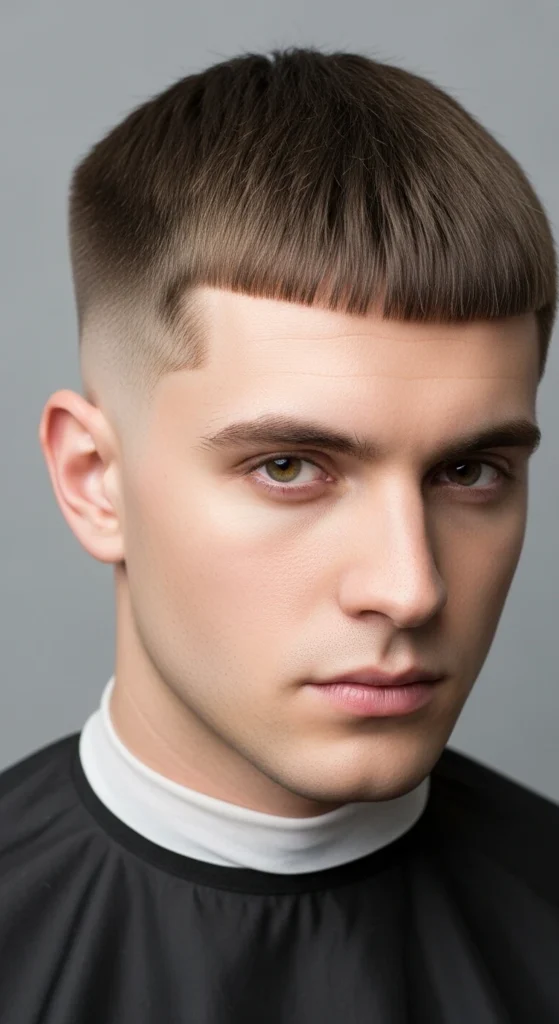
The short Caesar cut keeps everything close-cropped at 0.5-1 inch (1-2.5 cm) throughout with a minimal but visible fringe that still maintains the Caesar silhouette.
- Best for: Hot climates, ultra-low maintenance preference, active lifestyles
- Celebrity example: George Clooney (early 2000s)
- Hair types: All types
- Face shapes: All face shapes
- Styling: Virtually none required; optional light matte paste
- Maintenance: Trim every 3-4 weeks
- Styling time: Under 1 minute
Textured Caesar Cut
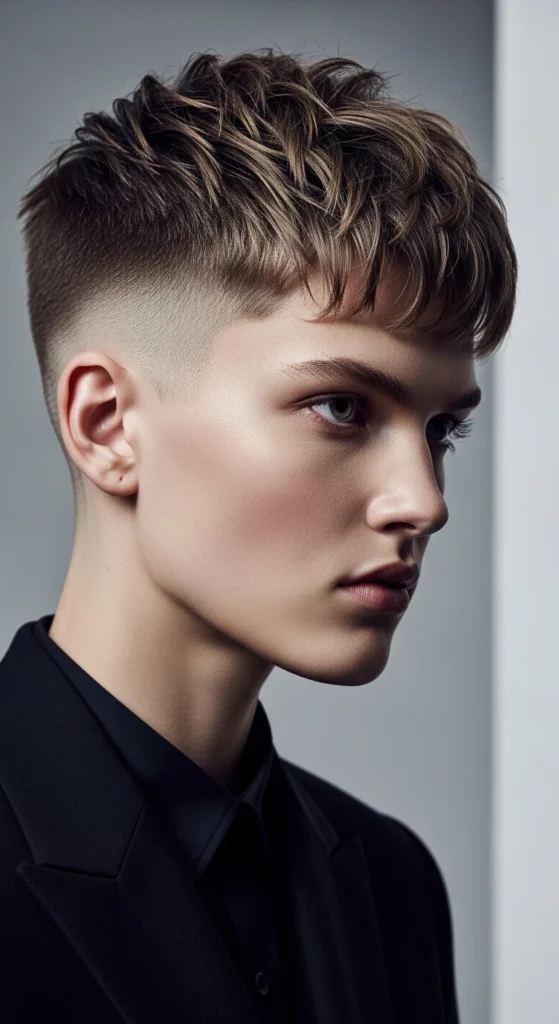
The textured Caesar haircut adds choppy, uneven layers throughout the top, creating movement and preventing the flat “helmet” appearance some classic Caesars can have. This variation uses point-cutting technique to create natural-looking separation.
- Best for: Thick hair, modern edge preference
- Celebrity example: Tom Blyth
- Hair types: Thick, straight, wavy
- Face shapes: All face shapes
- Styling: Texturizing paste or sea salt spray, finger-tousled
- Maintenance: Trim every 3-4 weeks
Messy Caesar Cut

The messy Caesar is deliberately tousled and relaxed, with a soft fringe that appears effortlessly undone rather than precisely styled. This variation appeals to men who prefer casual, approachable aesthetics.
- Best for: Creative professionals, casual style preference
- Hair types: All types, especially wavy
- Face shapes: All face shapes
- Styling: Sea salt spray, scrunch and air dry
- Maintenance: Trim every 4-5 weeks
Curly Caesar Cut
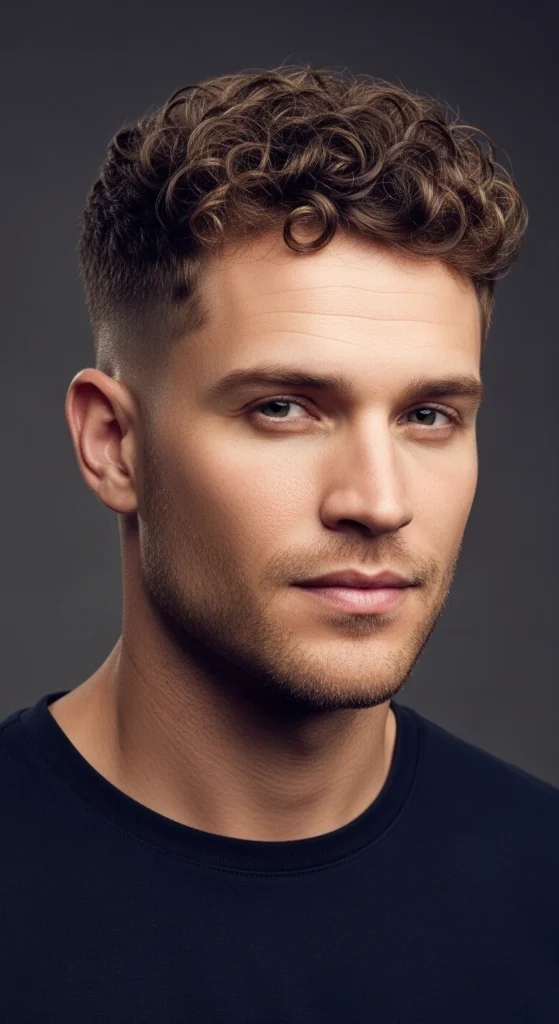
The curly Caesar haircut works with naturally curly hair rather than against it, keeping curls short but visible while maintaining the forward fringe direction.
- Best for: Type 2-3 naturally curly hair
- Celebrity example: Timothée Chalamet
- Hair types: Curly, coily
- Face shapes: All face shapes
- Styling: Curl cream, diffuser attachment on blow dryer, light hold gel
- Maintenance: Trim every 3-4 weeks
Wavy Caesar Cut

The wavy Caesar embraces natural wave texture, creating a soft, flowing fringe with subtle movement throughout that adds visual interest without appearing unkempt.
- Best for: Naturally wavy hair wanting structure
- Hair types: Type 2 wavy
- Face shapes: All face shapes
- Styling: Curl-enhancing mousse, air dry or diffuse
- Maintenance: Trim every 3-4 weeks
Caesar Cut for Straight Hair
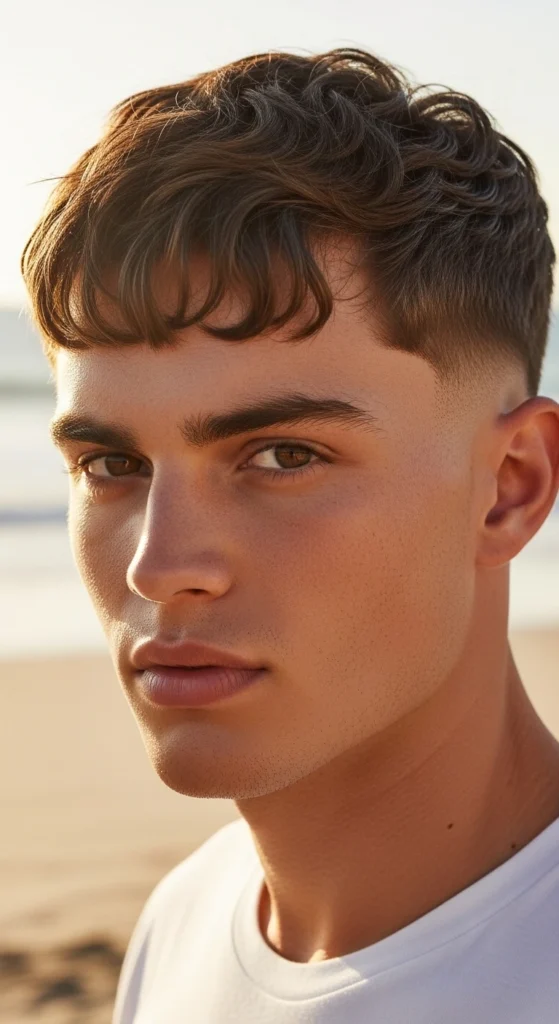
The straight hair Caesar produces clean, sharp lines with a flat fringe that sits neatly across the forehead without any deviation or flyaways.
- Best for: Straight hair wanting defined structure
- Hair types: Type 1 straight
- Face shapes: All face shapes
- Styling: Blow-dry forward, matte clay for hold
- Maintenance: Trim every 3-4 weeks
Asian Caesar Cut

The Asian Caesar haircut works exceptionally well with the density and straight growth pattern typical of East Asian hair types. The hair’s natural thickness creates clean, defined lines without requiring heavy product.
- Best for: Asian hair texture, modern look
- Hair types: Dense, straight (common in East Asian hair)
- Face shapes: All face shapes
- Styling: Avoid heavy thinning (ruins natural shape), light pomade
- Note: Density and straight growth create an ideal canvas for sharp, clean lines
- Maintenance: Trim every 3-4 weeks
Caesar Cut for Thin Hair

The thin hair Caesar uses the forward fringe strategically to add the appearance of density and fullness where hair is most sparse.
- Best for: Fine hair, thinning crowns
- Hair types: Thin, fine
- Face shapes: All face shapes
- Styling: Volumizing mousse at roots, light clay (avoid heavy products that weigh hair down)
- Maintenance: Trim every 4-5 weeks
Caesar Cut for Receding Hairline
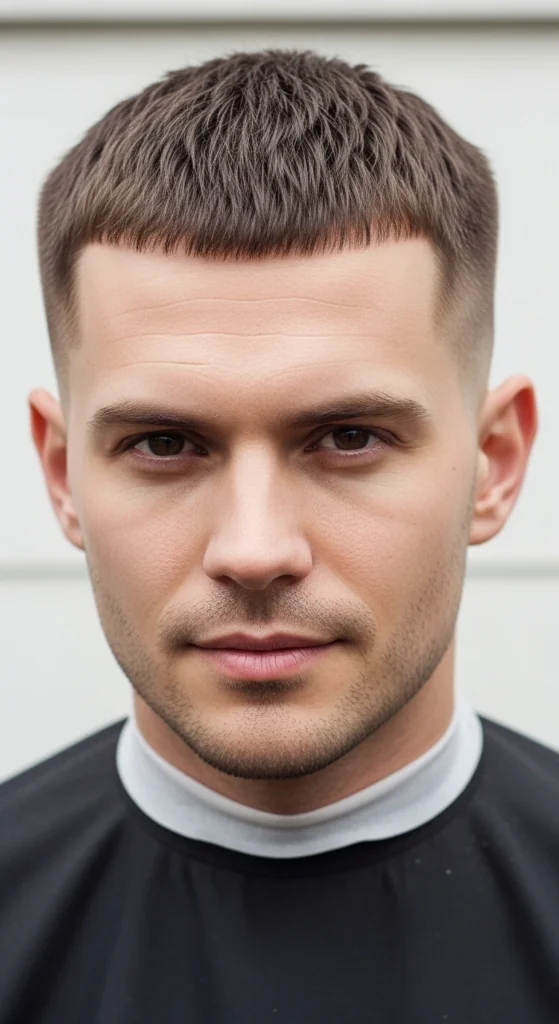
The receding hairline Caesar is specifically designed to disguise temple recession by sweeping the fringe forward over problem areas. This variation has helped countless men feel confident about their appearance.
- Best for: Early to mid hair loss, receding temples
- Celebrity example: Eminem
- Hair types: All types
- Face shapes: All face shapes
- Styling: Always sweep fringe forward, never slick back
- Why it works: Forward fringe reduces contrast between hairline and forehead
- Maintenance: Trim every 3-4 weeks
Caesar Undercut

The Caesar undercut creates dramatic disconnect between the heavy top and buzzed sides, producing bold contrast that makes a strong style statement.
- Best for: Bold contrast seekers, edgy style preference
- Hair types: Thick, straight, wavy
- Face shapes: Oval, square
- Styling: Strong-hold clay, defined separation
- Maintenance: Undercut touch-up every 2-3 weeks
Caesar Mullet
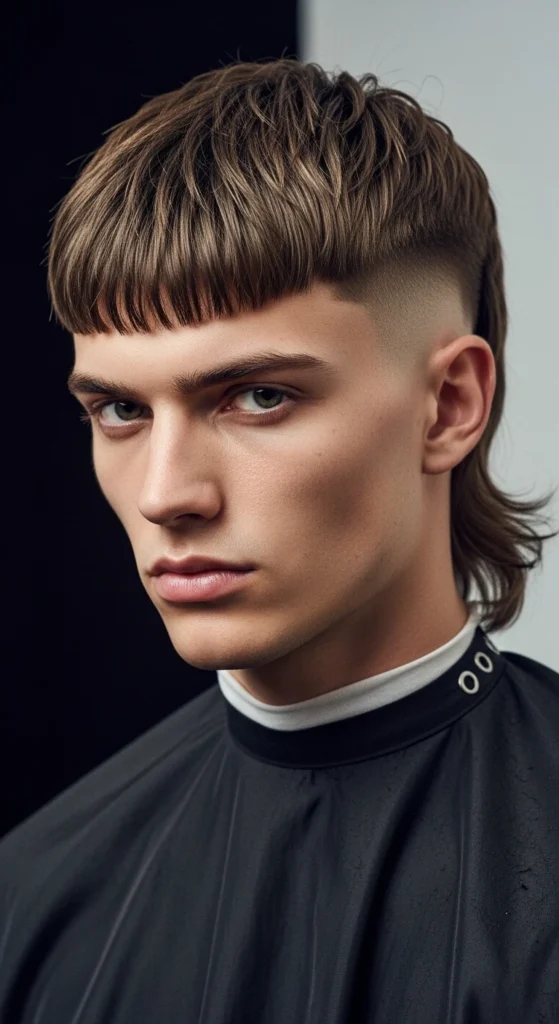
The Caesar mullet combines the short forward fringe with longer hair at the back, merging two iconic styles into one statement cut that’s gained significant popularity in 2025-2026.
- Best for: Trend-forward, edgy preference
- Hair types: Straight, wavy
- Face shapes: Oval, heart
- Styling: Texture throughout with clay, control spray for hold
- Maintenance: Shape-up every 3-4 weeks
Caesar with Beard
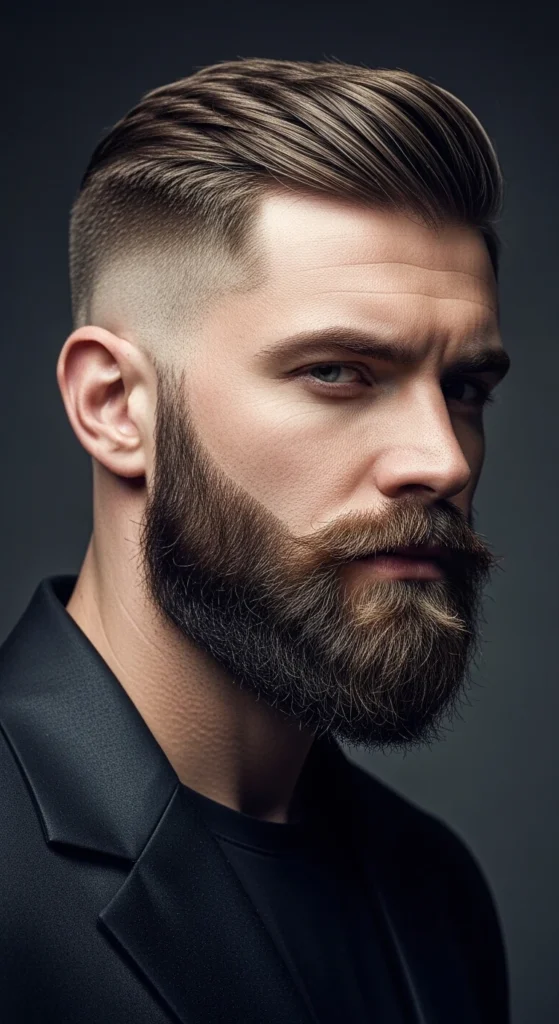
The Caesar haircut with beard pairs the cropped top with facial hair of any length, creating masculine balance between the clean haircut and natural beard growth.
- Best for: Men with full beard growth, masculine aesthetic
- Hair types: All types
- Face shapes: All face shapes (beard adds definition to weaker jawlines)
- Styling: Texture clay for hair, argan oil or beard oil for facial hair
- Maintenance: Haircut every 3-4 weeks, beard trim as needed
Caesar Buzz Cut
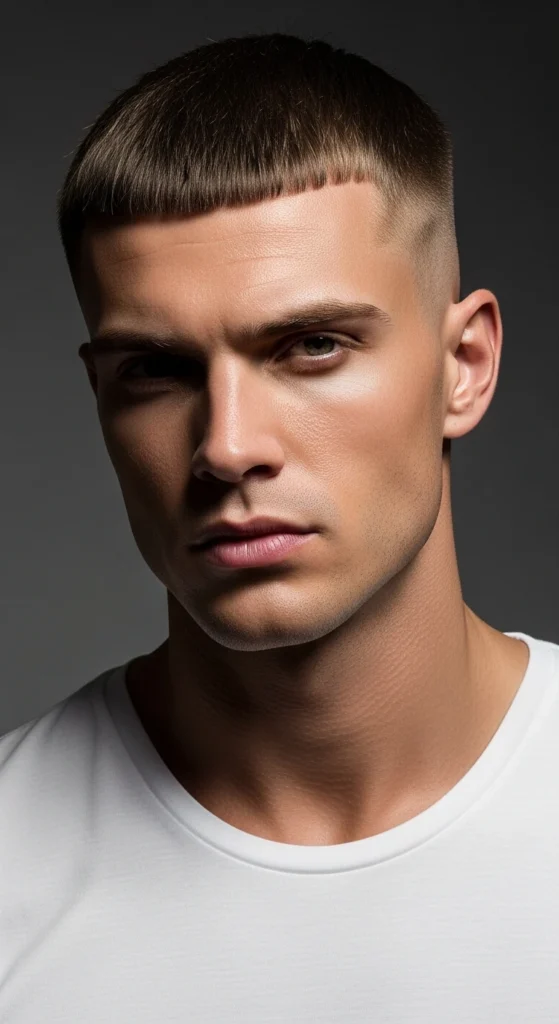
The Caesar buzz cut is the shortest variation, keeping hair extremely close-cropped with a barely-there fringe that still maintains the forward-brushed direction.
- Best for: Minimal maintenance, hot climates, active lifestyles, military
- Celebrity example: Drake (early career)
- Hair types: All types
- Face shapes: Oval, square (strong features handle short length well)
- Clipper guards: #1-2 all over
- Styling: None required
- Maintenance: Trim every 2-3 weeks
Caesar Crop (French Crop Hybrid)
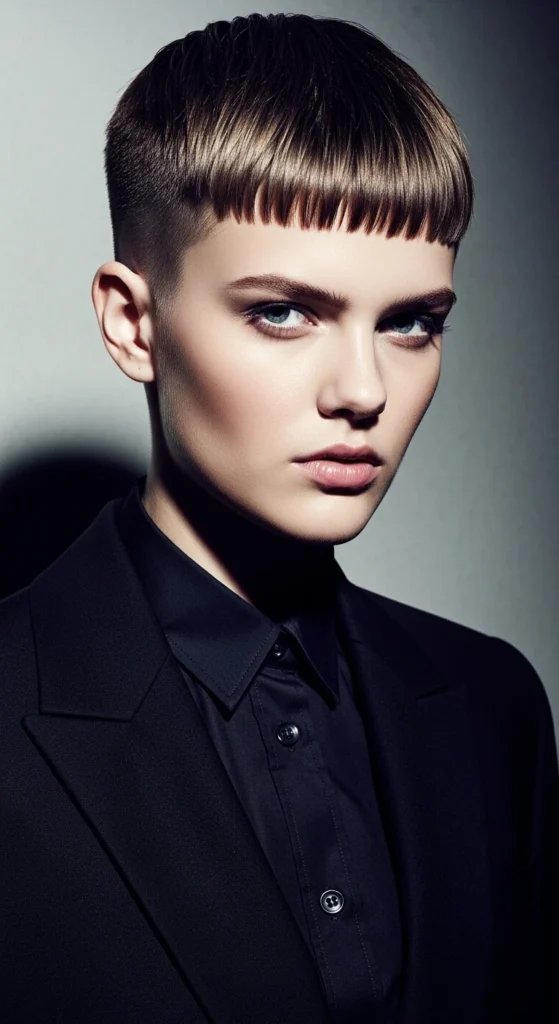
The Caesar crop blends elements of both the Caesar and French crop, featuring a longer textured fringe with faded sides. This hybrid addresses men who can’t decide between the two popular styles.
- Best for: Trendy preference, textured style lovers
- Hair types: All types
- Face shapes: All face shapes
- Styling: Texture powder for lift, piece-y finish with paste
- Maintenance: Trim every 3-4 weeks
Soft Caesar Cut

The soft Caesar features rounded edges and a gentle fringe rather than sharp, blunt lines. The overall effect is more approachable and less severe.
- Best for: Softer facial features, less angular faces
- Hair types: All types, especially fine hair
- Face shapes: Angular faces (softens sharp features)
- Styling: Lightweight styling cream
- Maintenance: Trim every 4-5 weeks
Spiky Caesar Cut
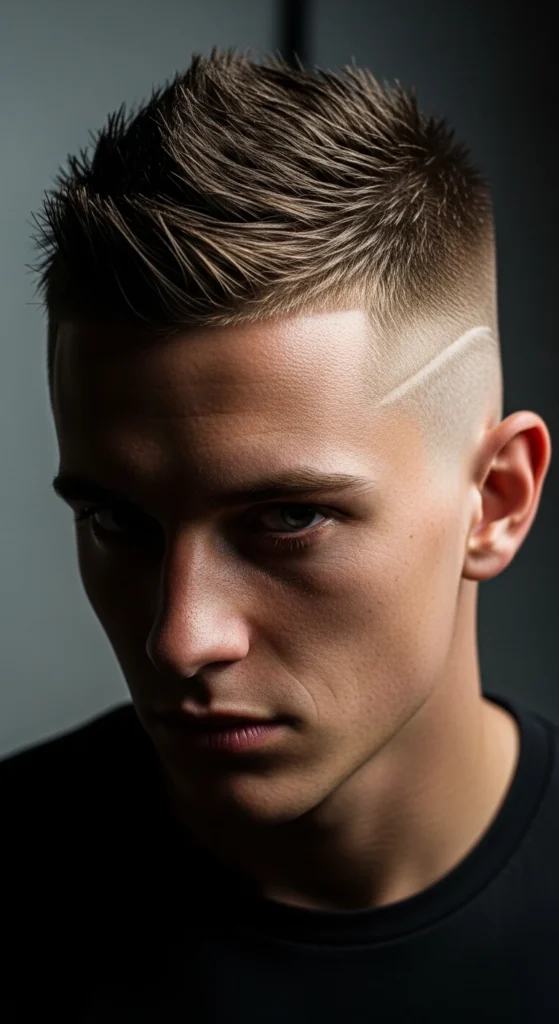
The spiky Caesar haircut lifts the top into textured spikes while maintaining the forward fringe direction. This variation adds height and visual interest.
- Best for: Younger men, edgy preference
- Hair types: Straight, thick
- Face shapes: Round (adds height), oval
- Styling: Strong-hold matte paste, style upward from roots
- Maintenance: Trim every 3-4 weeks
Blonde Caesar Cut
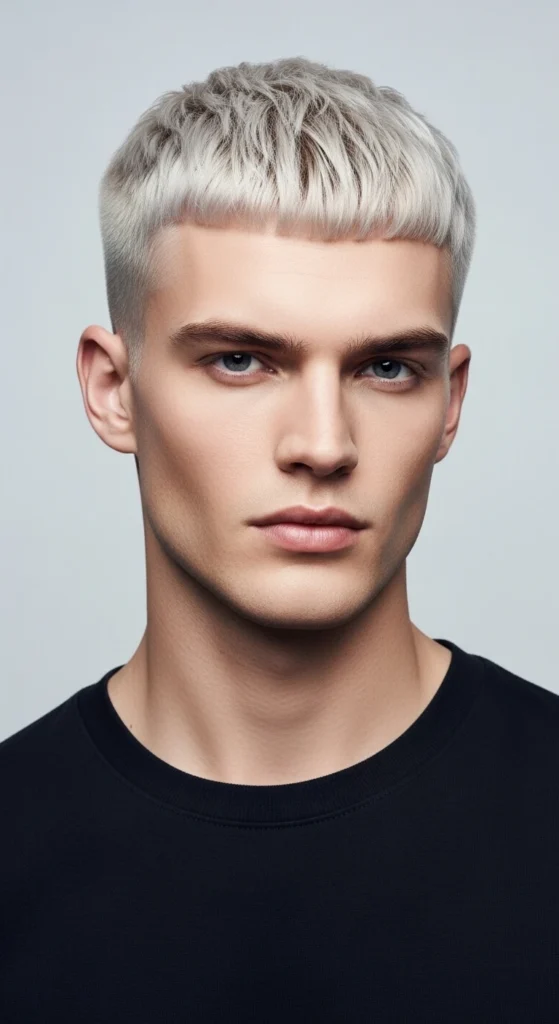
The blonde Caesar highlights light hair tones, with the structured cut providing definition that can sometimes be lost in lighter hair colors without proper styling.
- Best for: Blonde, light brown, or highlighted hair
- Hair types: All types
- Face shapes: All face shapes
- Styling: Texture clay for definition without heaviness
- Maintenance: Trim every 3-4 weeks, toner touch-up if color-treated
Caesar with Line-Up
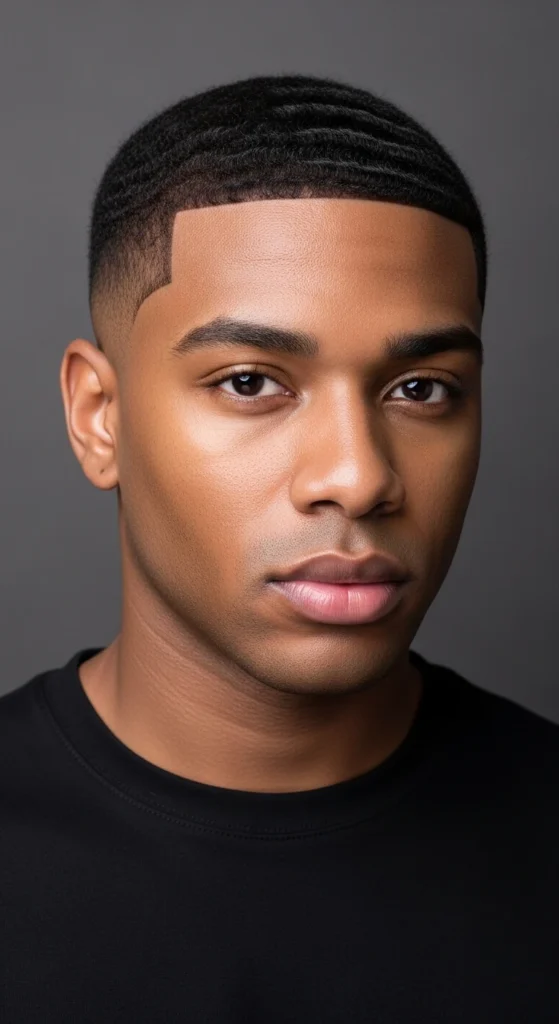
The Caesar with line-up features sharp, defined edges around the hairline created with a straight razor or trimmer. The precision creates a polished, intentional appearance.
- Best for: Clean, precise appearance
- Celebrity example: Michael B. Jordan
- Hair types: All types, especially common with dark Caesar
- Face shapes: All face shapes
- Styling: Maintain crisp edges with regular touch-ups
- Maintenance: Line-up touch-up every 1-2 weeks
Caesar with Shaved Design
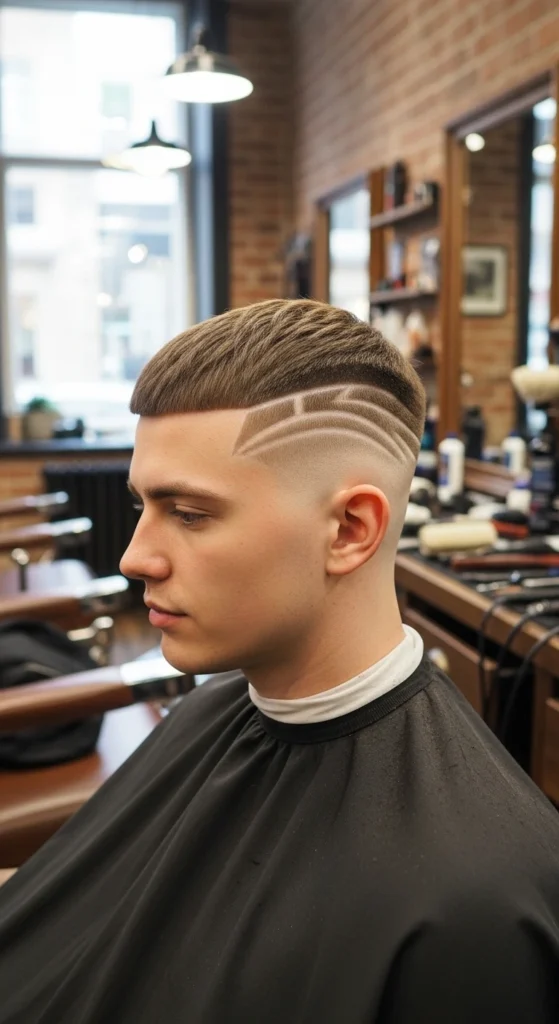
The Caesar with shaved design incorporates geometric patterns, lines, or artistic elements shaved into the fade for creative personal expression.
- Best for: Creative expression, statement style, younger men
- Hair types: All types (designs show best on darker hair)
- Face shapes: All face shapes
- Styling: Standard Caesar styling; keep design lines fresh
- Maintenance: Design touch-up every 1-2 weeks
Fluffy Caesar Cut

The fluffy Caesar maximizes volume and airiness on top, creating a fuller appearance through lift rather than density. This variation adds significant visual height.
- Best for: Thick hair wanting lift, voluminous preference
- Hair types: Thick, straight, wavy
- Face shapes: Round (adds height), heart
- Styling: Volumizing mousse, blow-dry upward from roots
- Maintenance: Trim every 3-4 weeks
Heavy Caesar Cut
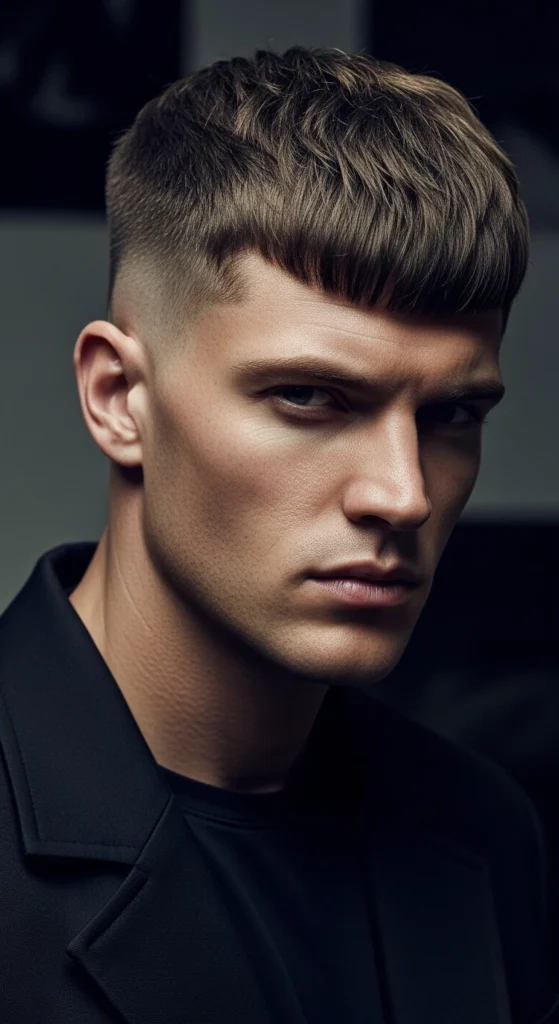
The heavy Caesar keeps maximum weight and density in the fringe, creating a fuller, more pronounced forward section with significant visual impact.
- Best for: Fuller appearance, thick hair
- Hair types: Thick, dense
- Face shapes: Long (shortens face visually), oval
- Styling: Matte cream, brush forward to emphasize weight
- Maintenance: Trim every 3-4 weeks
Women’s Caesar Cut
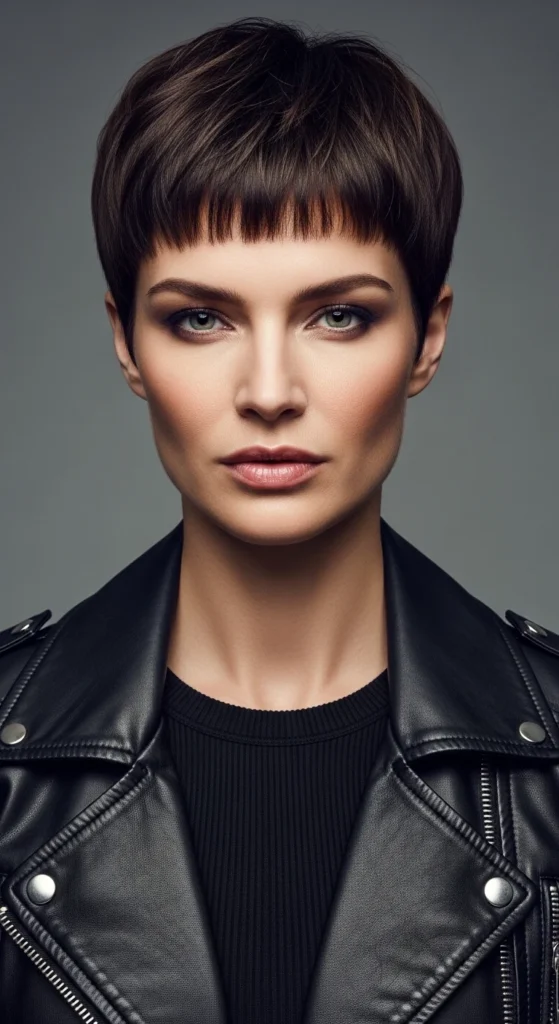
The women’s Caesar haircut adapts the style for women, typically featuring a softer fringe and more versatile styling options. It’s a bold choice that’s gained popularity among women seeking low-maintenance elegance.
- Best for: Women wanting short, structured style
- Hair types: All types
- Face shapes: Oval, heart, diamond
- Styling: Texture cream, versatile fringe direction (forward, side-swept, or textured)
- Maintenance: Trim every 4-6 weeks
Why the Caesar Cut Is Trending in 2026
The Caesar haircut remains one of the most requested styles in 2026 because it combines low-maintenance appeal with versatile styling options. Celebrity influence from Drake, Timothée Chalamet, and Ryan Gosling continues driving popularity, while the cut’s ability to conceal thinning hair attracts men of all ages.
The Caesar haircut isn’t making a comeback—it never truly left. However, several factors have driven its renewed popularity this year.
The Low-Maintenance Revolution
Men increasingly value haircuts that require minimal daily effort. The Caesar delivers polished style without constant product application or complicated morning routines. While high-maintenance fades demand frequent touch-ups, a well-cut Caesar looks good for 3-4 weeks between barbershop visits. This practical appeal resonates strongly with busy professionals, students, and active men who want to look sharp without investing significant time.
Celebrity Influence
High-profile celebrities continue championing Caesar variations:
- Drake maintains his signature dark Caesar with 360 waves
- Timothée Chalamet sports a textured curly Caesar on red carpets
- Zac Efron has been spotted with a modern Caesar drop fade
- Michael B. Jordan rocks a Caesar with sharp line-up
- Ryan Gosling has worn a classic Caesar with side-swept twist
- Usher popularized the Caesar with 360 waves combination
Social media platforms like TikTok and Instagram have amplified barber transformation videos, inspiring millions of men to request this versatile cut. The hashtag #caesarcut has accumulated over 2.3 billion views across platforms.
Problem-Solving Appeal
The Caesar remains the best-in-class solution for receding hairlines. The forward-brushed fringe naturally conceals thinning temples without looking obvious or unnatural. For men experiencing early to mid hair loss, this cut provides confidence without resorting to dramatic measures. Many barbers specifically recommend the Caesar to clients concerned about thinning because it addresses the problem while remaining stylish.
Modern Versatility
Today’s Caesar variations accommodate virtually any preference:
- Want minimal contrast? Choose a classic Caesar with no fade
- Prefer bold edges? Opt for a skin fade Caesar
- Love texture? Try a messy textured Caesar
- Have curly hair? The curly Caesar embraces natural texture
This adaptability across hair types, face shapes, and personal styles ensures the Caesar remains relevant for men of all ages and backgrounds.
History of the Caesar Haircut
The Caesar haircut originated in ancient Rome over 2,000 years ago when Julius Caesar adopted the forward-brushed fringe to disguise his receding hairline. The style experienced major revivals in the 1990s through George Clooney and continues evolving with modern fades and textures in 2026.
Ancient Rome Origins
The Caesar cut traces its origins to ancient Rome, where Julius Caesar himself reportedly wore this distinctive style. Historical accounts from Roman historians suggest the Roman Emperor adopted the forward-brushed fringe specifically to disguise his thinning hairline—a problem many men still face today. This practical origin story connects the modern haircut directly to one of history’s most powerful figures.
The 1990s Revival
The Caesar haircut experienced a massive resurgence during the 1990s when George Clooney popularized it through his role as Dr. Doug Ross in the television series ER. His clean, sophisticated version introduced the style to a new generation, making it one of the decade’s most requested haircuts in barbershops across America and Europe. Sam Fender has recently brought similar classic Caesar styling back into the spotlight for younger audiences.
2000s Hip-Hop Influence
Throughout the early 2000s, the Caesar evolved within hip-hop culture. Artists began pairing the cut with 360 waves, sharp line-ups, and low fades, creating the dark Caesar variation that remains popular among Black men today. This cultural adaptation demonstrated the haircut’s versatility across different hair textures and communities.
2026 Modern Evolution
The Caesar cut in 2026 has evolved significantly from its predecessors:
| Era | Caesar Characteristics |
| Ancient Rome | Blunt fringe, uniform length, no fade |
| 1990s | Clean, classic, minimal texture |
| 2000s | Dark Caesar, 360 waves, line-ups |
| 2026 | Textured tops, defined fringes, versatile fades |
Modern barbers now incorporate textured layers, skin fades, and drop fades while preserving the signature forward fringe. This evolution keeps Caesar relevant for men seeking both classic appeal and contemporary edge.
What’s the Difference Between a Caesar Cut and Other Haircuts?
Understanding how the Caesar compares to similar short styles helps you make the right choice. The Caesar’s defining feature—its forward-brushed fringe—distinguishes it from other popular cuts that may appear similar at first glance.
Caesar Cut vs French Crop
Many men confuse these two styles because both feature fringe at the front. However, they differ significantly in texture and overall aesthetic:
| Feature | Caesar Cut | French Crop |
| Fringe | Short, blunt, horizontal | Longer, textured, choppy |
| Top texture | Uniform or lightly textured | Heavily layered |
| Sides | Tapered or faded | Usually faded |
| Fringe length | 1-1.5 inches (2.5-4 cm) | 1.5-3 inches (4-7.5 cm) |
| Maintenance | Lower | Moderate |
| Best for | Receding hairlines, classic preference | Trendy, modern look |
| Styling time | 2-5 minutes | 5-10 minutes |
Bottom line: Choose the Caesar for a cleaner, more classic appearance with less styling effort. Choose the French crop for more texture, length, and styling versatility.
Caesar Cut vs Crew Cut
These cuts are often confused because both are short and masculine, but they differ fundamentally in fringe treatment:
| Feature | Caesar Cut | Crew Cut |
| Fringe | Forward-brushed bangs covering forehead | No fringe, tapered front exposing hairline |
| Top shape | Even length throughout | Longer front, shorter back (graduated) |
| Hairline | Covered by fringe | Fully exposed |
| Styling direction | Forward | Upward/backward |
| Best for | Thinning hair, receding hairline | Athletic, clean look, full hairline |
Bottom line: The Caesar conceals the hairline while the crew cut exposes it completely. If you’re concerned about recession or thinning at the temples, the Caesar is the significantly better choice.
Caesar Cut vs Buzz Cut
Both are low-maintenance options, but they differ in length and styling:
| Feature | Caesar Cut | Buzz Cut |
| Length | 1-2 inches (2.5-5 cm) | Under 0.5 inches (1.25 cm) |
| Fringe | Defined forward fringe | None |
| Styling required | Minimal (2-5 minutes) | None |
| Visual interest | Structured shape with character | Uniform simplicity |
| Best for | Style with minimal effort | Ultimate simplicity, military |
Bottom line: The buzz cut is shorter and simpler with zero styling required. The Caesar adds structure and character while remaining low-maintenance—it’s the choice for men who want some style without significant effort.
Is a Caesar Cut Right for Me?
One of the biggest questions men have is: will this haircut actually suit my face? The good news is the Caesar works with almost every face shape—here’s how to optimize it for yours.
Best Face Shapes for Caesar Cut
| Face Shape | Recommendation | Why It Works | Best Variation |
| Oval | Ideal match | Balanced proportions suit any variation | Any Caesar style |
| Round | Highly recommended | Horizontal fringe adds length; fades slim sides | Mid/high fade Caesar |
| Square | Excellent | Complements strong jawline, softens angles | Textured Caesar |
| Diamond | Great fit | Fringe balances narrow forehead | Classic or soft Caesar |
| Heart | Works well | Fringe adds visual width to forehead | Long Caesar |
| Long/Rectangle | Good with modifications | Keep fringe short to avoid elongating further | Short Caesar, avoid long fringe |
Best Hair Types for Caesar Cut
| Hair Type | Suitability | Best Variation | Styling Notes |
| Straight | Excellent | Classic, textured, Asian Caesar | Clean lines, easy styling |
| Wavy | Excellent | Wavy Caesar, textured Caesar | Natural movement, minimal product |
| Curly | Great | Curly Caesar, Caesar with line-up | Embrace texture, use curl cream |
| Coily/4C | Great | Dark Caesar, Caesar with 360 waves | Wave pomade, durag maintenance |
| Thick | Excellent | Any variation; textured works especially well | May need thinning for control |
| Thin/Fine | Highly recommended | Short Caesar; forward fringe adds density | Volumizing products, avoid heavy styling |
| Thinning/Receding | Best choice | Forward fringe conceals hairline naturally | Keep fringe forward, never expose temples |
Who Should Consider a Different Style?
While the Caesar suits most men, consider alternatives if you:
- Have extremely tight curls (Type 4C) that resist laying forward
- Strongly prefer hair parted to the side
- Want significant length throughout (3+ inches everywhere)
- Dislike any hair touching your forehead
- Have a very long face and prefer not to add horizontal emphasis
What Should I Tell My Barber to Get a Caesar Cut?
Walking into a barbershop and asking for exactly what you want can feel intimidating. These exact phrases eliminate any guesswork and ensure you leave with the cut you envisioned.
Exact Script to Use
“I want a modern Caesar cut. Textured on top, natural fringe brushed forward about [1-2 inches / 2.5-5 cm]. Give me a [low/mid/high] fade on the sides. Keep it soft, not blunt. No hard lines unless I ask.”
This single statement covers the essential elements any experienced barber needs to deliver your desired result.
Alternative Phrases That Work
- “Caesar with a [low/mid/high] taper, textured fringe”
- “Classic Caesar, but add some texture—I don’t want it flat”
- “Like George Clooney in the 90s, but with a modern fade”
- “Dark Caesar with a line-up” (for Black men wanting the traditional style)
Key Measurements to Specify
| Area | Length | Clipper Guard | Notes |
| Top | 1-2 inches (2.5-5 cm) | #4 to #8 | Longer for texture, shorter for clean |
| Fringe | 1-1.5 inches (2.5-4 cm) | Scissors or #6-8 | Defines the entire look |
| Sides (classic) | 0.5-1 inch (1-2.5 cm) | #3 to #5 | No fade, even length |
| Low fade start | Above ears | #1 to #2 blending up | Subtle, professional |
| Mid fade start | Temple level | #0.5 to #1 blending up | Balanced contrast |
| High fade start | Above temples | #0 to #0.5 blending up | Bold, dramatic |
| Skin fade | Down to skin | #0 or foil shaver | Maximum contrast |
Reference Photo Tips
- Bring front, side, and back views of your desired style
- Show fringe length specifically—this is the defining feature
- Indicate fade height preference clearly
- Discuss face shape compatibility with your barber before cutting begins
Questions to Ask Your Barber
- “Which fade height would suit my face shape best?”
- “Should I add texture or keep it more classic?”
- “How often will I need touch-ups for this style?”
- “What products would you recommend for my hair type?”
- “Can you show me where the fade will start before you cut?”
How Do I Style a Caesar Cut at Home?
You might be wondering: do I really need product for a Caesar cut? The short answer is very little—but the right product applied correctly makes a noticeable difference in how polished and intentional your cut appears.
Daily Styling Routine (3-5 Minutes)
Step 1: Wash or wet hair Towel dry until damp (not dripping). Starting with slightly wet hair allows product to distribute evenly and helps you shape the fringe.
Step 2: Apply pre-styler (optional) For extra texture: sea salt spray (3-4 sprays) For extra volume: volumizing mousse (golf ball size)
Step 3: Blow-dry forward Use medium heat with the dryer pointing toward your forehead. Direct airflow in the direction you want hair to lay. This takes 1-2 minutes and sets the foundation.
Step 4: Apply finishing product Matte clay, paste, or pomade—amount varies by hair length:
- Short Caesar: pea-sized amount
- Long Caesar: dime-sized amount
Step 5: Shape with fingers Push fringe forward and down. Create texture on top by pinching and separating small sections. Avoid combing after product application (creates unnatural lines).
Styling by Caesar Variation
| Caesar Type | Best Product | Technique | Time |
| Classic | Light pomade | Comb forward smoothly | 2-3 min |
| Textured | Matte clay | Finger-tousle for separation | 3-4 min |
| Curly | Curl cream | Scrunch, diffuse dry | 5-7 min |
| Dark/360 waves | Wave pomade + durag | Brush circular pattern, compress overnight | 15+ min brushing |
| Messy | Sea salt spray | Air dry, scrunch randomly | 2-3 min |
| Sleek | Light-hold gel | Comb flat against head | 2-3 min |
| Fluffy | Volumizing mousse | Blow-dry upward from roots | 4-5 min |
Styling Tips for Best Results
- Start with less product—you can always add more, but excess creates greasiness
- Warm product between palms for 5-10 seconds before applying
- Work from roots to tips for even distribution
- Avoid touching hair repeatedly after styling (causes frizz and flatness)
- Use matte products for natural appearance; avoid shiny gels that look dated
- Don’t fight your hair’s natural direction—work with it
What Products Work Best for a Caesar Cut?
Texture Clay
Texture clay provides matte finish with strong hold, making it the most versatile product for Caesar cuts. It’s ideal for textured, modern, and messy variations.
- Finish: Matte, natural
- Hold: Medium to strong
- Best for: Textured Caesar, modern Caesar, spiky Caesar
- How to use: Warm between palms, work through damp hair from roots to tips, shape with fingers
- Recommended brands: Hanz de Fuko Claymation, Baxter of California Clay Pomade
Matte Pomade
Matte pomade delivers natural finish with medium hold, perfect for classic Caesar styles in professional settings where you want polish without shine.
- Finish: Matte to low shine
- Hold: Medium
- Best for: Classic Caesar, professional environments
- How to use: Small amount, comb through forward
- Recommended brands: Uppercut Deluxe Matte Pomade, Layrite Cement Clay
Sea Salt Spray
Sea salt spray adds texture and volume as a pre-styling product, enhancing natural wave patterns and creating grip for other products.
- Finish: Natural, beachy
- Hold: Light
- Best for: Pre-styling, wavy Caesar, messy Caesar
- How to use: Spray on damp hair (3-5 sprays), scrunch, blow-dry or air dry
- Recommended brands: Bumble and Bumble Surf Spray, Moroccanoil Dry Texture Spray
Styling Cream
Styling cream provides lightweight hold with natural movement, suitable for curly Caesar and soft styles that shouldn’t look stiff or crunchy.
- Finish: Natural, soft
- Hold: Light to medium
- Best for: Curly Caesar, soft Caesar, natural looks
- How to use: Distribute evenly through damp hair, finger-style
- Recommended brands: American Crew Forming Cream, Blind Barber 90 Proof Pomade
Wave Pomade
Wave pomade moisturizes while defining wave patterns. This specialized product is essential for achieving and maintaining 360 waves with dark Caesar cuts.
- Finish: Light shine
- Hold: Medium
- Best for: 360 waves, dark Caesar
- How to use: Apply to damp hair, brush in circular pattern, compress with durag or wave cap overnight
- Recommended brands: Murray’s Superior Hair Dressing Pomade, WaveBuilder Cocoa & Shea Wave Butter
Volumizing Mousse
Volumizing mousse creates lightweight lift for thin or fine hair that needs volume without weight.
- Finish: Natural
- Hold: Light to medium
- Best for: Thin hair Caesar, fluffy Caesar
- How to use: Apply golf-ball-sized amount to roots of damp hair, blow-dry upward
- Recommended brands: Paul Mitchell Extra-Body Sculpting Foam, Kenra Volume Mousse
Argan Oil
Argan oil hydrates and adds shine without heaviness. It’s perfect for dry hair or pairing with a well-groomed beard.
- Finish: Natural shine
- Hold: None (conditioning only)
- Best for: Dry hair, Caesar with beard
- How to use: 2-3 drops, work through ends (hair) or throughout beard
- Recommended brands: Moroccanoil Treatment, OGX Argan Oil of Morocco
Curl Cream
Curl cream defines curls while reducing frizz. It’s essential for curly Caesar variations to maintain definition without crunchiness.
- Finish: Natural, defined
- Hold: Light
- Best for: Curly Caesar, wavy Caesar
- How to use: Apply to damp curls, scrunch upward, diffuse or air dry
- Recommended brands: SheaMoisture Coconut & Hibiscus Curl Enhancing Smoothie, DevaCurl SuperCream
How Often Should I Trim My Caesar Cut?
Maintaining the clean, intentional appearance of a Caesar cut requires regular barbershop visits. The frequency depends entirely on which variation you wear.
Trim Frequency by Style
| Caesar Type | Trim Frequency | Reason | Cost Consideration |
| Classic (no fade) | Every 4-5 weeks | Shape retention, fringe length | Lower annual cost |
| With low fade | Every 3-4 weeks | Fade definition maintenance | Moderate annual cost |
| With mid/high fade | Every 2-3 weeks | Sharp contrast maintenance | Higher annual cost |
| With skin fade | Every 1-2 weeks | Prevents visible stubble | Highest annual cost |
| 360 waves | Every 2-3 weeks | Wave pattern maintenance | Moderate annual cost |
| With line-up | Line-up every 1-2 weeks | Edge crispness | Additional cost |
At-Home Care Routine
- Wash 2-3 times per week—avoid daily washing that strips natural oils
- Use sulfate-free shampoo—gentler on hair and scalp, preserves moisture
- Condition after every wash—maintains softness and manageability
- Towel dry gently—pat, don’t rub aggressively (causes frizz and breakage)
- Sleep on silk or satin pillowcase—reduces friction, prevents frizz, maintains style
Between-Trim Maintenance
- Edge neckline with trimmer if you’re comfortable (otherwise wait for barber)
- Use product to control overgrowth as hair length increases
- Brush or comb daily to maintain forward direction
- For 360 waves: brush consistently (minimum 15 minutes daily) and wear durag or wave cap every night
Signs You Need a Trim
- Fringe falls into eyes or past desired length
- Sides appear puffy or lose fade definition
- Hair no longer lays forward naturally
- Neckline appears uneven or grown out
- Overall shape looks undefined
How to Cut a Caesar at Home (DIY Guide)
While professional barbershop cuts deliver the best results, you can maintain a Caesar at home between appointments with the right tools and technique.
Tools Needed
- Quality hair clippers with guard attachments (#1-#8)
- Barber scissors for precision cutting
- Fine-tooth comb for sectioning
- Spray bottle with water
- Hand mirror for viewing back
- Trimmer for edges and neckline
- Cape or towel to catch hair
- Good lighting (essential for even results)
Step-by-Step Process
Step 1:
Prepare Hair Dampen hair with spray bottle until evenly moist (not wet). Comb all hair forward and down to remove tangles and establish natural growth direction.
Step 2:
Cut Sides and Back Attach #3 guard to clippers. Using upward rocking motions (scoop technique), buzz sides and back evenly. Stop where hair transitions to top section—usually about 1 inch above the ear.
Step 3:
Blend Mid-Section Switch to #5 guard. Blend the transition zone between sides and top using the same upward motion. This blending step prevents harsh lines between sections.
Step 4:
Cut Top Use #7-8 guard or scissors to trim top to 1-2 inches. Maintain even length throughout, cutting with the direction of hair growth. For scissors, lift small sections with comb and cut consistently.
Step 5:
Create Fringe Comb fringe forward over forehead. Hold clippers horizontally and cut straight across at desired length (typically 1-1.5 inches from hairline). For texture, use point-cutting technique with scissors—cut vertically into the ends rather than straight across.
Step 6:
Blend Transitions Use #4 and #6 guards alternately where sections meet. Rock clippers in small motions to eliminate visible lines between lengths.
Step 7:
Clean Neckline Use trimmer without guard to create clean edge at neckline. Follow natural hairline or create squared/rounded shape based on preference.
Step 8:
Refine and Check Use hand mirror to check back and sides from all angles. Trim any uneven areas. Style forward with product to assess final fringe appearance.
DIY Mistakes to Avoid
- Cutting too short initially—you can always cut more, but can’t add length
- Skipping guard transitions—creates harsh lines
- Cutting dry hair—produces uneven results
- Rushing the blend—take time where sections meet
- Forgetting to check the back—use hand mirror religiously
Frequently Asked Questions
What is a Caesar haircut?
A Caesar haircut is a short men’s style featuring a horizontal fringe brushed forward with evenly trimmed sides and back. Named after Roman Emperor Julius Caesar, it’s known for being low-maintenance and particularly effective at concealing thinning hair and receding hairlines. The defining characteristic is the forward-brushed fringe that covers the forehead.
Is the Caesar cut still in style in 2026?
Yes. The Caesar has evolved with modern fades, textures, and variations that keep it relevant. Current versions feature more texture on top, defined fringes, and versatile fade options ranging from subtle tapers to bold skin fades. Celebrity adoption from Drake, Timothée Chalamet, and Zac Efron continues driving popularity.
What face shape suits a Caesar cut best?
Oval, round, square, and diamond faces suit the Caesar cut best. The horizontal fringe adds balance and structure, while short sides sharpen the jawline. Round faces benefit from mid or high fades that slim the sides. Long faces should opt for shorter fringes to avoid elongating further.
Does a Caesar cut work for thinning hair?
Absolutely. The forward-brushed fringe is one of the most effective solutions for concealing receding hairlines and thinning crowns. The fringe naturally covers temples and creates the illusion of denser hair at the front—which is reportedly why Julius Caesar himself adopted this style.
How often should I trim a Caesar cut?
Every 3-4 weeks for classic styles without fades. Every 2-3 weeks if you have a mid or high fade. Every 1-2 weeks for skin fades to maintain sharp contrast and prevent visible stubble. Line-ups need touch-ups every 1-2 weeks for crispness.
What’s the difference between a Caesar cut and French crop?
The Caesar has a shorter, blunt fringe with uniform length, while the French crop features a longer, textured, choppy fringe with more layering. The Caesar is more classic and lower maintenance; the French crop is trendier with more styling versatility.
What’s the difference between a Caesar cut and crew cut?
The Caesar has a forward-brushed fringe covering the hairline, while the crew cut has no fringe and exposes the hairline with a tapered front. Choose the Caesar if you want to conceal recession; choose the crew cut if you have a strong hairline you want to show.
Can you get a Caesar cut with curly hair?
Yes. A curly Caesar looks excellent when kept short, allowing natural curls to show while maintaining the structured fringe. Use curl cream and a diffuser attachment for best results. Timothée Chalamet has popularized this variation.
What is a dark Caesar haircut?
A dark Caesar is a variation designed for Black men featuring very short, dense hair (under 1 inch), typically with a low fade and sharp line-up. It pairs beautifully with 360 waves and requires wave pomade and a durag or wave cap for maintenance. Drake and Usher have made this style iconic.
How do I ask my barber for a Caesar cut?
Say: “I want a Caesar cut with textured top, forward-brushed fringe about 1-2 inches, and a [low/mid/high] fade on the sides.” Bring reference photos showing front, side, and back views. Specify clipper guard preferences if you know them.
What products work best for a Caesar cut?
Matte clay for textured looks, light pomade for classic styles, sea salt spray for volume and pre-styling, curl cream for curly variations, and wave pomade for 360 waves. Avoid heavy gels that create unnatural shine or stiffness.
Is a Caesar cut good for older men?
Yes. The Caesar is dignified, low-maintenance, and softens facial lines while concealing thinning areas. It’s popular among men of all ages—George Clooney helped popularize it in his 30s and it suits men well into their 50s, 60s, and beyond.
Can women get a Caesar cut?
Yes. Women’s Caesar cuts feature softer fringes with versatile styling options. It’s a bold, structured short style that has gained popularity among women wanting low-maintenance elegance with strong visual impact.
Will a Caesar cut make my hair look thicker?
Yes. The forward-brushed fringe creates the illusion of density at the hairline, and textured variations add volume throughout. For thin hair, use volumizing mousse and avoid heavy products that weigh hair down and expose scalp.
Is a Caesar cut hard to maintain?
No. Caesar cuts are among the most low-maintenance styles available, requiring only 3-5 minutes of daily styling with minimal product. Trims every 3-4 weeks maintain the shape, or every 2 weeks if you have a fade that needs refreshing.
Can I get a Caesar cut with a beard?
Absolutely. A Caesar cut pairs excellently with beards of all lengths. The clean, structured haircut balances fuller facial hair, creating a masculine, well-groomed appearance. Use argan oil or beard oil to keep facial hair soft and healthy.
How short is a Caesar haircut supposed to be?
Traditional Caesars keep hair 1-2 inches (2.5-5 cm) on top with the fringe at similar length. Modern variations range from 0.5 inches (buzz Caesar) to 3-4 inches (long Caesar) depending on personal preference.
What’s the best Caesar cut for a round face?
A Caesar with mid or high fade works best for round faces. The horizontal fringe adds perceived length while the faded sides slim the face, creating more balanced, angular proportions.
Is the Caesar cut only for young men?
No. The Caesar cut suits men of all ages. For older men, it offers a dignified, sophisticated style that softens facial lines while gracefully concealing thinning areas without looking like an obvious cover-up.
What should I tell my barber if I want a Caesar cut?
Tell your barber: “I want a modern Caesar cut with textured top, forward-brushed fringe around 1-2 inches, and a [low/mid/high] fade on the sides.” Specify if you want texture or a classic blunt look. Always bring reference photos.
The Caesar cut has survived over 2,000 years because it solves real problems—thinning hair, low maintenance needs, and the desire for timeless style—while adapting to each era’s aesthetic preferences. Whether you choose a classic blunt fringe honoring Julius Caesar’s original style or a modern textured fade variation inspired by Drake or Zac Efron, this versatile haircut delivers confident style with minimal daily effort.