

Let’s be honest for a second. When most guys hear the word “fringe,” their brain flashes a quick, unwanted image of a bowl cut they had in third grade. Maybe there was a school photo involved. Maybe Mom thought it looked “neat.” That trauma is real, and for years, it kept the fringe locked in the style graveyard, somewhere between frosted tips and a mullet.
But here’s the thing no one told you: a fringe isn’t a single haircut. It’s a toolkit. It’s the most powerful face-shaping instrument a barber has, and right now, in 2026, it has quietly taken over every men’s fashion week runway, every Netflix heartthrob’s head, and every barber shop worth its salt.
This isn’t about chasing a trend. For a lot of men, the real motivation runs deeper. On a popular subreddit like r/AsianMasculinity, a user once put it bluntly: “I’ve always had a fringe because I’ve got a fat and wide forehead.” Whether it’s a wider forehead, a maturing hairline that’s decided to retreat a little early, or just a face that feels a bit too long, a strategically cut fringe is the most confident move you can make without saying a word.
This guide is built on a simple idea: you shouldn’t just look at 31 pictures and pick the one with the best lighting. You should find the fringe that was designed for your geometry: your face shape, your hair type, your willingness to use a blow dryer on a Tuesday morning. We’ve combed through barber techniques, styling physics, and real-world experience to build a blueprint that takes you from “I wonder if I could pull that off” to “here’s exactly what I’m showing my barber.”
The 31 Best Fringe Hairstyles for Men (Curated by Purpose)
Forget scrolling through a random gallery. We’ve organized the 31 best styles into sections that match exactly what you’re trying to achieve with your face. Each one is built on a simple formula: who it’s for, how to ask for it, and how to make it last.
Want a deep dive on a specific style? Three of the styles below have full guides with 20+ variations each: the French Crop with Fringe (28 styles), the Textured Fringe (45 styles), and the Messy Fringe (35 styles).
Fringes for The “Face Shaper” (Balancing Proportions)
These styles are the scalpels of the hair world. They are designed to correct, balance, and enhance the geometry of your face.
1. Side-Swept Fringe

- The Face-Shaping Logic: This is the universal corrector. By brushing the hair diagonally across the forehead, you instantly break up a wide forehead and draw the eye down to the jawline. It’s softer than a straight-down fringe and makes a square jaw look less severe.
- What to Tell Your Barber: “I want a side-swept fringe, keeping the length enough to fully sweep across my forehead, with a soft taper on the sides. I want it to move naturally, not look like a helmet.”
- Styling Mechanic: Towel-dry your hair until it’s damp, and while it’s still wet, use a wide-tooth comb to push all your top hair to the side you want it to fall. Blow-dry it in that exact direction using medium heat, following the path of the comb with the nozzle. A small fingernail-sized amount of lightweight styling cream warmed between your palms and raked through will lock in the sweep without grease.
2. High Volume Fringe
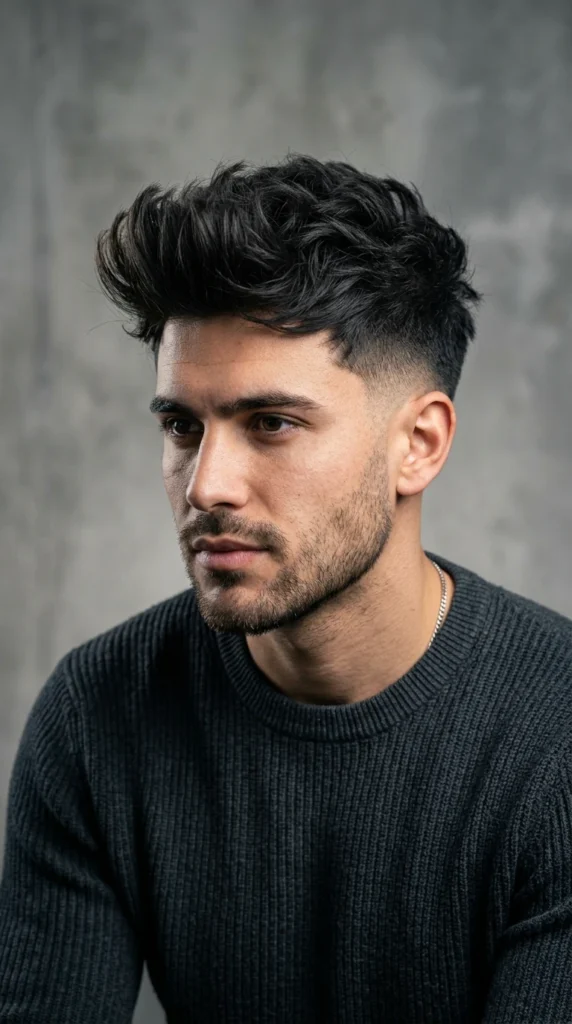
- The Face-Shaping Logic: A go-to for round and heart-shaped faces. The vertical lift at the front directly counters the face’s horizontal width, creating a lengthening effect that works like a structural illusion.
- What to Tell Your Barber: “I want a fringe that’s long enough to fall forward, but I want to style it with a lot of height at the roots. Don’t take too much bulk out of the front, I need the density for lift. Blend the sides with a mid taper.”
- Styling Mechanic: This is a two-product play. On damp hair, apply a golf-ball-sized dollop of volumizing mousse to the roots. Flip your head upside down and blast the roots with a blow-dryer on high heat until 80% dry. Flip back up, and use a round brush to roll the fringe forward and up. Finish with a matte clay on the ends for piecey separation that doesn’t collapse.
3. French Crop Fringe
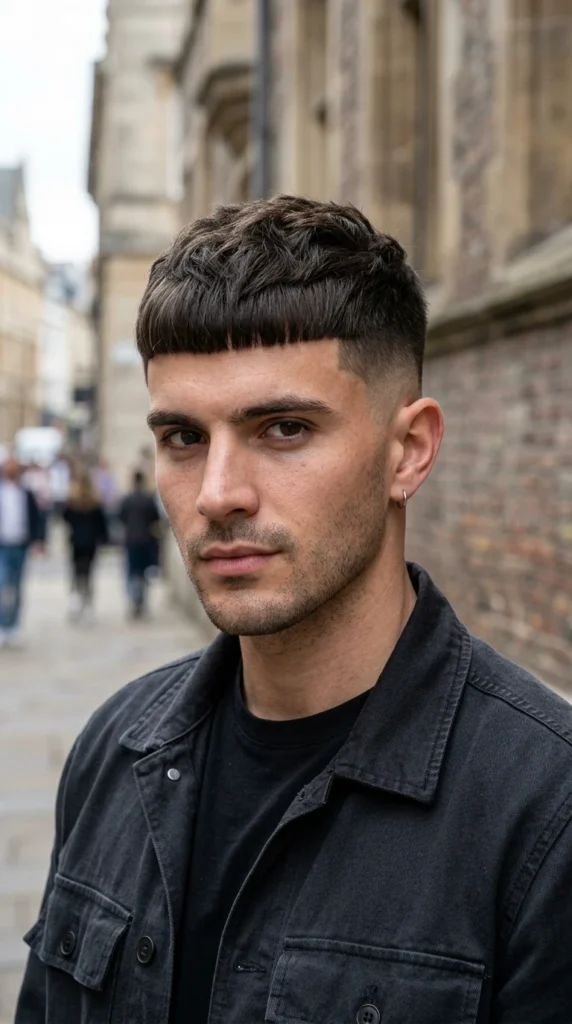
- The Face-Shaping Logic: The king of forehead camouflage. For men with oblong faces or receding hairlines, the short, heavy, straight-across fringe acts as a visual cap, shortening the face and hiding temple recession instantly. This is very similar to the philosophy behind the Caesar cut, which uses a horizontal fringe for identical practical reasons.
- What to Tell Your Barber: “I want a classic French crop. Keep the fringe blunt and heavy, sitting straight across the forehead. Give me a skin fade on the back and sides, but don’t blend it into the top, I want a clear disconnect.”
- Styling Mechanic: Less is more here. With this cut, you are not going for texture or movement; you want it to look solid and sharp. On dry hair, take a tiny amount of matte paste and smooth the fringe down forward. The finish should look almost intentional and architectural.
Want more options in this exact style? See our full French Crop with Fringe guide with 28 variations.
4. Angular Fringe
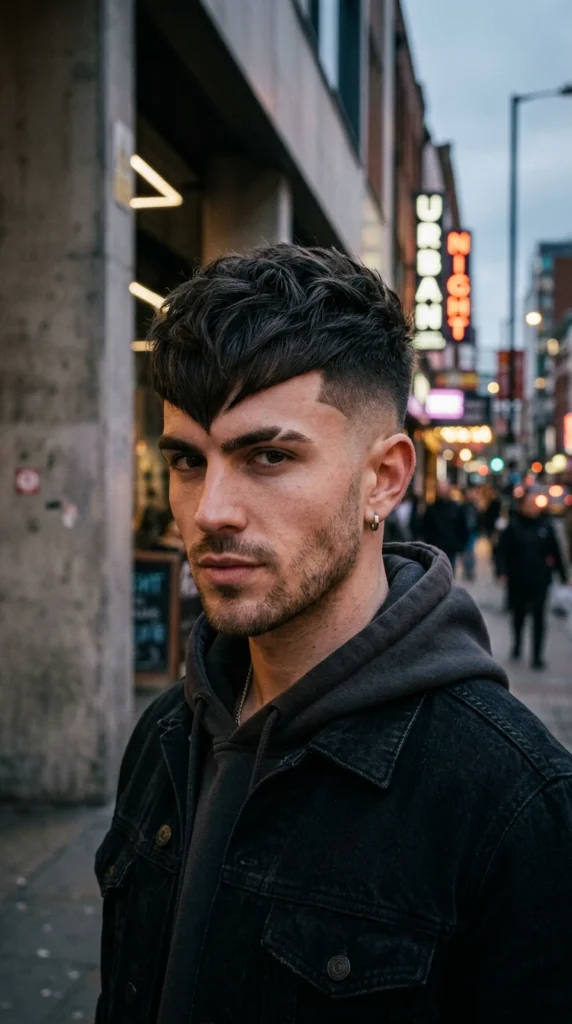
- The Face-Shaping Logic: The sharp diagonal line of this fringe is engineered for round face shapes. Where a straight fringe widens, an angular fringe cuts diagonally down, visually slicing the roundness and adding a defined, chiseled edge to a soft facial structure.
- What to Tell Your Barber: “Cut my fringe at a sharp angle, keeping it longer on one side and gradually tapering up. I want a hard line, not a soft one. Pair it with a low fade on the sides.”
- Styling Mechanic: Precision is everything here. While blow-drying, use a flat brush to pull the hair in the exact direction of the angle you want to emphasize. Use a strong-hold matte clay to pinch the ends into a sharp point that defines the geometry.
5. Asymmetrical Fringe

- The Face-Shaping Logic: Another powerful tool for round and square faces. The uneven, longer-on-one-side cut creates an off-kilter visual line that breaks rigid facial symmetry and adds length in a non-obvious way.
- What to Tell Your Barber: “Carve a deep side part and cut the fringe so it falls in two distinct lengths across the forehead. I don’t want it to look like a mistake; I want it to look like a designed asymmetry.”
- Styling Mechanic: Use a flat brush to blow-dry the longer section forward and down, letting the shorter section do its own thing. A sea salt spray on the longer piece will give it a natural, deconstructed separation that stops it looking too precious.
6. Caesar Cut

- The Face-Shaping Logic: This is the timeless tactical cut. It’s short, uniform, and pushes forward. It’s exceptionally good for oblong faces by shortening the forehead, and its horizontal texture adds width to a narrow top.
- What to Tell Your Barber: “Keep the length short and uniform all over the top, about a finger’s width, with a blunt, horizontal fringe. Give me a high skin fade on the sides.”
- Styling Mechanic: Work a small dab of matte cream into towel-dried hair and push it forward with your fingers. The goal is a soft, uniform texture that looks completely natural.
Fringes for The “Trend Weaver” (Modern Texture & Flow)
These cuts are about the feeling of the hair. Movement, lived-in texture, and that perfectly imperfect finish that looks like you just got back from a beach trip.
7. Textured Fringe
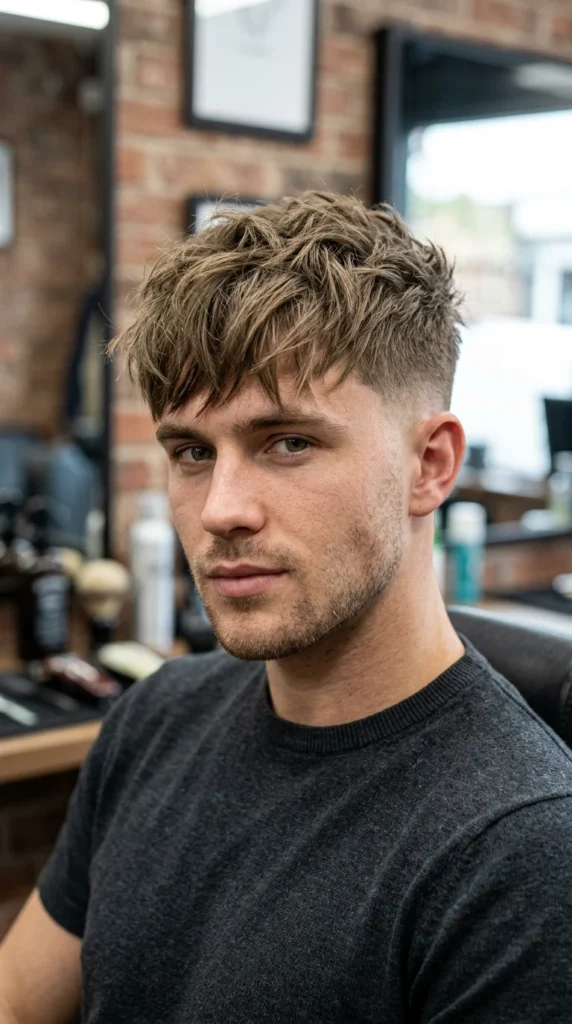
- The Modern Edge: This is the quintessential style for 2026. It’s not about being perfect; it’s about controlled chaos. The choppy, uneven ends create a visual softness that flatters almost everyone.
- What to Tell Your Barber: “I want a heavy texture on top, please. Use point cutting to create a jagged, choppy finish on the fringe. I want it to be messy, not a solid line. Blend into a low taper fade.”
- Styling Mechanic: Your fingers are the only tool here. Blow-dry the fringe forward on medium speed, flicking it randomly. Then warm some matte texture clay and piece out the ends, twisting small sections to define the separation.
Want every variation? See our full Textured Fringe guide with 45 styles organized by fade type.
8. Messy Fringe
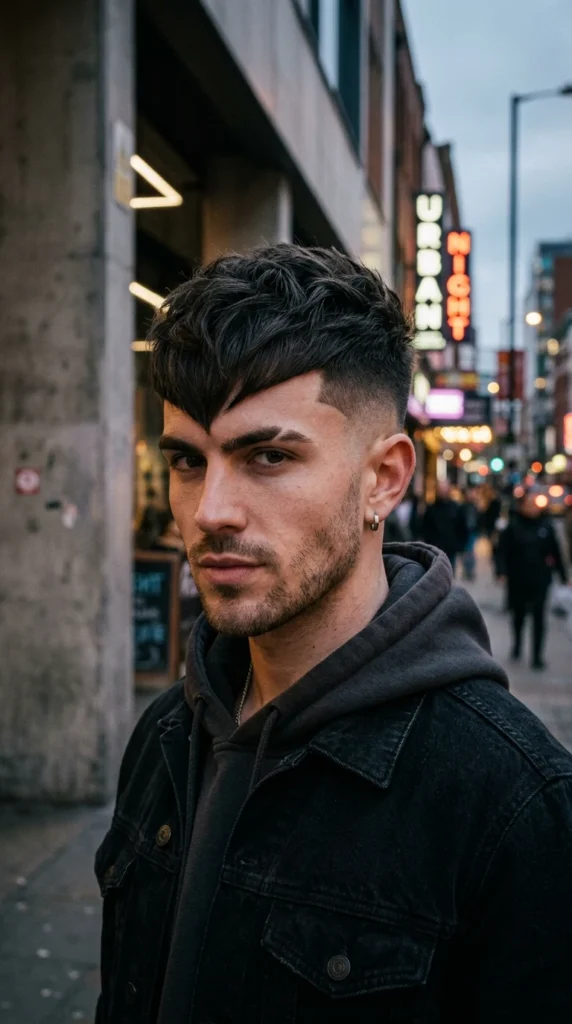
- The Modern Edge: The younger, more rebellious cousin of the textured fringe. It’s meant to look like you didn’t try, which is still a style you have to try for. It’s the ultimate low-maintenance, high-cool cut.
- What to Tell Your Barber: “Keep the top heavy and layered. I’m going to be wearing this fully messy, so the cut needs to look good unstyled. Keep a little length around the temples so it doesn’t look too polished.”
- Styling Mechanic: Avoid a comb entirely. On damp hair, work in a sea salt spray for grit. Towel-scrunch it dry or hit it with a diffuser. Finish by pinching a small amount of texture paste into a few random chunks to create a “slept-in” definition.
Want every variation? See our full Messy Fringe guide with 35 styles.
9. Choppy Fringe

- The Modern Edge: This is about edge and attitude, giving off a subtle rock-and-roll energy. The deliberately jagged, uneven ends break up a wide forehead in a much more subtle way than a solid blunt cut.
- What to Tell Your Barber: “Keep the top medium length, and I want the fringe to be aggressively layered so it looks broken and jagged. Give me a short back and sides with a mid skin fade.”
- Styling Mechanic: This style lives or dies by its separation. Blow-dry it forward roughly, then use a dry texture powder at the roots to lift them up. Use your fingertips to pull small pieces of the fringe apart, avoiding any solid, combed-together look.
10. Fluffy Fringe

- The Modern Edge: Driven by the Korean pop and drama style wave, the fluffy fringe is soft, airy, and characterized by a rounded shape that perfectly frames the eyes.
- What to Tell Your Barber: “I want a soft, wispy fringe that sits just above my eyebrows. Keep the top very layered so it’s airy and light. Blend it into a short, tidy back and sides.”
- Styling Mechanic: Dryness and volume are everything. Mousse on wet roots, then blow-dry with your head upside down. Flip up once dry and use a gentle, flexible hold paste to shape the fringe loosely, being careful not to crush its natural bounce.
11. Curtain Bangs (Centre Part)

- The Modern Edge: The hallmark of the modern E-boy or 70s revival look. The middle-parting fringe sweeps open to frame and draw direct attention right to the eyes and cheekbones.
- What to Tell Your Barber: “I’m growing out a curtain look. I need the fringe to part cleanly in the center and fall to about cheekbone length. Keep the back and sides neatly tapered.”
- Styling Mechanic: The part must be trained. After showering, create your middle part with a comb while hair is soaking wet. Blow-dry each half outwards and back with a round brush. A light styling cream will smooth any flyaways and give it that glossy, healthy finish.
Fringes for the “Low-Maintenance Minimalist”
For the guy who wants to look sharp without a 10-step grooming routine. These cuts are the wash-and-go warriors.
12. Short Fringe
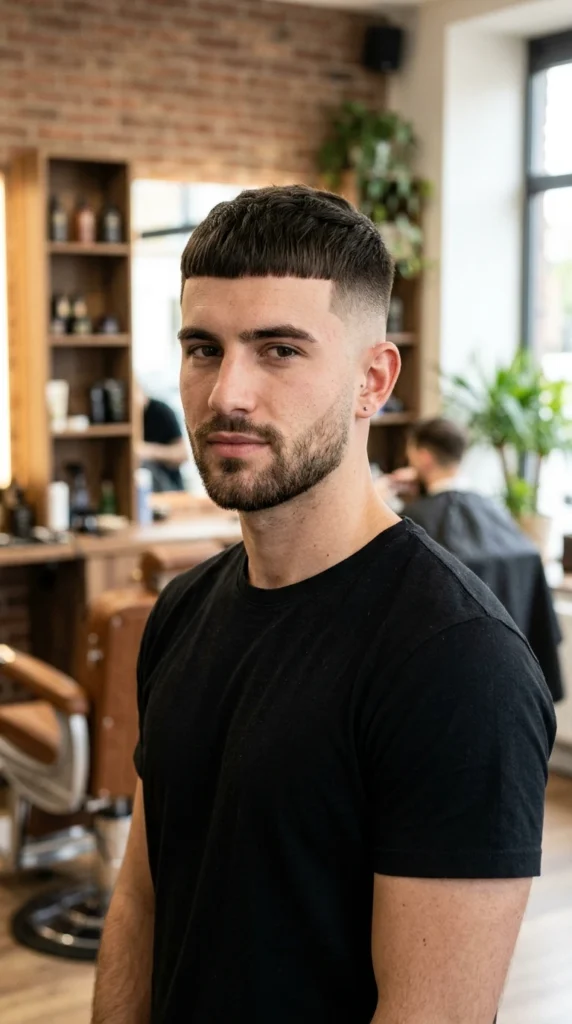
- The Sharp Simplicity: Clean, crisp, and impossible to mess up. The fringe sits high on the forehead with a defined edge, offering structure without length.
- What to Tell Your Barber: “Keep the fringe short and strict, cut straight across about an inch above the eyebrows. Fade the sides clean, a high taper fade works best.”
- Styling Mechanic: Nothing more than a quick blow-dry forward and a tiny dab of matte cream to keep the ends looking defined, not fluffy.
13. Cropped Fringe
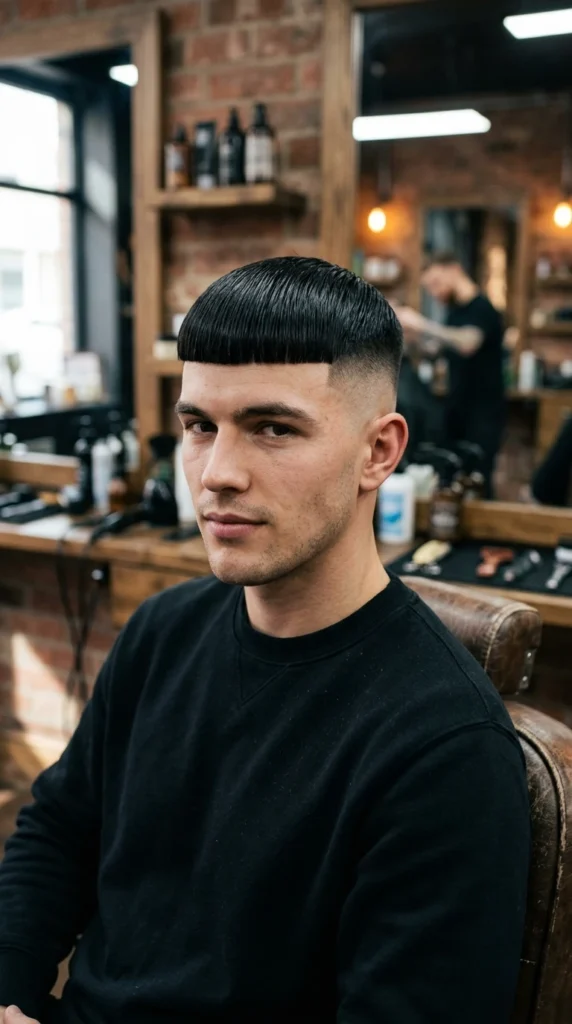
- The Sharp Simplicity: A statement cut defined by blunt, horizontal lines and strong contrast. It’s severe, modern, and emphasizes the bone structure sharply.
- What to Tell Your Barber: “I want a completely flat, straight-across fringe with zero texture. Keep the top smooth and the fade on the sides high and tight with a hard contrast.”
- Styling Mechanic: Requires the fringe to be completely flat and solid. Blow-dry it straight down with a vent brush and apply a molding paste to lock every strand into a single, architectural plane.
14. Buzzcut Fringe
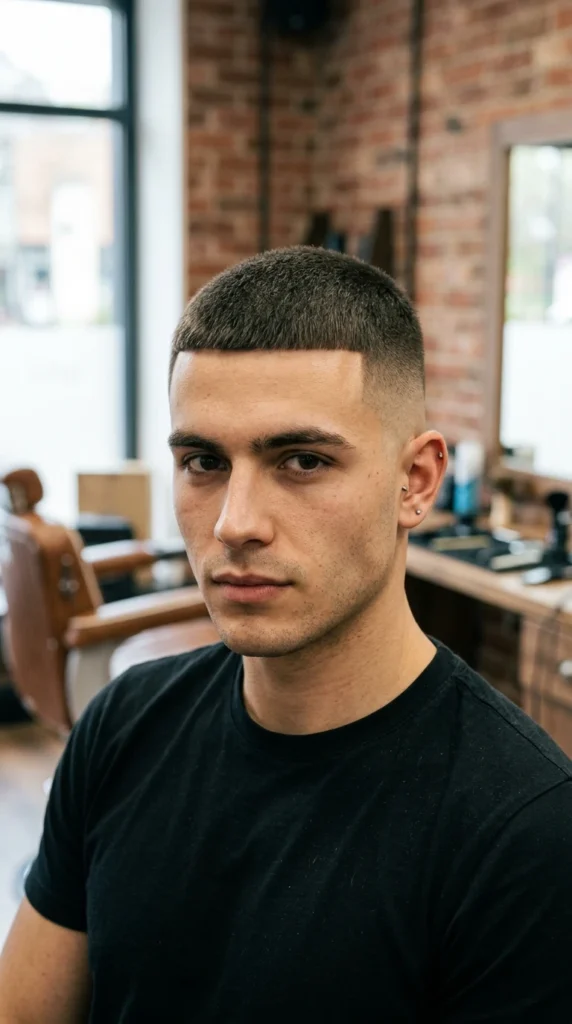
- The Sharp Simplicity: Military practicality meets a modern, functional design. It’s the ultimate low-stakes, high-reward style with a bold graphic line across the forehead.
- What to Tell Your Barber: “Buzz the top to a short uniform length, like a number 3 or 4, but leave the front line blunt. Skin fade the sides with zero blending.”
- Styling Mechanic: Styling cream is not optional but functional. A tiny, water-based cream simply pushes the short strands forward and keeps them uniform, adding a touch of healthy texture without shine.
15. Disconnected Fringe

- The Sharp Simplicity: A deliberately stark contrast between a heavy, longer top fringe and ultra-short sides. It’s a confident, high-fashion barbering statement.
- What to Tell Your Barber: “I want a hard disconnect. Keep the top heavy and long, and clip the sides to a high 0 or skin fade. No blending between them.”
- Styling Mechanic: The fringe itself does the talking. Blow-dry it straight forward for a solid mass, or piece it out with a clay for a messy contrast against the tight sides.
Fringes for Specific Hair Types
These four are built around a single variable: the hair you actually have, not the hair in the reference photo.
16. Curly Fringe
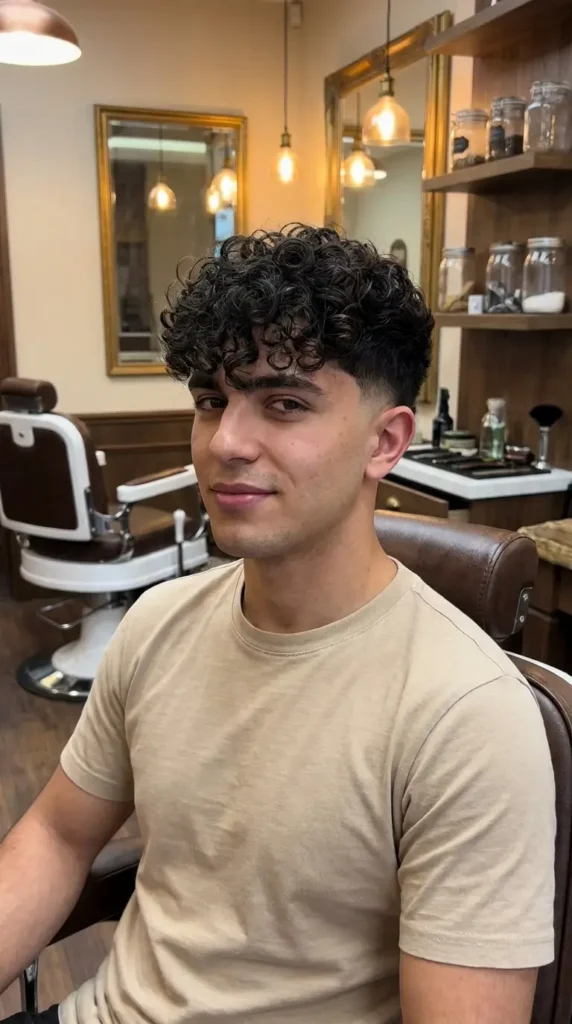
- The Face-Shaping Logic: Works with your natural curl pattern instead of fighting it, letting ringlets rest forward on the forehead for built-in texture no product can fake.
- What to Tell Your Barber: “Cut my fringe dry, in its natural curl state. Don’t straighten it first. Keep enough length that it doesn’t shrink too high when it dries.”
- Styling Mechanic: Curl cream on soaking wet hair, then either air dry or use a diffuser on low heat. Never touch it while drying, that’s what causes frizz.
17. Wavy Fringe
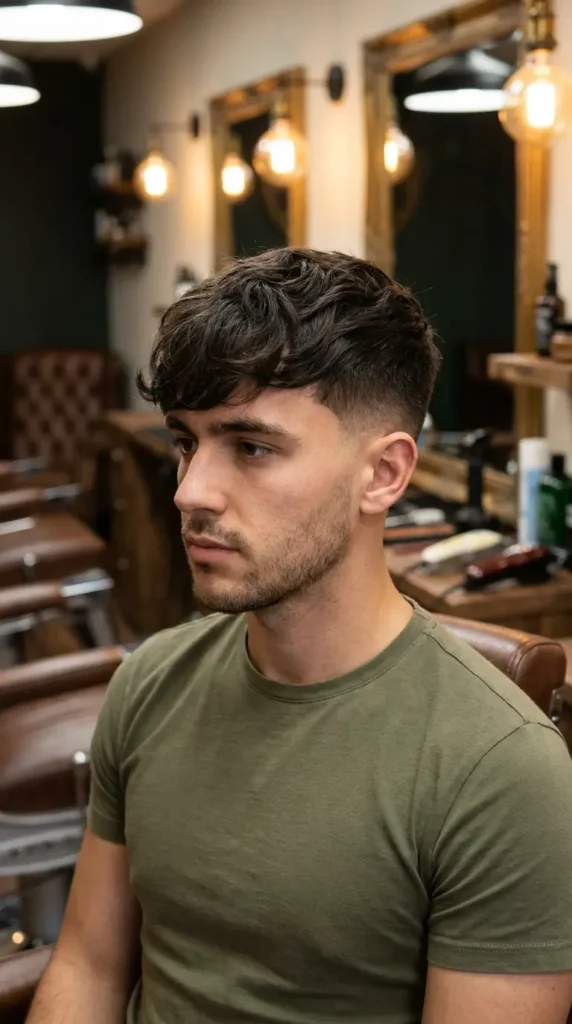
- The Face-Shaping Logic: The natural S-bend does most of the styling work for you, breaking up straight lines without any cutting technique required.
- What to Tell Your Barber: “Work with my natural wave pattern, light layers throughout so the movement shows, fringe forward.”
- Styling Mechanic: Scrunch sea salt spray into damp hair and let it air dry, or diffuse on low heat while scrunching upward.
18. Fine Hair Fringe (The Density Illusion)

- The Face-Shaping Logic: Stacks fine strands forward to create the appearance of density at the front of the head, the single best haircut trick for thin hair.
- What to Tell Your Barber: “My hair is fine, please use point cutting, not thinning shears, and keep the fringe choppy rather than one heavy block.”
- Styling Mechanic: Texture powder at the roots first, then blow-dry forward with lift. Skip heavy waxes entirely.
19. Thick Hair Fringe (Debulked)
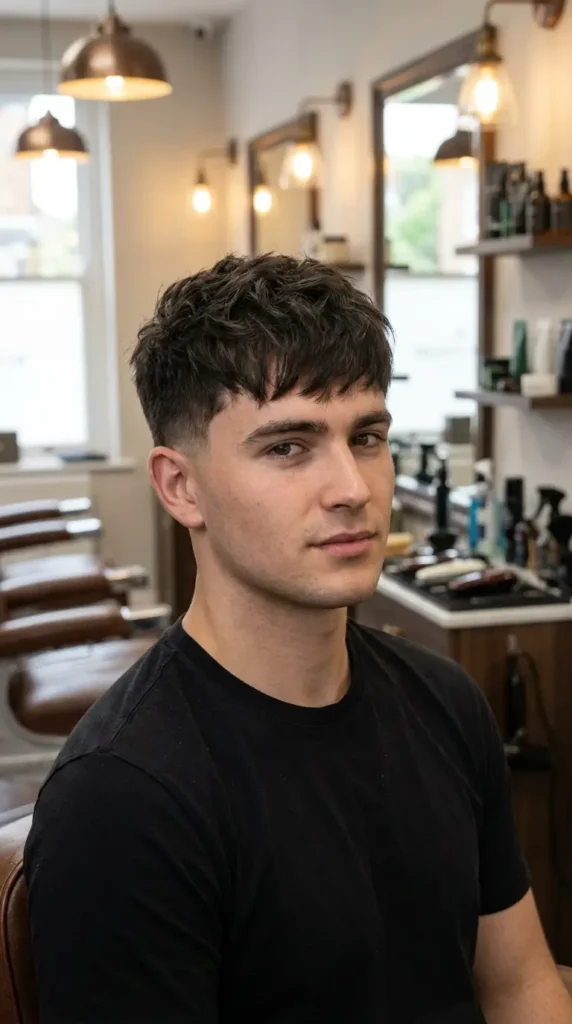
- The Face-Shaping Logic: Removes internal weight so a naturally heavy fringe sits softly instead of forming a helmet shape.
- What to Tell Your Barber: “My hair is thick, use texturizing shears to remove weight from underneath before you cut the length.”
- Styling Mechanic: Sea salt spray for grip, then a light matte clay, more product will just add unwanted weight back.
Fringe and Fade Combinations
The fringe gets the attention, but the fade sets the frame. These four pairings each change the fringe’s visual weight.
20. Skin Fade Fringe

- The Face-Shaping Logic: Maximum contrast. Shaving the sides to bare skin makes any fringe on top look heavier and more dominant by comparison.
- What to Tell Your Barber: “Skin fade on the sides, all the way to zero. Keep the fringe as the clear focal point.”
- Styling Mechanic: Matte clay for hold, since the bald sides mean every flyaway on top is visible.
See our full Skin Fade guide for length and fade-height options.
21. Burst Fade Fringe

- The Face-Shaping Logic: The fade curves around the ear instead of running in a straight line, adding a sporty, unconventional detail to a standard fringe.
- What to Tell Your Barber: “Burst fade that curves around my ear, not a straight fade line. Keep the fringe textured on top.”
- Styling Mechanic: Blow-dry forward, twist small sections between your fingers, finish with texture powder.
22. Low Taper Fringe

- The Face-Shaping Logic: The most conservative pairing. Keeps the fringe as the focal point without drawing attention to the sides at all, works in nearly any setting.
- What to Tell Your Barber: “Low taper starting just above my ears, nothing dramatic. Keep the fringe as the main feature.”
- Styling Mechanic: Light matte clay, minimal product, this pairing is designed to look effortless.
23. Mid Fade Fringe

- The Face-Shaping Logic: The balanced middle ground, enough contrast to look intentional without going full high-fade drama.
- What to Tell Your Barber: “Mid fade starting at my temples, blend it clean into a textured fringe on top.”
- Styling Mechanic: Texture clay worked through with fingers for volume and control.
Fringes for Life Stages and Settings
The same fringe concept, adjusted for where you’re wearing it.
24. Professional Office Fringe

- The Face-Shaping Logic: A shorter, less messy fringe that reads as deliberate and polished rather than casual, ideal for client-facing roles.
- What to Tell Your Barber: “Keep the fringe neat and slightly shorter, nothing too textured or messy. Low or mid taper on the sides.”
- Styling Mechanic: Light styling cream smoothed forward or slightly to one side. Skip sea salt spray on work days; it adds too much texture for a conservative look.
25. Teen Fringe

- The Face-Shaping Logic: A low-fuss version built for guys who don’t want to spend more than two minutes styling before school or sports.
- What to Tell Your Barber: “Keep the fringe short to medium and choppy so it doesn’t need daily styling. Moderate fade for easy upkeep.”
- Styling Mechanic: A small amount of matte cream is often the only product needed.
26. Mature Man’s Fringe

- The Face-Shaping Logic: A conservative, slightly longer fringe that looks current without leaning into overly trendy territory.
- What to Tell Your Barber: “Low taper, textured fringe, nothing too aggressive. Clean and conservative overall.”
- Styling Mechanic: Light styling cream for a natural hold that doesn’t look overworked.
27. Formal Event Fringe (Wet Look)

- The Face-Shaping Logic: Takes the same fringe shape and gives it a polished, high-shine finish appropriate for weddings or formal events.
- What to Tell Your Barber: “Cut my fringe with texture in mind, I’ll style it with a wet-look product for formal occasions.”
- Styling Mechanic: A light-hold shine pomade, applied sparingly and combed through for a slicked, deliberate finish.
Bold and Statement Fringes
For guys who want the fringe to be the loudest part of the haircut.
28. Fringe Mullet

- The Face-Shaping Logic: Pairs a disciplined, forward fringe with extra length at the back, a “business in front” hybrid that’s a breakout 2026 trend.
- What to Tell Your Barber: “Standard fringe up front with faded sides, but leave extra length at the nape. Don’t taper it in.”
- Styling Mechanic: Sea salt spray for natural movement throughout.
See our full Modern Mullet guide for more back-length variations.
29. Wolf Cut Fringe
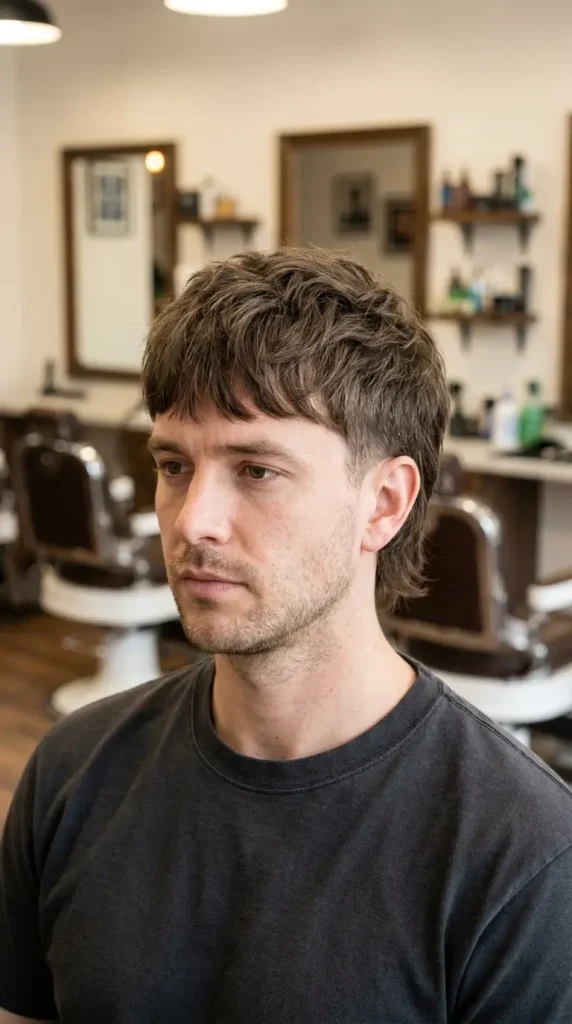
- The Face-Shaping Logic: Shaggy layers throughout with a messy fringe up front and wispy ends, adds volume at the crown while the fringe frames the face.
- What to Tell Your Barber: “Wolf cut with a messy fringe, heavy layers throughout, wispy ends, mid fade on the sides.”
- Styling Mechanic: Texture spray plus a small amount of light wax.
See our full Wolf Cut guide for the full layering breakdown.
30. Undercut Fringe

- The Face-Shaping Logic: A hard disconnection between very short sides and a long, heavy fringe on top, pure contrast with no blending.
- What to Tell Your Barber: “Disconnected undercut, uniform short sides, hard line, long fringe on top falling forward.”
- Styling Mechanic: Strong hold matte paste for separation and definition.
See our full Undercut guide for more side-length options.
31. Quiff Fringe
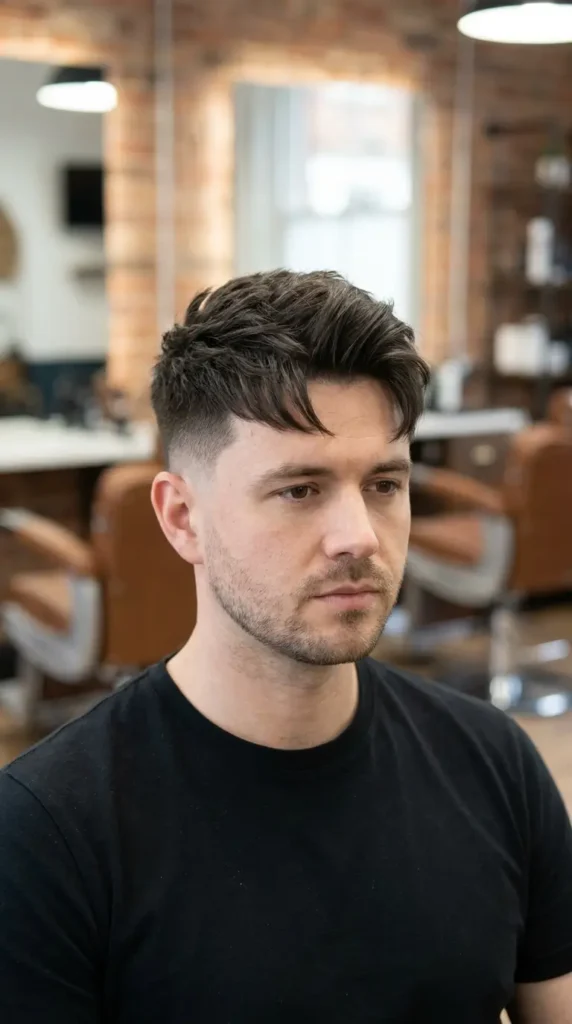
- The Face-Shaping Logic: The front section is blow-dried upward first for height, then pushed forward into a fringe, combining lift and forward movement in one style.
- What to Tell Your Barber: “Quiff fringe, volume at the roots, falling forward, high fade on the sides.”
- Styling Mechanic: Volumizing mousse at the roots, blow-dried up and then forward with a round brush.
Finding Your Perfect Fringe: The Face Shape + Hair Type Matrix
Before you scroll down and fall in love with a style that a curly-haired model is making look effortless, we need to have an honest chat about the two things that actually decide if a fringe will work. This is the conversation a really good barber has with every first-time fringe client. It’s a simple equation: Face Shape + Hair Physics = Your Perfect Fringe.
Face Shape Matching: The Geometry of a Good Haircut
Grab your phone, pull up a selfie where you’re staring straight at the camera with your hair pushed back, and trace the outline of your face. The goal of a fringe is balance. If your face is round, you don’t want a round haircut. If it’s long, you don’t want a haircut that makes it look longer. It’s that simple.
- Round Faces (Goal: Add Length): Your face is about as wide as it is long, with softer angles at the jaw. A fringe pushed straight down and flat will just echo that roundness. You need height and sharp angles to pull the eye upward. Best Picks: Angular Fringe, High Volume Fringe, Asymmetrical Fringe. These styles break the circular symmetry with a strong diagonal line, making your face look instantly leaner and more structured.
- Square Faces (Goal: Soften the Strong Jaw): You have a strong, angular jawline that could cut glass. That’s a feature most guys want, but a super blunt, straight-across fringe can make your whole head look like a box of Wheaties. You want soft, broken-up texture that de-emphasizes the jaw without hiding it. Best Picks: Messy Wavy Fringe, Tousled Fringe, Long Layered Fringe.
- Oval Faces (Goal: Don’t Over-Elongate): Congrats, you have the head shape that gets to play by house rules. An oval face is slightly longer than it is wide, with balanced proportions. Almost anything works, but you should avoid a mountain of extra height on top, which can make your face look unnecessarily long. Best Picks: Textured Crop, Side-Swept Fringe, Classic Fringe.
- Oblong/Long Faces (Goal: Shorten Vertically): Your face is longer than it is wide, often with a high forehead. The absolute worst thing you can do is slick your hair straight up to add height. A fringe is your secret weapon to visually cap the forehead and bring the focus to your eyes. Best Picks: Blunt Fringe, French Crop Fringe, Straight Hair Fringe. Keep the fringe sitting low and full across the brow to “cut” the vertical length.
- Heart-Shaped Faces (Goal: Balance a Wider Forehead with a Narrower Chin): Your forehead is the widest part of your face, narrowing to a pointed chin. You want to avoid adding volume at the top and instead sweep the hair down and across to narrow the forehead’s visual weight while adding a little width at the lower part of the face. Best Picks: Side-Swept Fringe, Curtain Bangs (Centre Part), Fluffy Fringe.
- Diamond Faces (Goal: Soften Cheekbones, Add Forehead Fullness): You have wide, prominent cheekbones and a narrower forehead and jawline. The goal here is to add width to the forehead while softening the cheeks. A side-swept volume is your best friend. Best Picks: Side-Swept Long Fringe, Tapered Fringe with weight kept at the temples.
Hair Type Physics: Working With, Not Against, Your Strands
Texture is non-negotiable. The most famous fringe on Pinterest will look like a flat disaster on your head if you’re fighting your natural hair.
- Straight Hair: Naturally falls forward, so a fringe is rarely a fight. Perfect for the sharp, defined lines of a Blunt Fringe, a side-swept flow, or a Korean-inspired fold. The trap is flatness, so a texture powder is your morning coffee.
- Wavy Hair: This is the texture that the “effortless cool” look was invented for. The natural S-wave gives you built-in movement that looks great in a Messy or Tousled Fringe.
- Curly Hair: Here’s the golden rule: always, always get a fringe cut dry. If a barber soaks your curls, combs them straight, and cuts, that fringe will bounce up to your hairline the moment it dries. A knowledgeable stylist will cut your natural curl pattern dry to see exactly where each coil will live.
- Fine/Thin Hair: A fringe is actually a brilliant optical illusion for you. Pushing fine hair forward creates a “stacked” density at the front, making the hair look much fuller than it is. The key is using a choppy, textured cut (never a heavy, solid one) and a root-lifting texture powder.
- Thick/Coarse Hair: Your challenge is bulk management. Without the right cut, a thick fringe can look like a heavy helmet. You need a barber skilled with texturizing shears to remove internal weight while keeping the length, allowing the fringe to sit softly.
The “Hider’s” Blueprint: Fringes for a Wide or Large Forehead
We need to have a direct conversation about this, because it’s the number one reason a lot of men walk into a barber shop and nervously ask about bangs. As that Redditor perfectly summarized, they had “always had a fringe because I’ve got a fat and wide forehead.” This isn’t a niche concern; it’s a mainstream need that most style guides completely ignore in favor of talking about the latest TikTok dance.
The solution, however, is not just any fringe. A poorly chosen, heavy, solid fringe worn like a mop doesn’t hide a wide forehead, it ironically emphasizes it. The eye sees a solid wall of hair and compares it to the rest of the face, making the horizontal span even more obvious. This is the “Bowl Cut Paradox.”
The solution is what we call Point Break Camouflage. You don’t cover up the forehead with a single solid object; you break up its visual width with texture and irregularity. Here are the three non-negotiable rules:
- Never Go Blunt. A perfectly straight, horizontal line is a ruler across your face, measuring its width for everyone to see. A jagged, choppy, or wispy fringe acts like a coastline. It creates an irregular, unpredictable line that the eye can’t easily measure, effectively “erasing” the true top of the forehead.
- Control the Contrast. The worst mistake is a super-heavy fringe on top with shaved skin on the sides. This creates a “mushroom head” silhouette that balloons the top of the head. Ask for a low taper fade or keep the sides relatively fuller (like a scissor cut). This creates a smooth, vertical flow that slims the face.
- Add a Diagonal. A side-swept fringe is the single most effective cut for this. By pulling the bulk of the hair off the center of the forehead and crossing it on an angle, you cover the temple recession and pull the eye diagonally, making the forehead’s width not just hidden, but completely unreadable.
The Barber Shop Script: How to Ask for Your Fringe (And Actually Get It)
Most bad haircuts are a communication problem, not a skill problem. Walking in and saying “I want a fringe, I guess” is like walking into a restaurant and telling the chef, “I want food, I’m hungry.” Take control of the consultation with this formula:
The “Name + Length + Texture + Fade” Formula
Stop using vague words like “short” or “long.” Be specific about the architecture.
- Bad: “Can I have a fringe? Maybe something modern?”
- Good: “I want a textured fringe [Name]. I’d like to keep around two to three inches of length at the very front [Length]. I really want it to be piecey and messy, so please use point cutting or a razor to break the ends up, not a blunt straight-across line [Texture]. Then blend it into a mid-skin fade [Fade].”
The Guarantee of Texture
One single request will save you from looking like a medieval page boy. Always say this: “Please use texturizing shears at the front, not thinning shears, and definitely not just a straight scissor cut along the hairline.” Point cutting creates a soft, natural looking line. A straight scissor cut creates a hard, unforgiving ledge.
The Photo Is a Blueprint, Not a Contract
Bringing a photo is perfect, but don’t just silently thrust your phone at them. Explain what you like about it: “I like how the fringe isn’t solid here, see how it separates into different clumps? That’s the texture I want.” Facial hair can also play a role; a beard can balance a heavy top. A barber is a reverse-engineer; give them the details to reverse-engineer the look for your specific head.
The Styling Physicist: Products & Durability for the Real World
A fringe in the barber chair at 10 a.m. is a promise. A fringe after a windy commute, a sweaty meeting, and a rainy lunch is a test of physics. The right product is not a cosmetic; it’s a structural support beam.
The Product-Problem Match Matrix
- If you have thick hair and want a matte, messy, separated look: Use a Matte Texture Clay. It provides hold without shine, adding a gritty, natural separation that keeps thick hair from clumping together into a single solid block.
- If you have fine, thin, or straight hair that falls flat by noon: Your salvation is a Dry Texture Powder. It’s a weightless volumizer that creates friction between strands, fluffing the hair up from the root and creating the illusion of much higher density.
- If you have straight hair that needs “grip” to hold a messy shape: Start with a pre-styler. Sea Salt Spray on damp hair adds the micro-texture and grit that straight, slippery hair lacks, giving styling products something to hold onto.
- If you have curly hair and need defined, frizz-free curl clumps: Avoid dry pastes entirely. Use a dedicated Curl Cream on wet hair to form defined, juicy curl clumps. Once dry, you can break the “cast” (the slight crunchiness) by gently scrunching the curls with your hands.
The Anti-Gravity Blow-Dry (The “Cold Shot” Secret)
Here’s the physics of a fringe that lasts all day. After you’ve blow-dried your wet, product-laden hair into its perfect forward position using hot heat, immediately switch your dryer to the “cool shot” button and blast the roots with cold air for 15 seconds. Heat makes the hydrogen bonds in your hair flexible and sets the direction. A sudden cold blast re-hardens those bonds in place, acting as a thermal “lock.” This single step is the difference between a fringe that collapses by lunch and one that holds until dinner.
Frequently Asked Questions About Men’s Fringes
Is a fringe unprofessional for work?
Not anymore. The key is in the execution. A well-executed textured crop or neat side-swept fringe reads as a deliberate, modern, and highly polished style in any professional environment. It’s a far cry from the unkempt, teenage-style bangs of decades past.
I have a receding hairline. Can a fringe still work?
Actually, this is one of the best applications. A French crop or a choppy, forward-raked fringe is specifically designed to sit directly on the hairline, completely masking the areas of recession while drawing attention to the texture and forward movement of the hair. For more targeted options, see our receding hairline guide.
What face shape should absolutely NOT have a fringe?
It’s less about face shape and more about the wrong fringe for that shape. However, if you have a very small, compact face with fine features, an extremely heavy, massively oversize fluffy fringe can risk overwhelming your face and burying your features.
How often do I actually need to trim a fringe to keep it looking good?
Fringes grow at the same rate as the rest of your hair, but they feel like they grow faster because they hit your eyes first. To keep the length exactly where it looks intentional, you need a micro-trim every 3 to 4 weeks. Most barbers will do this as a quick, cheap service.
The barber cut my fringe too short. What do I do?
This is a genuine styling emergency. You can’t glue it back on, so you pivot. Immediately switch from a forward-down style to a High Volume Fringe or a Side-Swept Fringe using a strong product. Blow-drying it up and over instead of down will visually borrow back the length.
Is styling my fringe going to give me forehead acne?
It can, if you use heavy, oil-based products or let sweat sit on your skin under the hair. The fix is simple: always use water-based, matte styling products that don’t clog pores, and make sure you’re cleansing the forehead area thoroughly at night.
Do I need a completely different cut for curly hair?
Yes. The physics are fundamentally different. If you cut a curly fringe as if it were straight hair, it will bounce up to half its length when it dries. Always insist your barber cuts your fringe dry in its natural, coiled state so they can accurately see where the final landing point will be.