

The faux hawk haircut is the style that lets you channel rockstar energy on Saturday night and walk into a Monday morning meeting without raising eyebrows. It’s the perfect middle ground between bold self-expression and workplace acceptability, what stylists call “safe rebellion.”
The faux hawk haircut features shorter faded or tapered sides with a longer central strip styled upward through the crown, creating a ridge that mimics the classic mohawk silhouette without the extreme commitment. David Beckham famously popularized the fohawk in the early 2000s, and it has remained one of the most requested cuts in barbershops worldwide ever since.
Whether you want a burst fade for weekends or a taper fade for the office, this guide gives you 50 styles, exact barber scripts, and a step-by-step styling routine so you never leave the chair disappointed.
What Is a Faux Hawk Haircut?
A faux hawk haircut, also called fauxhawk, fohawk, or fo-hawk, is a short-sided men’s hairstyle where the hair on top is styled upward into a central crest, mimicking a mohawk without completely shaved sides.
The name itself tells the story: “faux” means fake in French. You get the visual impact of a mohawk without the dramatic shaved sides that make growing out awkward and limit your styling options.
The Anatomy of a Faux Hawk
Understanding the structure helps you communicate with your barber and style it correctly at home:
| Component | Description |
| The Ridge/Crest | The central strip of longer hair running from forehead to crown (vertex) |
| The Crown | The highest point at the back of the head where hair grows in a spiral pattern |
| The Fringe | The front hairline section that can be styled forward or swept back |
| The Sides | Faded or tapered sections creating contrast with the central strip |
| The Neckline/Nape | The finish at the back, tapered, blocked, or rounded |
The contrast between the longer top and shorter sides creates the signature silhouette. This contrast can be subtle (blended taper) or dramatic (skin fade with disconnection), depending on your preference.
50 Best Faux Hawk Styles for Every Hair Type
The faux hawk adapts beautifully to different hair textures, lengths, and personal preferences. Here are the most popular variations organized by category.
1. Short Textured Faux Hawk
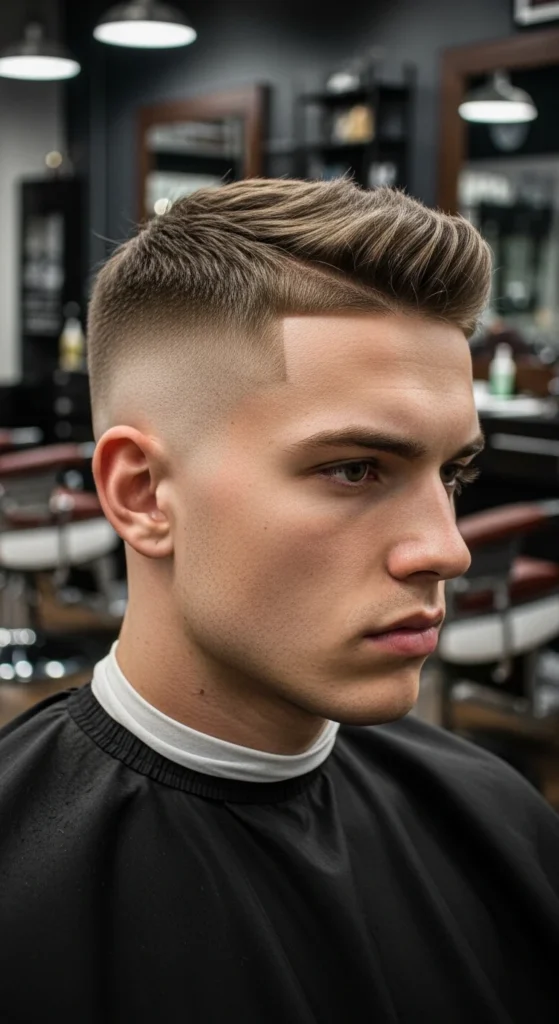
Minimal length on top (1-2 inches) with maximum texture. The short height is compensated by choppy, point-cut layers that create movement and dimension. Ideal for men who want the faux hawk shape without daily styling commitment.
2. Buzz Cut Faux Hawk
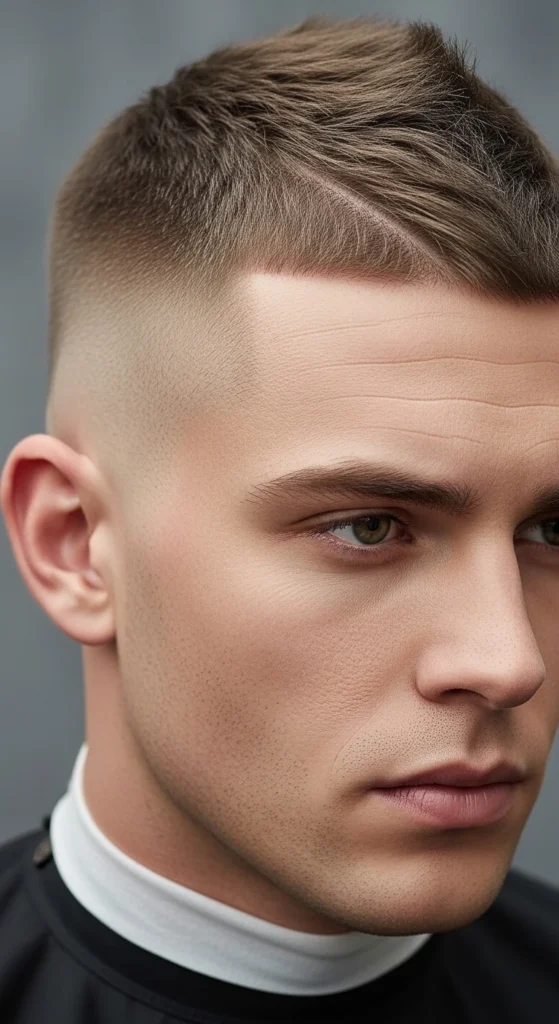
Ultra-short variation where the “hawk” is created through subtle length differences rather than dramatic height. The top might be a #4 guard while the sides are a #1 or #2. Perfect for military-adjacent aesthetics or hot climates.
3. Short Spiky Faux Hawk
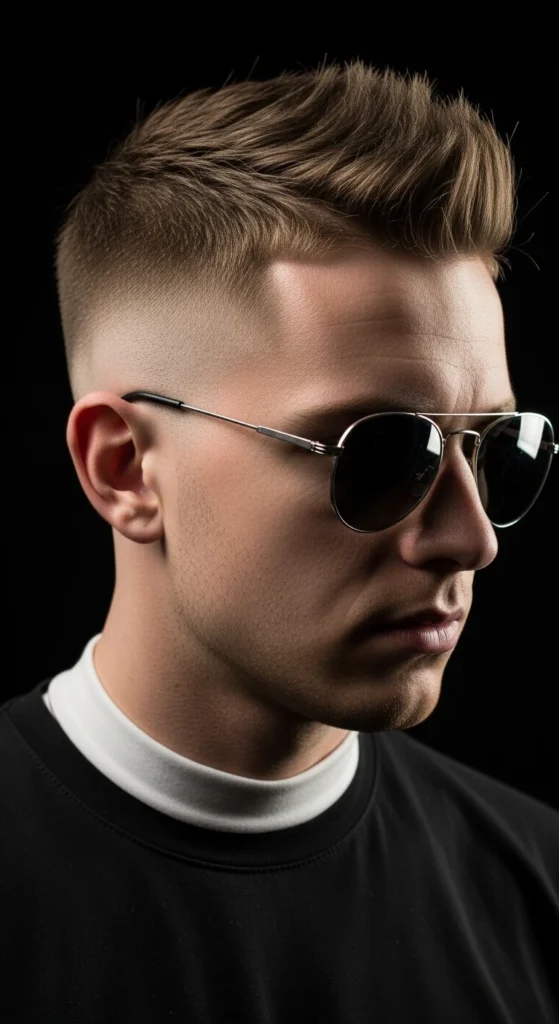
Classic early-2000s energy with defined peaks along the central ridge. Achieved with strong-hold clay or matte paste. Best for straight to slightly wavy hair that holds spikes well.
4. Long Flowing Faux Hawk
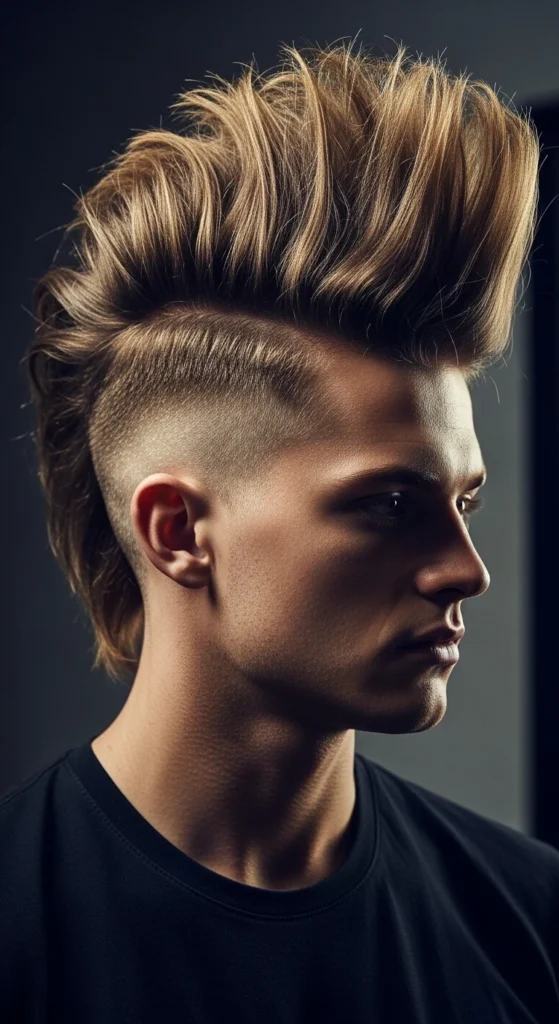
Four or more inches on top, swept back dramatically. Requires more styling time but delivers maximum visual impact. The length allows for pompadour-like volume while maintaining the faux hawk silhouette.
5. Shaggy Faux Hawk
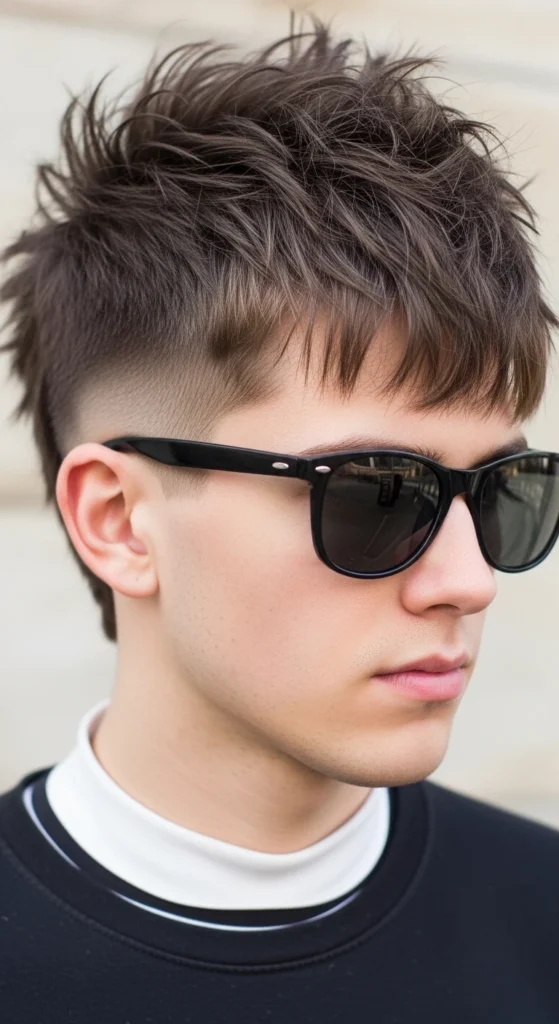
Layered, wind-blown texture with flipped-out ends. Less structured, more relaxed, the “I woke up like this” version. Works beautifully with wavy hair that provides natural movement.
6. Faux Hawk Pompadour
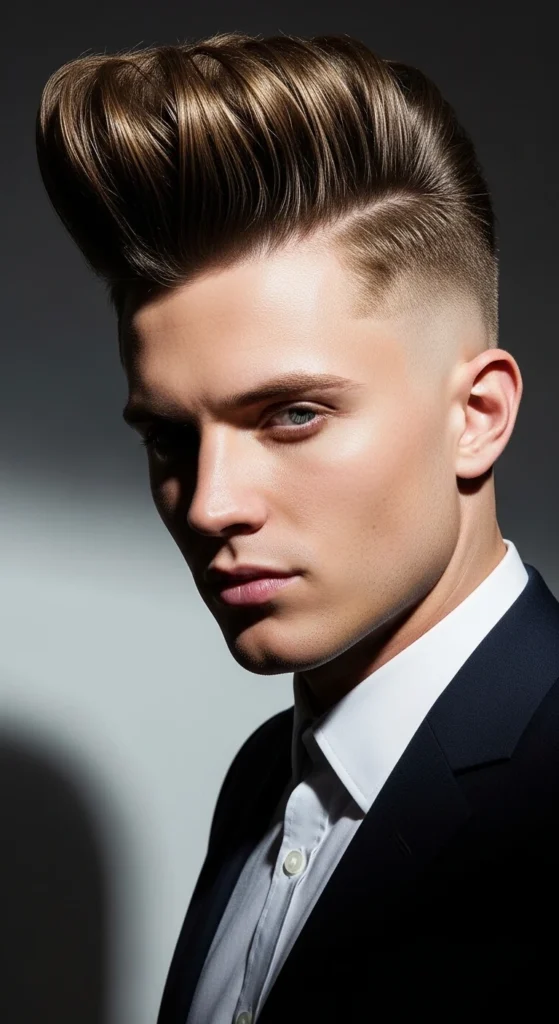
Retro volume meets modern edge. The front is styled high and rolled back like a classic pompadour, while the sides maintain the characteristic fade. Requires blow-drying technique and medium-hold product.
7. Messy Textured Faux Hawk
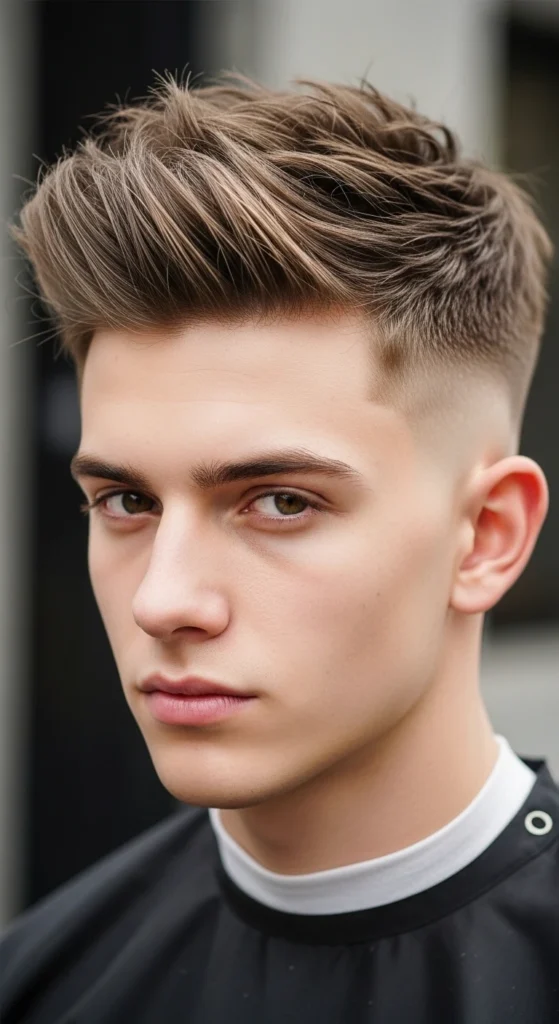
Tousled, organic appearance with intentional dishevelment. Achieved by scrunching product through damp hair and air-drying or diffusing. Perfect for men who want style without looking “done.”
8. Choppy Faux Hawk
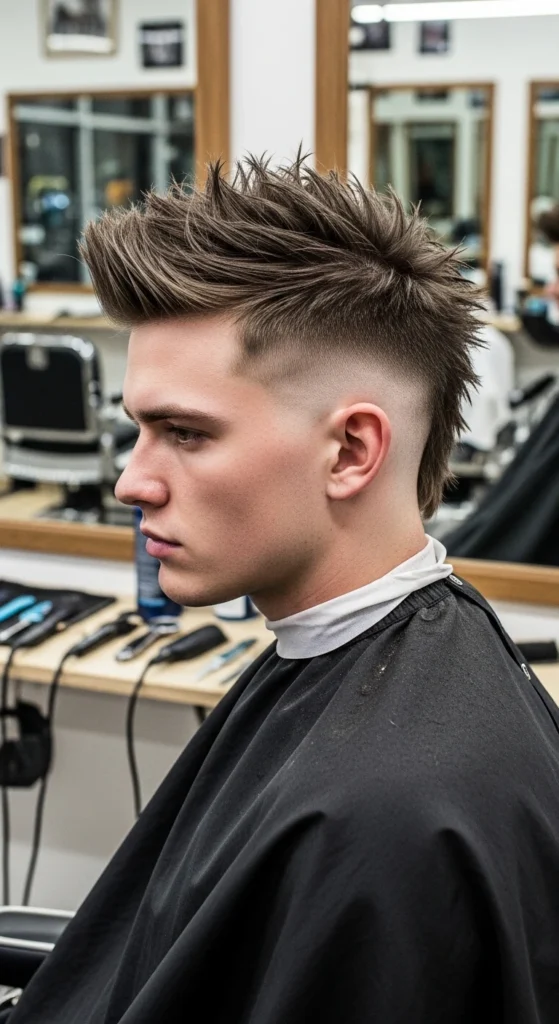
Point-cut layers create jagged, piece-y texture throughout the central ridge. More aggressive than the messy version, intentionally rough-hewn. Best styled with clay for separation.
9. Wavy Faux Hawk
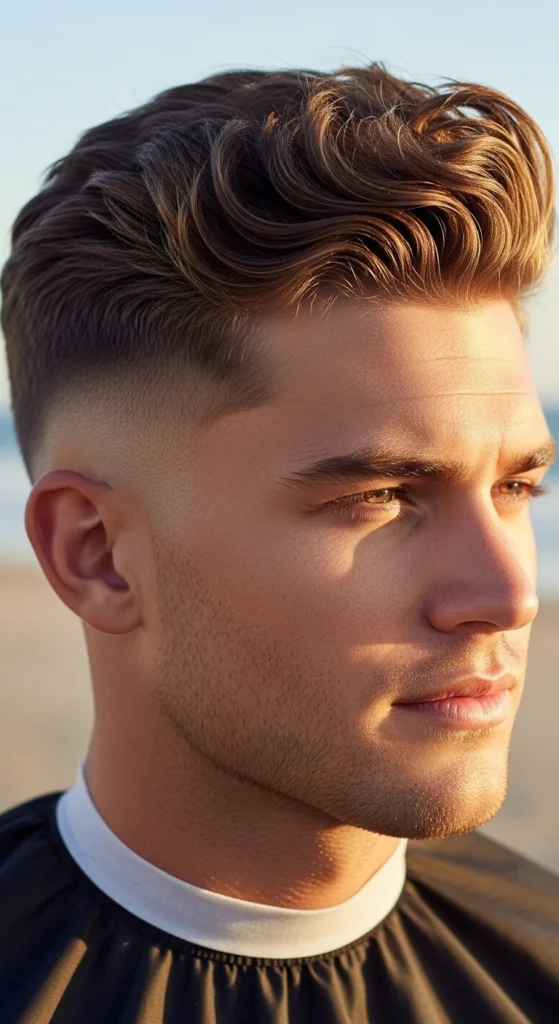
Natural wave enhanced rather than fought against. Sea salt spray amplifies the texture while light cream controls frizz. One of the lowest-maintenance options for naturally wavy hair.
10. The Faux Hawk Mullet: The Trending Hybrid
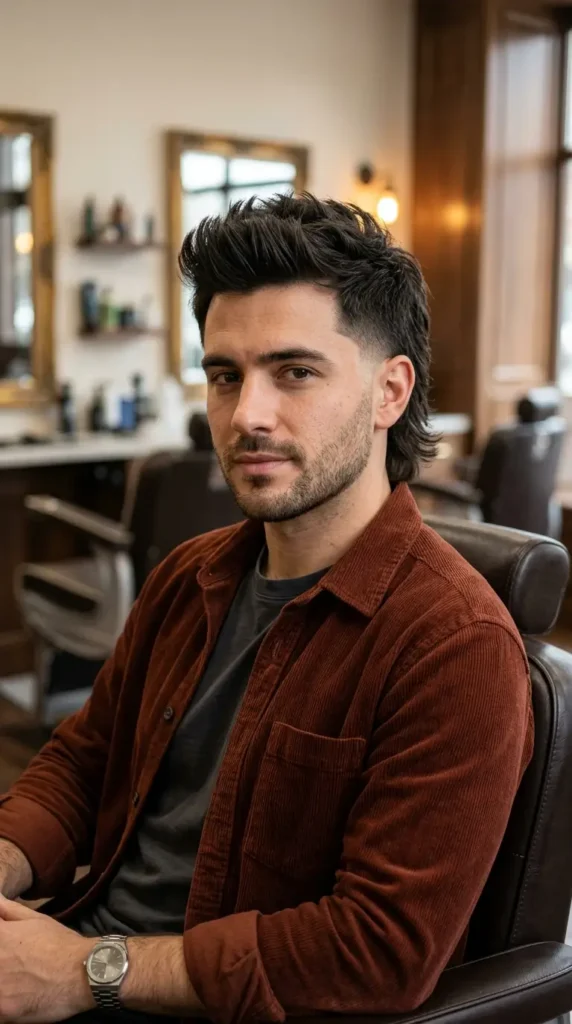
The faux hawk mullet (sometimes called the mull-hawk) combines the structured front of a fohawk with extended length at the nape: “business rebellion in front, party in back.”
Key Characteristics:
- Faded or tapered sides through the temple and ear area
- Central ridge styled upward at the crown
- Hair left longer at the nape, extending 2-4 inches below the occipital bone
- Intentional layering prevents the “accidental mullet” look
Maintenance Warning: The mullet component requires deliberate shaping. Without regular trims (every 3-4 weeks), the proportions become unbalanced. Tell your barber you want the length intentional and layered, not just grown out.
This hybrid is currently surging in popularity among younger demographics and represents the evolution of both parent styles.
11. Curly Faux Hawk
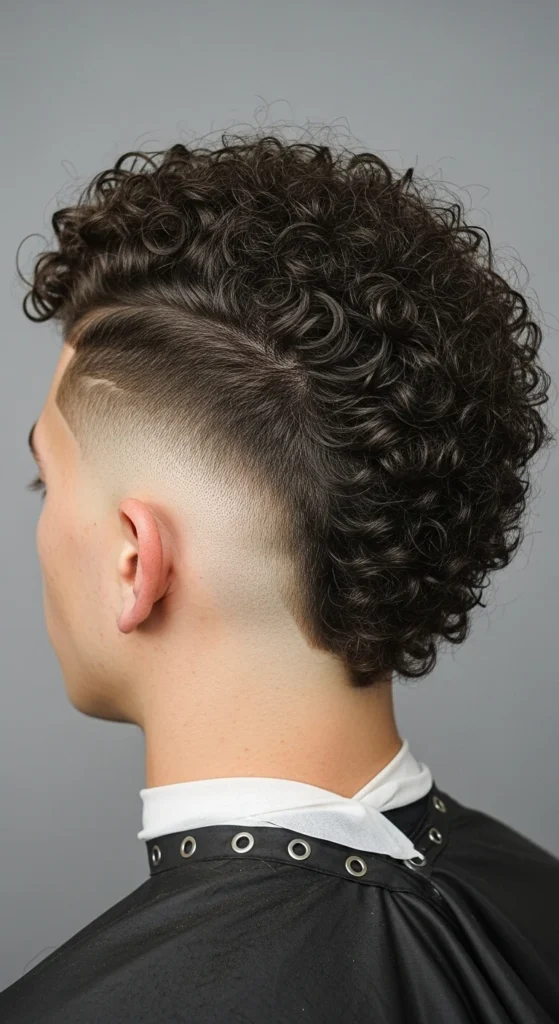
Embrace the volume rather than fighting it. The curls provide built-in height and texture. Use curl-defining cream to enhance ringlets and reduce frizz. Avoid heavy products that flatten the natural bounce.
12. Frohawk (Afro Faux Hawk)
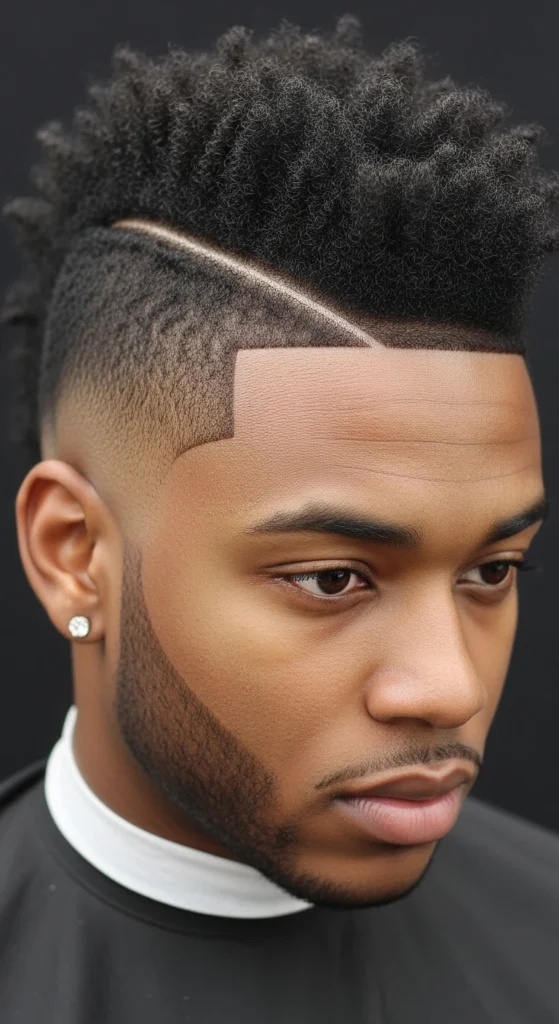
Specifically for coily Type 4 hair, the frohawk features tight curls shaped into a central ridge with high-contrast fades on the sides. The natural texture creates dramatic height without product. Moisturizing cream keeps the coils healthy and defined.
13. Wavy Faux Hawk
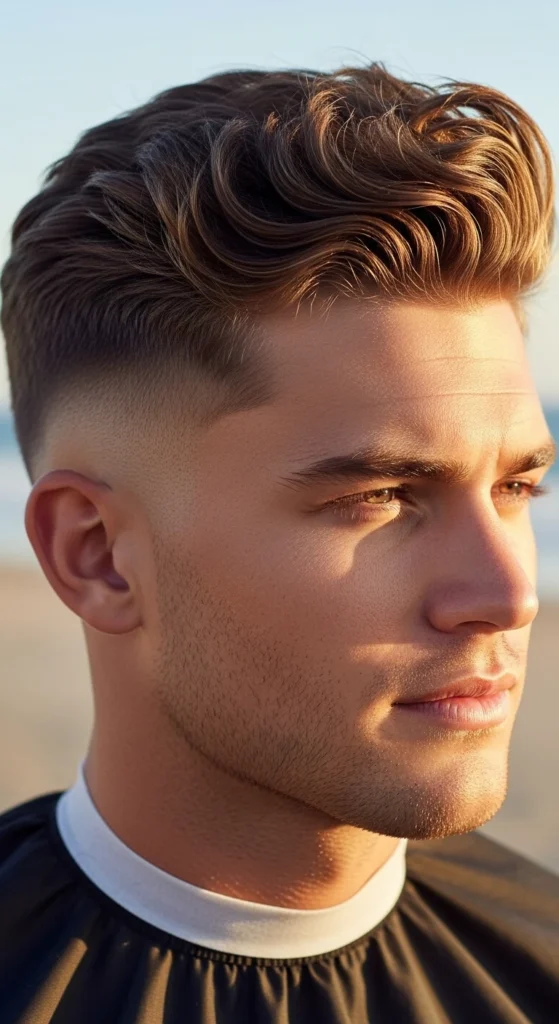
The gentlest texture variation. Sea salt spray plus air drying creates effortless, beachy texture. Light hold styling cream provides control without crunch. One of the most forgiving styles for wash-and-go routines.
14. Faux Hawk for Straight Hair
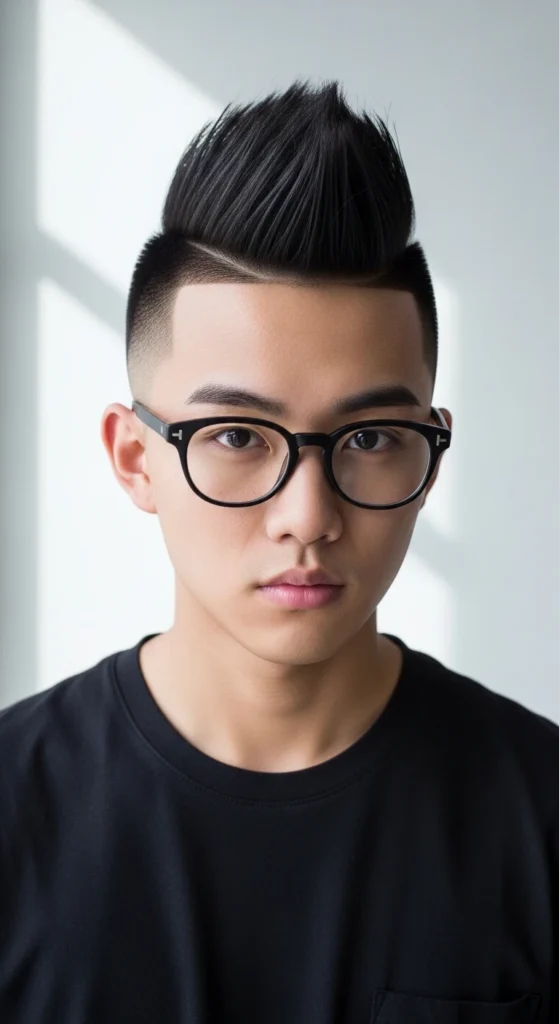
Straight hair presents a specific challenge: it tends to either fall flat or spike unnaturally.
The Challenge: Without natural wave or curl, straight hair lacks built-in volume and may resist staying in the upward-styled position.
The Solution:
- Pre-styling with sea salt spray or volumizing mousse creates grip
- Blow-drying against the growth pattern teaches hair to stand up
- Texture powder at the roots adds lasting lift
- Matte clay or paste provides hold without weighing hair down
Best Styles: Spiky variations, quiff-hybrids, or slicked-back looks work best. Avoid attempting the “messy” look, straight hair often looks limp rather than tousled without texture.
15. Faux Hawk for Thin or Thinning Hair
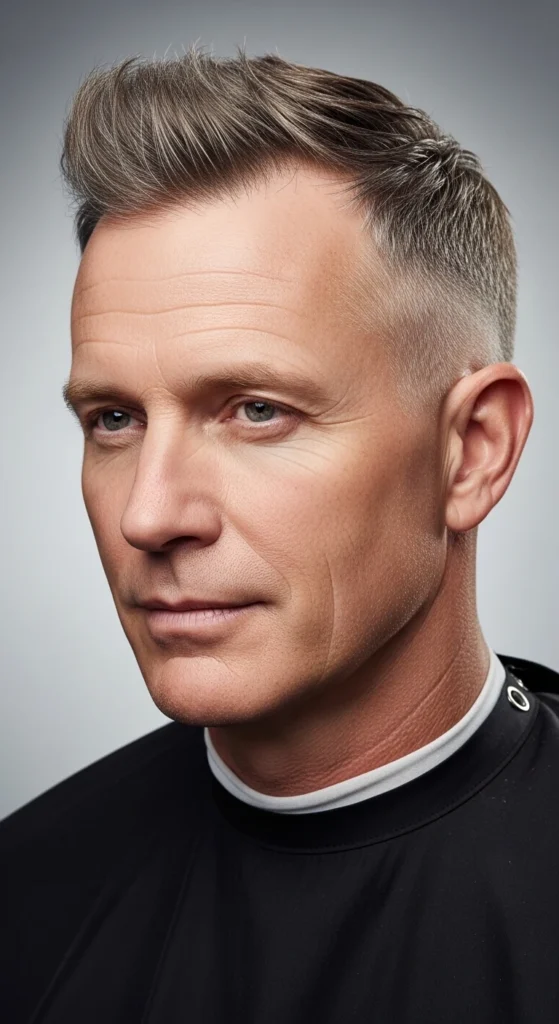
The faux hawk can actually be an excellent choice for thin hair when styled correctly.
The Strategy: Create the illusion of density through texture rather than fighting against the hair’s natural body.
Best Products:
- Volumizing powder (sprinkled at roots for instant lift)
- Sea salt spray (adds grip and texture without weight)
- Matte clay (light application for separation)
Products to Avoid:
- Heavy pomades (weigh hair down, expose scalp)
- Excessive gel (creates clumping that reveals thin areas)
- High-shine products (reflect light and emphasize sparse areas)
Styling Tip: A shorter faux hawk with textured, piece-y styling often looks fuller than longer versions that can appear stringy.
16. Frohawk Fade
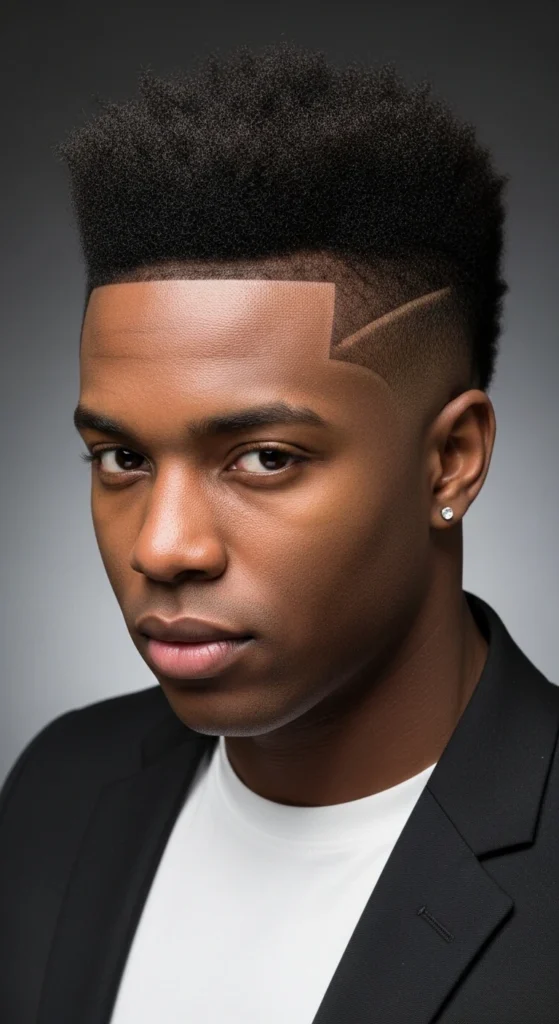
Tight coils with a high-contrast skin fade create one of the most striking faux hawk variations. The natural texture provides volume that straight hair cannot achieve. Define the coils with curl cream and maintain moisture with leave-in conditioner.
17. Faux Hawk with Braids
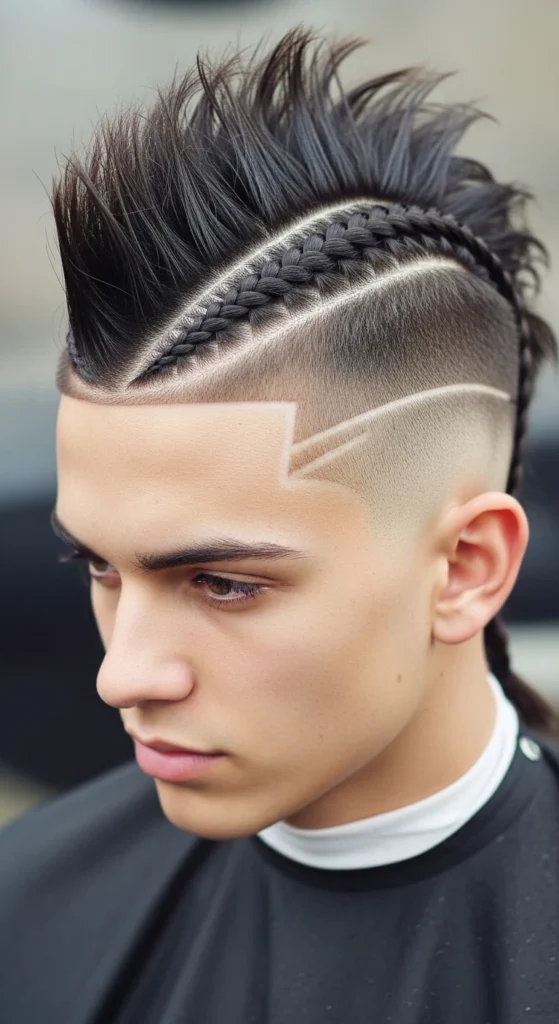
Cornrows styled into a central ridge with faded sides. The braids can run front-to-back along the central strip or be designed in patterns. Requires professional braiding but offers excellent longevity (2-4 weeks between maintenance).
18. Faux Hawk with Dreads or Twists
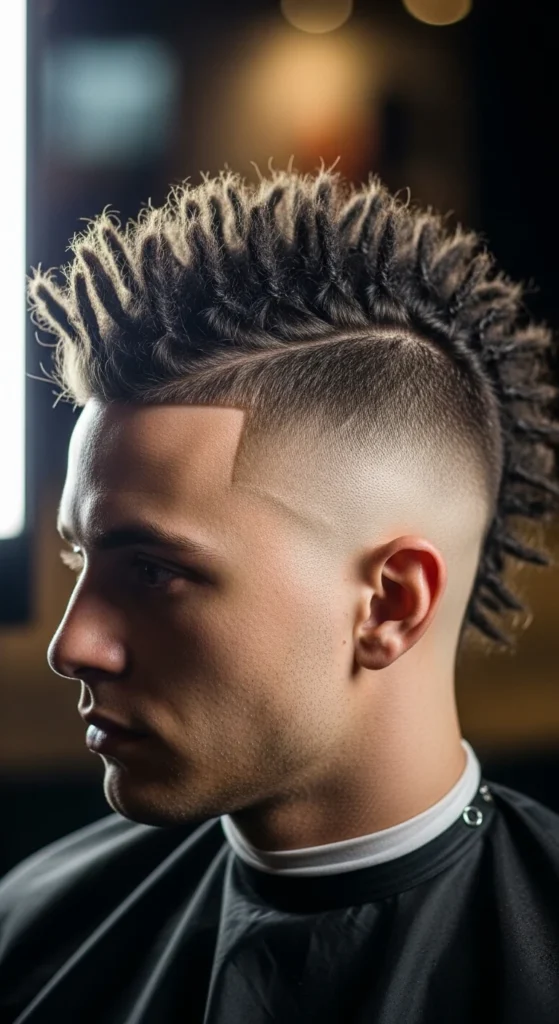
Loc’d or twisted hair gathered centrally with faded or undercut sides. The locs provide dramatic height and texture. Can be styled up for maximum impact or laid down for a more conservative appearance.
19. Faux Hawk with Line-Up
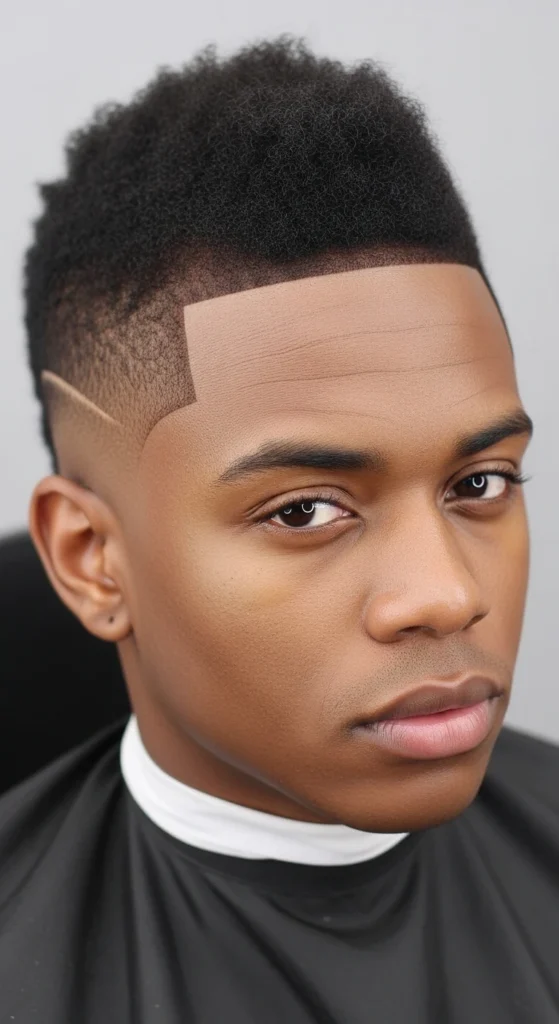
Sharp edges along the hairline and temples create geometric precision that complements the central ridge. The line-up (also called shape-up or edge-up) requires maintenance every 1-2 weeks.
20. Faux Hawk for Asian Hair
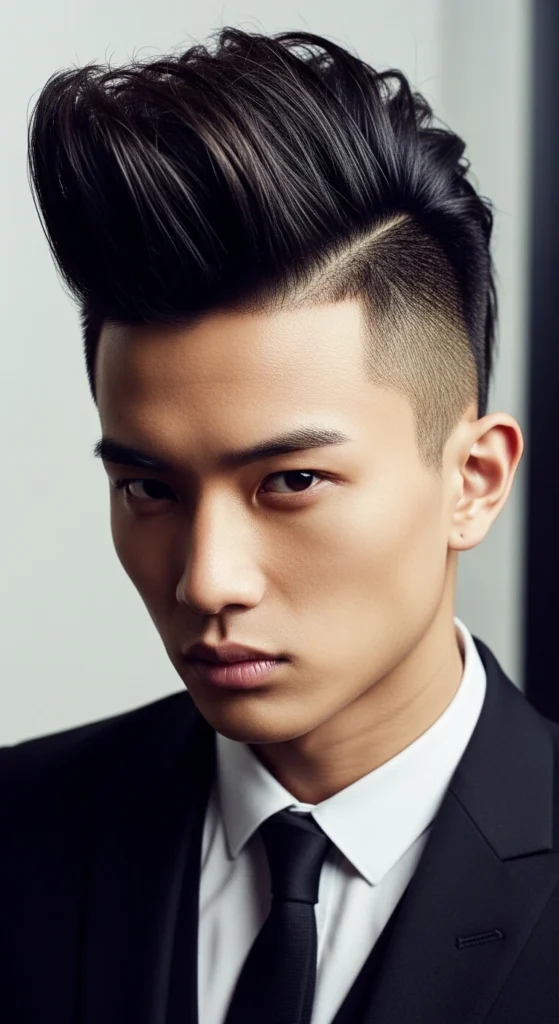
Asian hair presents specific styling considerations due to its typical characteristics.
The Challenge: East Asian hair is often thick, straight, and resistant to styling direction. Individual strands may spike outward rather than lying in the intended direction.
The Solution:
- Strong-hold clay or paste (not gel, it creates crunchy spikes)
- Blow-drying against the natural growth pattern to train direction
- Layering and texturizing by the barber to reduce bulk and aid styling
- Regular trims to maintain shape as thick hair grows out quickly
Best Styles: Textured, spiky, or undercut variations that work with the hair’s natural stiffness rather than against it. The thickness that makes styling challenging also creates excellent volume once directed properly.
21. Faux Hawk for Boys & Kids
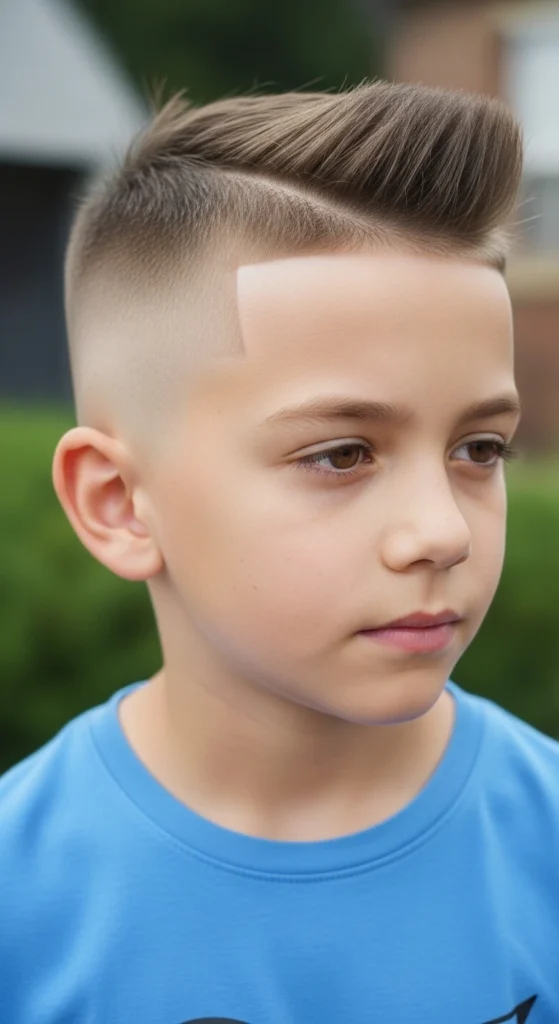
The faux hawk is hugely popular for boys, it’s cool enough to earn playground credibility while remaining parent-and-school-appropriate.
School-Friendly Versions:
- Longer, softer transitions rather than dramatic skin fades
- Lower height on top (less “extreme” appearance)
- Tapered rather than disconnected sides
Easy Maintenance Tips for Parents:
- Start with styles requiring minimal daily product
- Choose taper fades that grow out gracefully
- Allow 3-4 weeks between haircuts
Conversation Starter: Let the child choose the variation within acceptable parameters. A sense of ownership encourages them to participate in styling.
22. Faux Hawk Undercut
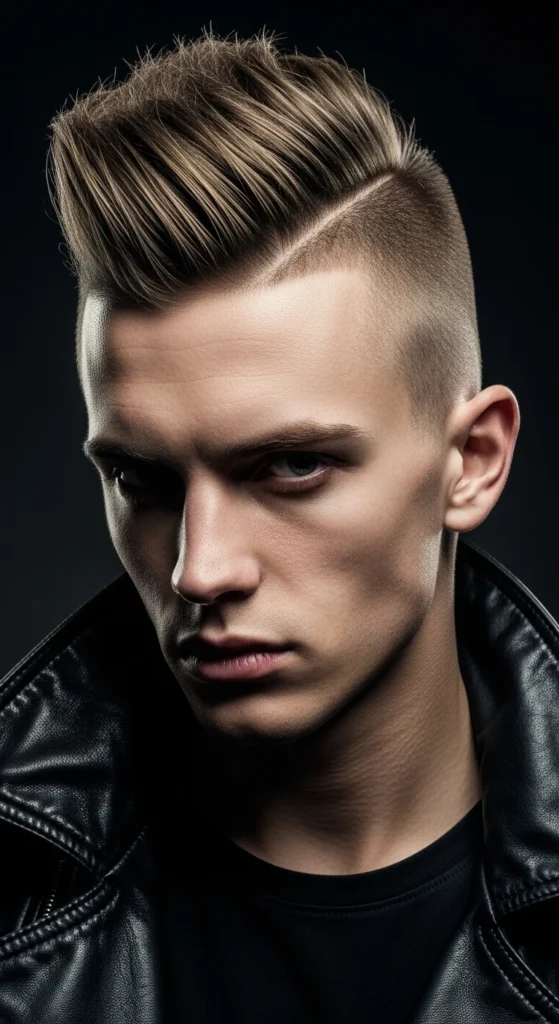
Dramatically disconnected with no blending between the top and sides. The undercut creates a sharp line of demarcation. Bold and unmistakable.
23. Punk Faux Hawk
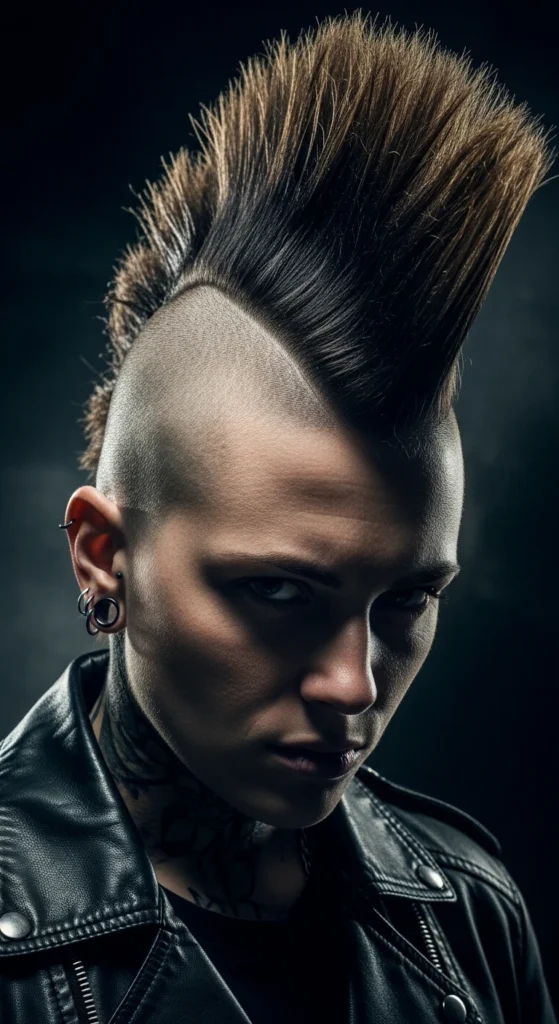
Liberty spike influences with extreme height along the central ridge. Requires strong-hold products (often gel for this specific look). The most dramatic variation before crossing into full mohawk territory.
24. Faux Hawk with Shaved Design
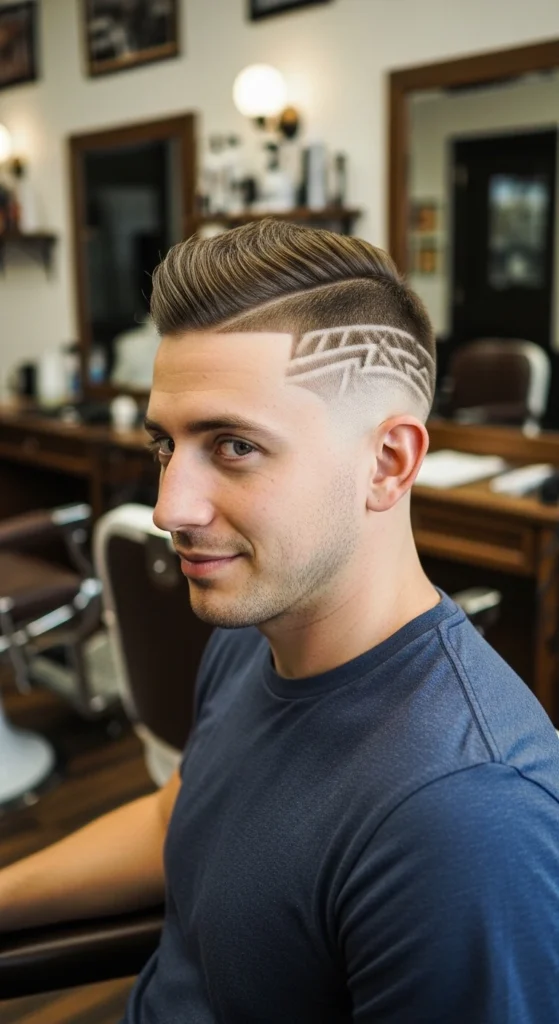
Geometric patterns, lines, or shapes cut into the faded sections. Requires a skilled barber and fades within 1-2 weeks. Eye-catching but high-maintenance.
25. Faux Hawk with Beard
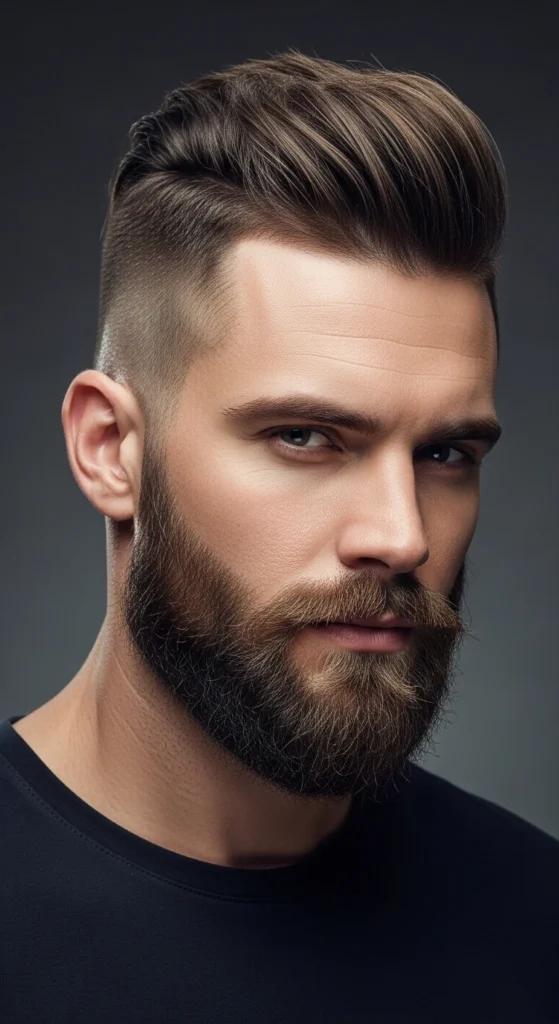
The complete masculine aesthetic package. The vertical lines of the faux hawk complement the vertical growth of a well-groomed beard. Ensure both are maintained on similar schedules for a cohesive appearance.
26. High Volume Faux Hawk
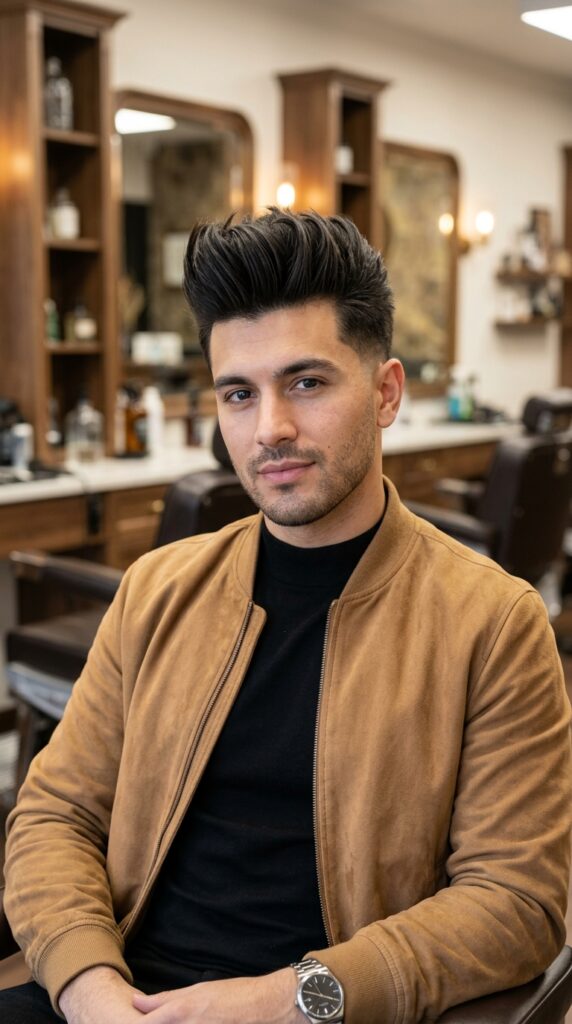
Maximum lift achieved through backcombing and root-lifting products before styling upward. The ridge stands noticeably taller than standard faux hawks, closer to a mohawk silhouette while sides stay tapered. Best for thick or medium-density hair that can support the extra height without collapsing by midday.
27. Slicked Faux Hawk
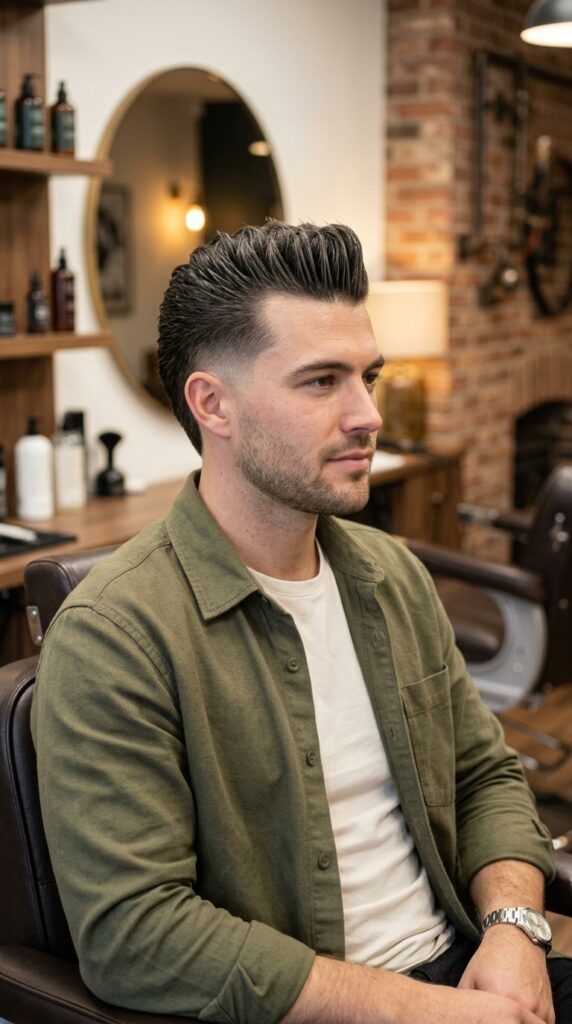
A polished, wet-look finish using water-based pomade instead of matte clay. The central ridge is combed rather than finger-styled, creating clean lines and high shine. Popular for formal occasions where the textured versions feel too casual.
28. Textured Crop Faux Hawk
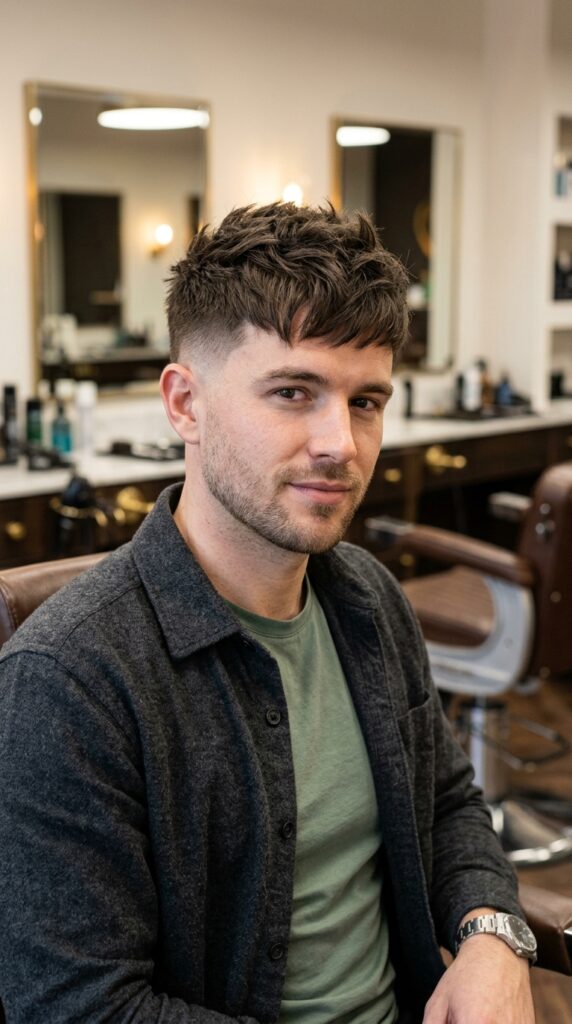
Combines the cropped fringe of a French crop with faux hawk sides. Shorter overall length with heavy texturizing on top, styled slightly forward-up rather than straight vertical. Low-maintenance option that still reads as intentional and edgy.
29. Two-Strand Twist Faux Hawk
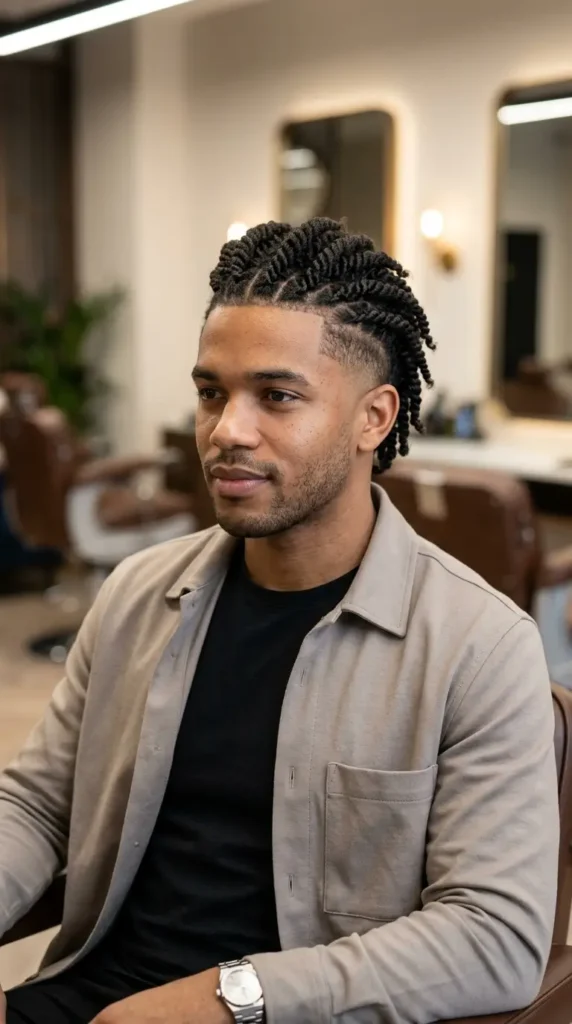
Twisted sections replace loose curls along the central strip, common on natural Type 3-4 hair. Twists are gathered upward and pinned or held with light gel during setting, then released for a defined, sculptural ridge. Offers longer wear between restyles than loose curl versions.
30. Faux Hawk with Hard Part
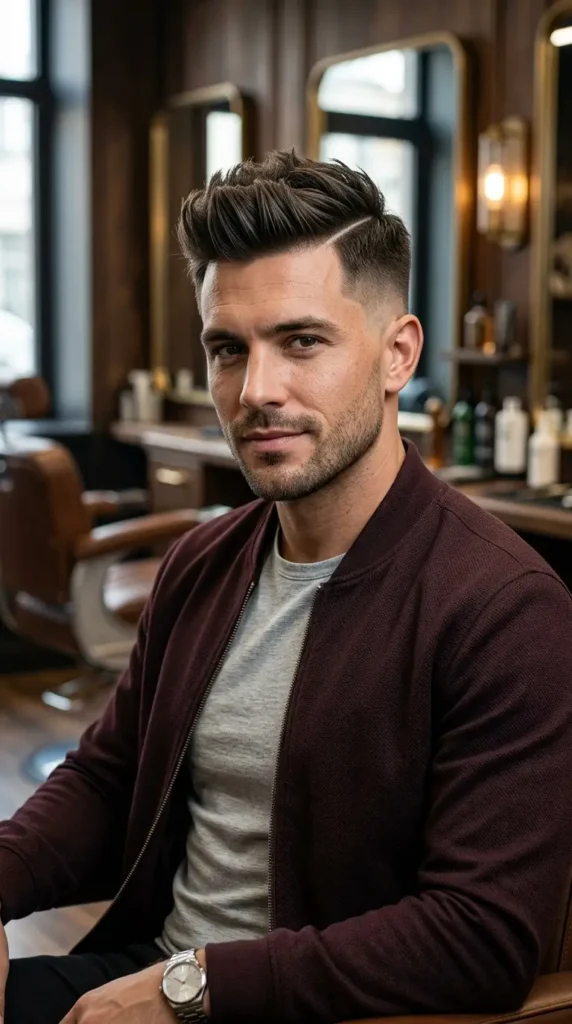
A razor-shaved line separates the fringe from the faded side, adding a sharp geometric detail to an otherwise soft transition. Works especially well with taper and low fades that would otherwise lack definition. Requires a touch-up every 1-2 weeks to keep the part crisp.
31. Ivy League Faux Hawk
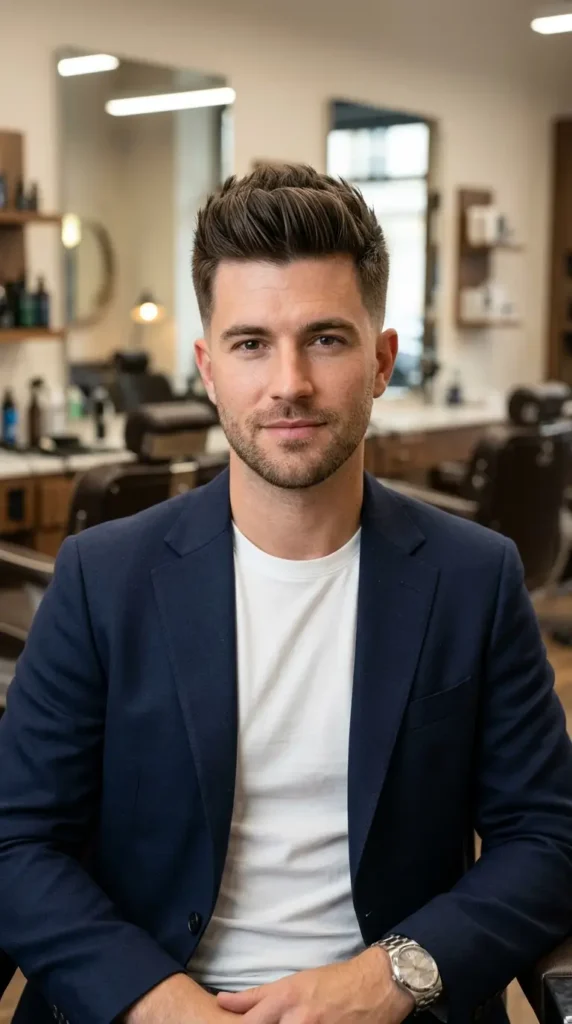
A conservative hybrid pairing the classic Ivy League’s short, structured length with a subtle upward brush at the crown. Sides stay close-cropped but not faded, keeping the whole look boardroom-appropriate. The most understated entry on this list.
32. Faux Hawk Quiff
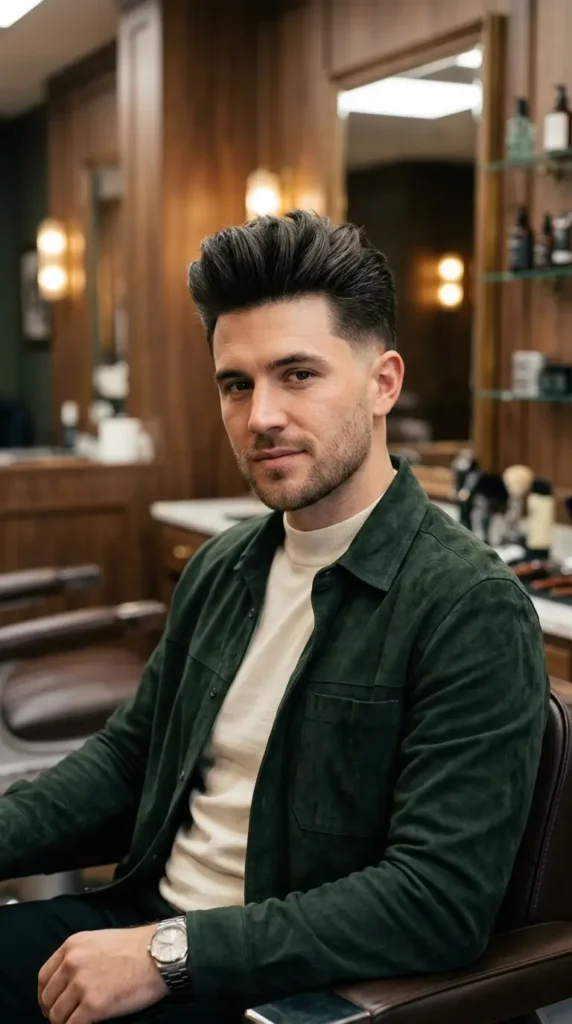
The fringe is swept up and back like a quiff, while the rest of the central strip narrows into a hawk-like taper toward the crown. Bridges two of the most requested men’s cuts into one style. Needs a strong-hold cream to keep the front lift through the day.
33. Faux Hawk with Undercut Design
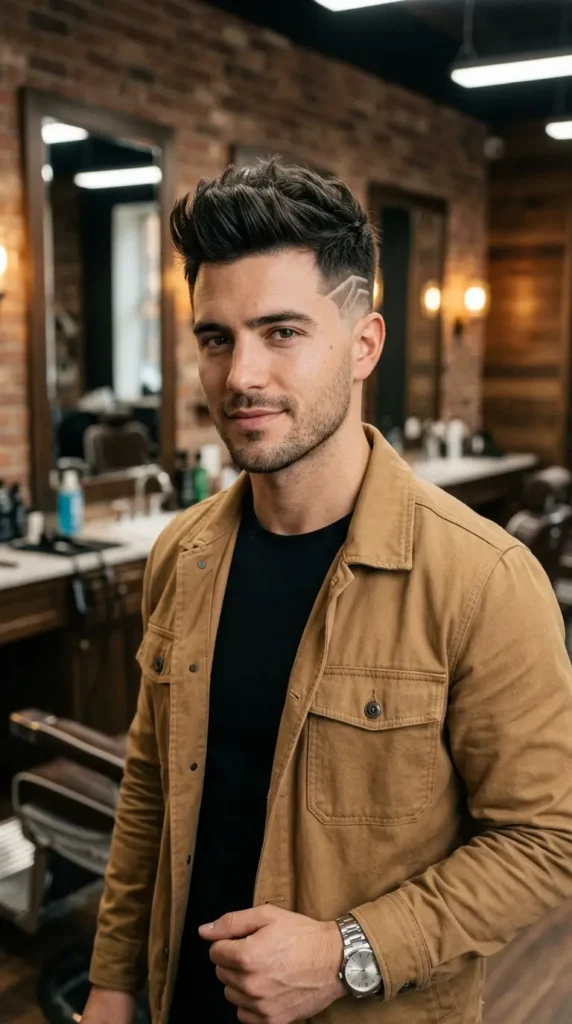
Combines a disconnected undercut with a shaved geometric line or pattern along the temple. More understated than a full shaved-design fade since the pattern is confined to a small section. Good middle ground for men who want detail without full commitment.
34. Colored Tip Faux Hawk
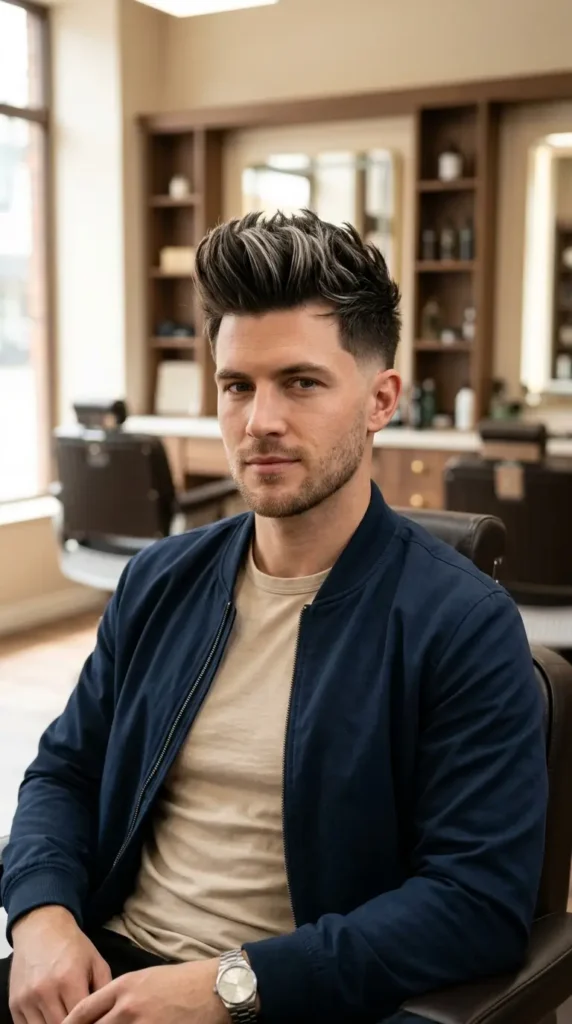
Bleached or dyed tips along the central ridge add contrast and draw the eye upward, emphasizing height. Works on any base style but shows best on spiky or textured variations. Semi-permanent color needs re-application every 4-6 weeks as it fades.
35. Platinum Faux Hawk
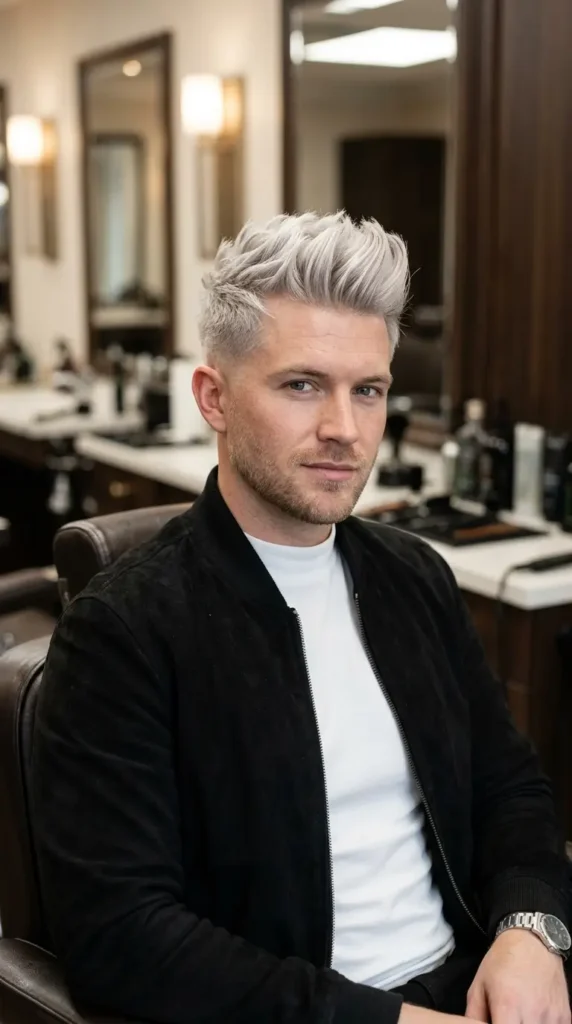
Full head bleached to platinum blonde with the classic faux hawk shape underneath. High-maintenance both for color upkeep (toning every 3-4 weeks) and for the cut itself. Makes the strongest visual statement of any style on this list.
36. Faux Hawk with Temple Fade
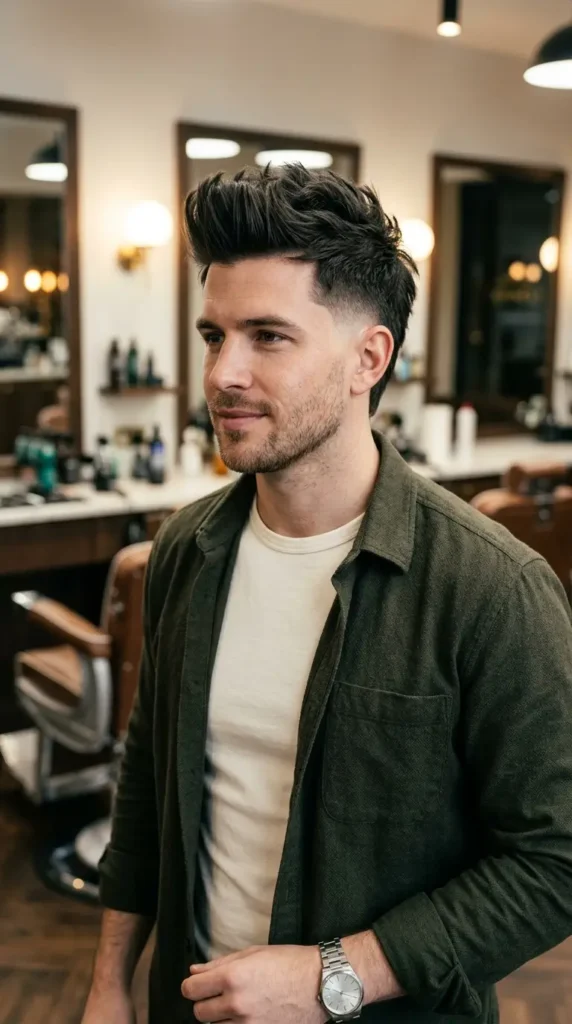
Fade concentrated specifically around the temple area rather than running continuously to the nape, leaving more length at the back and sides. Creates a distinctive frame around the face while softening at the back. A good option for men who want fade detail without full-head commitment.
37. Faux Hawk for Fine Straight Hair
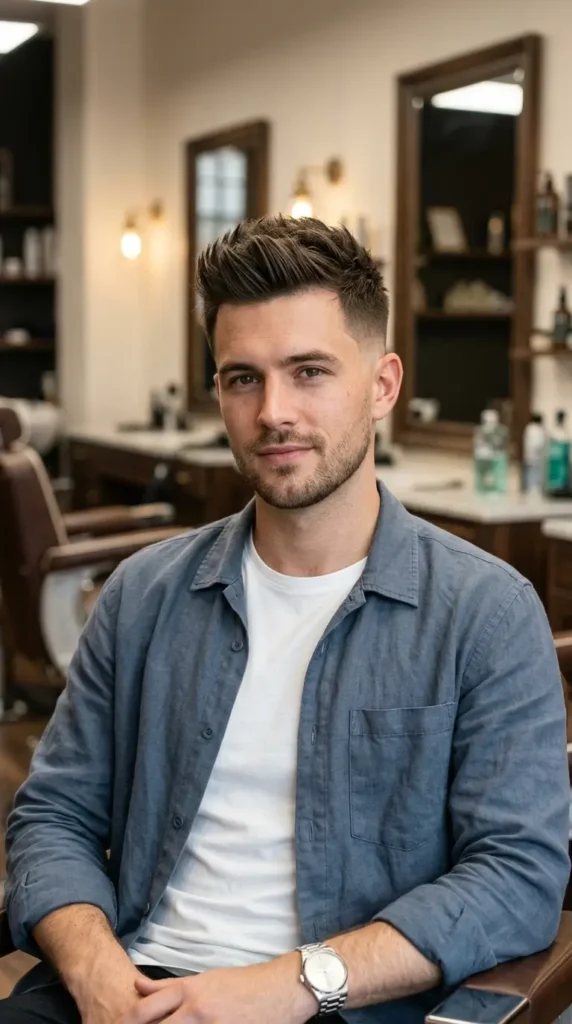
Shorter length paired with heavy point-cutting to create the illusion of texture that fine strands don’t naturally hold. Root-lifting spray applied at the base before blow-drying gives lasting lift without weighing the fine hair down. Avoids long, flowing versions that tend to fall flat by midday.
38. Faux Hawk for Older Men

A softened, low-fade version with modest height and minimal disconnection, designed to read as sharp rather than youth-chasing. Works especially well paired with grey or salt-and-pepper hair, which adds natural texture. Pairs nicely with a trimmed beard for a polished, age-appropriate finish.
39. Business Faux Hawk
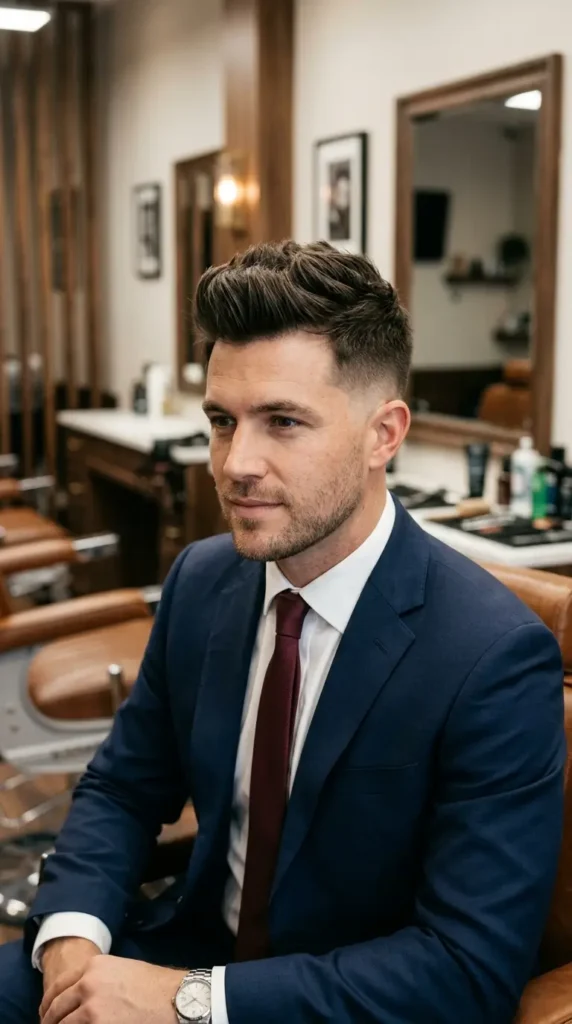
The most conservative styling of the crest: low height, tight taper fade, and a smooth rather than spiky finish. Designed to pass unnoticed in corporate settings while still offering more shape than a standard short back and sides. The go-to recommendation for first-timers worried about office reaction.
40. Faux Hawk with Comb Over
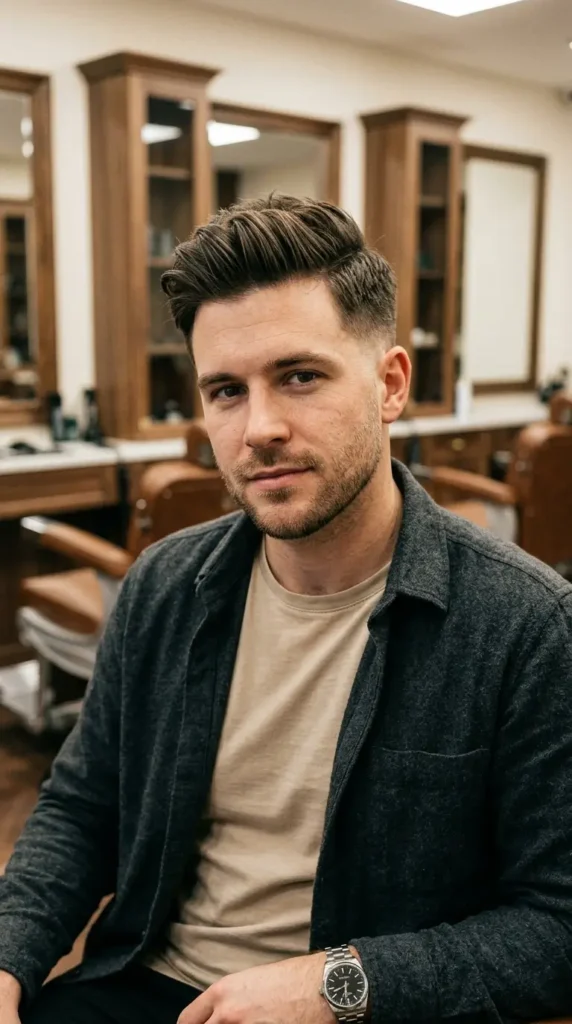
Instead of styling straight up, the central strip is combed diagonally across the crown before rising into a soft peak. A more directional take that softens the aggressive vertical lines of a classic hawk. Works well for men transitioning out of a traditional comb over into something edgier.
41. Wet Look Faux Hawk

Styled and left with visible product sheen rather than the matte finish trending in 2026. Achieved with gel or high-shine pomade applied to damp hair and left to air dry. A deliberate throwback aesthetic for men who like the early-2000s original look.
42. Faux Hawk Bald Fade with Design
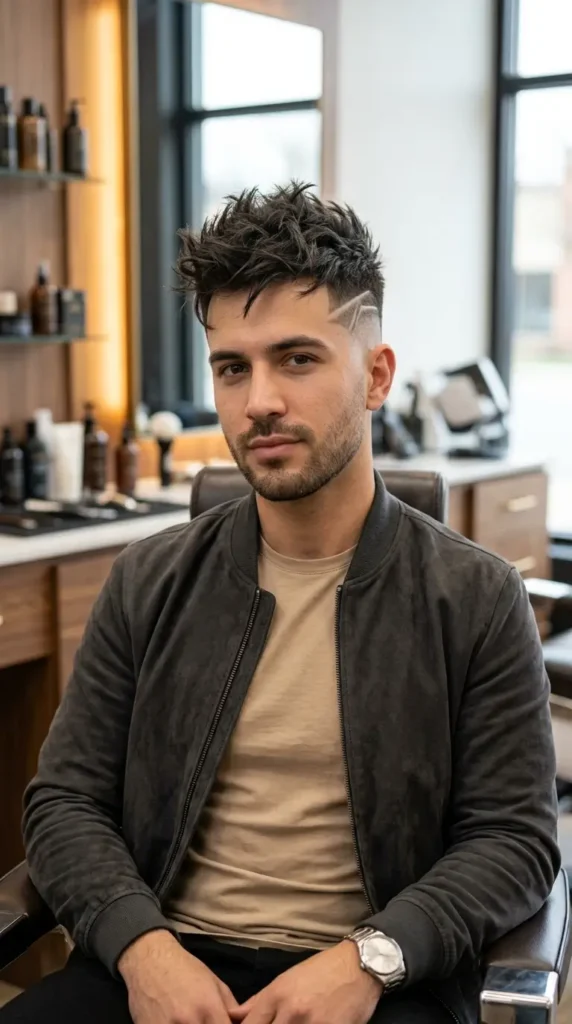
Combines the sharpest possible skin fade with a shaved line, star, or lightning bolt cut into the faded section. The maximum-drama version of the shaved-design style, requiring weekly barbershop visits to stay crisp. Best suited to men who enjoy frequent grooming appointments.
43. Textured Faux Hawk with Beard Fade
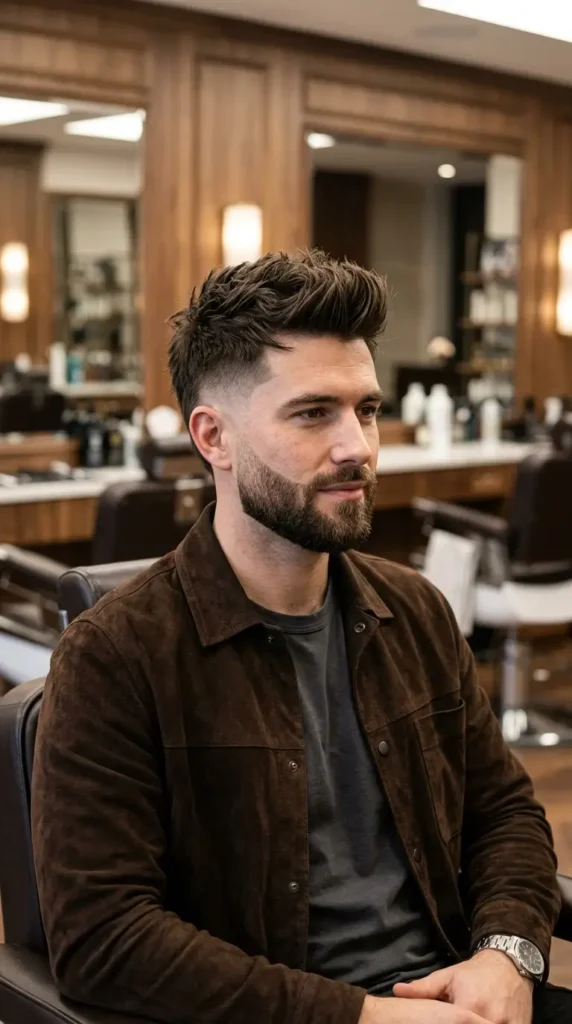
The beard fades from full at the chin into the sideburns and connects seamlessly with the hair fade at the temple. Creates one continuous line from beard to crest instead of two separate grooming zones. Requires coordinated maintenance so the beard and hair fade lines stay level.
44. Faux Hawk for Wedding/Formal Events
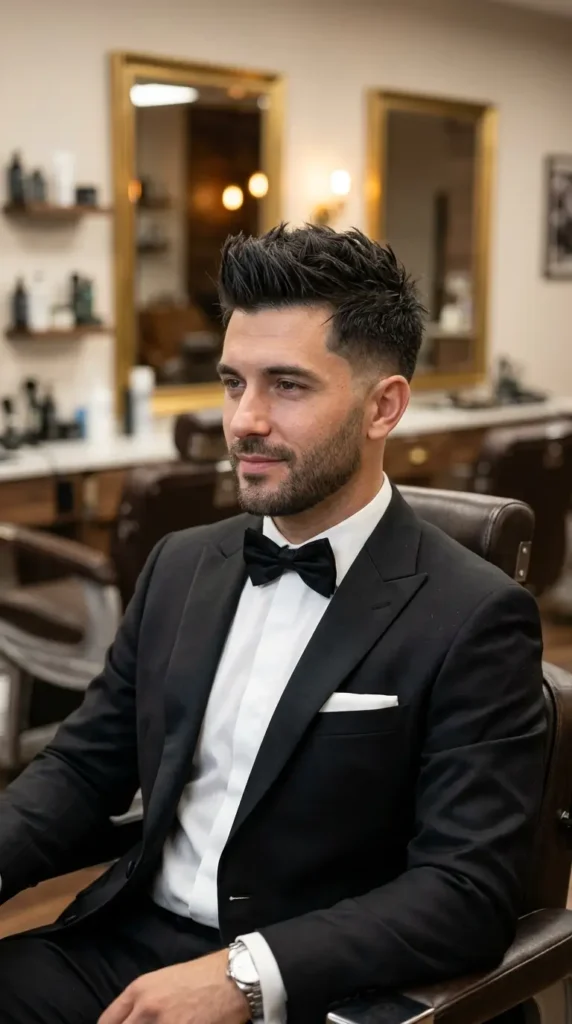
A dressed-down height with a smooth, defined finish using light pomade instead of matte clay. Sides kept to a low or taper fade so the overall look reads sharp rather than edgy in photographs. A safe way to bring personality to formalwear without overpowering a suit.
45. Athletic Faux Hawk
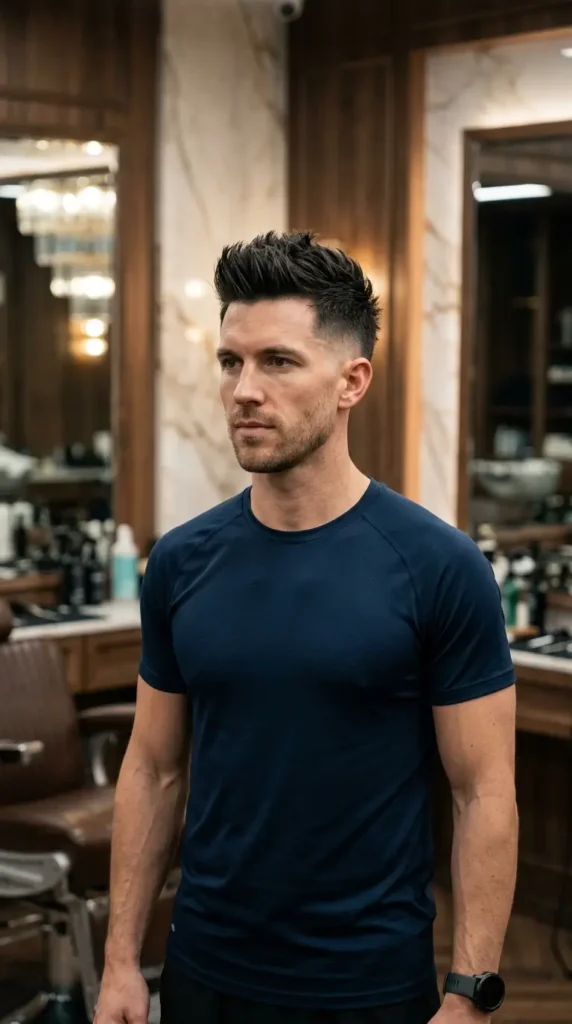
Short on top, high fade on the sides, styled with sweat-resistant matte paste for gym and sports use. Minimal length keeps hair out of the eyes during activity while still holding a defined crest. A practical choice for men who want style without daily restyling after workouts.
46. Faux Hawk with Cornrows and Fade
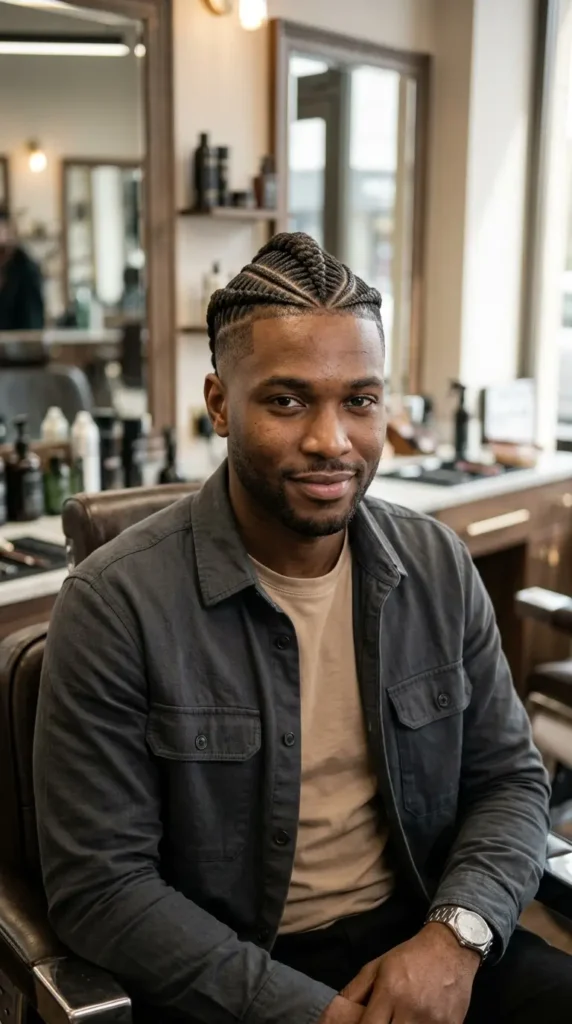
Tight cornrows run front-to-back along the crest and meet a sharp skin fade at the sides, creating strong contrast between braided texture and bare scalp. More structured and longer-lasting than loose braid versions, typically holding 3-4 weeks. Requires a skilled braider for clean, even rows.
47. Salt and Pepper Faux Hawk
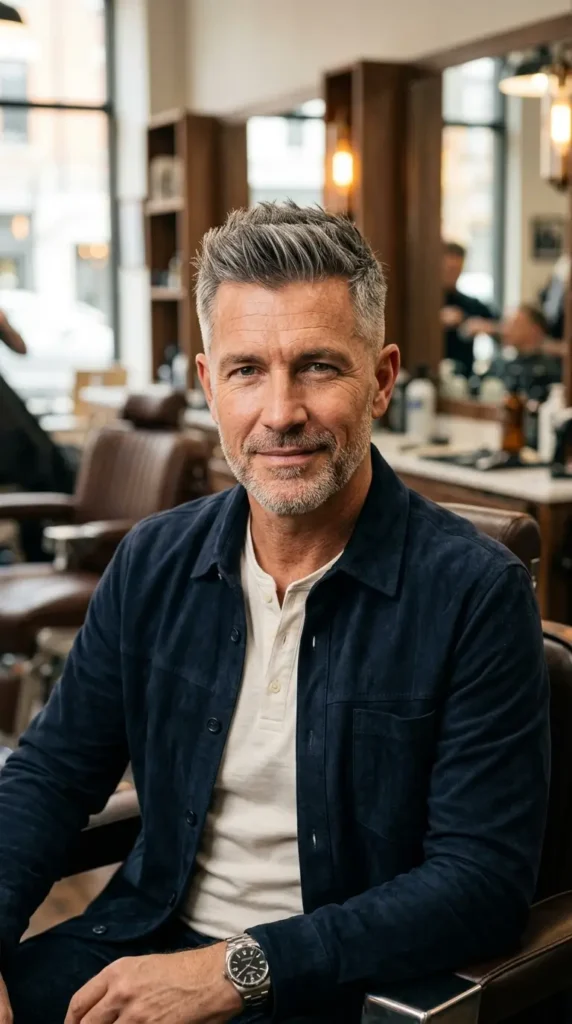
Leans into natural greying rather than concealing it, using the salt-and-pepper mix to add visual texture along the ridge. Works best with a low or taper fade and matte finish that highlights depth rather than shine. A confident, low-maintenance option for men embracing their natural color.
48. Faux Hawk with Widow’s Peak
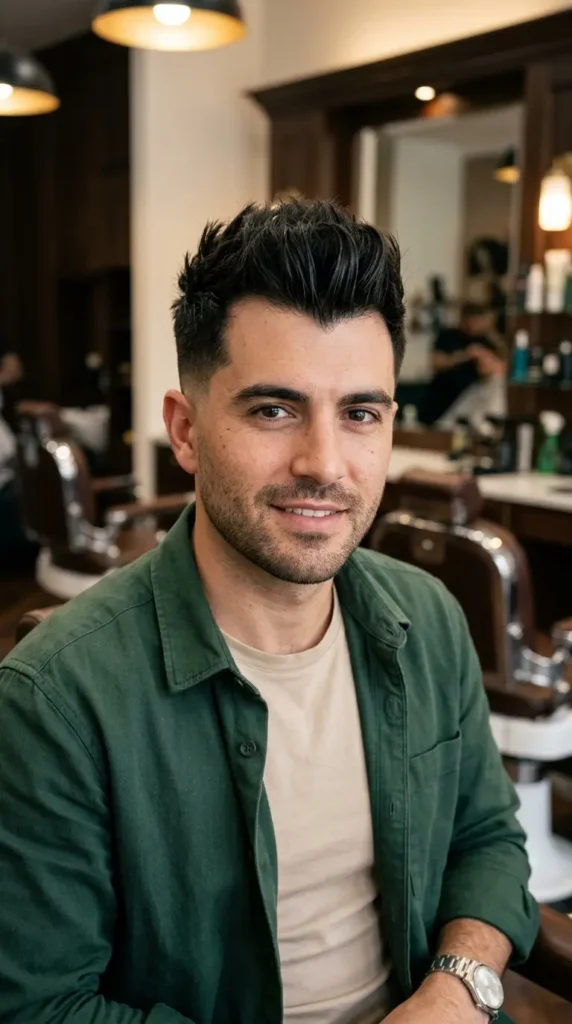
Styled to work with, rather than against, a natural widow’s peak by letting the point extend slightly forward before the ridge sweeps back. Barbers shape the fringe around the peak instead of cutting straight across it. Turns a feature some men try to hide into part of the style’s structure.
49. Micro Faux Hawk
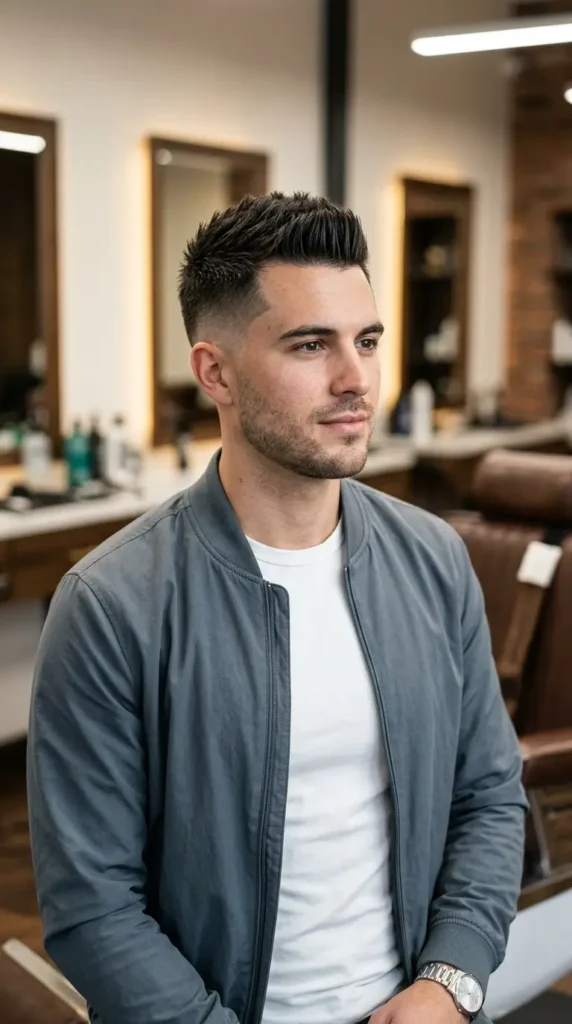
The most subtle version possible: under an inch of length difference between top and sides, just enough to suggest a ridge without any dramatic height. Nearly invisible to a casual glance but still gives definition under styling product. Ideal for very conservative workplaces or first-time faux hawk trials.
50. Extreme Height Faux Hawk
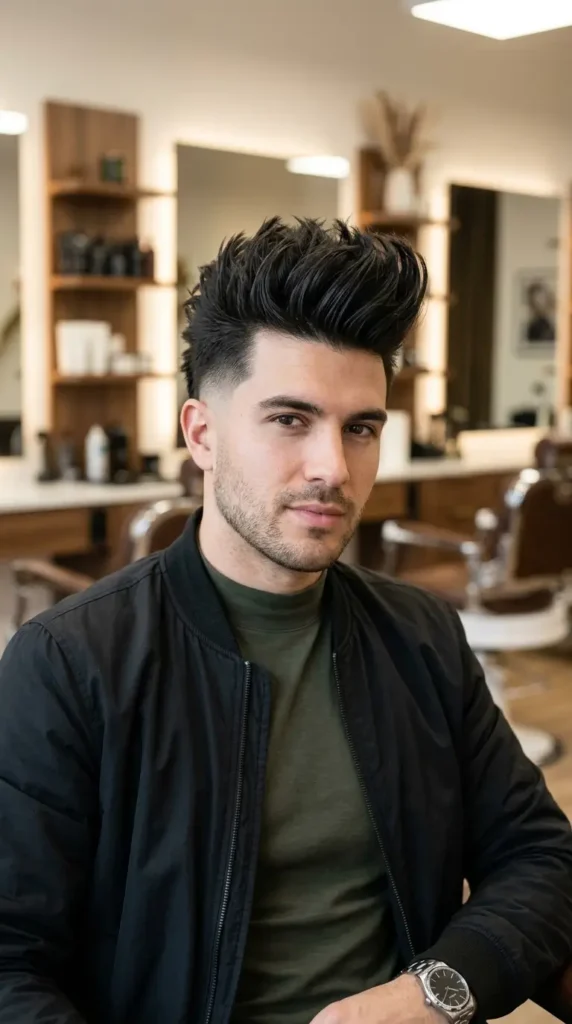
Pushes as close to true mohawk height as possible while keeping side hair intact, often using gel and a fine-tooth comb to build vertical spikes several inches tall. Reserved for special occasions or performance settings rather than daily wear. The boldest, most maintenance-heavy style on this list.
Faux Hawk vs Mohawk: The Key Differences
This is one of the most searched comparisons, and understanding the distinction helps you make the right choice.
| Feature | Faux Hawk | Mohawk |
| Sides | Faded or tapered (hair remains) | Completely shaved to skin |
| Commitment Level | Low, grows out gracefully | High, awkward grow-out phase |
| Workplace Suitability | Generally office-appropriate | Often not acceptable in professional settings |
| Daily Styling Time | 3-5 minutes | 5-10 minutes |
| Maintenance Frequency | Every 2-4 weeks | Weekly touch-ups needed |
| Celebrity Examples | David Beckham, Zac Efron, Zayn Malik | Travis Barker, Mr. T |
The fohawk gives you mohawk aesthetics with real-world practicality. You can style it up for maximum impact or comb it down for a conservative appearance, versatility the traditional mohawk simply cannot offer.
The Euro Hawk Explained
The Euro hawk (sometimes called European hawk) is a distinct variation that many competitors mention but fail to properly define.
The key differences:
- Wider central strip than the American fohawk
- Softer gradient into the sides (less dramatic contrast)
- More blended transition rather than disconnected undercut
- Popular in European football culture, think Premier League players
If you want the faux hawk look but prefer something less aggressive and more refined, the Euro hawk is your answer. It’s particularly popular among men who want edge without making a loud statement.
Fohawk, Fauxhawk, Fo-Hawk: Are They the Same?
Yes. These are simply spelling variations of the identical haircut. Regional differences and colloquial usage created multiple spellings, but they all describe the same style: shorter sides with a longer central strip styled upward.
Other names you might encounter:
- Fake mohawk
- The Beckham (after David Beckham)
- Faux-hawk (hyphenated version)
How to Choose the Right Faux Hawk for Your Face Shape
The best faux hawk for you depends on your facial structure. The goal is to create visual balance, adding height where needed and softening angles where appropriate.
Round Face
Goal: Add vertical height to elongate the face
Best Choice: High fade faux hawk with maximum volume on top. The added height creates the illusion of a longer, more oval face shape.
Styling Tip: Direct the hair straight up rather than forward. Use volumizing powder at the roots for extra lift.
Avoid: Low, wide styles that emphasize the face’s roundness. Keep the sides tight to prevent adding horizontal width.
Square Face
Goal: Soften the strong angular jawline
Best Choice: Textured or messy faux hawk with a taper fade (not skin fade). The softer edges complement rather than compete with your natural bone structure.
Styling Tip: A slightly disheveled, organic texture works better than sharp, geometric styling.
Avoid: Sharp disconnected styles with hard lines that amplify the angular appearance.
Oval Face
Goal: Maintain natural balance (most versatile face shape)
Best Choice: Any variation works, this face shape is the most adaptable. Experiment freely with different fade types and styling approaches.
Celebrity Reference: Zac Efron has worn multiple faux hawk variations successfully with his oval face.
Diamond or Heart Face
Goal: Add width at the temples and balance a narrow forehead or chin
Best Choice: Burst fade faux hawk or styles that add volume at the sides rather than strictly on top. The curved fade behind the ear adds visual width.
Styling Tip: Avoid excessive height that makes the head appear top-heavy. A more horizontal styling direction balances narrow features.
Faux Hawk Styles by Fade Type: The Critical Decision
Choosing your fade type is the most important decision after deciding on the faux hawk itself. The fade determines how dramatic, professional, or trendy your cut appears.
Taper Fade Faux Hawk
The Look: Gradual blend from longer hair at the top to shorter hair approaching the neckline. No skin exposure, the hair simply gets progressively shorter.
Best For:
- Professional environments and conservative workplaces
- First-time faux hawk wearers who want a subtle contrast
- Men who prefer lower-maintenance cuts
Maintenance: Every 3-4 weeks
Barber Terms: “Taper fade,” “blended sides,” “no skin showing”
The taper fade faux hawk is the most versatile and forgiving option. It works across virtually all settings and grows out more gracefully than sharper fades.
Burst Fade Faux Hawk
The Look: A semi-circular fade that radiates behind and around the ear, creating a “burst” or “drop” pattern. The fade follows the ear’s natural curve.
Best For:
- Trend-conscious men (this is the TikTok favorite of 2025-2026)
- Younger demographics seeking a modern aesthetic
- Men who want maximum visual impact
Maintenance: Every 2-3 weeks (fades quickly due to the precision required)
Barber Terms: “Burst fade,” “curved fade around the ear,” “South of France” (related style)
The burst fade faux hawk is currently one of the most requested styles in barbershops. Its distinctive curved shape photographs well and creates a unique silhouette from every angle.
Low Fade Faux Hawk
The Look: The fade begins just above the ear, keeping more hair on the sides and creating subtle contrast with the top.
Best For:
- Men seeking understated contrast
- First-time faux hawk wearers
- Professional settings requiring conservative grooming
- Those who want to ease into the style gradually
Maintenance: Every 3-4 weeks
Barber Terms: “Low fade,” “fade starts at the ear,” “subtle transition”
Mid Fade Faux Hawk
The Look: The fade begins at temple level, creating balanced contrast, not too subtle, not too dramatic.
Best For:
- Everyday versatility
- Men who want noticeable style without extreme contrast
- The “Goldilocks” choice for those unsure between low and high
Maintenance: Every 2-3 weeks
Barber Terms: “Mid fade,” “temple fade,” “medium fade”
High Fade Faux Hawk
The Look: The fade begins high on the head (above the temples), creating maximum contrast between the short sides and longer top.
Best For:
- Bold style statements
- Athletic, clean-cut aesthetics
- Men with strong facial features who can carry dramatic contrast
- Summer months when cooler sides are practical
Maintenance: Every 2 weeks
Barber Terms: “High fade,” “high and tight sides,” “maximum contrast”
Drop Fade Faux Hawk
The Look: The fade “drops” or curves downward behind the ear, following the head’s natural curvature rather than running straight across.
Best For:
- Correcting head shape irregularities
- Creating a unique, custom silhouette
- Men who want something different from standard fades
Maintenance: Every 2-3 weeks
Barber Terms: “Drop fade,” “curved fade line,” “follows the head shape”
Skin Fade (Bald Fade) Faux Hawk
The Look: The fade goes all the way to the skin (no guard) at the lowest point, creating the sharpest possible contrast.
Best For:
- Maximum edge and drama
- Men comfortable with frequent barbershop visits
- Hot climates where cooler sides are practical
- Those who want the closest thing to a mohawk while keeping it wearable
Maintenance: Weekly touch-ups recommended to maintain the crisp line
Barber Terms: “Skin fade,” “bald fade,” “zero fade,” “fade to skin”
The Back View: What Your Barber Needs to See
This is where most guides fail their readers. Users search for “taper faux hawk back” and “faux hawk back view” because they need reference images for their barber, yet most guides only show front and side angles.
Why the Back View Matters
The neckline finish defines the overall silhouette of your faux hawk. From the front, many fade types look similar. From the back, the differences become obvious.
When you sit in the barber’s chair, they’ll ask how you want the back finished. Knowing these options prevents miscommunication:
Neckline Options Explained
| Neckline Style | Description | Best For |
| Tapered | Gradual fade into the neck following natural hairline | Most versatile, low maintenance, natural appearance |
| Blocked | Squared-off, sharp horizontal line across the nape | Clean, geometric look; requires frequent maintenance |
| Rounded | Curved line following the natural hairline shape | Softer, natural appearance; suits rounder head shapes |
| V-Shaped | Pointed finish at the center of the nape | Edgy, attention-grabbing; popular with burst fades |
Burst Fade Back View vs Taper Back View
The burst fade wraps around the ear in a curved, radiating pattern and often finishes with a V-shape or pointed nape. It’s more dramatic and intentional.
The taper fade creates a gradual, blended transition that follows the natural hairline without sharp lines. It’s more conservative and grows out cleanly.
Pro Tip: Bring photos showing the back view specifically. Tell your barber: “I want the back to look like this.” Front-view photos alone leave the neckline to interpretation.
How to Ask Your Barber for a Faux Hawk
Communication prevents disappointment. Here’s exactly what to say:
The Barber Script (What to Say)
Step 1
“I want a faux hawk.”
Step 2
Specify the fade type:
- “…with a taper fade” (subtle)
- “…with a burst fade” (trendy)
- “…with a skin fade” (dramatic)
- “…with a low/mid/high fade” (positioning)
Step 3
Specify length on top:
- “Leave about [X] inches on top”
- “I want to be able to style it [up high / more subtle]”
Step 4
Specify the neckline:
- “For the back, I want it tapered” (natural)
- “For the back, I want it squared/blocked” (sharp)
- “For the back, I want a V-shape” (edgy)
Step 5
Texture preferences:
- “Texturize the ends so I can style it messy”
- “Point-cut it for movement”
- “Keep it blunt for a cleaner look”
Barber Terminology Cheat Sheet
| Term | Meaning |
| Disconnected | Sharp contrast between top and sides (no blending) |
| Blended | Gradual transition from top to sides |
| Texturized | Point-cut or razor-cut ends for movement |
| Guard #1 | ~3mm / 1/8 inch |
| Guard #2 | ~6mm / 1/4 inch |
| Guard #3 | ~10mm / 3/8 inch |
| Guard #4 | ~13mm / 1/2 inch |
| Scissor-over-comb | Hand-cutting technique for precision blending |
| Point cutting | Cutting into the ends at an angle for texture |
| Razor texturing | Using a razor blade to thin and texturize |
| Occipital bone | The bump at the back of the skull (fade reference point) |
Mistakes to Avoid at the Barbershop
- Don’t say “just a faux hawk” without specifying fade type, length, and neckline
- Don’t assume your barber knows your preferred length, give measurements or visual references
- Always bring 2-3 reference photos showing front AND back views
- Don’t show only celebrity photos without acknowledging your hair type may differ
- Don’t rush the consultation, a 2-minute conversation prevents a 2-week regret
How to Style a Faux Hawk at Home
Proper technique transforms a good haircut into a great hairstyle. Here’s the step-by-step process:
Step 1: Prep Your Hair
Wash or Rinse:
- Use a lightweight, clarifying shampoo (heavy conditioners weigh hair down)
- Rinse thoroughly to remove residue
Towel Dry:
- Remove excess water until hair is damp but not wet
- Damp hair absorbs product better and responds to blow-drying
Detangle:
- Use a wide-tooth comb to remove knots
- Comb in the direction you’ll be styling (upward toward the crown)
Step 2: Apply Pre-Styler for Volume
For Fine/Thin Hair:
- Volumizing mousse: Apply golf-ball-sized amount, work through roots to tips
- Focus on the crown and central ridge area
For Medium/Thick Hair:
- Sea salt spray: 4-6 sprays distributed through the top section
- Creates grip and natural texture
Application Technique:
- Work product from roots to tips
- Focus on the central ridge, this is where volume matters most
- Don’t neglect the back crown area
Step 3: Blow-Dry for Shape (The Critical Step)
This is where faux hawks are made or broken:
Equipment:
- Hair dryer with nozzle attachment
- Round brush or vent brush (optional but helpful)
- Your fingers work well for a more textured result
Technique:
- Set dryer to medium heat (high heat damages; low heat takes forever)
- Direct airflow upward and slightly forward from roots
- Use fingers to lift sections at the root while drying
- Work from back to front, start at the crown, finish at the fringe
- Continue until hair is 90% dry (slight dampness helps product application)
The Key Insight: You’re training the hair to stand up. The blow-drying direction teaches the follicles which way to point.
Step 4: Apply Styling Product
Product Amount:
- Start with a dime-sized amount (you can always add more)
- For longer faux hawks, use up to a quarter-sized amount
Application Technique:
- Emulsify the product between your palms until warm and evenly distributed
- Work through hair from back to front (crown first, fringe last)
- Pinch and twist sections for texture and separation
- Shape the central ridge with your fingers, push upward, then slightly back or forward depending on desired direction
- Use fingertips to define individual pieces at the fringe
Step 5: Set with Finishing Product (Optional)
For All-Day Hold:
- Light hairspray from 8-10 inches away
- 2-3 quick passes, not a continuous spray
Avoid:
- Heavy hairspray application (creates “helmet head”)
- Touching hair after spraying (disrupts the set)
Total Styling Time: 5-8 minutes once you’ve practiced the technique.
Best Products for Styling a Faux Hawk
Product selection dramatically affects your results. Here’s what works:
Matte Finish Products (Modern, Natural Look)
| Product Type | Best For | Hold Level | Finish |
| Texture Clay | Messy, textured, piece-y styles | Medium-Strong | Matte |
| Matte Paste | Natural separation, touchable hair | Medium | Matte |
| Styling Powder | Volume at roots, thin hair, on-the-go touch-ups | Light-Medium | Invisible/Matte |
Texture clay is the #1 recommended product for modern faux hawk styling. It provides grip, texture, and hold without shine.
Shiny Finish Products (Retro, Slick Look)
| Product Type | Best For | Hold Level | Finish |
| Water-Based Pomade | Slicked-back styles, formal events | Strong | High Shine |
| Styling Cream | Wavy/curly faux hawks, light control | Light-Medium | Low Shine |
Water-based pomade washes out easily (unlike oil-based) and allows restyling throughout the day.
Pre-Styling Products
| Product Type | Purpose | When to Apply |
| Sea Salt Spray | Adds grip, texture, natural wave | Damp hair before blow-drying |
| Volumizing Mousse | Lifts fine/thin hair | Damp hair before blow-drying |
| Heat Protectant | Shields from blow-dryer damage | Damp hair before blow-drying |
What to Avoid
Gel:
- Creates crunchy, dated “wet look”
- Flakes when dry
- Difficult to restyle
- Associated with 1990s styling (not modern)
Heavy Wax:
- Weighs hair down, kills volume
- Difficult to wash out
- Can look greasy
Excessive Hairspray:
- Creates stiff, unnatural finish
- Prevents touchable texture
- Attracts dust and debris
How to Maintain Your Faux Hawk
Proper maintenance keeps your faux hawk looking sharp between barbershop visits.
Trim Schedule by Fade Type
| Fade Type | Recommended Trim Frequency |
| Skin/Bald Fade | Every 1-2 weeks |
| High Fade | Every 2-3 weeks |
| Mid Fade | Every 2-3 weeks |
| Low Fade / Taper Fade | Every 3-4 weeks |
| Faux Hawk Mullet | Every 3-4 weeks (proportions need monitoring) |
Why Frequency Matters: Fades lose their sharpness as hair grows. A skin fade can look overgrown within 10 days. Budget your barbershop visits accordingly.
Daily Care Routine
Washing:
- Shampoo 2-3 times per week (not daily, daily washing strips natural oils)
- Rinse with water on non-wash days
- Use lightweight conditioner on wash days to prevent dryness
Styling:
- Re-style daily with product
- A quick blow-dry refreshes shape even on day-old hair
- Keep product at your sink for morning routine efficiency
Scalp Health:
- Healthy scalp equals healthy hair growth
- Massage while shampooing to stimulate circulation
- Address dandruff or irritation promptly
Growing Out Your Faux Hawk
Eventually, you may want to change styles. Here’s how to navigate the transition:
The Awkward Phase: Weeks 4-8 when the sides begin catching up to the top. The contrast that defined your faux hawk disappears, and proportions look unbalanced.
Transition Strategies:
- Textured crop: Let the top grow while keeping sides trimmed until they’re closer in length
- Quiff: As the top grows longer, sweep it back instead of up
- Slicked back: Very long faux hawks transition naturally into slicked-back styles
- Ask your barber to “soften” the contrast gradually over 2-3 visits
Frequently Asked Questions
What is a faux hawk haircut?
A faux hawk haircut is a short-sided men’s hairstyle where the hair on top is styled upward into a central crest that runs from the forehead to the crown, mimicking a mohawk without shaving the sides completely. The sides are faded or tapered instead of shaved to skin, which makes it far more versatile and office-friendly than a real mohawk.
Why is it called a faux hawk?
“Faux” means fake in French, so a faux hawk is literally a fake mohawk. It gives you the visual crest and silhouette of a mohawk while keeping hair on the sides instead of shaving them, which is why it grows out more gracefully and works in professional settings a real mohawk wouldn’t.
Is the faux hawk still in style in 2026?
Yes. The faux hawk remains one of the most popular men’s haircuts in 2026. While specific variations trend (burst fade and mullet hybrid are currently surging), the core style has remained fashionable for over two decades. Its versatility, working for both casual and professional settings, ensures continued relevance.
Is the faux hawk out of style?
No. Unlike trend-driven cuts that fade in a season, the faux hawk has held steady popularity since the early 2000s and continues evolving through hybrids like the burst fade and faux hawk mullet. It’s not currently trending downward in any major market; if anything, the mullet hybrid version is gaining ground with younger demographics right now.
What is the difference between a Mohawk and a faux hawk?
A mohawk has completely shaved sides with a dramatic central strip. A faux hawk keeps hair on the sides (faded or tapered) for a softer, more wearable look. The faux hawk works in professional settings, grows out gracefully, and requires less maintenance. The mohawk makes a bolder statement but limits styling options.
Can you get a faux hawk with curly hair?
Absolutely. Curly faux hawks, sometimes called frohawks, look excellent because natural texture provides built-in volume. Use curl-defining cream to enhance ringlets and control frizz. Avoid heavy products that flatten curls. Curly hair often requires less product than straight hair to achieve the faux hawk shape.
How long does my hair need to be for a faux hawk?
You need at least 2-3 inches on top to create the signature ridge. Shorter versions (1-2 inches) are possible but offer less dramatic styling options. For long, flowing faux hawks, you’ll need 4+ inches. The sides are cut short regardless of top length.
Does a faux hawk suit a round face?
Yes. The faux hawk is actually recommended for round faces. The vertical height elongates the face, creating a more balanced appearance. Opt for higher fades and maximum volume on top. Avoid low, wide styles that emphasize roundness.
How do I ask my barber for a faux hawk?
Specify three things: (1) the fade type (taper, burst, skin, low/mid/high), (2) length on top in inches, and (3) neckline preference (tapered, blocked, rounded). Always bring reference photos showing both front and back views. Don’t assume your barber knows your preferences, communicate clearly.
What products work best for a faux hawk?
Texture clay or matte paste for modern, natural styles. Sea salt spray as a pre-styler for volume and grip. Volumizing powder for fine hair needing lift. Avoid gel, which creates a dated, crunchy appearance.
How often should I get my faux hawk trimmed?
Every 2-4 weeks depending on your fade type. Skin fades require more frequent maintenance (1-2 weeks) to maintain the crisp line. Taper fades can last 3-4 weeks. Budget your barbershop visits based on how sharp you want your fade to look.
Can I style a faux hawk without a blow dryer?
Yes, but results will be less consistent. Air-drying works for textured and messy styles, especially with wavy or curly hair. For straight hair or maximum volume, blow-drying provides significantly better results. A quick 2-3 minute blow-dry makes a noticeable difference.
What is a Euro hawk?
A Euro hawk is a faux hawk variation with a wider central strip and softer blending into the sides. Popular in European football culture, it’s less aggressive than the American fohawk. The gradient is more gradual, making it appropriate for men who want edge without dramatic contrast.
What is the Gen Z haircut called?
There isn’t one single “Gen Z haircut,” but the faux hawk mullet (also called the mull-hawk) is one of the styles most associated with the trend right now, along with the wolf cut and curtain fringe. It pairs a faded or tapered faux hawk front with extended length at the nape, giving it a distinct silhouette that’s currently surging among younger men.
The faux hawk remains one of the most versatile, stylish, and practical haircuts available to men in 2026. Whether you choose a subtle taper fade for the office or a dramatic burst fade for weekend adventures, this cut adapts to your lifestyle while delivering consistent style. Find a skilled barber, communicate clearly, and invest in quality styling products, your faux hawk will reward you with a look that turns heads while fitting seamlessly into your daily life.